AI startup hiring shifts to work trials
TECH

AI startup hiring shifts to work trials

24+
Signals

Strategic Overview

  • 01.
    AI-generated resumes and interview answers have collapsed traditional screening signals, pushing AI startups toward paid, multi-day work trials where candidates do real project work before any offer.
  • 02.
    Foxglove invites finalists to a paid three-to-five-day engagement on a real project and explicitly encourages candidates to use AI tools, while Linear reports a 96% retention rate over four years tied to its 2-5 day trial.
  • 03.
    WorkTrial AI has launched a hiring platform that productizes the trial-based approach pioneered by Linear, PostHog, Gumroad, and 37signals, replacing resumes with real-work simulations scored by an automated Signal Engine.
  • 04.
    Forbes has opened nominations for its 12th annual Next Billion-Dollar Startups 2026 list with TrueBridge Capital Partners, signaling continued investor interest in breakout startups beyond AI.

The Screen Broke: Why Resumes and Interviews Stopped Working in 2026

The trigger for the work-trial wave is that the entire top of the funnel went numb at once. Job applications are up roughly 45% with about 11,000 submissions hitting employers every minute, and almost every one of them is now AI-polished. Rising Team CEO Jennifer Dulski put the consequence bluntly: 'Hiring managers often can't tell the difference between people and AI bots.' That isn't a complaint about candidates being lazy — it's a structural failure of the signal. When ATS filters and human screeners are both reading text that another model wrote, the resume stops being a representation of the person.

The interview round broke at the same time. Reddit's r/cscareerquestions surfaced a now-canonical case in which a 'vibe coder' passed a traditional interview and joined a team only for colleagues to discover he didn't know what an epoch or a confusion matrix was — he had been routing every coding question through an AI tab. WorkTrial AI's Michael Guan summarizes the moment in product terms: 'Resumes lie. Interviews mislead.' That sentence is now the thesis behind a wave of startups rebuilding hiring around observed work, because the only thing AI hasn't degraded is what someone actually ships across several days of real conditions.
Why a Paid 5-Day Trial Is Cheaper Than One Wrong Hire

Why a Paid 5-Day Trial Is Cheaper Than One Wrong Hire
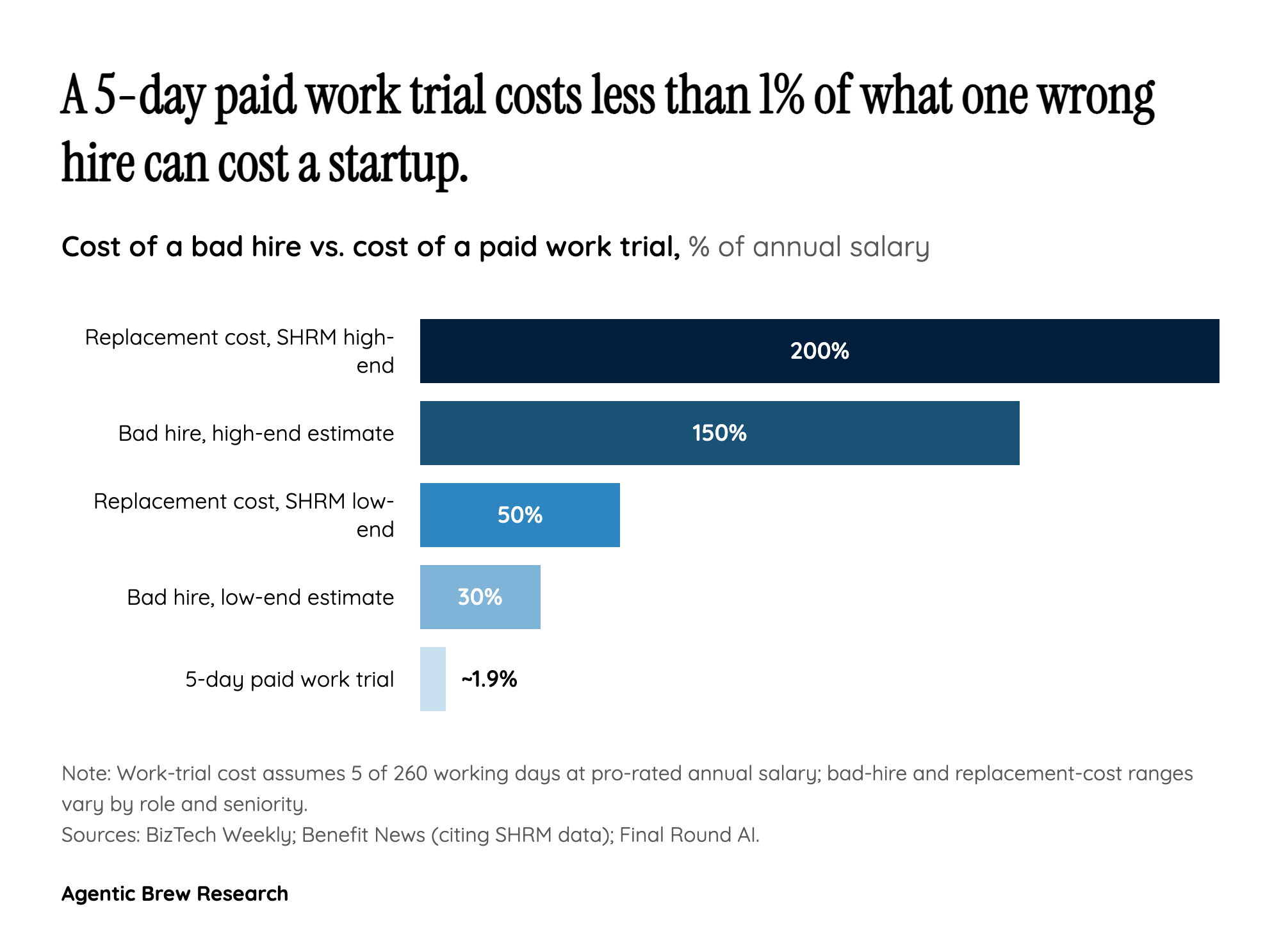
A 5-day paid work trial costs less than 1% of what one wrong hire can cost a startup.

The economics of trials look expensive on a single line item and cheap on the spreadsheet. Average cost-per-hire sits around $4,700, but a bad hire — once you include lost productivity, re-recruiting, onboarding, and team disruption — runs anywhere from 30% to 150% of annual salary, with SHRM data putting full replacement cost at 50% to 200% of salary and some estimates climbing to 3-4x at the high end. Against those numbers, paying an engineer for three to five real working days is a rounding error.

The outcome data is starting to back up the math. Linear, the project-management startup whose hiring playbook is now widely copied, reports a 96% retention rate over four years tied directly to its 2-5 day work trial. That is the lever WorkTrial AI is pulling on commercially: the company has built a real-work simulation environment plus an AI 'Signal Engine' that scores commits, edits, and Slack threads, productizing the same observation-first model that Linear, PostHog, Gumroad, and 37signals built in-house. When the cost of a wrong hire is measured in salary multiples and the cost of the trial is measured in days, the trial is the cheap option.

Inside the Playbook: Sunday Slots, Real Codebases, and AI on the Desk

What a trial looks like in practice is now fairly standardized across AI-native startups. Foxglove invites finalists to a paid three-to-five-day engagement after a short interview loop, and the team is explicit that 'work trial projects' must be 'real work, not hypothetical scenarios.' Crucially, candidates are encouraged to use any AI tools they want — the trial is designed to measure how they ship with AI, not whether they can resist using it. Crosby, the Sequoia-backed AI law firm, runs the same idea with a scheduling twist: it offers Sunday slots so employed candidates don't burn PTO. CEO Ryan Daniels recalls candidates' relief: 'When the company started offering Sundays as an option, a lot of people were just like, That would be a huge relief.' Harvey, on the legal-AI side, leans on take-home Google Docs problem sets as a lighter-weight version of the same instinct.

The new evaluation criterion is judgment, not memorization. BizTech Weekly's Aarav Patel captures the shift in one line: 'the question is no longer Can you code? but increasingly Can you ship with AI responsibly?' A thread in r/startups echoes the on-the-ground version — take-home tests are dead, live sessions are in, and the explicit setup is 'Here is a laptop with Cursor and Claude Code installed. Here is a problem.' Some teams have started 'poisoning' CLAUDE.md files with subtle anti-patterns to test whether candidates blindly accept AI suggestions or treat the model 'like a junior dev' and double-check it. That is the posture the trial format is built to detect, and resumes never could.

The Contrarian Read: Humans as the Hiring Moat

Not everyone is convinced the answer to AI-broken hiring is more software. On EO's channel, Paraform founder John Kim describes a market in which it now takes roughly 5,000 cold emails to make a single engineering hire, up from about 500 five years ago — a tenfold collapse in inbound signal. His response was to 10x revenue by paying out more than $50 million to human recruiters working with companies like Palantir, Rippling, and Decagon. The bet is that when AI floods both sides of the funnel, the scarce resource is a human who has met the candidate and can vouch.

The community is split along the same axis. A Reddit thread in r/webdev framed the preferred interview model as 'watch how they work with AI — not whether they can code from memory,' but vocal contrarians pushed for AI to be banned in interviews entirely so fundamentals can be tested. The Verge's recruiting segment landed in the middle, with hiring leaders at LinkedIn, Greenhouse, and Glassdoor confirming that AI-generated resumes are overwhelming AI-driven ATS filters and that the most consistent advice to candidates is to 'be more human.' Trials, human recruiters, and AI-banned whiteboards are three different answers to the same problem — and right now all three are growing.

Who Gets Locked Out When the Interview Becomes a Workweek

There is a quiet cost to the trial model that the playbook posts don't dwell on: not everyone can do a five-day trial. A paid three-to-five-day engagement at Foxglove, a 2-5 day trial at Linear, or a 4-6 week paid contractor trial at Gumroad all assume the candidate can carve out that block of time. In practice, that selects sharply for the unemployed, students, and people willing to moonlight; employed senior candidates with families have the hardest time saying yes. Crosby's Sunday-slot innovation is a direct response to that — Ryan Daniels positioned weekend slots so candidates wouldn't have to burn PTO — but it also normalizes giving up a weekend to compete for a job.

The broader signal is that as trials become the default, the social contract of hiring shifts. A 2025 NACE survey found nearly two-thirds of employers now use skills-based hiring for entry-level roles, which is the bull case: people without elite credentials get a real shot to demonstrate work. The bear case is selection bias in the other direction — the candidates who can afford the time, accept the Sunday slot, and absorb the unpaid prep cost are not necessarily the best engineers, just the most available. Founders adopting trials should plan for both effects, because the same format that beats AI-resume noise can quietly narrow the pool it draws from.

Historical Context

2015
Forbes launched its annual Next Billion-Dollar Startups list with TrueBridge; the 2026 edition will be the 12th installment, with nominations now open.
2025
A 2025 National Association of Colleges and Employers survey found nearly two-thirds of employers now use skills-based hiring for entry-level roles, foreshadowing the work-trial wave.
2025-06-17
Crosby emerged from stealth as a Sequoia-backed AI law firm with a $5.8M seed round, later raising a $20M Series A while institutionalizing its Sunday work-trial format.
2026-04-19
Aarav Patel chronicled the spread of work trials and Sunday interviews across AI startups including Crosby, Foxglove, and Harvey, framing trials as the new replacement for resume-led screening.

Power Map

Key Players
Subject

AI startup hiring shifts to work trials

CR

Crosby

Sequoia-backed AI law firm using Sunday work-trial sessions and live project drops to vet engineers and lawyers against AI-inflated resumes; raised $20M Series A.

FO

Foxglove

Robotics observability startup running paid 3-5 day trials on real, scoped projects, with explicit permission to use any AI tools during the engagement.

HA

Harvey

Legal AI company cited for using take-home Google Docs problem sets to assess candidates amid AI-resume noise.

LI

Linear, PostHog, Gumroad, 37signals

Pioneer companies whose paid work-trial models — Linear's 2-5 day trial, PostHog's SuperDay, Gumroad's 4-6 week contractor trial — are now being copied across AI-native startups.

WO

WorkTrial AI

Vendor productizing trial-based hiring with a real-work simulation environment plus an AI Signal Engine that scores commits, edits, and Slack threads.

FO

Forbes / TrueBridge Capital Partners

Co-publishers of the Next Billion-Dollar Startups 2026 list; nominations open with publication slated for August 2026.

Source Articles

Top 1

THE SIGNAL.

Analysts

"AI bots have made it impossible for hiring managers to distinguish real candidates from automated applications, a breakdown driving employers toward work trials."

Jennifer Dulski
CEO, Rising Team

"Resumes and interviews are structurally broken; observing real work under real conditions is the only reliable signal of performance."

Michael Guan
Co-Founder, WorkTrial AI

"Sunday work trials let candidates demonstrate skills without sacrificing PTO, and let executives evaluate genuine problem solving in an AI-resume world."

Ryan Daniels
Co-Founder & CEO, Crosby

"The hiring question for AI-era engineers is shifting from raw skill to AI-leveraged delivery, and trials reframe recruitment as a measured preview of real work."

Aarav Patel
Technology and finance writer, BizTech Weekly

"Trial projects must be real, scoped work — not hypotheticals — and the company should support the candidate throughout the engagement."

Foxglove engineering team
Engineering hiring team, Foxglove
The Crowd

"Proof beats promises. See candidates do the actual work. WorkTrial AI → book a demo today."

@@WorkTrialai0

"We use AI to elevate what only humans can do. Real-world skills that AI can't replicate — but Vetano helps you hire them faster. We're not another resume filter. We're a hiring platform built for proof — not promises. Show your skills. Get hired faster."

@@Vetano0

"I was very pessimistic about AI taking jobs. Then a vibe coder joined my team."

@u/Frosty-Elevator60223100

"How are startups adapting technical assessments now that candidates use AI anyway?"

@u/snoopdoge11130
Broadcast
We spoke to recruiting companies on hiring in the AI era

We spoke to recruiting companies on hiring in the AI era

He 10x'd Revenue Doing the Opposite of Every AI Startup | Paraform, John Kim

He 10x'd Revenue Doing the Opposite of Every AI Startup | Paraform, John Kim

The End of Job Interviews? How Work Trials Are Changing Hiring

The End of Job Interviews? How Work Trials Are Changing Hiring