Sony AI's Ace robot defeats elite table tennis players in Nature paper
TECH

Sony AI's Ace robot defeats elite table tennis players in Nature paper

34+
Signals

Strategic Overview

  • 01.
    Sony AI unveiled Ace, an autonomous table tennis robot that defeated elite and professional human players under official ITTF rules, with the research published on the cover of Nature on April 22, 2026.
  • 02.
    In the April 2025 tournament underlying the Nature paper, Ace won 3 of 5 matches against elite amateur players but lost both matches to professional players Minami Ando and Kakeru Sone, winning just 1 of 7 games against the pros.
  • 03.
    In follow-up matches held in December 2025 and March 2026, Ace defeated professional players including Miyuu Kihara, currently ranked in the top 25 of the World Table Tennis women's singles rankings.
  • 04.
    Sony claims Ace is the first robot to achieve human expert-level play in a commonly played physical competitive sport, combining event-based vision, a physics-accurate simulator, and model-free reinforcement learning.

Deep Analysis

The Ace Doesn't Hit Harder. It Just Hits Where You Aren't.

The most counterintuitive finding in the Nature paper has nothing to do with speed. An outside technical read of the match data found that humans who win points do so with faster-than-average shots — statistically significant — while Ace wins points with ordinary shots. The robot's shot profile looks the same whether it wins the rally or loses it: no special velocity, no special spin when it matters. What changes is where the ball lands and when.

That inverts the instinctive narrative about machine athletes. The usual worry about a robot opponent is that it will win by brute physics — a faster swing, more RPM on the ball, a paddle face angle no human wrist could achieve. Ace does have that capacity; it returns balls at up to 19.6 m/s and handles incoming spin above 160 rev/s. But in the matches that count, it wins by positioning and timing — the soft skills of the sport, the things coaches spend years trying to beat into teenagers. Sony AI President Michael Spranger frames this as the design intent: 'the robot cannot just win by hitting the ball faster than any human ever could, but it has to win by actually playing the game.' The data suggests the training regime delivered exactly that — a robot that wins the rallies humans are supposed to win, with the shots humans are supposed to hit.
A 10x Perception Gap Sony Says Doesn't Count

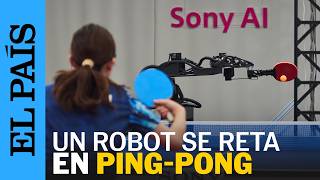
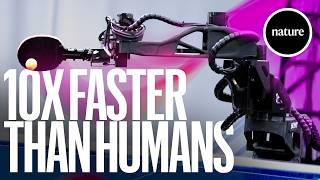
Under the hood, Ace is not competing on level ground. End-to-end system latency is 20.2 ms, against roughly 230 ms for elite human players — an order-of-magnitude advantage before the paddle has even moved. Perception alone completes in 10.2 ms. Ball state is tracked at 200 Hz with millimeter accuracy; spin is measured at up to 700 Hz. The robot arm runs a 1 kHz control loop across eight degrees of freedom. Twelve synchronized high-speed sensors — nine Sony Pregius IMX273 cameras plus three IMX636 event-based sensors co-developed with Prophesee — feed that pipeline. Event-based sensors, worth glossing, don't capture frames; each pixel independently reports brightness changes with microsecond resolution, which is what makes sub-11 ms ball tracking possible.

Sony's position is that this hardware asymmetry is the point, not a flaw: the scientific question is whether an autonomous system can win a real physical sport under real rules, not whether it can do so with two eyes and two legs. The rebuttal, from the field's own founder John Billingsley, is pointed: 'they have gone at the task mob-handed, and used sledgehammer techniques.' His argument is that with 12 cameras and event-based vision, Ace is solving a different problem than a human player solves, and calling the result 'expert-level play' smuggles in a comparison the hardware has already broken. Both views can be true at once — and the tension is exactly what the next generation of human-robot sports benchmarks will have to resolve.

The Elite-to-Pro Gap That Took a Year to Close

The cleanest story about Ace is not the April 2025 tournament but the arc after it. In that first ITTF-rules event, Ace won 3 of 5 matches against elite amateurs — players who practice about 20 hours a week — but was shut out 0-2 by professionals Minami Ando and Kakeru Sone, winning just 1 of 7 games across those two matches. Elite amateur and touring pro turned out to be very different problems. By December 2025, Ace had won one of two matches against pros. By March 2026, it was winning three against professionals including Miyuu Kihara, a top-25 women's singles player in the World Table Tennis rankings. Sony's 'expert-level play' claim rests almost entirely on that final slice of data — the April 2025 tournament alone would not support it.

Why that matters: it changes what the result says about learning systems. An improvement of this shape — elite-amateur level on first contact, pro level a year later — suggests the underlying method (physics-accurate simulation seeded with recorded human gameplay, model-free reinforcement learning, iteration against real opponents) scales with exposure to diverse play styles rather than plateauing once it masters 'average' table tennis. Sony AI's Guilherme Jorge Maeda puts the mechanism plainly: 'Every player plays in a different style, and we always learn something new.' The robot's losses, in that framing, were the training data that produced the wins.

The 'Physical Deep Blue' Framing — and Why the Community Isn't Sold

Sony AI is explicit that it wants Ace read as a lineage moment: Deep Blue in 1997, AlphaGo in 2016, Ace in 2026 — the series of AI milestones finally crossing from virtual games into physical sport. Chief Scientist Peter Stone says so directly: 'This breakthrough is much bigger than table tennis. It represents a landmark moment in AI research.' It's a frame designed to travel, and the Nature cover gives it a vehicle.

The response across enthusiast communities is more divided than Sony's press day implied. One camp takes the Deep Blue comparison on its own terms and treats this as the physical-world analogue — a genuine phase transition from game boards to real sport. Another camp reads the same result through a sharper lens: that 'AI' has been diluted by a year of LLM-branding fatigue, and is now being applied to traditional ML-and-robotics wins that would have been celebrated more clearly under their own names a decade ago. A third strain — visible in the sport-fairness objections — points out that humans read body language, that the ITTF's open-palm serve rule is effectively impossible for a robot arm to comply with, and that the meaningful test isn't beating elite amateurs or even a top-25 pro, but facing the Chinese national team. None of these reads are wrong, and that's the honest state of the result: a real scientific milestone whose cultural status — Deep Blue moment or niche industrial-arm demo — is still being argued in public in real time.

Historical Context

1983
Billingsley's 'Robot Ping-Pong' paper launches the contest-driven research tradition that the Sony AI result now claims to close out.
1998
Sony AI researchers frame Ace as the latest in a lineage of AI milestones that began with Deep Blue defeating Garry Kasparov at chess.
2016
AlphaGo is cited by Sony AI as the prior landmark in game-playing AI preceding Ace's move from virtual boards to the physical world.
2020
Project Ace launches as one of Sony AI's founding research projects, focused on physical AI and dynamic control in a real sport.
2022
Sony AI's reinforcement-learning Gran Turismo agent defeats top human sim-racing drivers, serving as Ace's simulated-play predecessor.
2025-04
First formal ITTF-rules tournament: Ace wins 3 of 5 matches versus elite amateurs but is swept in 2 matches against professionals Minami Ando and Kakeru Sone.
2025-12
Second match series: Ace defeats 3 of 4 high-skill players and wins 1 of 2 matches against professionals, signaling measurable improvement since April.
2026-03
Ace wins three matches against professional players, including top-25 world-ranked Miyuu Kihara, the result that upgrades the 'expert-level' claim.
2026-04-22
'Outplaying Elite Table Tennis Players with an Autonomous Robot' publishes on the cover of Nature, making Project Ace public.

Power Map

Key Players
Subject

Sony AI's Ace robot defeats elite table tennis players in Nature paper

SO

Sony AI

Lead research organization and developer of Ace; Project Ace launched in 2020 out of Sony AI Zurich as one of the lab's founding research efforts, and the group owns publication, open-source release, and the Nature cover narrative.

SO

Sony Semiconductor Solutions

Supplied the IMX636 event-based vision sensors and IMX273 active-pixel cameras that make Ace's sub-11ms perception possible, placing Sony's sensor division at the center of a flagship robotics showcase.

PR

Prophesee

Co-developer with Sony of the IMX636 event-based vision sensor used in Ace's gaze system, giving the Paris-based neuromorphic vision startup a high-visibility validation for its technology.

JA

Japan Table Tennis Association

Provided licensed umpires to referee all ITTF-rules matches, lending procedural legitimacy to the results that Sony's scientific claim depends on.

MI

Miyuu Kihara

Top-25 world-ranked women's singles professional whose March 2026 loss to Ace converted the story from 'robot beats amateurs' to 'robot beats ranked pros' and anchors Sony's expert-level claim.

MI

Minami Ando & Kakeru Sone

Professional Japanese league players who swept Ace 2-0 in matches in April 2025, setting the benchmark the system had to improve against over the following year.

THE SIGNAL.

Analysts

"Argues Ace proves an autonomous robot can match or exceed human reaction time and decision-making in a physical competitive sport, and that table tennis cannot be hand-programmed: 'There's no way to program a robot by hand to play table tennis. You have to learn how to play from experience.'"

Peter Dürr
Director, Sony AI Zurich; Project Ace lead engineer

"Frames Ace as a broader landmark for real-world perception, reasoning, and action, comparing it to prior AI landmarks: 'This breakthrough is much bigger than table tennis. It represents a landmark moment in AI research.'"

Peter Stone
Chief Scientist, Sony AI

"Stresses that the design target was human-comparable play rather than raw superhuman speed: 'the robot cannot just win by hitting the ball faster than any human ever could, but it has to win by actually playing the game.'"

Michael Spranger
President, Sony AI

"Contrarian view from the field's founding researcher: 'I would not want to belittle the achievement, but they have gone at the task mob-handed, and used sledgehammer techniques' — arguing the result leans on non-human sensor advantages rather than human-like constraints."

John Billingsley
Retired mechatronics professor, University of Southern Queensland; author of 1983 'Robot Ping-Pong' paper

"On watching one of Ace's shots: 'no one else would have been able to do that. I didn't think it was possible' — suggesting the robot is extending, not merely replicating, the envelope of what's physically playable."

Kinjiro Nakamura
1992 Barcelona Olympics table tennis competitor
The Crowd

"New @Nature paper today : Sony's Ace robot beats 3 of 5 elite table tennis players. Loses to professionals. Human players win points with faster-than-average shots (p<0.001 between won vs returned). Ace wins with ordinary shots. Same speed and spin profile whether it wins or"

@@BoWang870

"An autonomous robot ping-pong player dubbed Ace achieved a milestone for AI and robotics in Tokyo by competing against — and sometimes defeating — top-level human players at table tennis"

@@Reuters0

"AI-powered robot beats elite table tennis players; In feat hailed as milestone in robotics, Sony AI's Ace wins three out of five matches played under official rules"

@u/jupa30022

"A paddle-wielding AI Robot 'Ace' has outplayed elite human players in Table Tennis"

@u/avantgarde0000
Broadcast
IA | El PRIMER ROBOT en competir contra jugadores de TENIS DE MESA de élite y profesional | EL PAÍS

IA | El PRIMER ROBOT en competir contra jugadores de TENIS DE MESA de élite y profesional | EL PAÍS

This robot can beat you at table tennis

This robot can beat you at table tennis

Project Ace

Project Ace