AMD Q1 2026 earnings beat fueled by AI data center demand
TECH

AMD Q1 2026 earnings beat fueled by AI data center demand

38+
Signals

Strategic Overview

  • 01.
    AMD reported Q1 2026 revenue of $10.25B, up 38% year-over-year and roughly $400M ahead of consensus, with Data Center now the company's primary growth engine.
  • 02.
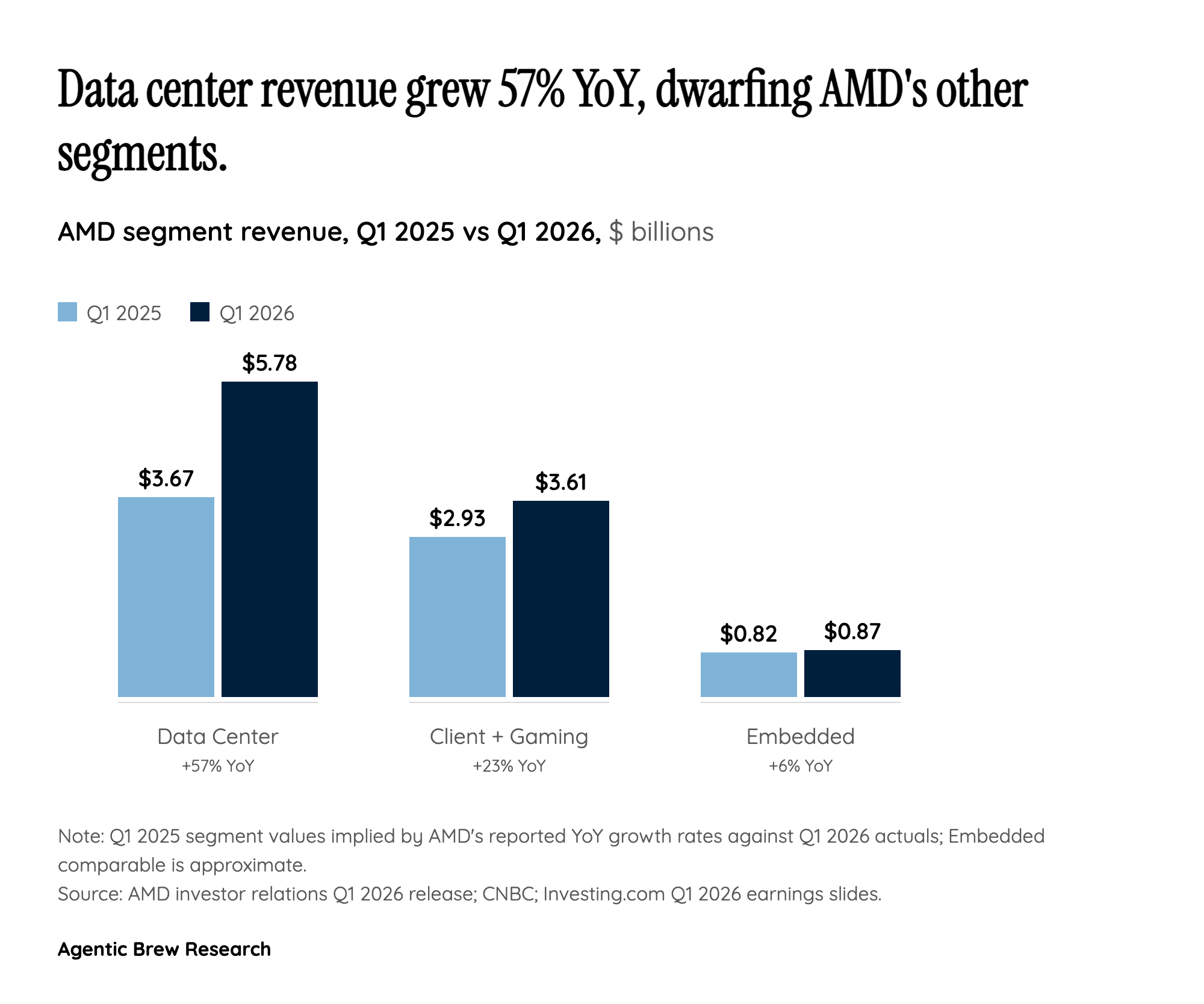
    Data center segment revenue hit $5.78B, up 57% year-over-year, while Non-GAAP diluted EPS came in at $1.37 versus an expected $1.29.
  • 03.
    AMD guided Q2 2026 revenue to roughly $11.2B (±$300M), implying ~46% YoY growth and well above the ~$10.5B consensus, with Lisa Su explicitly tying the outlook to inference and agentic AI demand.
  • 04.
    Shares jumped roughly 4-15% in extended trading to record highs, and AMD generated a record $2.566B of free cash flow in the quarter.

Deep Analysis

Inference Is the Door AMD Walked Through
Inference Is the Door AMD Walked Through
Data center revenue grew 57% YoY, dwarfing AMD's other segments — Q1 2025 vs Q1 2026, $ billions

The most important sentence in AMD's release is not the headline beat — it is Lisa Su's line that "inferencing and agentic AI drive increasing demand for high-performance CPUs and accelerators." Inference is the workload of running already-trained models in production: the chatbot reply, the code completion, the agent calling a tool. It is fundamentally different from training, which compresses months of data into weights and rewards extreme interconnect bandwidth between thousands of GPUs. Inference rewards something else — fitting the model and its key-value cache in memory on as few chips as possible, then serving tokens cheaply. That is exactly the axis on which AMD's Instinct line was built: the MI300X shipped with 192GB of HBM3, the MI350 series moved to 288GB of HBM3e, and the upcoming Helios rack pairs 72 MI450 GPUs into a 31TB HBM4 pool delivering 1.4 exaFLOPS of FP8 compute. More memory per chip means a 70B- or 400B-parameter model can be served on fewer accelerators, which collapses both the bill of materials and the networking overhead.

That explains why hyperscalers are willing to dual-source. In the training era they bought Nvidia because nothing else got the job done; in the inference era, where total cost of ownership is the dominant variable and frontier-model operators are now serving billions of queries a day, a chip with more memory and a more favorable price can win footprint even if it lags on raw FLOPS. The 57% data center growth this quarter is the financial expression of that shift — and it is why Lisa Su is comfortable forecasting "tens of billions of dollars in data center AI revenue next year" rather than a one-quarter pop. The question is no longer whether AMD has a credible AI silicon offering. It is how big a slice of the inference market it can lock in before Nvidia's Rubin generation arrives in volume.

The Meta Deal Is a Financial Engine, Not Just a Customer Win

Wall Street has covered Meta's 6GW Instinct commitment as a logo win, but the real story is in the structure. Alongside the multi-year deployment of custom MI450 silicon and Helios racks, AMD issued Meta warrants for up to 160 million AMD shares — roughly a tenth of the company — vesting in tranches as Meta deepens its purchases, with the final tranche vesting at a $600 strike price. That single number reframes the deal. A warrant strike is a public negotiating price; both sides are putting it in writing that they expect AMD's stock to clear $600 over the strategic horizon. At today's share count that is north of a $900B market cap. The Reddit megathread caught this immediately and is treating $600 as Lisa Su's implicit price target.

The second-order effect is that Meta and AMD are now financially co-invested in each other's success. If Meta's AI infrastructure cap-ex pays off, Meta picks up cheap AMD upside; if AMD's accelerator share keeps compounding, Meta has effectively pre-paid for chips at a discount. It also means dilution is contingent on execution, not raw — shareholders only absorb the share issuance if the stock performance that triggers vesting actually arrives. Combined with the OpenAI multi-gigawatt commitment that is, by AMD's account, separate from the Meta arrangement, AMD has done something Nvidia has not needed to do: it has bound its two largest prospective AI customers into the equity stack. That is a different competitive playbook, and one that gets harder to copy the bigger Nvidia gets.

The Bear Case Nobody on the Earnings Call Mentioned

The AMD megathread on Reddit split sharply. The bullish majority celebrated Lisa Su's commentary that CPU-to-GPU ratios in modern AI deployments are sliding from 1:4 or 1:8 toward 1:1 — meaning every GPU shipped is now pulling additional EPYC CPU revenue with it, and the Helios/Venice/Verano roadmap looked credible to operators. But one widely-read bear post argued the print does not justify the multiple. The case is uncomfortable: AMD is trading at roughly 136x trailing earnings and 51x forward earnings, the after-hours move added about $120B of market cap on what is effectively a ~$700M revenue beat — an incremental multiple north of 170x — and Cisco, the canonical 2000-era networking comparable, ultimately suffered an 89% drawdown from a similar valuation. None of those numbers, on their own, predicts a crash. Together they describe a stock priced for everything to keep going right.

And "everything going right" still has a real bottleneck: TSMC. Pre-earnings, HSBC's downgrade explicitly cited advanced-node and packaging capacity as the gate on AMD's ability to convert Meta- and OpenAI-class commitments into shipped revenue. AMD does not own its fabs; it competes with Apple, Nvidia, and the rest of TSMC's customer book for CoWoS capacity. If the demand picture Lisa Su just painted is correct, the binding constraint over the next 18 months is not whether the Helios design wins benchmarks but whether AMD can secure enough wafers and advanced packaging slots to ship the racks Meta has already committed to. The contrarian framing is that the bull case and the supply ceiling are now visible at the same time, and the gap between the two is what will determine whether the stock vindicates the warrant strike or compresses back toward the fundamentals.

Why This Beat Lands Differently Than February's Did

Three months ago, almost the same company posted almost the same kind of report and the market punished it. On February 4, 2026, AMD's Q4 2025 print disappointed on guidance and the stock fell 17% — its worst single-day decline since 2017 — forcing Lisa Su into a public-defense posture about AI demand. Today's earnings beat is bigger in dollars but smaller in surprise; what changed is the surrounding story. Between February and May, AMD signed a multi-year, 6GW Meta deal with strike-priced warrants, locked in a separate multi-gigawatt OpenAI commitment for the MI450, and got customer forecasts on Helios that, in the company's own language, are "exceeding our initial expectations." The numbers reported today are confirming a thesis the market had already started underwriting, rather than asking the market to believe a new one cold.

That distinction matters for how durable the move is. February's drop was about uncertainty over whether AMD's AI revenue ramp was real; May's rally is about pricing in a roadmap whose customer commitments are already public. The analyst behavior reflects the change — D.A. Davidson's Gil Luria upgraded AMD to Buy and lifted his price target from $220 to $375, more than a 70% revision, the kind of move analysts only make when they believe the trajectory rather than a single quarter. Wedbush's Dan Ives went further, calling the data center result "another validation sign for AI Revolution bull thesis." Stripped of cheerleading, the operative point is that AMD has now delivered two consecutive proof points — Meta's structural commitment and Q1's data center print — that align with Lisa Su's $20-EPS strategic target. The market is no longer asking whether AMD is in the AI accelerator race; it is asking how much of the second-place spot it can claim before the question closes.

Historical Context

2023-12
AMD launched the MI300X with 192GB of HBM3, its first credibly competitive AI GPU against Nvidia's H100 and the start of the company's serious accelerator push.
2024-12
AMD closed 2024 with more than $5B in AI accelerator revenue after MI300 first crossed $1B in a single quarter in Q2 2024.
2025-09
AMD began ramping the MI350 series on CDNA 4 with 288GB of HBM3e, internally describing it as the fastest-ramping product in company history.
2026-02-04
AMD shares fell 17% in their worst single-day drop since 2017 after Q4 2025 guidance disappointed, forcing Lisa Su to publicly defend AI demand expectations.
2026-02-24
AMD and Meta announced an expanded multi-year partnership to deploy up to 6GW of Instinct GPUs using custom MI450 silicon and Helios racks, paired with warrants for up to 160M AMD shares.
2026-05-05
AMD reported Q1 2026 revenue of $10.25B (+38% YoY), data center of $5.78B (+57% YoY), and guided Q2 to ~$11.2B, sending shares to record highs after-hours.

Power Map

Key Players
Subject

AMD Q1 2026 earnings beat fueled by AI data center demand

AM

AMD (Advanced Micro Devices)

The reporting company; data center accelerators have shifted from a side bet to the primary revenue and earnings driver, materially changing AMD's competitive posture against Nvidia.

LI

Lisa Su (AMD Chair & CEO)

Architect of AMD's data center strategy; her decision to raise Q2 guidance and publicly commit to scaling supply has reframed the bull case around multi-year, not single-cycle, AI revenue.

ME

Meta

Anchor strategic customer signing a multi-year, up to 6GW Instinct deployment built on custom MI450 plus Helios racks, and receiving warrants for up to 160M AMD shares that vest as the relationship scales.

OP

OpenAI

Separate multi-gigawatt MI450 customer; pairs with Meta to broaden AMD's hyperscaler footprint and signals that frontier-model operators are willing to dual-source AI silicon.

NV

Nvidia

Dominant AI GPU incumbent at roughly 80% share whose lead AMD is targeting most aggressively in inference workloads, where higher memory and TCO comparisons are starting to favor challenger silicon.

TS

TSMC

Critical sole-source manufacturing partner; AMD's ability to convert Meta and OpenAI commitments into shipped revenue is gated by TSMC advanced-node and CoWoS capacity, a constraint flagged by analysts pre-print.

Source Articles

Top 5

THE SIGNAL.

Analysts

"Data Center is now the primary driver of AMD's growth, and supply expansion will let server momentum accelerate further from here: "Looking ahead, we expect server growth to accelerate meaningfully as we scale supply to meet demand.""

Lisa Su
Chair and CEO, AMD

"Frames the AI accelerator opportunity as multi-year, not a single ramp: "strong and increasing confidence ... to reach tens of billions of dollars in data center AI revenue next year and to exceed our long-term growth target of greater than 80 percent in the coming years.""

Lisa Su
Chair and CEO, AMD

"Tied the AI ramp to a concrete EPS bar: "a clear path to exceed our long-term financial targets, including delivering more than $20 in EPS over the strategic timeframe.""

Lisa Su
Chair and CEO, AMD

"Reads the data center print as confirmation that the broader AI build-out is real, not a sentiment trade: "AMD monster data center numbers another validation sign for AI Revolution bull thesis.""

Dan Ives
Managing Director, Wedbush Securities

"Upgraded AMD to Buy from Hold and lifted his price target to $375 from $220, signaling that analysts are repricing AMD's accelerator ramp rather than just the cyclical CPU recovery."

Gil Luria
Analyst, D.A. Davidson
The Crowd

"AMD Q1 2026 Earnings - Adj EPS $1.37 (est $1.28) - Rev. $10.25B (est $9.89B) - Expenses $2.40B (est $2.26B) - Adj. Oper Income $2.54B (est $2.41B) - Adj. Oper Margin 25% (est 24.3%) - CAPEX $389M (est $215.2M) - Sees Q2 Rev. $10.90B To $11.50B (est $10.52B)"

@@FirstSquawk0

"AMD's stock climbs as AI demand drives earnings beat — live coverage"

@@MarketWatch0

"$AMD reports First Quarter 2026 financial results. View non-GAAP financial measures reconciliation & cautionary statement."

@@AMD0

"AMD Q1 2026 Earnings Discussion"

@u/brad471197
Broadcast
AMD Q1 2026 EARNINGS LIVE | LISA SU SPEAKS

AMD Q1 2026 EARNINGS LIVE | LISA SU SPEAKS

AMD Q1 EARNINGS REPORT/CALL REVIEW | LISA SU SPEAKS

AMD Q1 EARNINGS REPORT/CALL REVIEW | LISA SU SPEAKS

AMD Stock (+ SMCI, UPST, etc) Earnings Call | Q1 2026 Breakdown

AMD Stock (+ SMCI, UPST, etc) Earnings Call | Q1 2026 Breakdown