SynthID and C2PA watermarking for AI-generated images
TECH

SynthID and C2PA watermarking for AI-generated images

29+
Signals

Strategic Overview

  • 01.
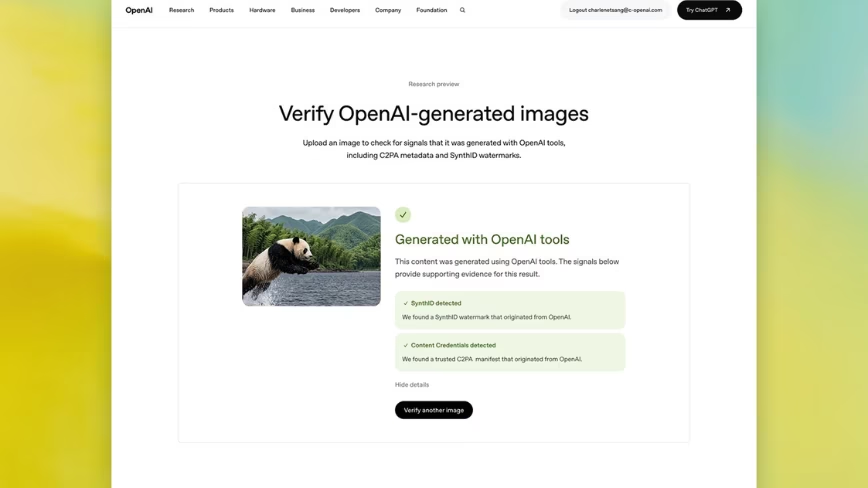
    OpenAI is now a C2PA Conforming Generator and has integrated Google DeepMind's SynthID invisible watermark into images generated by ChatGPT, Codex, and the OpenAI API, alongside a public verification tool at openai.com/verify.
  • 02.
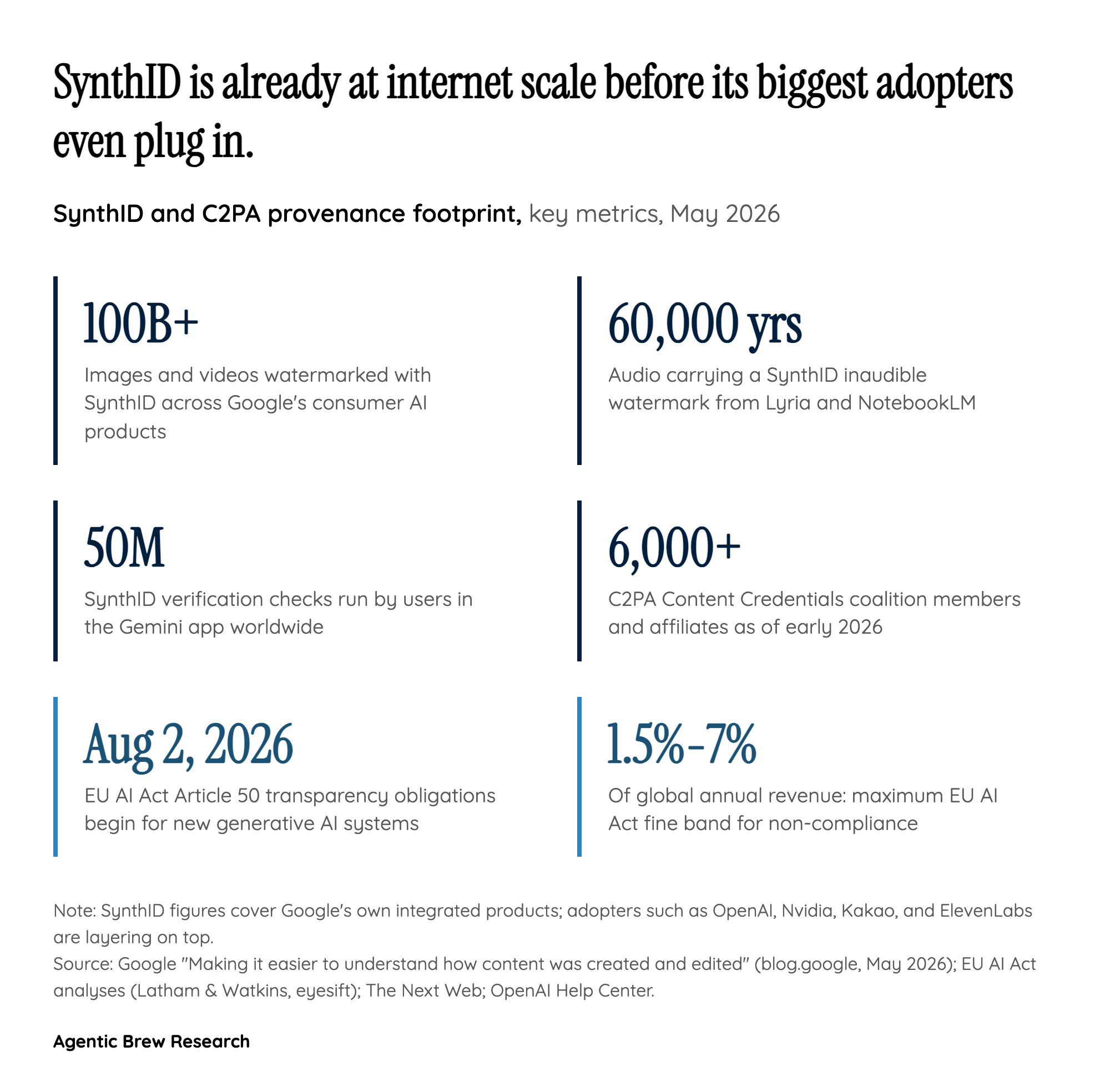
    Google says SynthID has now watermarked over 100 billion images and videos and 60,000 years of audio across its consumer AI products, and verification has been used 50 million times globally in the Gemini app.
  • 03.
    Google is expanding SynthID and C2PA detection beyond Gemini into Google Search and Chrome, letting users ask 'Is this made with AI?' through Lens, AI Mode, Circle to Search, and Gemini in Chrome.
  • 04.
    An open-source 'remove-ai-watermarks' command-line tool removes both visible and invisible AI watermarks, including SynthID and StableSignature, and strips C2PA, EXIF, and XMP provenance metadata in the same pipeline.

Two layers, because one was never going to hold

The OpenAI rollout is structurally a dual-layer system, and the design choice tells you what failed in earlier attempts. C2PA Content Credentials are signed manifests written into image metadata that record how a file was created and edited - rich, human-readable, but living in the same EXIF/XMP block that any social platform, screenshot, or format conversion can wipe. SynthID is the opposite: imperceptible pixel-level perturbations embedded at generation time that ride along inside the actual image bytes, designed to survive cropping, resizing, compression, and screenshots [1]. OpenAI's own statement frames the pairing explicitly - watermarking can be more durable through transformations like screenshots, while metadata can provide more information than a watermark alone, so together they make provenance more resilient than either layer would be on its own [1].

The practical consequence is that the public verification tool at openai.com/verify is doing two independent checks per upload. If both layers survive, you get a high-confidence positive. If C2PA has been stripped - which TechCrunch notes is common because metadata is clearly accessible and easily manipulated - the SynthID layer can still flag the image as OpenAI-generated [1]. And if both are missing, the tool deliberately does not make a definitive claim, because absence of a watermark is not evidence of human authorship [2]. That last constraint is important: this is provenance infrastructure for trusted content, not a universal deepfake detector.

Three months to the EU's August deadline is not a coincidence

The reason two of the largest AI labs converged on the same provenance stack on the same Tuesday is regulatory, not technical. Article 50 of the EU AI Act takes effect on August 2, 2026 for new generative AI systems, with pre-existing systems given until December 2, 2026 to comply [3]. The Commission's draft Code of Practice, published on December 17, 2025, is unusually prescriptive about the technical implementation: machine-readable provenance information must be embedded in the file using standards such as C2PA, and an invisible watermark must be woven in at the pixel level that survives compression, cropping, and format conversion [4]. That is, almost word-for-word, the OpenAI launch.

The enforcement teeth back it up. Non-compliance with the EU's AI transparency rules can trigger fines in the range of 1.5% to 7% of global annual revenue, the same penalty band as serious GDPR violations [5]. For a frontier lab whose image generators get used inside the EU at consumer scale, that risk is large enough to force a buy-versus-build decision against a three-month clock - and 'buy' here means licensing SynthID rather than reinventing pixel-level watermarking from scratch. That dynamic explains why Google chose this exact week to publicize that Nvidia, Kakao, and ElevenLabs are also signing on [6]: the Code of Practice is creating a procurement deadline, and Google is positioning SynthID as the off-the-shelf answer.

The bypass economy is already shipping

The same week OpenAI announced provenance support, a public GitHub project called 'remove-ai-watermarks' was already documenting how to defeat it. The library removes visible watermarks like Gemini's sparkle logo using reverse alpha blending, strips invisible watermarks including SynthID and StableSignature using diffusion-based regeneration, and removes C2PA, EXIF, and XMP metadata in the same pipeline - explicitly to disable the 'Made with AI' labels that social platforms key off. A parallel ComfyUI workflow, 'SynthID-Bypass V2,' adds resolution-aware denoise and a face-reconstruction path, and the author bundles it with before-and-after comparisons that show the watermark vanishing.

Community sentiment around this is split in revealing ways. On the technology and Gemini subreddits, the dominant top-comment angle is that any pixel-level marker can be eroded, and one widely-upvoted thread walks through how SynthID's keyed-hash mechanism works for text and points out that compression or rephrasing degrades the signal long before sophisticated attacks are needed. A separate thread reporting that Gemini's Nano Banana image-to-image edit silently drops the SynthID watermark - confirmed by replies running test edits like adding a scratch or a bird - suggests the watermark may not even survive Google's own editing tools, let alone third-party transformations. Independent academic work agrees with the skeptics on the text side: a March 2026 arXiv analysis documents black-box layer-inflation and paraphrasing attacks that significantly degrade SynthID-Text detectability [7]. The picture is not 'watermarks are useless' - it is that the watermark works against casual reuse and breaks against motivated removal, which is a meaningfully narrower claim than the marketing implies.

SynthID is becoming a coalition, and Google sets the terms

SynthID is becoming a coalition, and Google sets the terms
SynthID is already at internet scale before its biggest adopters even plug in - and the EU AI Act's August deadline forces the rest of the industry to catch up.

Stepping back from any individual product, the more interesting development is that SynthID is no longer a Google feature. It is now embedded - or contracted to be embedded - across OpenAI image generation, Nvidia's Cosmos world foundation models for video, Kakao's Kanana model (the first Asian-company adopter), and ElevenLabs voice synthesis [6]. With 100 billion images and videos already watermarked through Google's own products and 60,000 years of audio carrying SynthID signals, the network is already at internet scale before competitors plug in [6].

Google is also keeping the detection API closed, framing broad scan access as a potential attack vector - meaning verification flows through Google's properties (Gemini app, openai.com/verify routing back to Google's libraries, soon Google Search and Chrome) rather than as a public oracle anyone can call [8]. That is a meaningful power position: the C2PA layer is an open standard, but the durable, transformation-resistant layer goes through one company's framework. For competing labs the calculus is uncomfortable - implementing the EU's required invisible watermark via SynthID is the fastest path to compliance, but it also means agreeing that Google's encoder is the de facto industry primitive. The cat-and-mouse story therefore has a second axis: not just removal tools versus encoders, but adopters versus the single vendor who owns the encoder.

Historical Context

2019
Adobe, Microsoft, BBC, and Truepic launched Project Origin, the precursor effort to standardize cryptographic content provenance that later evolved into C2PA.
2021
The Coalition for Content Provenance and Authenticity was founded by Adobe, Arm, the BBC, Intel, Microsoft, and Truepic, formalizing an open technical standard for media credentials.
2024
The EU AI Act was enacted, including Article 50 transparency obligations that require providers of generative AI to mark synthetic content in a machine-readable format.
2025-12-17
The Commission published the first draft of its Code of Practice for marking and labelling AI-generated content, prescribing a multi-layered approach combining C2PA-style metadata with invisible pixel-level watermarking.
2026-05-19
OpenAI announced C2PA Conforming Generator status and SynthID integration across ChatGPT, Codex, and the OpenAI API, the same day Google detailed expanded SynthID adoption by OpenAI, Nvidia, Kakao, and ElevenLabs.

Power Map

Key Players
Subject

SynthID and C2PA watermarking for AI-generated images

OP

OpenAI

First major rival to embed SynthID across its image stack; by adopting C2PA and Google's watermark simultaneously, OpenAI turns provenance into a shared cross-vendor layer rather than a Google-only feature, and exposes a public verification tool that currently covers only OpenAI outputs.

GO

Google DeepMind

Owns SynthID and controls who gets access; by licensing it to OpenAI, Nvidia, Kakao, and ElevenLabs while keeping the detection API closed, it positions SynthID as the de facto pixel-level watermark standard for generative AI.

C2

C2PA / Content Authenticity Initiative

Provides the open metadata standard OpenAI now conforms to. With founding members Adobe, Arm, BBC, Intel, Microsoft, and Truepic and a coalition now over 6,000 affiliates, C2PA carries the rich-but-strippable provenance manifest that SynthID is meant to back up.

EU

European Commission (EU AI Act)

Sets the regulatory deadline driving the timing. Article 50 transparency obligations apply from August 2, 2026 for new generative AI systems, with December 2, 2026 for pre-existing systems, prescribing a multi-layered C2PA-plus-invisible-watermark approach.

OP

Open-source bypass community

Builds and publishes tools that remove SynthID, StableSignature, and C2PA/EXIF metadata. The 'remove-ai-watermarks' CLI and a separate ComfyUI workflow demonstrate that pixel-level watermarks are removable given motivation, reframing SynthID as a friction layer rather than a guarantee.

Fact Check

9 cited
  1. [1] OpenAI is making it easier to check if an image was made by their models
  2. [2] C2PA and SynthID in OpenAI-generated images
  3. [3] AI Act Update: EU Resolves to Change Rules and Extend Deadlines
  4. [4] Code of Practice on marking and labelling of AI-generated content
  5. [5] C2PA Content Credentials 2026 - Cryptographic Provenance Adoption Guide
  6. [6] Making it easier to understand how content was created and edited
  7. [7] On Google's SynthID-Text LLM Watermarking System: Theoretical Analysis and Empirical Validation
  8. [8] OpenAI Adopts Google SynthID Watermarks for AI Image Detection
  9. [9] OpenAI adds C2PA metadata and SynthID watermarks to AI images

Source Articles

Top 5

THE SIGNAL.

Analysts

"Pichai framed the rollout as a usability play, saying Google wants more people to have easy access to provenance tools and is therefore expanding both Content Credentials and SynthID verification to Search and Chrome."

Sundar Pichai
CEO, Google

"In Google's own announcement they describe SynthID as a watermark embedded directly into AI-generated images, audio, text, or video and imperceptible to humans, with the signal designed to survive standard edits."

Laurie Richardson and Pushmeet Kohli
VP of Trust and Safety, Google; Chief Scientist, Google Cloud and VP, Google DeepMind

"OpenAI's position is that the two layers reinforce each other: watermarking can be more durable through transformations like screenshots while metadata can provide more information than a watermark alone, so together they make provenance more resilient than either layer would be on its own."

OpenAI
Official statement, Advancing content provenance
The Crowd

"I created an open source Synthid remover that actually works (Educational purposes only)"

@u/Top-Extreme-6092188

"Google's SynthID AI Watermarking Tech Adopted by OpenAI, Nvidia, And More"

@u/CircumspectCapybara84

"SynthID watermark is gone !!"

@u/Background_Soup269311
Broadcast
SynthID: A tool for watermarking and identifying AI-generated content

SynthID: A tool for watermarking and identifying AI-generated content

AI Watermarking Tech by Google DeepMind: How SynthID Works & Why It's Not Enough (Major Issues!)

AI Watermarking Tech by Google DeepMind: How SynthID Works & Why It's Not Enough (Major Issues!)

SynthID – Watermarking and identifying AI-generated text

SynthID – Watermarking and identifying AI-generated text