Anthropic Rapidly Closing Gap on OpenAI in Enterprise Adoption
TECH

Anthropic Rapidly Closing Gap on OpenAI in Enterprise Adoption

42+
Signals

Strategic Overview

  • 01.
    Anthropic's share of paying US businesses reached 30.6% in March 2026, up sharply from 24.4% in February, narrowing the gap with OpenAI's 35.2% from 11 points to just 4.6 in a single month.
  • 02.
    Anthropic's ARR crossed $30B in April 2026, surpassing OpenAI's $25B for the first time, representing growth of over 8,000% from its $87M ARR baseline in January 2024.
  • 03.
    Anthropic wins approximately 70% of head-to-head matchups among businesses purchasing AI for the first time, and already leads OpenAI in the Information/Software, Finance & Insurance, and Professional Services sectors.
  • 04.
    Overall business AI adoption reached 50.4% as of March 2026, up from 35% year-over-year, reflecting a broader enterprise AI acceleration that is disproportionately benefiting Anthropic.

Deep Analysis

From $87M to $30B in 27 Months: The Enterprise Revenue Machine Nobody Modeled
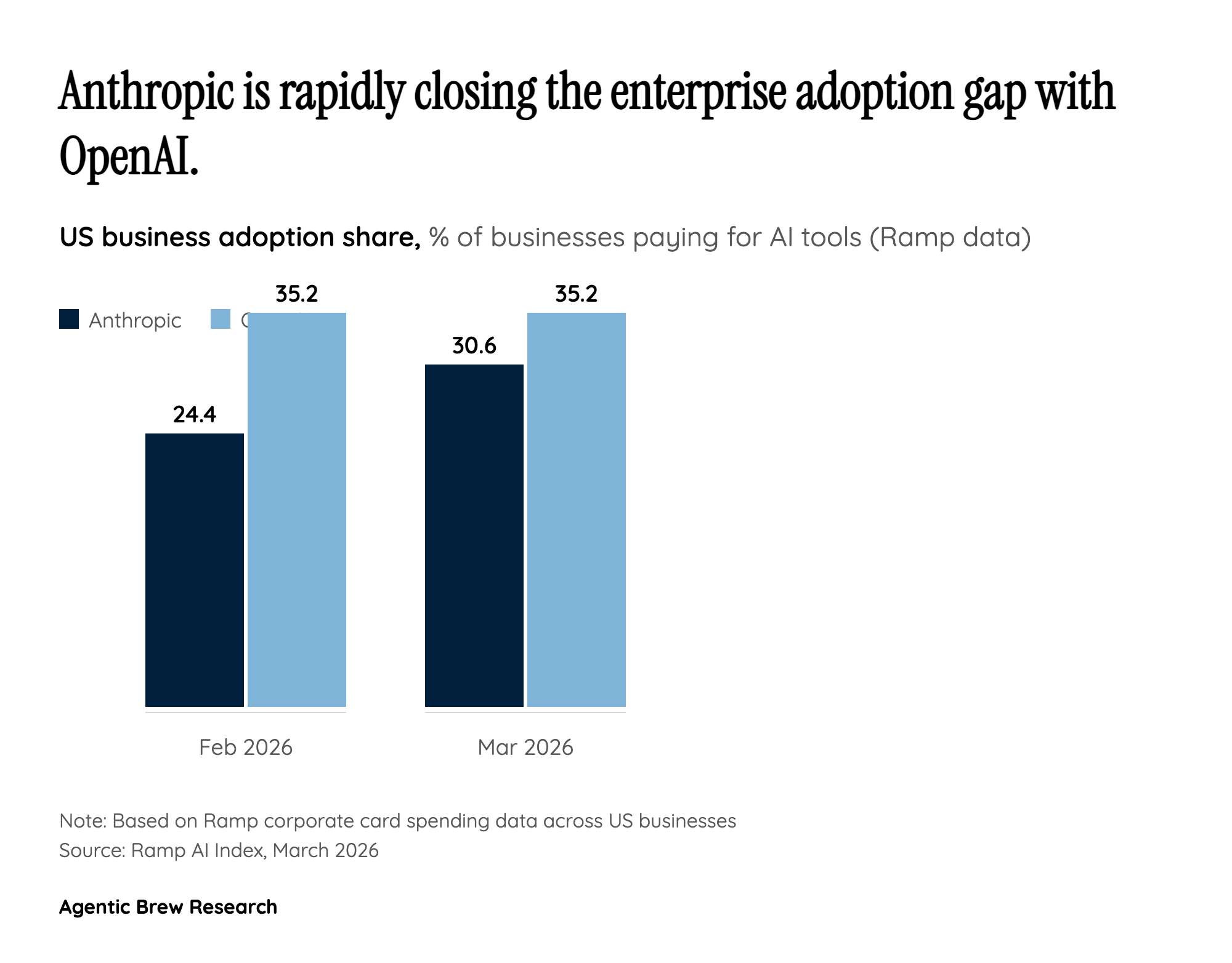
From $87M to $30B in 27 Months: The Enterprise Revenue Machine Nobody Modeled
Anthropic enterprise adoption surged from 24.4% to 30.6% in one month, closing the gap with OpenAI at 35.2%

In January 2024, Anthropic's annualized revenue was $87 million. By April 2026, it had crossed $30 billion — a 345x increase in 27 months. This is not a gradual market share shift; it is a discontinuous commercial event. For context, Salesforce took roughly a decade to reach $1B ARR from founding. Anthropic did it in four years, then added another $29B in 15 months. The growth rate of 10x per year, documented by Epoch AI, is not sustainable indefinitely, but it does not need to be — at this pace, Anthropic's revenue base is structurally difficult for OpenAI to overcome even at OpenAI's own 3.4x growth rate.

The composition of that revenue is equally telling. Roughly 80% comes from business customers, not consumers. This means Anthropic's growth is anchored in sticky, high-contract-value enterprise relationships rather than volatile subscription churn. The $1M+ annual spend threshold, which over 1,000 companies now cross — a number that doubled in under two months — signals that enterprises are not experimenting with Claude; they are standardizing on it. Eight of the Fortune 10 being Anthropic customers is not a marketing claim; it is an indicator of platform-level entrenchment that will be structurally difficult to reverse.

Three Clouds vs One: The Distribution Asymmetry OpenAI Cannot Easily Fix

Claude is available natively on AWS Bedrock, Google Cloud Vertex AI, and Microsoft Azure Foundry. OpenAI is available exclusively through Azure. This is not a minor operational detail — it is a fundamental distribution asymmetry that compounds over time. Enterprise procurement follows existing cloud relationships. A company that standardizes on AWS or Google Cloud faces meaningful friction to adopt OpenAI, while Anthropic is already present in their existing procurement and compliance frameworks. This gives Anthropic a structural sales motion that does not require winning a new vendor approval process.

The deeper irony is that both AWS and Google Cloud are strategic investors in Anthropic, creating aligned incentives for those platforms to route enterprise AI workloads toward Claude. Microsoft, as OpenAI's primary partner, publicly showed support for Anthropic following the Pentagon dispute — an unusual signal that even OpenAI's closest ally is hedging. For OpenAI to close this distribution gap, it would need to negotiate comparable native integrations with AWS and Google Cloud, platforms that are simultaneously Anthropic investors and competitors via their own AI models. That negotiation is structurally compromised before it begins.

First-Time Buyers Are the Only Buyers That Matter for Long-Term Share

Ramp's data shows Anthropic winning approximately 70-73% of head-to-head matchups among businesses purchasing AI for the first time. This single statistic may be the most consequential number in the entire competitive picture. OpenAI's current 35.2% adoption lead is largely a legacy artifact — businesses that adopted AI when OpenAI was the only credible enterprise option. The question of who wins the next five years of AI enterprise adoption is answered almost entirely by who wins first-time buyers today.

Among VC-backed companies — which represent the incubator of future enterprise spend as startups scale — Anthropic usage (66%) already exceeds OpenAI (59%). This cohort will write the enterprise RFPs of 2027 and 2028. Sector leadership reinforces this: Anthropic already leads in Information/Software, Finance & Insurance, and Professional Services — the three sectors with the highest AI spend intensity and the highest tendency to set industry-wide procurement norms. When a major bank or a top-tier law firm standardizes on Claude, their vendors, clients, and competitors face pressure to adopt compatible tooling. OpenAI's legacy base, meanwhile, faces renewal cycles that Anthropic is increasingly positioned to contest.

The Hidden Cost War: Why OpenAI's Training Budget Is a Strategic Liability

Projected 2030 training costs tell a story that transcends market share: OpenAI faces $121-125B per year in training expenditure versus Anthropic's approximately $30B. This four-to-one cost differential means that even if both companies had identical revenue trajectories, OpenAI's path to profitability is structurally harder. OpenAI already projects $14B in losses for 2026 against a backdrop of accelerating revenue; Anthropic has set a breakeven target of 2027. The cost structure gap is not a temporary technology disadvantage — it reflects fundamental architectural and operational choices that do not reverse quickly.

This cost reality shapes the IPO dynamics in ways that go beyond valuation optics. OpenAI's accelerated Q4 2026 IPO timeline, targeting a valuation of up to $852B against a backdrop of $14B projected losses, looks like a capital-raising race against time. A public market event locks in capital before the competitive gap widens further — but it also locks in public scrutiny of loss ratios that Anthropic, as a private company targeting 2027 breakeven at $380B valuation, does not yet face. The competitive asymmetry is not just who has more customers; it is who has the more defensible cost structure as AI model training scales.

OpenAI's IPO Acceleration as a Strategic Concession

When a market leader accelerates its IPO timeline in the same quarter a challenger surpasses it in revenue, the IPO is not merely a financial event — it is a strategic signal. OpenAI's move toward a Q4 2026 public offering, combined with Fidji Simo's public admission that internal distractions have cost the company focus in the enterprise segment, suggests that OpenAI's leadership recognizes the competitive window is narrowing. The IPO raises capital to fund a cost structure that is currently unsustainable, while also creating a public currency for acquisitions and talent retention at a moment when Anthropic's momentum may be accelerating employee interest in the challenger.

The pricing response is equally revealing. OpenAI cut Codex pricing from $200 to $100 per month in the same period Anthropic launched Claude Cowork with role-based access — a feature-versus-price trade that reflects each company's competitive posture. Anthropic is competing on capability differentiation and enterprise workflow integration; OpenAI is competing on price to retain customers at risk of switching. Historically, price-led retention is a weaker strategic position than capability-led acquisition. If Anthropic continues winning first-time buyers at 70%+ rates while OpenAI defends legacy accounts with discounts, the structural trajectory of the competitive dynamic becomes increasingly difficult for OpenAI to reverse through pricing alone.

Historical Context

2021
Founded by Dario Amodei, Daniela Amodei, and other ex-OpenAI employees after disagreements over AI safety direction.
2023
OpenAI dominated the AI landscape following the viral success of ChatGPT, establishing a commanding lead in both consumer and early enterprise markets.
2024-01
Anthropic's ARR stood at just $87M while OpenAI held approximately 50% of the AI API market.
2025-01
Anthropic crossed $1B ARR, marking its first major commercial milestone and the beginning of its steepest growth phase.
2025-05
Anthropic launched Claude Code, which rapidly captured 54% of the enterprise coding market and reached a $1B run-rate within six months of launch.
2025-10
Anthropic reached $7B ARR, representing 8,000% growth in 21 months from January 2024.
2026-02
A Pentagon AI dispute boosted Anthropic's enterprise credibility; Epoch AI published its revenue crossover model projecting Anthropic surpassing OpenAI by mid-2026.
2026-04
Anthropic's ARR crossed $30B, surpassing OpenAI's $25B for the first time. Ramp data showed the enterprise adoption gap narrowing to 4.6 percentage points.

Power Map

Key Players
Subject

Anthropic Rapidly Closing Gap on OpenAI in Enterprise Adoption

AN

Anthropic

Challenger AI company founded by ex-OpenAI employees; $30B ARR as of April 2026, with 80% of revenue from business customers and 8 of Fortune 10 as clients.

OP

OpenAI

Incumbent AI leader at 35.2% enterprise adoption, pivoting aggressively to enterprise while planning a Q4 2026 IPO at up to $852B valuation; projected 2026 losses of $14B.

RA

Ramp

Corporate spend platform providing the primary dataset tracking AI vendor adoption across US businesses; projects Anthropic will surpass OpenAI in business customers within two months.

AW

AWS & Google Cloud

Strategic investors in Anthropic and cloud distribution partners; Claude's availability on both platforms (plus Azure) gives it structural distribution advantages over OpenAI's Azure-exclusive cloud arrangement.

EP

Epoch AI

Research institution that modeled revenue crossover projections, estimating Anthropic will surpass OpenAI in revenue by August 2026 (90% CI: February 2026 – April 2027).

EN

Enterprise Fortune 500

Primary battleground for the OpenAI vs Anthropic competition; 8 of Fortune 10 are now Anthropic customers, and over 1,000 companies spend $1M+ annually with Anthropic.

THE SIGNAL.

Analysts

""We cannot miss this moment because we are distracted by side projects. We really need to get productivity right overall, and in the enterprise space in particular.""

Fidji Simo, CEO of Applications, OpenAI
Internal acknowledgment of OpenAI's enterprise vulnerability

""When vendors compete, enterprises win, as they get better capabilities at lower costs, and today's updates are the perfect showcase of this.""

Holger Mueller, Constellation Research
Competitive dynamics benefit enterprise customers

"Epoch AI's modeling shows Anthropic growing at 10x per year versus OpenAI's 3.4x, projecting a revenue crossover point of August 2026 with a 90% confidence interval spanning February 2026 to April 2027."

Luke Emberson & Yafah Edelman, Epoch AI
Quantitative projection of revenue crossover

""At the current pace, Anthropic is on track to surpass OpenAI within the next two months. It already leads among early adopters.""

Ramp spokesperson
Real-time spend data signals imminent market leadership flip
The Crowd

"OpenAI may be a household name, but Anthropic could soon be earning more revenue. Since each company hit $1B in annualized revenues, Anthropic has grown substantially faster (10x vs 3.4x per year) and could overtake OpenAI by mid-2026 if recent trends continue."

@@EpochAIResearch0

"Sam Altman posted a Codex growth chart without a Y-axis. That's the most important detail in this tweet. Here's what the chart conveniently leaves out. Ramp's March 2026 AI Index shows Anthropic now wins 70% of head-to-head matchups against OpenAI among businesses buying AI"

@@aakashgupta0

"Most people in tech know Anthropic commands the majority of API spend by U.S. businesses. As of January, Anthropic took >50% of spend on enterprise AI subscriptions too. OpenAI still leads on business count. But the biggest spenders go to Anthropic. All from Ramp data."

@@arakharazian0
Broadcast
Why Anthropic's Founder Left Sam Altman's OpenAI

Why Anthropic's Founder Left Sam Altman's OpenAI

Anthropic Is Beating OpenAI to Profitability. Here's why

Anthropic Is Beating OpenAI to Profitability. Here's why

AI's new power brokers: Ramp's chief economist and the 24-yr-old taking on Big AI

AI's new power brokers: Ramp's chief economist and the 24-yr-old taking on Big AI