Meta AI-first restructuring layoffs
TECH

Meta AI-first restructuring layoffs

45+
Signals

Strategic Overview

  • 01.
    Meta began laying off roughly 8,000 employees — about 10% of its global workforce — starting at 4 a.m. local time on May 20, 2026, beginning in Asia and rolling out worldwide.
  • 02.
    Alongside the cuts, Meta is forcibly reassigning approximately 7,000 employees into new AI-focused units — Applied AI Engineering, Agent Transformation Accelerator XFN, Central Analytics, and Enterprise Solutions — and is closing 6,000 open roles, for an effective 14,000-position headcount reduction.
  • 03.
    The restructuring lands the same quarter Meta reported $56.3 billion in revenue and $26.8 billion in net income, with 2026 AI-infrastructure capex guided to $125–$145 billion — roughly twice the 2025 outlay.
  • 04.
    Meta is also rolling out the Model Capability Initiative (MCI), software that records keystrokes, mouse movements, and screen snapshots from employee laptops to train internal AI agents — a program staff have protested with petitions and US flyers branding the company an 'Employee Data Extraction Factory.'

Deep Analysis

Record profits, eight thousand layoffs — the trade is the story

Meta is not laying off 8,000 employees because the business is in trouble. It is laying them off in the same quarter it reported $56.3 billion in revenue and $26.8 billion in net income [1], with year-over-year revenue up 33%. That alone makes this a different category of layoff from the 2022 'year of efficiency' round, when belt-tightening had at least a soft cover story.

The trade is explicit. Meta has raised 2026 AI-infrastructure capex guidance to $125–$145 billion [2]— roughly twice 2025's outlay — and is funding the bump partly by removing 14,000 positions (8,000 active employees plus 6,000 cancelled open roles) [3]. In other words: the payroll line is being cut so the GPU and data-center line can grow. Janelle Gale, Meta's chief people officer, said the quiet part on the record, framing the reorg as a way to 'run the company more efficiently and to allow us to offset the other investments we're making' [4]. That sentence is the new template for an AI-era layoff — not 'we're shrinking,' but 'we're reallocating headcount into silicon.'

The Reddit reaction picked this up immediately. The most upvoted threads frame the move not as restructuring but as a capital-allocation choice with workers as the variable being cut. The framing matters: it removes the macro-cyclical excuse that justified prior tech layoffs and forces a more uncomfortable conversation about whether high-margin software businesses still owe anything to the engineers who built them.

Forced AI transfers: a labor model unique to this cycle

What separates Meta's May 20 reorg from any prior tech layoff is the 7,000 employees who weren't fired — they were ordered to move. Engineers are being routed into four new units: Applied AI Engineering, Agent Transformation Accelerator XFN, Central Analytics, and Enterprise Solutions [5]. Two smaller pods — one building AI cloud infrastructure, the other an internal agent codenamed Hatch — are pulling about 25 engineers each [6].

The language around these moves is unusually direct. Maher Saba, VP of Applied AI Engineering, told reassigned engineers that 'AAI is one of the company's highest priorities and we're resourcing it by moving our strongest talent to address it. Therefore, the transfers aren't optional' [7]. That phrasing — 'aren't optional' — is what's new. Meta isn't asking. It's redirecting an experienced workforce by fiat, because hiring 7,000 AI engineers in twelve months on the open market is impossible at any salary.

The second-order effect is a manager purge. Janelle Gale said the company is moving to 'a flatter structure with smaller teams,' and many managers are being laid off outright or demoted into individual contributor roles [4]. Zuckerberg has been telegraphing this since January, when he told investors that 'we're elevating individual contributors, and flattening teams' and that 'projects that used to require big teams now be accomplished by a single very talented person' [4]. The reorg is the operational version of that thesis: fewer managers, more ICs, all pointed at AI.

The Model Capability Initiative — workers training their own replacements

The most combustible piece of the restructuring is a piece of software, not a layoff list. The Model Capability Initiative (MCI), deployed on US employee laptops in April, captures keystrokes, mouse movements, click locations, and periodic screenshots across hundreds of apps and websites — including Google, GitHub, Slack, LinkedIn, Wikipedia, Threads, and Meta's internal AI assistant Metamate [8]. Andrew Bosworth, Meta's CTO, confirmed in an internal memo that 'there is no option to opt out of this on your work provided laptop' [3].

The captured data trains AI systems designed to replicate how employees perform digital tasks [8]. One Meta engineer described the program as 'an invasion of my privacy' and 'a microcosm for the AI movement,' adding: 'I don't want to live in a world where humans — employees or otherwise, are exploited for their training data' [8]. The optics are brutal: workers are being asked to generate the training corpus for the same agents that justify the reorg removing their colleagues.

The employee response has been organized. Office flyers branding Meta the 'Employee Data Extraction Factory' appeared on vending machines, in bathrooms, and in meeting rooms, directing staff to a petition at mcipetition.com [6]. The petition has cleared 1,000 signatures [3], and UK-based Meta workers are organizing under United Tech and Allied Workers (UTAW), a Communication Workers Union branch [6]. That is the first credible unionization attempt inside Meta, and it traces directly to MCI — not to the layoffs themselves. The lesson for other AI labs deploying employee-task-capture tools: the program, not the layoff, is what radicalizes workers.

Wall Street's split verdict on the $145B bet

Wall Street's split verdict on the $145B bet
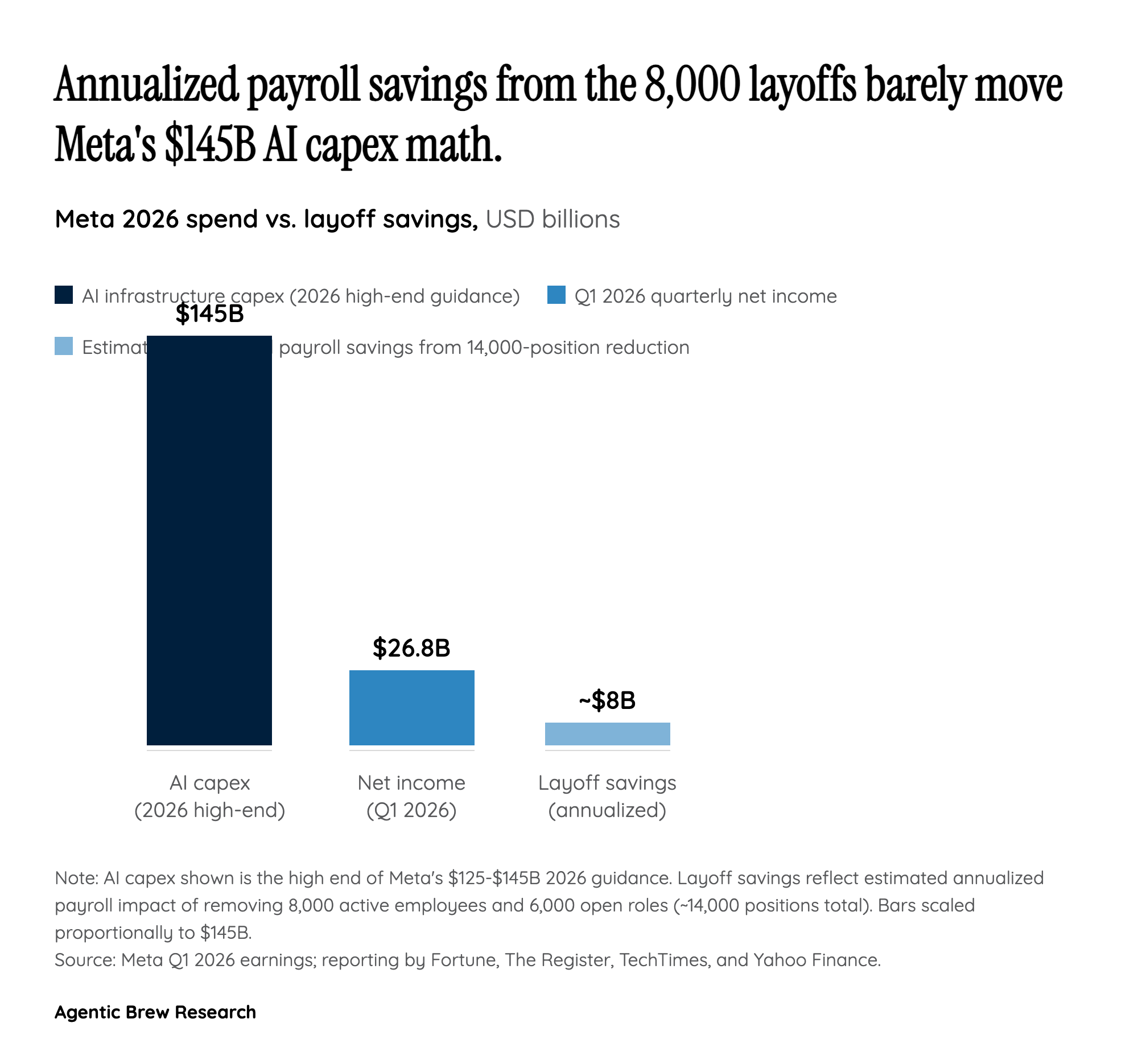
Meta's 2026 AI capex guidance dwarfs both quarterly profit and the annualized payroll savings from cutting 14,000 positions.

The financial story is messier than the headlines suggest. When Meta raised 2026 capex guidance to $125–$145 billion at Q1 earnings on April 29, shares fell as much as 10% in early trading — its worst earnings reaction in six quarters [9]. JPMorgan downgraded the stock, arguing Meta faces 'a more challenging path to returns' compared with its AI rivals [10]. Melissa Otto at S&P Global Visible Alpha put the analyst worry plainly: 'It raises this question about what is the real ROI on all this capex that they're spending' [2].

And yet the sell-side consensus has barely moved. Across the 67 analysts covering Meta, the ratings split is 11 Strong Buy, 50 Buy, 6 Hold, and zero Sell, with a consensus price target implying 42% upside [10]. That gap — short-term punishment, long-term faith — is what Zuckerberg is betting on. The executive comp package reinforces the bet: stock options worth up to $921 million each for CTO Bosworth, CPO Chris Cox, and COO Javier Olivan, and $787 million for CFO Susan Li, all tied to reaching a $9 trillion market cap by 2031 [3].

The workforce is the slack variable in that equation. With ~$7–$8 billion in annualized payroll savings [8]against $125–$145 billion in capex, the cuts barely move the AI-spending math — which makes 'efficiency' framing thin. What the cuts do is signal to Wall Street that Meta is willing to reshape its cost base to defend operating margins while the AI investments compound. The 8,000 layoffs are, in capital-markets terms, a credibility purchase.

What the community read that the press release didn't say

On Reddit, the discussion didn't stop at outrage. The most-upvoted r/SoftwareEngineerJobs post — written by a self-identified hiring manager — argued that Meta sold roughly $25 billion in bonds not to weather a downturn but specifically to buy 'more silicon, more electricity, and more data centers,' and that the layoffs are the cost-side leg of that bond raise. Software engineering communities are reading this as a structural reset of the social contract, not a one-off cull.

A second thread that surfaced repeatedly: skepticism about whether the AI replacement story will hold. One widely shared comment captured the contrarian read — 'the difference between what management thinks these things can do and what they can actually do is enormous' — and predicted a rehire cycle once internal agents underdeliver. That argument is now Gergely Orosz's framing on X as well: many of these 'AI layoffs' may be backwards, happening because AI spend isn't yet correlating with business results, so payroll is the lever leadership can actually pull this quarter.

The practical takeaway circulating in developer communities is the most useful signal here, and it doesn't depend on whose narrative wins. Engineers who add value primarily by translating tickets into pull requests are exposed; engineers who can scope, design, and validate AI-augmented systems are insulated. The advice — become a multiplier, not an executor — is consistent across r/cscareerquestions, r/SoftwareEngineerJobs, and r/Layoffs, and it reads like the most honest piece of career guidance to emerge from this week's reorg.

Historical Context

2022-11
Meta laid off 11,000 employees (13% of staff) in its first mass layoffs, kicking off the 'year of efficiency' that reshaped how Silicon Valley treats engineering headcount.
2026-01
Told Q4 2025 investors Meta is 'elevating individual contributors, and flattening teams,' previewing the manager-collapse that now drives the May 20 reorg.
2026-04
Reassigned at least 1,000 engineers to a data-labeling team called Applied AI — initially voluntary, then made mandatory — establishing the playbook for the May 20 forced transfers.
2026-04
Deployed the Model Capability Initiative (MCI) on US employee laptops, capturing keystrokes, mouse movements, and screen snapshots across Google, GitHub, Slack, Wikipedia, LinkedIn, and Meta's internal AI assistant Metamate to train internal agents.
2026-04-29
Raised 2026 capex guidance to $125–$145 billion at Q1 earnings; shares fell as much as 10% as JPMorgan downgraded the stock on ROI concerns.
2026-05-13
Workers posted protest flyers in offices, bathrooms, and meeting rooms branding Meta the 'Employee Data Extraction Factory' and pointing to mcipetition.com; the petition crossed 500 signatures, then surpassed 1,000.
2026-05-20
Notifications began at 4 a.m. local time in Singapore, rolled across Asia, then hit US workers during the morning — the largest single-day Meta layoff since the 2022 round.

Power Map

Key Players
Subject

Meta AI-first restructuring layoffs

MA

Mark Zuckerberg

CEO. Drove the AI-first reorganization, raised 2026 capex guidance to $125–$145B, and told staff in a May 20 memo that 'success isn't a given' in the AI era. His decisions set the speed and shape of the entire restructuring.

JA

Janelle Gale

Chief People Officer. Authored the internal memo executing the layoffs and the move to 'flatter' structures with smaller teams, and is the executive face of the workforce transfers into the new AI units.

MA

Maher Saba

VP of Applied AI Engineering. Owns the team receiving the largest forced reassignments and publicly told engineers that 'the transfers aren't optional,' establishing the precedent that AI work overrides existing assignments.

AN

Andrew Bosworth

CTO. Confirmed there is no opt-out for the Model Capability Initiative tracking software on company-provided laptops, making him the executive sponsor of the most contested element of the restructuring.

UN

United Tech and Allied Workers (UTAW)

UK tech-worker union (a branch of the Communication Workers Union) that Meta UK staff are now organizing under in response to the surveillance and forced transfers — the first credible labor counterweight inside the company.

WA

Wall Street equity analysts

Set the cost-of-capital frame for Meta's AI spend. After the April capex raise, the stock fell as much as 10% in early trading and JPMorgan downgraded the shares, but consensus remains 11 Strong Buy / 50 Buy / 6 Hold / 0 Sell across 67 covering analysts.

Fact Check

10 cited
  1. [1] Meta Forces Workers to Train Their AI Replacements — Then Cuts 8,000 Jobs at Record Profit
  2. [2] Meta just bumped its 2026 capex forecast up to as much as $145 billion—and investors flinched
  3. [3] Meta cuts 8,000 jobs and cancels 6,000 open roles as $135B AI spending reshapes the company from the inside
  4. [4] Those spared latest Meta job cuts forcibly reassigned to AI roles
  5. [5] Meta shifts 7,000 employees into four new AI units ahead of mass layoffs
  6. [6] Meta orders 7,000 staff onto AI teams as UK workers move to unionise
  7. [7] Meta is rapidly reorganizing its workers' jobs around AI: 'Transfers aren't optional'
  8. [8] Meta Layoffs May 2026: 8,000 Jobs Cut, AI Pivot
  9. [9] Meta stock sinks after Q1 earnings as company raises 2026 AI spending forecast to $125 billion-$145 billion
  10. [10] Meta Tumbles 8% on $145 Billion CapEx Bombshell: Are AI Investments Spiraling Out of Control?

Source Articles

Top 5

THE SIGNAL.

Analysts

"In his May 20 memo to staff, framed the cuts as competitive necessity, writing that 'success isn't a given' in 'the fierce and competitive space of artificial intelligence' and calling AI 'the most consequential technology of our lifetimes.'"

Mark Zuckerberg
CEO, Meta

"Told engineers being moved into Applied AI: 'AAI is one of the company's highest priorities and we're resourcing it by moving our strongest talent to address it. Therefore, the transfers aren't optional.'"

Maher Saba
VP of Applied AI Engineering, Meta

"Said the restructuring is happening because 'we're now at the stage where many orgs can operate with a flatter structure with smaller teams' — collapsing management layers into individual contributor roles."

Janelle Gale
Chief People Officer, Meta

"On the $145B capex raise: 'It raises this question about what is the real ROI on all this capex that they're spending.'"

Melissa Otto
Head of S&P Global Visible Alpha Research

"Frames the workforce shift as Meta using AI to 'automate tasks that once required large teams, allowing the company to streamline operations.'"

Dan Ives
Senior Equity Analyst, Wedbush Securities
The Crowd

"Breaking News: Meta plans to cut 10% of its work force, roughly 8,000 employees, and close another 6,000 open roles. The cuts come as the company — which owns Facebook, Instagram and WhatsApp — spends heavily on developing A.I."

@@nytimes0

"This is a worthwhile read from Meta engineer @championswimmer (who I met last time I was in London - great guy). His point is that a lot of these “AI layoffs” could well be backwards: they are prob happening because more AI spend doesn't correlate with better business results..."

@@GergelyOrosz0

"Meta layoffs investors had been bracing for are coming, with roughly 8,000 jobs cut starting May 20, about 10% of its 79,000-person workforce. Mainly to free up billions for AI infrastructure, shifting resources from payroll to data centers, chips, and advanced models..."

@@kimmonismus0

"Meta Begins Laying Off 8,000 Employees Amid A.I. Transformation"

@u/Krankenitrate1317
Broadcast
Tech layoffs are different this time — and AI is why | A Meta source speaks out

Tech layoffs are different this time — and AI is why | A Meta source speaks out

Meta Begins Layoffs With 4 AM Emails | 8,000 Jobs Cut Amid AI Push: Report | Firstpost Live | 4K

Meta Begins Layoffs With 4 AM Emails | 8,000 Jobs Cut Amid AI Push: Report | Firstpost Live | 4K

"Threatening Established Players" - Meta AXES 8,000 Jobs As The AI Takeover Begins

"Threatening Established Players" - Meta AXES 8,000 Jobs As The AI Takeover Begins