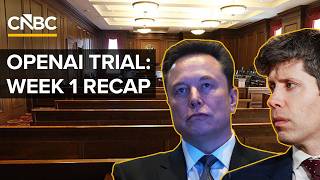
Musk v. Altman OpenAI Trial Closing Arguments
TECH

Musk v. Altman OpenAI Trial Closing Arguments

42+
Signals

Strategic Overview

  • 01.
    Closing arguments concluded Thursday May 14, 2026 in Judge Yvonne Gonzalez Rogers's Oakland federal courtroom after more than 10 days of testimony, with a nine-person jury (six women, three men) set to begin deliberations Monday May 18.
  • 02.
    The jury's verdict is advisory only; Judge Gonzalez Rogers retains final authority on liability, and the remedies phase begins Monday concurrently with deliberations.
  • 03.
    Only two civil claims remain before the jury — breach of charitable trust and unjust enrichment — narrowed from the 26 original claims Musk filed in 2024.
  • 04.
    Musk was absent for closing arguments because he traveled to Beijing with President Trump's delegation; his attorneys apologized to the jury, and OpenAI's counsel pointedly told jurors 'Mr. Musk isn't here today — my clients are here.'

Deep Analysis

The empty chair: Musk's absence becomes OpenAI's closing argument

The most damaging exhibit at Thursday's closing wasn't a document — it was a vacant seat. Musk had been placed on recall status by Judge Gonzalez Rogers, meaning he was theoretically available to be brought back to testify, yet he chose to board a flight to Beijing with President Trump's delegation rather than sit through closing arguments in his own case [6]. His lead attorney Steven Molo opened by apologizing to the jury, and OpenAI's counsel weaponized the absence with a single line that will likely echo into deliberations: 'Mr. Musk isn't here today — my clients are here' [1].

That framing dovetails with the broader defense theory that has run through the trial. Bloomberg Law's coverage observed that the case has been driven by personalities rather than documentary proof, with no witness providing evidence of explicit promises tied to Musk's $38 million in donations [4]. The r/law community treated the absence as emblematic of selective accountability for the powerful, and even sympathetic observers acknowledged the optics gave OpenAI a free rhetorical gift. Whether the jury weighs presence as character evidence is technically improper — but in a trial where credibility is the central question, optics matter.
An advisory verdict and a $500B unwind: why the jury isn't actually deciding this case

The structural twist most coverage has buried is that the jury's verdict is advisory only. Judge Gonzalez Rogers retains final authority on liability, and the remedies phase begins concurrently on Monday — meaning the court will already be hearing argument on what to do if Musk wins while the jury is still deciding whether he should [1][3]. That structure exists because the two surviving claims — breach of charitable trust and unjust enrichment, narrowed from Musk's original 26 — are equitable in nature, and equitable relief belongs to the judge, not the jury.

What's on the table in that remedies phase is extraordinary. Musk is seeking removal of Altman and Brockman, disgorgement of up to $134 billion to the nonprofit, and a reversal of OpenAI's October 2025 recapitalization into OpenAI Group PBC [3][5]. UCLA's Rose Chan Loui has argued that under California charitable trust law, OpenAI would have needed court approval to repurpose nonprofit assets in the first place — which means even a narrow finding for Musk could leave Judge Gonzalez Rogers with statutory hooks to unwind the deal [3]. Microsoft's roughly 27% stake, valued near $135 billion, is downstream of that same recapitalization, which is why Microsoft sits as a co-defendant on the aiding-and-abetting count rather than a bystander [7].

The 'total control' problem: Musk's own behavior may be the defense's best evidence

Sarah Eddy's defense closing argued that 'Mr Musk wanted to turn OpenAI into a for-profit company that he could control. But the other founders refused to turn the keys of AGI over to one person, let alone Elon Musk' [2]. That argument matters because it inverts the entire 'stolen charity' theory: if Musk himself pushed to convert OpenAI into a for-profit he could dominate or merge with Tesla, his complaint that Altman later did the same thing — but without him — reads less like trust enforcement and more like sour grapes.

The OpenAI-watching community on Reddit seized on Altman's testimony that Musk wanted total control of OpenAI and even floated passing it to his children as the most quietly devastating moment of the trial — exactly the kind of evidence Bloomberg Law has flagged as missing on the plaintiff's side. Musk's counsel countered with a credibility attack: Molo argued five witnesses, including former chief scientist Ilya Sutskever, testified Altman was untrustworthy under oath [1]. But credibility cuts both ways. The defense's response — that 'this whole lawsuit is a pageant of hypocrisy' — works precisely because the documentary record, as William Savitt presented it, shows Musk pursuing the same for-profit conversion he now condemns [4].

The technicality that could end this before the merits

Beneath the spectacle sits a much drier defense theory that legal observers think could short-circuit the entire case: statute of limitations. OpenAI's forensic accountant testified that Musk's donations had already been spent before the lawsuit was filed in 2024, and OpenAI's broader argument has been that Musk delayed filing despite being aware of for-profit plans for years [2]. If Judge Gonzalez Rogers — who is making the ultimate liability call — agrees that the clock ran out on Musk's claims, none of the credibility theater matters. The court doesn't have to reach 'did Altman betray the mission' if 'Musk waited too long' resolves the case first.

That's also why the closing arguments leaned so heavily on rhetoric rather than smoking-gun documents. As Bloomberg Law's analysis noted, the trial has hinged on personalities precisely because the contemporaneous record from 2015 to 2018 doesn't yield an unambiguous 'we promise to stay a nonprofit forever' commitment tied to specific donations [4]. The advisory jury returns Monday May 18; the real decision sits with Judge Gonzalez Rogers, and it may turn on a calendar more than a charter.

Historical Context

2015-12-11
OpenAI founded in Delaware as a nonprofit by Musk, Altman, Brockman, Sutskever and others to develop AGI for the benefit of humanity.
2019-03-11
OpenAI created OpenAI LP, a 'capped-profit' for-profit subsidiary controlled by the nonprofit parent, with investor returns initially capped at 100x ROI.
2024-02-29
Musk filed his original lawsuit against OpenAI, Altman and Brockman in San Francisco Superior Court alleging breach of founding nonprofit promises.
2024-08-05
Musk re-filed in federal court (Northern District of California, case 4:24-cv-04722) before Judge Yvonne Gonzalez Rogers.
2025-05-01
Judge trimmed the lawsuit, dismissing false advertising and fiduciary duty claims but allowing fraud and unjust enrichment claims to proceed.
2025-10
OpenAI formed for-profit entity OpenAI Group PBC, with the nonprofit retaining approximately 26% ownership — the transaction Musk now seeks to reverse.
2026-04-27
Musk v. Altman trial began with jury selection and opening arguments before Judge Gonzalez Rogers.
2026-05-12
Altman testified he never promised Musk to keep OpenAI as a nonprofit, denying Musk's 'stole a charity' framing on the stand.
2026-05-14
Closing arguments concluded; case sent to nine-person advisory jury for deliberation beginning Monday May 18, 2026, with the remedies phase running concurrently.

Power Map

Key Players
Subject

Musk v. Altman OpenAI Trial Closing Arguments

EL

Elon Musk

Plaintiff and OpenAI co-founder seeking removal of Altman and Brockman, an unwinding of the for-profit, and up to $134 billion in disgorgement to the nonprofit. Absent for closing arguments while traveling to Beijing with President Trump.

SA

Sam Altman

OpenAI CEO and co-defendant; testified he never promised Musk to keep OpenAI as a nonprofit and rejected the framing that he 'stole a charity.' Musk seeks his removal from the CEO role and board.

GR

Greg Brockman

OpenAI President and co-defendant; Musk seeks his removal from leadership. Musk reportedly texted Brockman about settlement two days before trial began.

JU

Judge Yvonne Gonzalez Rogers

U.S. District Judge presiding in the Northern District of California; divided the trial into liability and remedies phases and will make the final liability determination since the jury's verdict is advisory.

MI

Microsoft / Satya Nadella

Co-defendant accused of aiding and abetting OpenAI's breach of charitable trust; Microsoft holds an approximately 27% stake valued near $135 billion. Nadella testified Musk never raised concerns about the partnership.

TR

Trial counsel — Molo (Musk), Savitt and Eddy (OpenAI)

Steven Molo delivered Musk's closing attacking Altman's credibility. William Savitt and Sarah Eddy led OpenAI's defense, calling the lawsuit a 'pageant of hypocrisy' and arguing no charitable trust was formed.

Fact Check

7 cited
  1. [1] Closing arguments conclude in Musk v. Altman, jury to deliberate next week
  2. [2] Closing arguments begin in Elon Musk's landmark lawsuit against OpenAI
  3. [3] OpenAI Jury to Begin Deliberations Monday: Judge Weighs Altman Removal, $500B Restructure Reversal
  4. [4] As Musk v. Altman Trial Closes, Spectacle and Personalities Rule
  5. [5] Musk v Altman closing arguments end, jury to start deliberations
  6. [6] Musk's lawyer apologizes to jury for Musk's absence during closing as he travels to China with Trump
  7. [7] Microsoft CEO Satya Nadella takes stand in Musk v. Altman trial

Source Articles

Top 5

THE SIGNAL.

Analysts

"Under California charitable trust law, OpenAI would need court approval to repurpose nonprofit assets to a different purpose — meaning the October 2025 recapitalization isn't beyond judicial reach. Her quote: 'Under the law, they would need to go to court and say we have a basis.'"

Rose Chan Loui
UCLA Law School (nonprofit governance expert)

"Argued Musk's own testimony undermines his case and that he sought a for-profit OpenAI he could dominate. Her closing line: 'Mr Musk is the one whose testimony is contradicted by every other witness and by all the documents.'"

Sarah Eddy
Defense counsel, OpenAI

"Framed the case as a credibility contest centered on Altman, citing five witnesses — including former chief scientist Ilya Sutskever — who he says testified Altman was untrustworthy under oath. His closing framing: 'Sam Altman's credibility is directly at issue in this case.'"

Steven Molo
Lead trial counsel for Elon Musk

"Observed the trial has hinged on personalities and theatrics rather than concrete documentary evidence, noting 'no witness provided evidence of explicit promises regarding Musk's $38 million donations' — a gap that goes directly to whether a charitable trust was ever formed."

Bloomberg Law trial analysis
Legal trade press
The Crowd

"Musk's attorney apologizes for his absence at trial during closing arguments"

@u/unknown1400

"Sam Altman testimony: Musk wanted 'total control' of OpenAI to pass to his children"

@u/businessinsider1100

"Musk sued OpenAI for $150B, skipped his own closing arguments to fly to China with Trump"

@u/DigiHold10
Broadcast
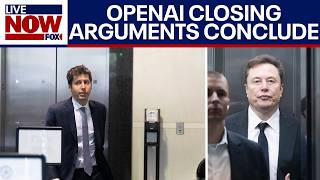
OpenAI closing arguments conclude in Musk vs. Altman trial

OpenAI closing arguments conclude in Musk vs. Altman trial

Did Musk Prove OpenAI Betrayed Its Original Mission?

Did Musk Prove OpenAI Betrayed Its Original Mission?

The Musk Vs. OpenAI Trial Is Underway — Here's Where Things Stand

The Musk Vs. OpenAI Trial Is Underway — Here's Where Things Stand