AI Infrastructure Spend and US Data-Center Bans
TECH

AI Infrastructure Spend and US Data-Center Bans

28+
Signals

Strategic Overview

  • 01.
    Goldman Sachs Global Institute's 'Tracking Trillions' baseline projects $765 billion in AI CapEx in 2026 scaling to $1.6 trillion annually by 2031, totaling roughly $7.6 trillion across chips, data centers, cooling, and power between 2026 and 2031.
  • 02.
    Local opposition has reached an inflection point: 69 US jurisdictions are now blocking new AI data-center builds, with at least four classified as permanent — and the broader moratorium tracker grew from 8 in May 2025 to 78 by May 2026.
  • 03.
    Google, Amazon, Microsoft, and Meta plan a combined $725 billion in 2026 capex, a 77% jump over the prior year's $410 billion record, signaling that hyperscaler commitments are accelerating even as siting becomes harder.
  • 04.
    Data Center Watch documents 188 local opposition groups across 40 states that have blocked or delayed $64 billion in U.S. data-center projects over the prior two years — $18 billion blocked outright and $46 billion delayed.
  • 05.
    In Q1 2026 alone, 20 proposed data-center projects were canceled in response to local opposition — double the previous quarterly record set in Q4 2025.
  • 06.
    The grid is already absorbing strain: in July 2024, a voltage fluctuation in northern Virginia triggered the simultaneous disconnection of 60 data centers and a 1,500-megawatt power surplus, while Dominion Energy's interconnection waits have stretched to 4-7 years from 18-24 months pre-AI-boom.

Deep Analysis

The Tenfold Year: How Data-Center Moratoriums Went From Footnote to Frontline
The Tenfold Year: How Data-Center Moratoriums Went From Footnote to Frontline
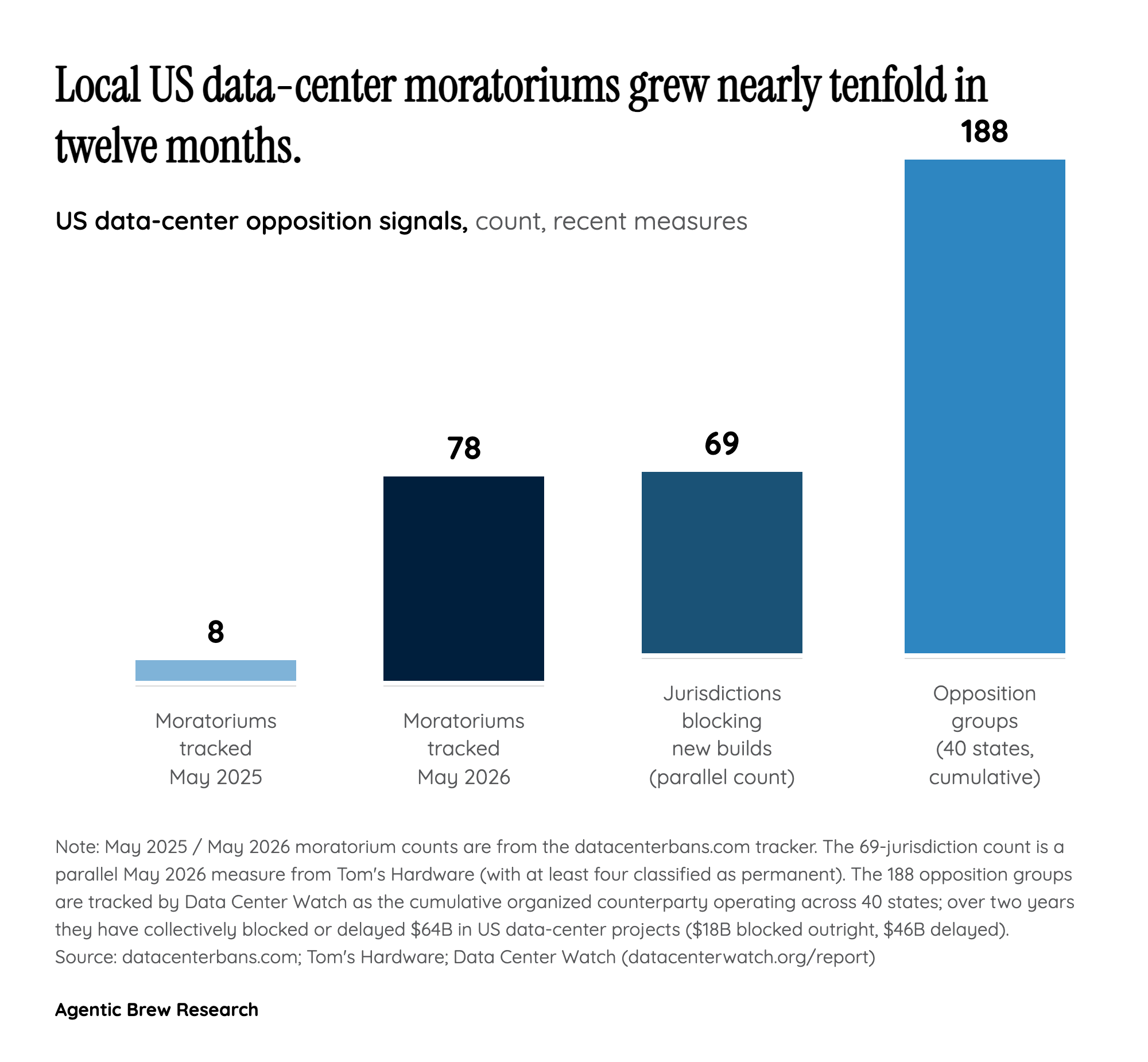
Local US data-center moratoriums grew from 8 in May 2025 to 78 in May 2026 — a parallel Tom's Hardware count finds 69 jurisdictions actively blocking new builds, while Data Center Watch tracks 188 organized opposition groups across 40 states.

Twelve months ago, the U.S. data-center moratorium tracker listed eight active local bans. By May 2026 that figure had reached 78 — and a parallel Tom's Hardware count puts 69 jurisdictions actively blocking new AI builds, with at least four of those moves classified as permanent. That is not a trend curve; it is a phase change. Data Center Watch, the most-cited dataset, now tracks 188 opposition groups operating in 40 states and credits them with blocking or delaying $64 billion in projects ($18B blocked outright, $46B delayed) over the prior two years. Q1 2026 alone produced 20 outright cancellations, doubling the record set in Q4 2025.

What changed is the visibility of impact. Jerome Township, Ohio's September 2025 moratorium — the first explicitly aimed at AI data centers — gave local governments a template. The OpenAI/Oracle Stargate override in Bingham Township, Michigan, where construction of a 1.4 GW campus proceeded after residents voted it down, became the catalyst event: within months, at least 19 Michigan municipalities had passed pre-emptive moratoriums of their own. As Data Center Frontier puts it, what 'was once dismissed as scattered NIMBY pushback is maturing into a multi-level political challenge to the AI-era infrastructure buildout' — a challenge that hyperscalers underwriting $725 billion of 2026 capex did not price into their site-selection models a year ago.
Goldman's $7.6 Trillion Bet Has a Cancellation Problem

Goldman Sachs Global Institute's baseline anchors industry expectations: $765 billion in AI CapEx in 2026, growing to $1.6 trillion annually by 2031, for a cumulative $7.6 trillion across chips, data centers, cooling, and power. The Big Four — Microsoft ($190B), Amazon ($200B), Alphabet ($185B), Meta ($135B) — have already committed $725 billion for 2026 alone, a 77% jump over the prior year's $410 billion record. Microsoft CFO Amy Hood disclosed that $25 billion of Microsoft's allocation goes to memory chips and components, and Amazon has signaled its free cash flow may turn negative under the load.

But announced capex is not deployed capex. Independent analysis circulating on YouTube has put roughly half of announced AI data-center capacity in the cancelled-or-delayed bucket — a number consistent with Data Center Watch's blocked/delayed totals and the Q1 2026 cancellation surge. Combine that with structural skepticism — Center for Public Enterprise analyst Advait Arun's comment that hyperscalers 'are all kind of playing a game of Mad Libs where they think these moonshot technologies will solve any existing problem,' and Michael Burry's warning that AI investment has become circular, with Nvidia, Microsoft and others funding the very firms buying their products — and the $7.6T baseline starts to look more like a planning ceiling than a forecast. The fragility is not in the demand assumption; it is in the assumption that physical permits, grid interconnections, and local consent will keep arriving on schedule. Dominion Energy's Northern Virginia interconnection queues have already stretched to 4-7 years from a pre-AI-boom 18-24 months — a timing shift that compounds against every dollar of committed capex.

It's Not Red vs. Blue Anymore: The Cross-Partisan Revolt

The most underappreciated feature of the backlash is that it has stopped behaving like a culture-war issue. Elena Schlossberg, founder of Save Prince William County, frames it bluntly: 'It’s never been red versus blue. It’s people who live here versus people who want to industrialize where we live.' Kerwin Olson of Indiana's Citizens Action Coalition makes the same point in a different register — 'Folks realize they’re getting duped. It’s not just something they hear on Fox News or MSNBC anymore. It’s happening in their own backyard.'

The electoral evidence is now concrete. In Festus, Missouri, voters removed four of eight city council members after a $6 billion data-center approval, with a follow-on petition seeking the mayor's removal. In Maine, the legislature passed a statewide data-center ban (LD 307) only to have Governor Janet Mills veto it — illustrating a new executive-vs-legislative cleavage that does not map onto traditional party lines. At the federal level, Senator Bernie Sanders and Rep. Alexandria Ocasio-Cortez have introduced the Artificial Intelligence Data Center Moratorium Act, formalizing what was a local frustration into national legislation. Reason's analysis projects this trajectory continues: 'As the data center boom continues, we can only expect the backlash to get worse as well.' For developers, the implication is structural — the political risk premium on a data-center site can no longer be hedged by choosing a 'friendly' state.

Power, Water, and the Sweetheart-Deal Backlash

The second-order constraints are where local opposition is hardening into permanent policy. U.S. data-center electricity demand is projected to grow from 176 TWh in 2023 to 325-580 TWh by 2028 — a range that, at the high end, exceeds the entire annual generation of multiple states. The July 2024 Northern Virginia event, in which a voltage fluctuation caused 60 data centers to disconnect simultaneously and produced a 1,500-megawatt power surplus, demonstrated that the largest existing cluster is already operating at the edge of grid stability. Dominion Energy's response — interconnection queues now running 4 to 7 years — is effectively a private-sector moratorium layered on top of the public ones.

The public-finance side is generating its own outrage. Community discussion has fixated on deal structures like the 9 GW Utah campus where energy use tax was reportedly cut from 6% to 0.5% alongside an 80% property tax rebate — read by residents as a textbook case of socialized costs and privatized gains. That perception is reinforced by polling showing 47% of Americans oppose new AI data-center construction in their neighborhood, and by reporting that AI demand has extended the operating life of coal and gas plants and is consuming a substantial share of global DRAM supply. The political product of these stressors is the cross-partisan coalition described above — and the reason a local opposition group's veto power is no longer rhetorical: when 188 such groups operate across 40 states, every major siting decision now has an organized counterparty.

Historical Context

2023
Since 2023, more than 100 counties and cities have passed temporary moratoria, zoning limits, or new environmental rules targeting data centers — the substrate from which the current wave grew.
2024-07
A voltage fluctuation triggered the simultaneous disconnection of 60 data centers, creating a 1,500-MW power surplus and forcing emergency grid adjustments — the first concrete evidence that the cluster had outgrown its grid.
2025-05
The U.S. data-center moratorium tracker listed only 8 moratoriums in May 2025 — the baseline against which the next year's tenfold escalation should be measured.
2025-09
Became the first local government to impose a moratorium specifically on AI data-center projects — the precedent cited by subsequent jurisdictions.
2026-02
By early February 2026, at least 19 Michigan municipalities had enacted moratoriums on new data-center development, a direct reaction to the Stargate Bingham Township state-level override.
2026
20 proposed data-center projects were canceled in Q1 2026 in response to local-official opposition — double the previous quarterly record set just one quarter earlier.

Power Map

Key Players
Subject

AI Infrastructure Spend and US Data-Center Bans

GO

Goldman Sachs Global Institute

Issued the 'Tracking Trillions' baseline projecting $7.6T cumulative AI CapEx between 2026 and 2031, anchoring the industry's planning case.

MI

Microsoft, Amazon, Alphabet, Meta

Big Four hyperscalers committing $190B, $200B, $185B, and $135B respectively in 2026 capex; Microsoft CFO Amy Hood attributed $25B of Microsoft's spend to memory chips and components, and Amazon flagged free cash flow may turn negative.

SE

Senator Bernie Sanders & Rep. Alexandria Ocasio-Cortez

Introduced the Artificial Intelligence Data Center Moratorium Act, elevating the local backlash into federal legislation.

MA

Maine Governor Janet Mills

Vetoed LD 307, the legislature-passed statewide data-center moratorium, citing the need to exempt a particular well-supported project — illustrating the executive-vs-legislative split now emerging at state level.

DA

Data Center Watch

Tracks 188 opposition groups across 40 states and has quantified $64B in blocked-or-delayed projects, providing the canonical dataset cited by both industry and policymakers.

DO

Dominion Energy (Virginia)

Imposed 4-7 year interconnection delays on new Northern Virginia data-center projects, materially altering siting economics in the country's largest data-center cluster.

OP

OpenAI/Oracle Stargate (Bingham Township, Michigan)

Began construction of a $16B, 1.4 GW data-center campus after residents voted it down — completing the project via state-level permitting override and triggering a wave of preemptive moratoriums in nearby Michigan municipalities.

FE

Festus, Missouri voters

Removed four of eight city council members after a $6 billion data-center approval; a follow-on petition seeks the mayor's removal — an electoral signal that data-center politics now decides local races.

Source Articles

Top 1

THE SIGNAL.

Analysts

"Reframes the data-center fight as residents versus industrializers rather than a partisan dispute, arguing gas-turbine-powered campuses make nearby life intolerable. Quote: 'It’s never been red versus blue. It’s people who live here versus people who want to industrialize where we live.'"

Elena Schlossberg
Founder, Save Prince William County (Virginia)

"Argues voters across the political spectrum now see the AI data-center boom as a direct community harm — a shift from media-driven sentiment to lived experience. Quote: 'Folks realize they’re getting duped. It’s not just something they hear on Fox News or MSNBC anymore. It’s happening in their own backyard.'"

Kerwin Olson
Executive Director, Citizens Action Coalition (Indiana)

"Skeptical of the AI capex justification, comparing the rationale to corporate Mad Libs in which moonshot framing papers over weak unit economics. Quote: hyperscalers 'are all kind of playing a game of Mad Libs where they think these moonshot technologies will solve any existing problem.'"

Advait Arun
Climate finance and energy infrastructure analyst, Center for Public Enterprise

"Warning that the circular structure of AI investment — where Nvidia, Microsoft and others fund the very firms buying their products — masks how real underlying demand actually is."

Michael Burry
Wall Street investor (of 'Big Short' fame)

"Argues local opposition has crossed a threshold from PR irritant to upstream development constraint. Quote: 'What was once dismissed as scattered NIMBY pushback is maturing into a multi-level political challenge to the AI-era infrastructure buildout.'"

Data Center Frontier
Industry trade publication

"Predicts continuing escalation: as AI's industrial importance grows, so does the resentment around its physical footprint. Quote: 'As the data center boom continues, we can only expect the backlash to get worse as well.'"

Reason
Magazine analysis
The Crowd

"I will be pushing for a moratorium on the construction of data centers that are powering the unregulated sprint to develop & deploy AI. The moratorium will give democracy a chance to catch up, and ensure that the benefits of technology work for all of us, not just the 1%."

@@SenSanders0

"AI data centers are scaling into ultra-mega projects. By year end, cumulative AI data center spend could pass >$300B, near 1% of US GDP, which tops Apollo at 0.8% and the Manhattan Project at 0.4%. The headline example is obviously OpenAI's Stargate Abilene with 1 GW power,"

@@rohanpaul_ai0

"With dozens of Cheyenne-Area data centers in various stages of discussion — one city councilman put the number at as many as 70 — some residents want to hit the brakes. A petition is circulating, calling for a data center moratorium."

@@daily_cowboy0

"New AI data center in Utah will generate and consume more than twice the amount of power the entire state uses — Kevin O'Leary's 9 Gigawatt Utah data center campus approved"

@u/lkl3422000
Broadcast
Exposing The Dark Side of America's AI Data Center Explosion | View From Above | Business Insider

Exposing The Dark Side of America's AI Data Center Explosion | View From Above | Business Insider

50% Of AI Data Centers Have Quietly Been Cancelled Or "Delayed"

50% Of AI Data Centers Have Quietly Been Cancelled Or "Delayed"

Nationwide boom in AI data centers stirs resistance

Nationwide boom in AI data centers stirs resistance