AI Embedding into Everyday Workflows: Default-On Infrastructure Across Browsers, Borders, and Bedside
TECH

AI Embedding into Everyday Workflows: Default-On Infrastructure Across Browsers, Borders, and Bedside

31+
Signals

Strategic Overview

  • 01.
    Google Chrome silently downloads a roughly 4GB local AI model file (weights.bin for Gemini Nano) into the OptGuideOnDeviceModel folder of users' Chrome profiles without explicit consent, and re-downloads it if deleted.
  • 02.
    At the May 2026 Border Security Expo in Phoenix, AI surveillance vendors openly pivoted product strategy toward ICE and CBP contracts, following the Trump administration's $165B DHS funding package that earmarked over $6B for AI-integrated border surveillance and $673M for biometrics.
  • 03.
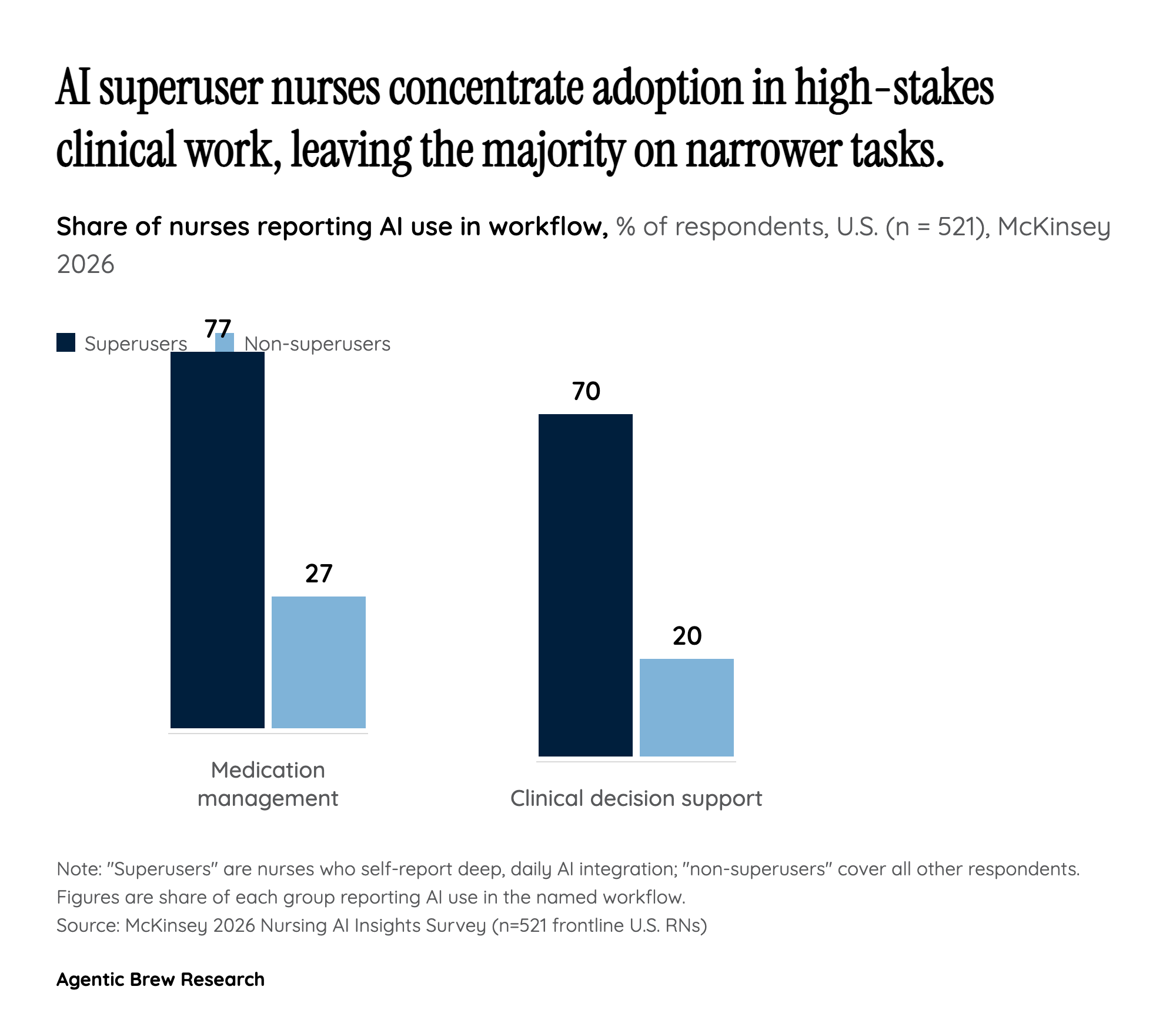
    McKinsey's 2026 Nursing AI Insights Survey of 521 frontline U.S. registered nurses found nearly 65% report using more AI tools than a year ago, while only about 2% say AI is embedded across everything they do — with 'superusers' clustered in high-stakes work like medication management (77%) and clinical decision support (70%).
  • 04.
    Independent state-level data triangulates the trend: a Massachusetts Nurses Association survey found 38% of nurses now report AI use in their facilities (up from 18% the prior year), but 80% say they've received no AI training and 81% have liability concerns.

AI Stops Asking Permission

The three stories in this cluster look unrelated until you line them up by who initiated the install. A 4GB Gemini Nano model lands in Chrome user profiles without an install prompt. AI-integrated sentry towers go up along the U.S.-Mexico border because Congress earmarked the money, not because end users requested them. Roughly 65% of frontline nurses report using more AI tools than a year ago, often inside electronic health record systems they have no power to swap out. In each case, the human who interacts with the AI is no longer the one making the adoption decision. The browser vendor, the procurement officer, and the hospital IT department are.

That is what makes the trend more than a sum of headlines. The conventional framing of an 'AI rollout' assumes a product launch, a download page, a new SKU. The 2026 pattern is different: AI is being shipped through pre-existing channels — a browser auto-update, a DHS contract vehicle, a Cerner or Epic module — to populations that did not negotiate for it. The branding of these features as user-empowering (faster scam detection, better border safety, less nurse burnout) is downstream of a more banal fact: once AI is cheap enough and cloud-optional enough to ride on infrastructure people already use, infrastructure owners will install it by default and let opt-out, not opt-in, become the user's job.

Follow the Money: How $6B in Border Contracts Sets the AI Product Roadmap

The Border Security Expo in Phoenix this May made the funding-to-product pipeline unusually explicit. Airship AI's president told reporters the strategic logic in one sentence: 'If you look at where the money's going, it's ICE and CBP. So if you're in this line of work, that's what you're doing.' That candor matters because the 'One Big Beautiful Bill Act' put $165B into DHS over four years, with more than $6B earmarked for AI-integrated border surveillance and $673M for biometrics. Vendors are not building general-purpose computer-vision platforms and then finding government buyers; they are reverse-engineering what ICE and CBP will buy and shipping that.

The industrial structure is consolidating in lockstep. Anduril holds roughly $450M in cumulative CBP revenue and covers about 30% of the southern border with autonomous towers; GDIT is on a $386.3M contract for DHS biometric identity operations; Palantir runs the $30M 'ImmigrationOS' platform and shares a national-security AI consortium with Anduril. Smaller specialists like PureTech Systems demo crowd-threat-scoring software, and Israeli vendor Elbit operates additional towers in Cochise County. The result is a vertically integrated stack — sensors, biometrics, identity platforms, decision software — that is far easier to renew than to dismantle. EFF's Dave Maass warns that this stack normalizes surveillance of U.S. residents who happen to live near the border, with a 25-year track record of underperformance behind it. Whether or not you accept that critique, the lock-in is now a budgetary fact, not a forecast.

The Consent Gap Chrome Just Made Visible

What Alexander Hanff documented on a fresh Chrome profile is, in narrow technical terms, mundane: Chrome creates an OptGuideOnDeviceModel directory and writes a roughly 4GB weights.bin file representing Gemini Nano, finishing the install on Apple Silicon in about 14 minutes. What makes it a flashpoint is the procedural framing. There is no install prompt. The file appears even when the foreground tab is doing something unrelated. Deleting it triggers a re-download. Google's user-facing 'AI Mode' button in the address bar, meanwhile, routes queries to Google's cloud — not to the local 4GB model the user did not consent to install. The two AI features look the same from the outside but have opposite data-flow assumptions, and only one of them actually uses the silent download.

Hanff's argument is that this pattern collides with EU law: 'a direct breach of Article 5(3) of Directive 2002/58/EC (the ePrivacy Directive)' and a violation of GDPR transparency and data-protection-by-design principles. He extends the critique to climate, estimating a single model push at Chrome's scale costs 'between six thousand and sixty thousand tonnes of CO2-equivalent emissions.' The community grievance on developer-leaning forums converged on the same nerve, and the dominant complaint was not AI itself but the install pattern — the storage cost on low-end machines, the inability to permanently remove the file, the fact that any 4GB binary arriving without a prompt would be treated as malware if a smaller vendor shipped it. Google's own answer — that as of February 2026 the model can be disabled in settings — is, read charitably, an acknowledgment that the original rollout did not meet a consent bar that the company itself now sees as necessary.

Pulled In vs Pushed Down: Two Speeds of Adoption

Pulled In vs Pushed Down: Two Speeds of Adoption
Among McKinsey survey respondents, AI superusers are far more likely than non-superusers to use AI for medication management (77% vs 27%) and clinical decision support (70% vs 20%).

Within healthcare, the McKinsey survey of 521 frontline RNs surfaces a split that the headline 65% number obscures. A small group of self-described AI 'superusers' is pulling AI into high-stakes clinical work — 77% of superusers use AI for medication management versus 27% of non-superusers, and 70% versus 20% for clinical decision support. Roughly 23% of nurses report no AI use at all. Only about 2% say AI is embedded in everything they do. The honest read is not that nursing has 'adopted AI'; it is that a minority is using AI deeply, a majority is using it for narrow tasks, and a meaningful tail is not using it at all. McKinsey's own authors, almost defensively, note that 'real transformation will come not from simply deploying more AI tools but from clinical-care organizations redesigning how nursing work actually gets done, end to end.'

Independent triangulation from the Massachusetts Nurses Association reframes that adoption number again. Facility-level AI use jumped from 18% to 38% in a year, but 80% of nurses say they have received no AI training and 81% report liability concerns. So nurses are increasingly working alongside systems they did not choose, were not trained on, and would be personally exposed for if those systems erred. That is the cluster's wider thesis in microcosm: when adoption is pulled in by clinicians choosing tools, you see superuser concentration in serious workflows; when it is pushed down by hospital IT, you see usage statistics that look healthy and a workforce that quietly reports it isn't ready. The same dual dynamic — bottom-up superusers versus top-down installs — explains why the same 'AI is everywhere now' headline can be simultaneously accurate and misleading.

What the Adoption Numbers Don't Show

Across community discussion, the most cynical interpretation of this cluster punches above its weight: forced installs and default-on AI features let vendors quietly inflate 'AI adoption' metrics. If 4GB of Gemini Nano sits on every recent Chrome profile, Google can describe the user base as 'AI-enabled' regardless of whether anyone has invoked it. If a hospital deploys an EHR with embedded AI assistants, the institution counts as an AI-using facility even if 80% of nurses had no training on the feature. If CBP towers run AI threat-scoring on every passing vehicle, every interaction is, in some technical sense, an AI interaction. None of this is fraud. It is a scoring system that confuses install-base with usage and usage with productive integration.

That distortion shows up in the social signal mix in a specific way. The Chrome silent-install thread went genuinely viral, with the community grievance pointed squarely at consent rather than at the model itself; one of the more popular framings was simply that any vendor force-installing a 4GB binary would be treated as malware, and that AI does not buy you an exemption from that norm. The McKinsey nursing survey, by contrast, generated comparatively muted conversation — neutral, curious, often promotional — even though the 80% no-training and 81% liability findings from the Massachusetts data are arguably more consequential for actual patients. Border-AI threads barely registered outside policy circles. The asymmetry is itself a finding: people viscerally feel AI when it touches their own machine, and tend to under-react when AI is touching the institutions that touch them. The mechanism reshaping daily life right now is the second one, not the first.

Historical Context

2020
Began deploying autonomous AI sentry towers for CBP, eventually accumulating ~$450M in border revenue and coverage of roughly 30% of the southern border.
2024-12-06
Announced a national-security AI consortium combining their platforms to pitch DoD and federal agencies as a single stack.
2025-07
'One Big Beautiful Bill Act' signed: $165B for DHS over four years, $6B+ for AI-integrated border surveillance, and $673M earmarked for biometric systems.
2026-02
Began rolling out the ability for users to disable and remove the on-device Gemini Nano model from Chrome settings, well after silent installs had begun.
2026-02-17
Began fielding the 2026 Nursing AI Insights Survey of 521 frontline U.S. registered nurses, running through March 17.
2026-04-24
On a fresh Chrome profile on Apple Silicon, observed Chrome create the OptGuideOnDeviceModel directory and finish weights.bin install in roughly 14 minutes, triggering the public disclosure cycle.
2026-05-08
Annual expo concluded with a vendor 'gold rush' in AI surveillance products explicitly tuned to ICE and CBP procurement priorities.

Power Map

Key Players
Subject

AI Embedding into Everyday Workflows: Default-On Infrastructure Across Browsers, Borders, and Bedside

GO

Google / Chrome team

Ships Gemini Nano weights.bin silently to Chrome's user base, controls when the model installs, re-installs, and (since February 2026) can be disabled from Chrome Settings — making it the single largest distributor of on-device LLM weights to consumer machines.

DH

DHS / ICE / CBP

Procuring agencies sitting at the center of the Trump-era border AI buying boom; the 'One Big Beautiful Bill Act' funding flood now sets the product roadmap for an entire vendor ecosystem.

AN

Anduril Industries

Palmer Luckey-led firm operating autonomous AI sentry towers along ~30% of the southern U.S. border with around $450M in cumulative CBP revenue since 2020; co-anchors a national-security AI consortium with Palantir.

PA

Palantir

Holds a $30M contract for the DHS 'ImmigrationOS' platform and partners with Anduril on the joint AI consortium pitching DoD and federal agencies — turning border AI into a stack play, not a point product.

AL

Alexander Hanff ('That Privacy Guy')

Computer scientist and privacy researcher whose macOS filesystem logs first surfaced the Chrome silent install and whose ePrivacy/GDPR analysis catalyzed the May 2026 backlash.

MA

Massachusetts Nurses Association

Independent labor-side data point on healthcare AI rollout; surveys document a doubling of facility-level AI usage year-over-year alongside near-universal training and liability gaps, providing a counterweight to consultancy framing.

Source Articles

Top 1

THE SIGNAL.

Analysts

"Argues Chrome's silent 4GB Gemini Nano install is 'a direct breach of Article 5(3) of Directive 2002/58/EC (the ePrivacy Directive)' and a violation of GDPR transparency and data-protection-by-design principles."

Alexander Hanff
Privacy researcher and computer scientist, author of 'That Privacy Guy'

"At Chrome's installed base, estimates a single model push translates to 'between six thousand and sixty thousand tonnes of CO2-equivalent emissions' — reframing default-on AI as a climate externality, not just a privacy one."

Alexander Hanff
Privacy researcher

"Says vendors are explicitly redirecting product strategy toward immigration enforcement: 'If you look at where the money's going, it's ICE and CBP. So if you're in this line of work, that's what you're doing.'"

Paul Allen
President, Airship AI

"Warns that AI-equipped border towers have a 25-year track record of underperformance and normalize surveillance of border-resident U.S. communities, summarizing the civil-liberties view as 'Living at the border is not a crime.'"

Dave Maass
Director of Investigations, Electronic Frontier Foundation (EFF)

"Argues real change in nursing 'will come not from simply deploying more AI tools but from clinical-care organizations redesigning how nursing work actually gets done, end to end' — pushing back on tool-count metrics."

McKinsey Healthcare practice (Nursing AI Insights Survey authors)
McKinsey & Company
The Crowd

"Surprise! Chrome silently installs a 4GB AI model you didn't ask for. No install prompt. No consent. If you delete it, Chrome downloads it again."

@@Malwarebytes0

"Google Chrome is quietly downloading a roughly 4 GB AI model to many users' computers without clear upfront consent. The file, called weights.bin, is part of Google's Gemini Nano on-device language model and lands in the browser's user data folder under OptGuideOnDeviceModel."

@@Pirat_Nation0

"What do nurses think about using #AI in healthcare? We surveyed over 7,200 US nurses in collaboration with the American Nurses Foundation to explore their views on AI in healthcare delivery. Here's what we discovered"

@@McKinsey0

"Google Chrome silently installs a 4 GB AI model on your device"

@u/BlokZNCR9400
Broadcast
Practical built-in AI with Gemini Nano in Chrome

Practical built-in AI with Gemini Nano in Chrome

AI Nurse with NVIDIA Brain: The Future of Healthcare is Here!

AI Nurse with NVIDIA Brain: The Future of Healthcare is Here!

Copilot usage reveals AI adoption patterns

Copilot usage reveals AI adoption patterns