
The $10 Billion Hole That Made Intel Say Yes to Musk
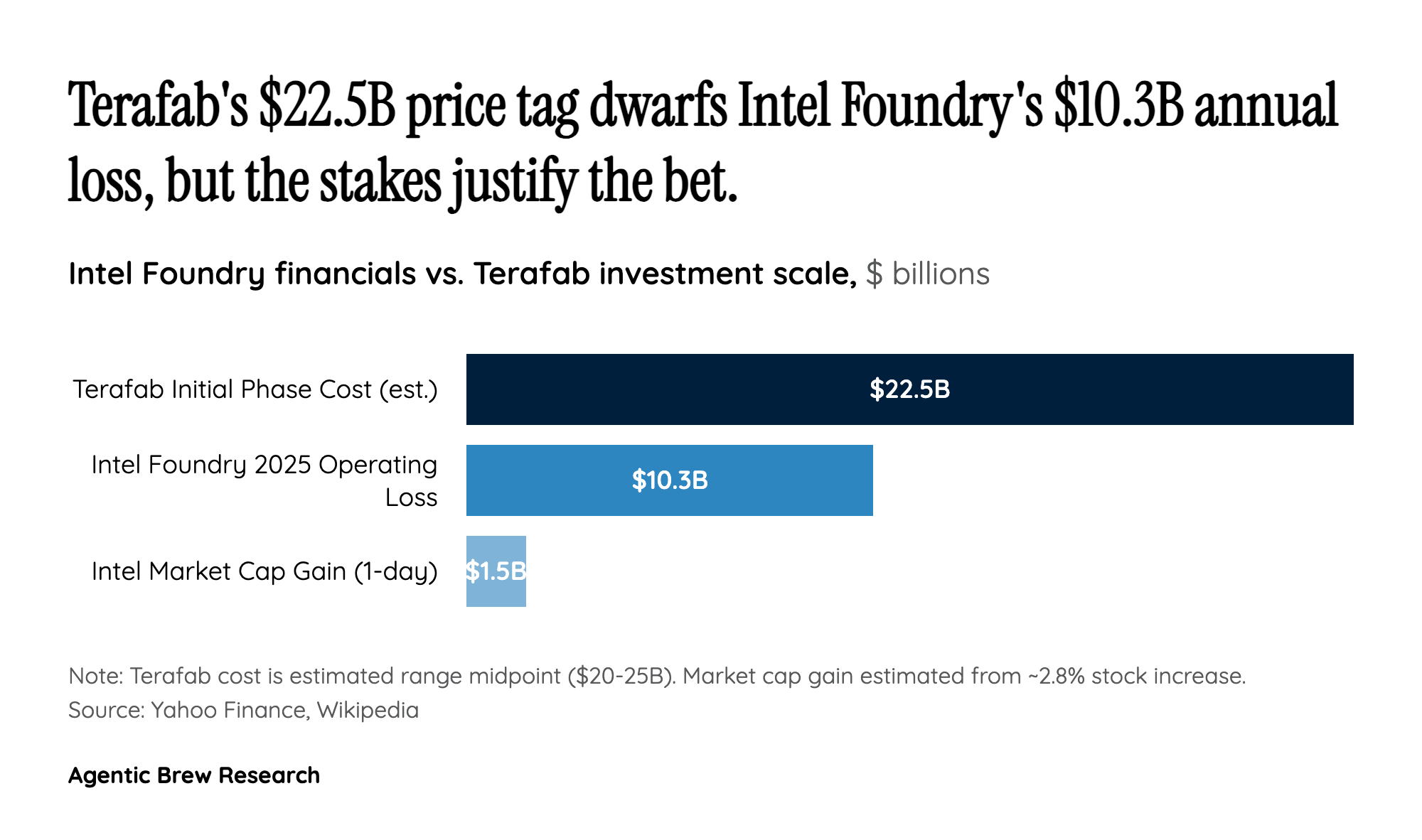
Intel's decision to join Terafab cannot be understood without grasping the dire state of its foundry business. In 2025, Intel Foundry posted a staggering $10.32 billion operating loss while managing only 3% revenue growth. For a company attempting the unprecedented feat of simultaneously designing its own chips and manufacturing them for outside customers, the math has been brutal. CEO Lip-Bu Tan, who took the helm with a mandate to revive Intel's manufacturing credibility, needed a flagship customer that would signal to the market that Intel Foundry is a serious contender against TSMC and Samsung.
Musk's Terafab provides exactly that signal. The partnership gives Intel a marquee customer with enormous volume potential — the facility targets 100,000 wafer starts per month initially, scaling to 1 million. Even if Intel captures a fraction of that volume, it represents a meaningful revenue stream for a foundry business desperately seeking anchor clients. The stock market's immediate response — Intel shares rising 2.8% to approach their 52-week high — suggests investors see this as validation of the foundry pivot strategy. Analyst Gil Luria of D.A. Davidson captured the sentiment precisely: Intel needs to prove it can support the largest customers with their most important projects. Whether the economics actually work remains an open question, but the optics alone may have been worth the handshake.