iQiyi pivots to AI-generated content
TECH

iQiyi pivots to AI-generated content

28+
Signals

Strategic Overview

  • 01.
    iQiyi unveiled Nadou Pro at its April 20, 2026 Beijing content showcase, an AI agent that handles scriptwriting, storyboards, and final video delivery, and CEO Gong Yu now expects AI to produce the bulk of iQiyi's films and shows within five years.
  • 02.
    The pivot is framed as iQiyi's largest restructuring since its 2010 founding, repositioning the Netflix-style app as a social destination for AI-generated content and targeting a commercially successful AI-generated film by summer 2026.
  • 03.
    Nadou Pro stitches iQiyi's proprietary QiZhi multimodal models with third-party systems including SeeDance, Kling, Vidu, Hailuo, and WAN, and 16 upcoming works across sci-fi, fantasy, historical, and contemporary genres have already been produced on the platform.
  • 04.
    The company is steering creators toward AI with a 20% bonus revenue share and 30% of net profits for finalists in its Peter Pau-led AI Theater, while Q1 2026 revenue is still expected to fall 13% amid short-video competition from Douyin.

Deep Analysis

The Nadou Pro stack: one workflow, five model vendors, sixteen pilots

Nadou Pro is not a single model — it is a routing layer. It fuses iQIYI's proprietary QiZhi multimodal large language models with third-party generators including SeeDance, Kling, Vidu, Hailuo, and WAN, then exposes scriptwriting, storyboard, video, and audio generation through one creator-facing interface. Senior Vice President Wenfeng Liu casts the product as 'creation, production, and distribution into one seamless, intelligent workflow,' which is another way of saying iQiyi wants to own the rails between a prompt and a premiere.

Sixteen upcoming works spanning sci-fi, fantasy, historical, and contemporary genres have already been produced on Nadou Pro, giving iQiyi a running start on its summer-2026 goal of a commercially successful AI-generated film. Model-agnosticism is the strategic tell: by keeping third-party vendors plugged in, iQiyi can ride whichever video model leads the frontier on any given quarter while still capturing the distribution margin. That is a sharply different bet from vertically-integrated Hollywood VFX pipelines — and it is a bet that compute supplier competition, not any one model, is the durable moat.

Why now: a 13% revenue drop, short-video pressure, and a model maturity window

The pivot did not arrive in a vacuum. iQiyi's Q1 2026 revenue is expected to fall 13%, attributed to competition from short-form platforms like Douyin — a secular squeeze that no prestige-drama budget can out-spend. iQiyi has also posted losses every year from its 2010 founding through its first full non-GAAP operating profit in 2023, so the marginal yuan of risk tolerance for experimental cost structures is unusually high for a company its size.

Meanwhile, multimodal video models crossed a threshold iQiyi was positioned to exploit, with CEO Gong Yu now declaring 'no longer any technical barriers to producing long-form AI dramas.' The result is a convergence trade: a revenue base bleeding to short-form video, a cost base that can be reset by AI, and a competitor (Tencent Video's Sun Zhonghuai) publicly expecting a premium AI-generated long-drama debut within a quarter. Gong Yu's 'once in a decade' framing is self-serving, but the macro setup genuinely constrains the option set.

The economics: from $500K an episode to the cost of electricity

The economics: from $500K an episode to the cost of electricity
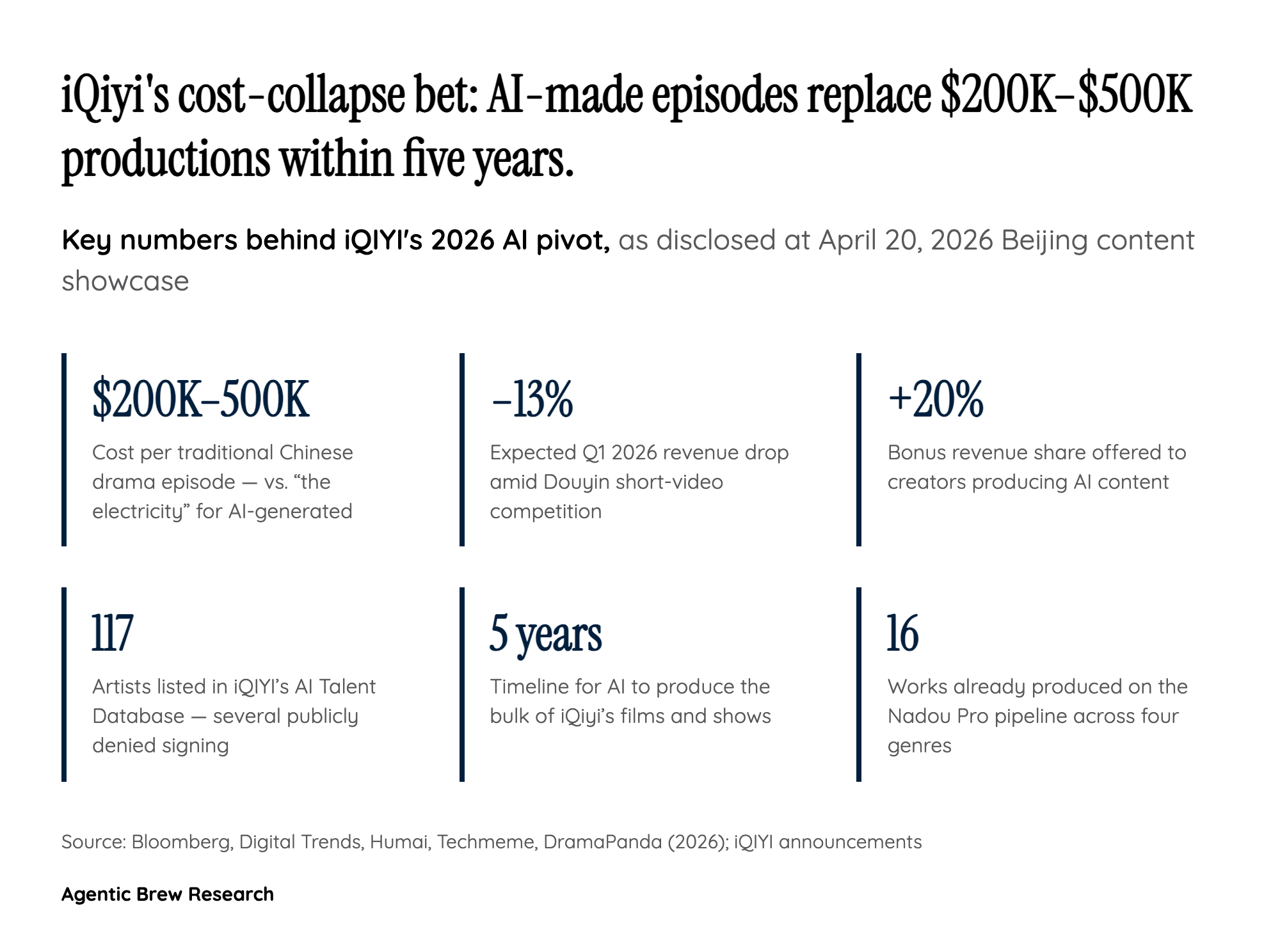
iQiyi's AI pivot by the numbers — cost collapse, creator incentives, and scale of the 2026 overhaul

The unit-economics gap iQiyi is chasing is not a rounding error. A traditional Chinese drama episode costs roughly $200,000 to $500,000 to produce; an AI-generated one, in the sharper framing from Humai's analysis, 'costs the electricity.' Sun Zhonghuai's structural claim — that a five-to-twenty-person AI team can do the work of hundreds — puts a multiplier on that per-episode delta across an entire content slate. Layer on a 20% bonus revenue share for AI creators and a 30% net-profit share for Peter Pau AI Theater finalists, and iQiyi is also externalizing its cost of content discovery to creators willing to work for royalty-style upside instead of upfront fees.

But the economics only work if two unknowns resolve favorably. First, audience willingness-to-pay for AI content must not collapse relative to human-made drama — a meaningful concern given r/cdramasfans subscribers openly threatening non-renewal. Second, compute prices for the underlying video models must stay on a declining curve. If either assumption slips, the 'electricity cost' comparison narrows and the 20% creator bonus starts looking like a permanent structural tax rather than a promotional incentive.

The backlash: an AI Talent Database that the talent had not agreed to

Gong Yu's unveiling of a 117-artist 'AI Talent Database' produced a reputational injury that is unusual for a Chinese tech announcement. The 'iQIYI Went Crazy' hashtag trended on Weibo, and named performers — Zhang Ruoyun, Li Yitong, Wang Churan, and Yu Hewei — publicly stated 'we have never signed any AI-related authorization,' forcing iQIYI to clarify the list only reflected a willingness to discuss. That is a consent failure publicly narrated by the consenting parties themselves.

Audience sentiment on Reddit's r/cdramasfans is overwhelmingly negative, with users citing China's CAC 'No Consent = No Use' rule and explicitly threatening to cancel subscriptions; the CEO's euphemism 'performance migration' for motion-captured actor doubles drew open mockery. Fan accounts amplifying the '100+ registered actor likenesses' plus '20% revenue share' framing turned a product launch into a power-imbalance story about a platform leveraging its contracted artists. The political risk is not that iQiyi cannot legally proceed — it probably can — but that the pipeline of A-list talent willing to continue working with iQiyi under normal dramas narrows precisely when the company still needs prestige hits to fund the AI transition.

What shrinks, what survives: the future shape of iQiyi

Gong Yu has been unusually explicit about the trade-off: he pledged to keep investing in professionally produced shows, but admitted 'that kind of content will shrink as a share of the platform over time.' Layered with his suggestion that actors could shoot 14 dramas a year instead of 4 — and that 'filming may one day become intangible cultural heritage' — the directional claim is that human-led prestige drama becomes a curated minority of the catalog, not the flagship. The Netflix-style app itself is being rebuilt as a social destination, not a lean-back cinema. That reframes iQiyi's product category from streaming service toward UGC-plus-IP platform with AI as the production layer.

Early signal traffic is consistent with that read. Over 2,600 creators from more than 30 countries have joined iQIYI's AI competitions and storytelling lab, the Peter Pau-led AI Theater is already shipping titles like 'Amazing Girl,' and virtual-production project usage at iQiyi jumped 125% year-over-year in the first half of 2025. If the summer AI-film goal lands commercially, the 2026 slate of 400+ new titles blending long, short, and AI-powered content becomes a template for the next decade. If it does not, iQiyi has still used the pivot to reset its cost base and shift creator payment structure toward revenue share — a floor outcome that explains why Wall Street's cited 'cautiously optimistic' stance is not naive.

Historical Context

2010-01
Founded by Baidu with Providence Equity Partners on January 6, 2010; renamed iQIYI in November 2011 as Baidu built a Netflix-style streaming bet inside its search empire.
2018-03
Listed on NASDAQ, raising $2.25 billion — a milestone IPO that crystallized iQiyi's position as the headline long-form video platform in China.
2023
Posted losses every year from inception, only reaching its first full year of non-GAAP operating profit in 2023 — a structurally thin margin base that makes AI's cost-collapse narrative existentially attractive.
2026-03-30
Launched Nadou Pro as China's first AI agent built specifically for professional film and TV production, weeks before the April 20 showcase formalized the full company pivot.

Power Map

Key Players
Subject

iQiyi pivots to AI-generated content

GO

Gong Yu

Founder and CEO, iQiyi — architect of the AIGC pivot and the 117-artist AI Talent Database; frames the moment as once-in-a-decade for the company.

WE

Wenfeng Liu

Senior Vice President, iQIYI — product lead positioning Nadou Pro as an end-to-end AI filmmaking workflow for professional creators.

PE

Peter Pau (Pau Tak-hei)

Oscar-winning cinematographer and partner on iQIYI AI Theater, publicly endorsing AI-generated content as a visual revolution while mentoring finalist teams.

SU

Sun Zhonghuai

Chairman, Tencent Video — rival streamer signaling the first premium AI-generated long-form Chinese drama could debut within a quarter, validating the industry-wide shift.

BA

Baidu

Majority shareholder owning roughly 70% of iQiyi; iQiyi generated 28% of Baidu's fiscal 2020 revenue, giving Baidu deep exposure to the AI bet's outcome.

NA

Named actors (Zhang Ruoyun, Li Yitong, Wang Churan, Yu Hewei)

Chinese performers listed in iQIYI's AI Talent Database who publicly denied signing any AI authorization, forcing the platform to clarify the list only reflected a willingness to discuss.

THE SIGNAL.

Analysts

"Argues there are no longer any technical barriers to producing long-form AI dramas, and paints a near-future in which actors could shoot 14 dramas a year instead of 4 while 'filming may one day become intangible cultural heritage.'"

Gong Yu, iQiyi CEO
Bullish

"Says 'a creative team of just five to 20 people can now use AI tools to produce content that used to require hundreds,' a re-ordering of film labor that his own team expects to validate with a high-quality AI long-form drama in the next quarter."

Sun Zhonghuai, Tencent Video Chairman
Structurally bullish

"Frames the pivot as labor displacement dressed up in ecosystem language, noting that 'a traditional Chinese drama episode costs roughly $200,000 to $500,000 to produce. An AI-generated one costs the electricity,' a gap too large for hundreds of creative professionals to survive."

Humai analysis
Skeptical

"Wall Street analysts cited in investor coverage credit iQIYI with an 'unmatched ability to produce hits consistently,' arguing that hit-making muscle could carry over as the catalog shifts toward AI, even as US funds trim Chinese equity exposure."

Goldman Sachs / Morgan Stanley (as cited)
Cautiously optimistic

"The Oscar winner calls AI-generated content a 'visual revolution' and has staked his reputation on mentoring finalist teams whose films premiere on iQiyi with a 30% net-profit share."

Peter Pau, cinematographer
Pro-AI, craft-grounded
The Crowd

"China's largest streaming platform iQIYI has announced its AI toolkit 'Nadou Pro,' featuring a database of over 100 registered actors. With the actors consent, creators can use their likeness to generate fully AI-produced titles. iQIYI will also offer creators a 20% share of..."

@@PopBase1500

"China's iQiyi plans to overhaul its streaming service into an AI content hub, with an app redesign and Nadou Pro AI tool handling "every aspect of film-making" (Bloomberg)"

@@Techmeme0

"IQiyi, China's Netflix, is overhauling its entire business around #AI generated content and launching a new tool that can handle almost every aspect of filmmaking. AI streaming is going mainstream in China, whether audiences want it or not"

@@DigitalTrends0

"IQIYI trending for wanting to use AI"

@u/ghost_flowerr144
Broadcast
爱奇艺搞出个AI艺人库,香港电影金像奖的含金又增加了| 梁家辉 | 舒淇 | 杜德伟

爱奇艺搞出个AI艺人库,香港电影金像奖的含金又增加了| 梁家辉 | 舒淇 | 杜德伟

【Trailer】《惊奇少女》Amazing Girl 鲍德熹·爱奇艺AI剧场预告!| iQIYI大电影

【Trailer】《惊奇少女》Amazing Girl 鲍德熹·爱奇艺AI剧场预告!| iQIYI大电影

iQIYI CEO: AI fuels China's film industry, unlocks greater potential

iQIYI CEO: AI fuels China's film industry, unlocks greater potential