Stripe enables AI agent payments via Link wallet
TECH

Stripe enables AI agent payments via Link wallet

27+
Signals

Strategic Overview

  • 01.
    On April 30, 2026 at Stripe Sessions, Stripe introduced Link — a digital wallet built for the AI era that lets autonomous agents shop, book reservations, buy tickets, and transact on behalf of a user.
  • 02.
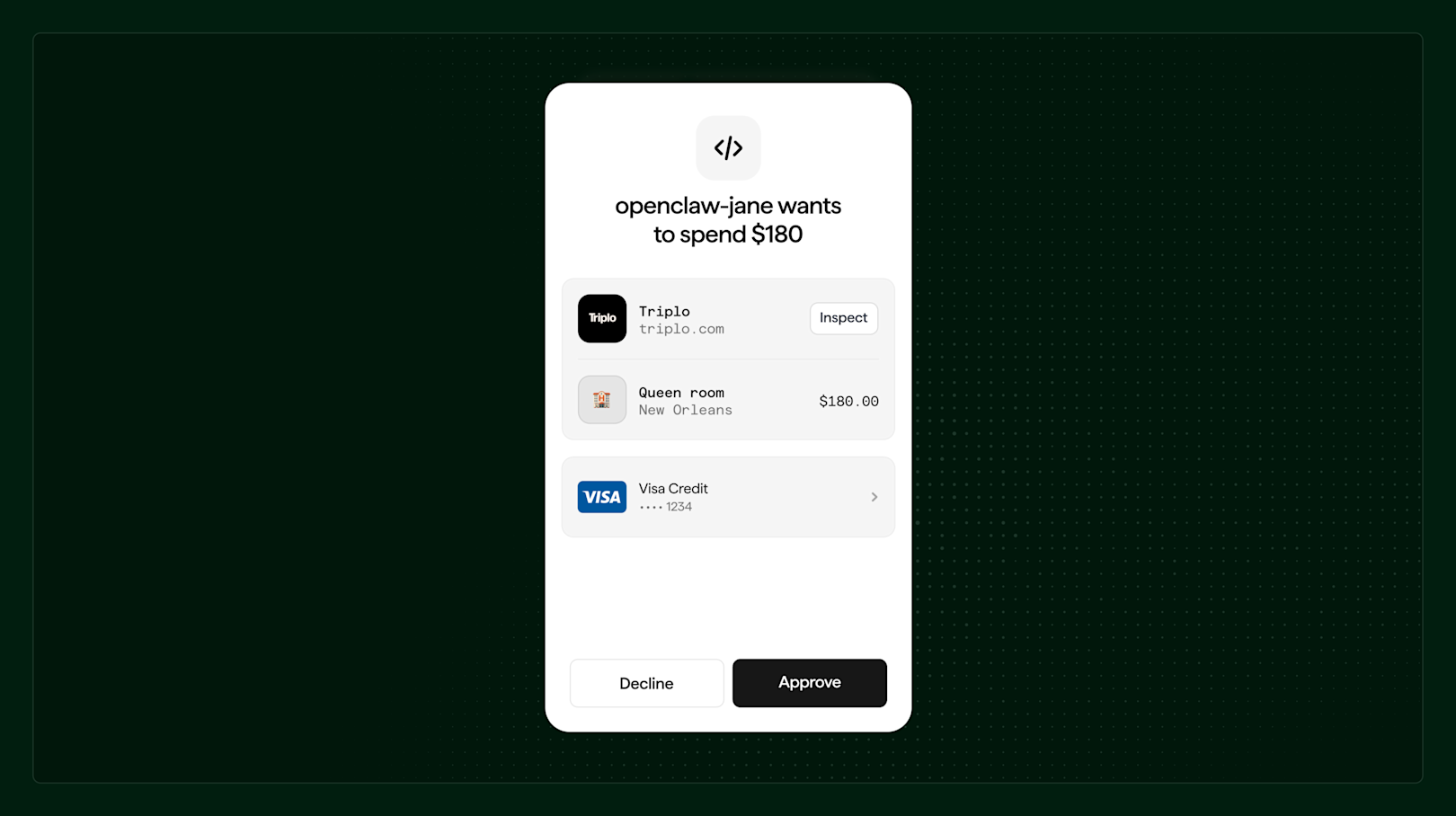
    Users grant their agent access via an OAuth flow; the agent then issues spend requests with context that the user must approve before any payment credential is shared.
  • 03.
    Agents transact through one-time-use virtual cards or Shared Payment Tokens (SPTs) backed by the user's existing cards and banks, so the agent never sees raw payment credentials.
  • 04.
    Link is built on Stripe's new Issuing for agents, which adds real-time authorization, spending controls, transaction monitoring, and advanced fraud tools, and Stripe also expanded SPT interoperability to Mastercard Agent Pay, Visa Intelligent Commerce, Affirm, and Klarna.

Deep Analysis

OAuth + SPT: How an Agent Pays Without Ever Holding Your Card

The technical heart of Link is a deliberately layered handoff that keeps raw payment credentials inside Stripe and out of the model's context window. A user first connects payment methods to Link, then grants their agent access through a standard OAuth flow — the same pattern that lets a third-party app post to a user's social account without learning the password. From there the agent does not freely charge anything; it builds a structured spend request, attaches context (what it wants to buy, why, and on whose behalf), and waits for the user to approve. Only after approval does Stripe issue either a one-time-use virtual card or a Shared Payment Token (SPT) backed by the user's existing cards and banks. Stripe is explicit that "the agent never gets access to your raw payment credentials."

This is meaningfully different from giving an agent a card number in a prompt. The SPT is scoped to a specific seller and constrained parameters — Stripe's own developer videos describe it as a primitive that "securely passes your card to sellers without exposing details," with the network performing identity and risk checks before authorization. Sellers integrate with what Stripe calls a one-line code change. The result is an architecture where the credential, the delegation, and the authorization each live in different places, and a compromised agent leaks at most a scoped token rather than a reusable card.


The Fraud Paradox: AI Is the Attacker and the Goalkeeper

Stripe's data tells a contradictory story that only makes sense if you accept that AI is now on both sides of the fraud line. Across AI services, 1 in 6 sign-up attempts is fraudulent and free-trial abuse has roughly doubled in six months — by Emily Glassberg Sands' count, free-trial abuse is up 4x in the last six months, and Radar blocked 3.3 million risky sign-ups in a single month for just eight AI businesses. For one large customer, Stripe blocks 250,000 fraudulent free trials per week. Generative models are industrializing the cheap, high-volume end of fraud.

And yet Stripe claims fraud rates have been near zero on merchants live with the Agentic Commerce Suite — Coach, Kate Spade, URBN, Revolve, Ashley Furniture, Halara, ABT Electronics, Nectar — even as industry-wide ecommerce fraud is up 15% year over year. The architectural reason matters: when an agent pays through scoped SPTs and virtual cards instead of scraping a checkout page, the network sees a richer, more deterministic signal than a human-shaped session, and Stripe's risk models can be tuned to it. The pitch to merchants is a backwards one — fraud is exploding everywhere except inside the rails Stripe is selling. That is either a real moat or a sample-size artifact, and the next twelve months will tell which.

The Standards Race Stripe Is Trying to Win Before It Starts

Link is not arriving in an empty field. Visa's Intelligent Commerce, Mastercard's Agent Pay, Ant International's AMP, and Coinbase's x402 are all racing to define how agents move money, and the agentic commerce market is projected to reach $28B by 2030 at a 46% CAGR. Stripe's strategy is the classic incumbent-platform play: rather than fight the networks, it expanded SPT interoperability to absorb Mastercard Agent Pay and Visa Intelligent Commerce, while pulling Affirm and Klarna into the same stack. The bet is that developers and merchants will choose one orchestration layer that speaks to all of them, not a card scheme that speaks only to itself.

The load-bearing counterpoint sits in crypto-native communities, and it is sharper than the headlines suggest. A 285-upvote post on r/mcp describes an agent earning fractions of a cent per call from other agents using x402 and USDC on Base, framed explicitly as "No Stripe. No invoices. Machine pays machine." Critics argue Stripe's rails carry KYC overhead and slow settlement that don't fit machine-to-machine economics, pointing to Solana x402 settling in 400ms. Stripe's framing in its developer videos pointedly treats agent payments as an extension of card rails, not a parallel crypto system — even as it promises stablecoin and "agentic token" support is coming. The unresolved question is whether sub-cent agent-to-agent transactions will live on card networks at all, or whether Link wins the consumer-delegated tier while crypto rails win the machine-native tier.

The Coasean Reshuffle: Fewer People Per Firm, More Firms

The most consequential idea in the cluster materials is not the wallet itself, it is the economic structure it enables. Read through a Coasean lens, AI lowers transaction costs both inside firms (shared context, aligned incentives among agents) and between them (agents handle discovery, integration, contracting, and agent-to-agent commerce). The medium-term prediction is fewer people per firm, more output per firm, more firms in total, and far more market-like coordination replacing what used to be done inside a single org chart. The cluster's anonymous viral tweet calls this "Service as a Software" (SaaS v2) — a category at $0 today that needs platforms designed for agents to buy from, not humans.

The early shape is already visible in Stripe's own data. Top AI companies are hitting $30M ARR in 18 months, three times faster than the 2018 SaaS cohort, and Sands says it is net new spending rather than budget replacement. Coinbase's Shan Aggarwal predicts the internet becomes "a programmable marketplace for agents" picking services on cost and efficiency. The downside for incumbents is the disintermediation thesis: if agents pick suppliers on lowest-cost terms, traditional brand and merchandising leverage erodes. Stripe is effectively selling shovels to both sides — the merchants trying to stay discoverable to agents, and the agents trying to spend efficiently — which is why 75% of NRF 2026 attendees said they are already implementing or planning agentic commerce.

Why Now: Automated Traffic Crossed 50%, and the CLI Finally Has Users

Two data points explain the timing better than any product roadmap. AWS data cited at Sessions shows 51% of web traffic is now automated and growing 8x faster than human clicks — the web is already majority machine, and the missing layer was payments, not capability. The cluster's other anonymous tweet captures the inversion drily: "Stripe launched a CLI seven years ago, and nobody used it. Until AI agents came along." Tools built for developers are quietly becoming tools built for autonomous software, and the same shift is happening to checkout.

Most users are not yet ready to delegate vacations or couches to an agent, per Stripe's own research, but they are comfortable delegating smaller everyday purchases — the example Sands gives is a kid's superhero outfit. That mismatch between low-trust large purchases and high-trust small ones is exactly why Link's per-transaction approval flow and spend caps matter: they let the agent economy bootstrap on the long tail of small, frequent, easy-to-undo purchases before earning trust on the high-stakes ones. Combined with Stripe's claim that Authorization Boost lifts acceptance rates ~3.8% and cuts processing costs up to 3.3%, the pitch to builders is concrete: if you are going to ship an agent that buys things, the rails are now cheaper and more accepting than they were a year ago, and you no longer have to build the wallet yourself.

Historical Context

2010
Stripe is founded; it grows to support roughly 135 currencies and processes nearly $2 trillion in payments in 2024.
2025
Stripe launches its Agentic Commerce Suite and earlier versions of Shared Payment Tokens, signaling its strategic pivot toward AI-driven payments.
2026-01
At NRF 2026, roughly 75% of retail attendees say they are either implementing or actively planning agentic commerce initiatives.
2026-04-30
Stripe announces 288 launches including the Link wallet for AI agents, Issuing for agents, expanded SPT support, the Machine Payments Protocol, and a Google Gemini commerce partnership.

Power Map

Key Players
Subject

Stripe enables AI agent payments via Link wallet

ST

Stripe

Issuer of the Link wallet and Issuing-for-agents stack; positions itself as the economic infrastructure layer for the agentic economy and announced 288 products at Sessions 2026.

OP

OpenAI, Microsoft, Meta, Google

Strategic partners on agentic commerce; Stripe brings merchant checkout to Google's Gemini apps and integrates with major model providers to channel agent spend.

VI

Visa & Mastercard

Network partners whose Intelligent Commerce and Agent Pay tokens now interoperate with Stripe's Shared Payment Tokens, anchoring agent payments to existing card rails.

AF

Affirm & Klarna

BNPL providers enabled inside Stripe's agentic payment stack via SPTs, extending agent purchasing power beyond debit/credit balances.

EA

Early-adopter merchants (Coach, Kate Spade, URBN, Revolve, Ashley Furniture, Halara, ABT Electronics, Nectar)

First retailers live on the Agentic Commerce Suite; reportedly seeing near-zero fraud rates and faster checkout, providing the proof points Stripe leans on.

PA

Patrick Collison (Stripe CEO)

Public proponent framing AI as the largest platform shift since the internet and arguing most online transactions will soon flow through agents.

Source Articles

Top 5

THE SIGNAL.

Analysts

""AI is the biggest platform shift for the economy since the internet, and in the not-too-distant future agents will account for most transactions online.""

Patrick Collison
CEO and cofounder, Stripe

""If AI can solve Nobel level physics problems but can't buy a domain, something's gone wrong. Our mantra: empower agents." Argues giving agents the ability to transact is critical infrastructure work."

Will Gaybrick
President of Product and Business, Stripe

"Says AI capabilities have crossed an inflection point and OpenAI now needs infrastructure-scale compute for the agent economy: "It does feel like we're on somewhat of a takeoff.""

Sam Altman
CEO, OpenAI

""In the future, the internet will be a programmable marketplace for agents" — frames agents as ruthless cost/efficiency optimizers expressing user intent across services."

Shan Aggarwal
Chief Business Officer, Coinbase

"Stripe processes 2% of global GDP; free-trial abuse rose 4x in six months; top AI companies are hitting $30M ARR in 18 months — 3x faster than the 2018 SaaS cohort, and most of it is net new spend, not budget replacement."

Emily Glassberg Sands
Head of Data & AI, Stripe
The Crowd

"Today, we're launching the @link wallet for agents. It lets you securely empower agents to spend on your behalf. Your payment credentials are never exposed and you approve every purchase."

@@stripe0

"New @stripe SDK for AI agents."

@@patrickc0

"stripe just announced their AI agent SDK and it's a pretty big deal imagine agents that don't just read transaction data, but actually act on it think about what this enables (3 ideas): 1. AI support agent that can: - understand a refund request in any language - check..."

@@gregisenberg0

"Stripe introduces Link, a digital wallet that autonomous AI agents can use, too"

@u/Additional_Key_80440
Broadcast
Implementing the Agentic Commerce Protocol with Stripe

Implementing the Agentic Commerce Protocol with Stripe

The future of agentic payments

The future of agentic payments

MCP and Claimable Sandbox APIs: Building Stripe integrations with AI agents

MCP and Claimable Sandbox APIs: Building Stripe integrations with AI agents