OpenAI-AWS Partnership Ends Microsoft Cloud Exclusivity
TECH

OpenAI-AWS Partnership Ends Microsoft Cloud Exclusivity

36+
Signals

Strategic Overview

  • 01.
    On April 28, 2026, AWS and OpenAI announced an expanded partnership making OpenAI frontier models, Codex, and Bedrock Managed Agents available on Amazon Bedrock in limited preview, with general availability in weeks.
  • 02.
    The Bedrock launch landed exactly one day after Microsoft and OpenAI restructured their partnership on April 27, 2026, ending Azure's exclusive hosting rights and converting Microsoft's IP license to non-exclusive through 2032.
  • 03.
    The deal pairs a $50 billion Amazon investment in OpenAI with OpenAI committing tens of billions to AWS Trainium chip capacity, expanding a prior $38B compute agreement by another $100B over eight years.
  • 04.
    OpenAI models on Bedrock inherit native AWS enterprise controls including IAM, PrivateLink, guardrails, encryption, and CloudTrail, with GPT-5.4 live and GPT-5.5 arriving within weeks.

Deep Analysis

The One-Day Gap Was Not a Coincidence — It Was Compute Physics

The most revealing detail in this whole reshuffle is the calendar. Microsoft and OpenAI announced their restructured partnership on April 27, 2026. Less than 24 hours later, OpenAI's models were live on Amazon Bedrock. That is not negotiation theater; that is a deal that had been engineered for months and was waiting for a clock to expire.

Why did the clock have to expire? Because the underlying constraint was never legal — it was physical. OpenAI has been signaling unrelenting demand for compute, with Sam Altman saying customers are asking for more capacity 'no matter what the price is.' Against that backdrop, OpenAI signed a $38B compute deal with AWS in November 2025, and expanded it by another $100B over eight years in 2026. Add Amazon's separate $50B equity investment and a 2-gigawatt Trainium commitment, and the math gets unambiguous: Azure could not, on its own, rack GPUs fast enough to absorb OpenAI's curve. On Reddit, the dominant frame in r/singularity and r/OpenAI was exactly this — that cloud exclusivity flipped because the compute commitments outran what any single hyperscaler could ship, with one r/OpenAI commenter claiming OpenAI was already routing AWS work as a stateful service to skirt the old contract.

In that read, the Microsoft restructure on April 27 was not Microsoft losing leverage — it was both parties acknowledging that the old contract had become unenforceable in practice, and replacing it with terms that matched physical reality. The April 28 Bedrock launch is what reality looks like once the paperwork catches up.
Amazon's $50 Billion Is a Silicon Customer-Acquisition Cost

Amazon's $50 Billion Is a Silicon Customer-Acquisition Cost
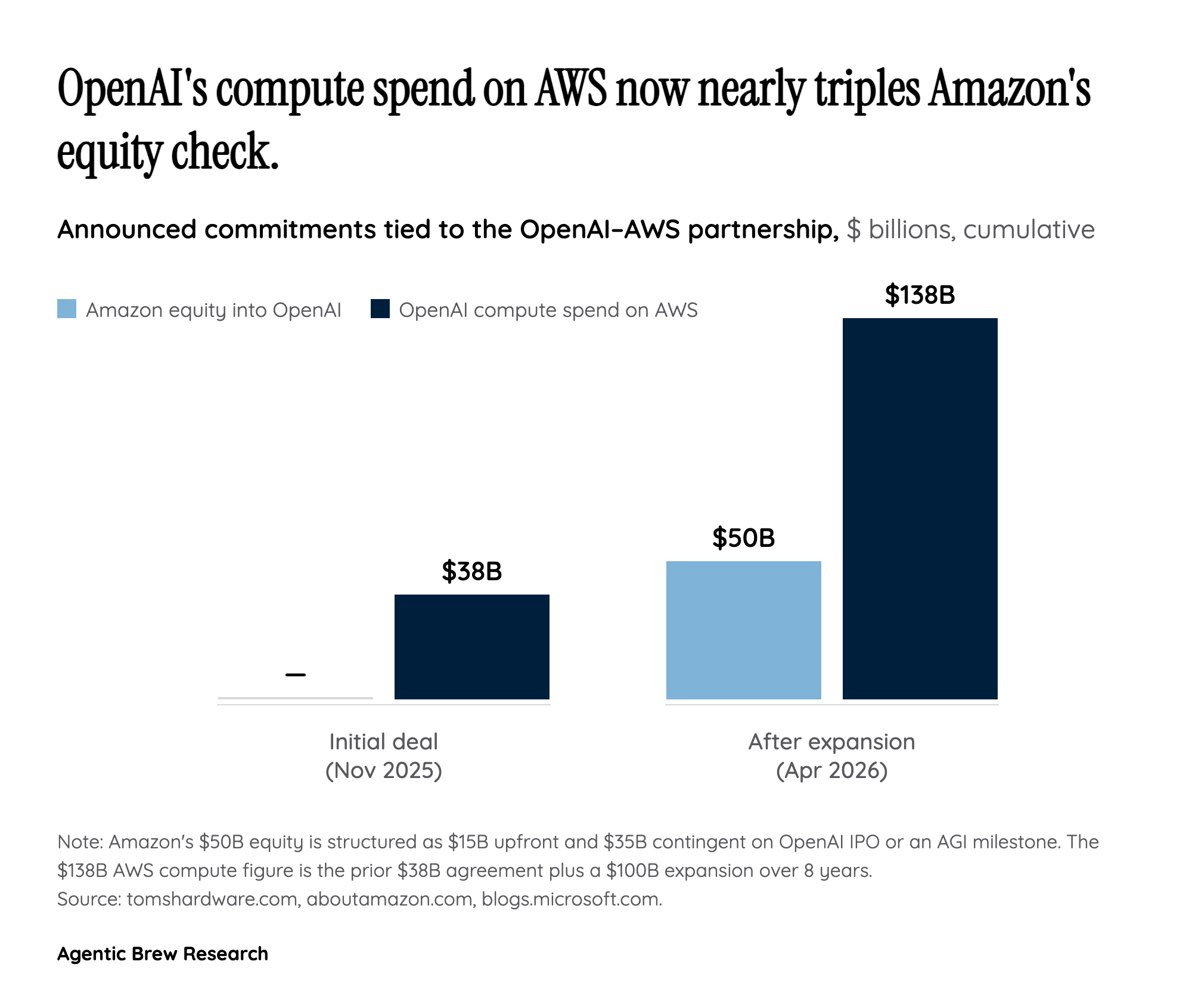
After the April 2026 expansion, OpenAI's compute spend on AWS reaches $138B — almost triple Amazon's $50B equity check, of which only $15B is upfront.

Amazon did not invest $50 billion in OpenAI to own a slice of OpenAI. It invested $50 billion to validate Trainium. The structure tells the story: $15B is upfront, but $35B is contingent on either an IPO or an AGI milestone — meaning the bulk of the check is a long-dated option, not a financial bet. The hard, present-tense commitment is on the other side of the table: OpenAI committing tens of billions to AWS Trainium capacity, including 2 gigawatts of Trainium 3 and Trainium 4 deployments.

AWS has been telling enterprise customers for two years that Trainium is 30-40% cheaper than Nvidia GPUs at training and inference. The problem with that pitch has always been that nobody at the frontier was using it for frontier models. 'Cheaper than Nvidia' doesn't matter if the cheapest path is also unproven at GPT-scale. Landing OpenAI as a Trainium customer at this scale is the missing reference architecture; it converts Trainium from a price-sensitive alternative into a credible primary platform. Trainium3 already supports up to 1 million chips per cluster via 144-chip UltraServers, which is the kind of envelope only an OpenAI-class workload can actually exercise.

This is why the Bedrock launch and the Trainium commitment had to ship together. Bedrock gives AWS the demand-side story — enterprise customers can now buy OpenAI inside AWS governance. Trainium gives AWS the supply-side story — the silicon under that demand is Amazon's, not Nvidia's. A flagship Trainium customer was the one piece AWS could not buy with marketing dollars, and now they have one.

The Real Microsoft Concession Was Killing the AGI Clause

Most coverage frames this as Microsoft losing exclusivity. The deeper structural shift is what replaced the old termination triggers. Under the prior partnership, Microsoft's IP rights were tied to AGI milestones — meaning the contract could be renegotiated, or in some readings terminated, the moment OpenAI declared AGI achievement. That clause has been buried-lede territory in every prior analysis of the Microsoft-OpenAI relationship, because it gave OpenAI a unilateral lever to reset the deal whenever it wanted.

The restructured agreement converts those AGI-conditional triggers into a fixed cap and a fixed end date: Microsoft's IP license now runs through 2032, and the revenue share is capped through 2030. That is the opposite of an exclusivity loss. Exclusivity was already de facto gone — OpenAI was selling models on AWS within 24 hours of the announcement. What Microsoft actually traded was a clause it was unlikely to win in court for a clause that locks in seven more years of model access on known terms. Reddit threads on r/microsoft framed this bluntly as a Satya Nadella gambit: no more revenue share owed to OpenAI, no more AGI-trigger time bomb, in exchange for losing the formal exclusivity OpenAI had already begun working around.

The practical effect is that Microsoft's downside is now bounded and dated. Azure customers will keep getting OpenAI's models; Microsoft Copilot will keep shipping on top of them. The strategic moat is gone, but the strategic risk is also gone — and bounded risk through 2032 may be worth more than de jure exclusivity that was eroding in practice.

Bedrock Managed Agents Reopens the Agent Runtime Fight

Bedrock Managed Agents is the part of this announcement that gets undersold. AWS and OpenAI are not just shipping model weights to a new cloud — they are co-shipping an agent runtime on AWS. The agents are built with the OpenAI agent harness, but every one of them gets its own AWS identity, logs each action through CloudTrail, and runs entirely on Bedrock infrastructure with all inference local to the customer's AWS account. Codex on Bedrock follows the same pattern via CLI, desktop, and a VS Code extension, with Codex already at 4 million weekly users.

Until this week, the AWS agent story was effectively an Anthropic story. Bedrock's flagship agent capabilities — Claude's tool use, the agent SDK patterns AWS has been promoting — were Anthropic-shaped. OpenAI's parallel agent stack lived in Azure or on api.openai.com. Bedrock Managed Agents collapses that split: enterprise builders on AWS can now choose OpenAI's agent harness or Anthropic's, inside the same governance perimeter, with the same IAM and PrivateLink wiring.

For builders, this is a real workflow change. The integration burden Matt Garman described — 'customers were kind of forced to pull that together themselves' — was the daily reality of stitching OpenAI's agent loop into a Bedrock-governed enterprise environment. That stitching is now AWS's problem, not the customer's. CNBC and Bloomberg coverage zeroed in on the same shift from a financial-markets angle, framing AWS's productivity-software push as a parallel front. For Anthropic, it's the first time on AWS turf that OpenAI is a peer agent provider rather than a cross-cloud rival, and analyst Gil Luria's read that buyers 'will now be more likely to consider OpenAI alongside Anthropic' lands hardest here, in the agent runtime layer where lock-in actually accumulates.

Historical Context

2025-11
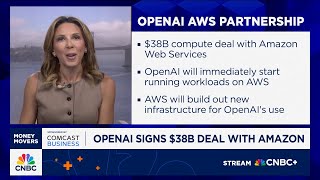
OpenAI and AWS struck an initial $38 billion compute agreement, the first crack in Azure's de-facto monopoly on OpenAI workloads.
2025-12
Amazon launched Trainium3, a 3nm chip delivering four times the performance of its predecessor at 40% better energy efficiency, setting the stage for an OpenAI-scale customer.
2026-04-27
Microsoft and OpenAI restructured their partnership: Azure exclusivity ended, Microsoft's IP license became non-exclusive through 2032, and AGI-trigger termination clauses were replaced with a fixed end date.
2026-04-28
OpenAI frontier models, Codex, and Bedrock Managed Agents went live on Amazon Bedrock in limited preview, alongside Amazon's $50B investment and OpenAI's expanded $100B-over-eight-years Trainium commitment.

Power Map

Key Players
Subject

OpenAI-AWS Partnership Ends Microsoft Cloud Exclusivity

OP

OpenAI

Model and agent provider diversifying distribution beyond Azure to relieve compute and capital constraints; Sam Altman (CEO) and Denise Dresser (CRO) frame the move as customer-driven trust expansion.

AM

Amazon Web Services

Cloud distributor, infrastructure provider, $50B investor, and Trainium chip supplier; Matt Garman (AWS CEO) gains a flagship customer for Trainium silicon at a scale Nvidia previously owned.

MI

Microsoft

Former exclusive cloud host; remains primary cloud partner with non-exclusive IP license through 2032 and capped revenue share through 2030, retaining equity but losing the lock-in moat.

NV

Nvidia

Incumbent AI accelerator vendor whose lock-in is challenged by OpenAI's 2GW Trainium commitment; AWS claims 30-40% cost savings versus Nvidia GPUs at this scale.

EN

Enterprise AI buyers

Now able to deploy OpenAI inside existing AWS governance perimeters; analysts say multi-cloud AI migration timelines are collapsing from years to months.

Source Articles

Top 5

THE SIGNAL.

Analysts

"Altman frames agents as the next phase of AI: 'I think the next phase of AI is going from you supply some text to an agent and get more text back...to we are going to have these agents running inside of a company doing all different kinds of work.' He also stresses unrelenting compute demand: 'We have way more customers asking us, No matter what the price is, can you give me more?'"

Sam Altman
CEO, OpenAI

"Garman positions Bedrock Managed Agents as removing customer integration burden: 'Customers were kind of forced to pull that together themselves...by building this thing together, we make it much easier for customers to much more rapidly get to value.'"

Matt Garman
CEO, AWS

"Dresser describes the Bedrock launch as customer-pull: 'Business customers of OpenAI want those models in a trusted environment that they know, and in a trusted infrastructure.'"

Denise Dresser
Chief Revenue Officer, OpenAI

"Luria argues the deal widens enterprise AI competitive pressure: AWS and Google Cloud customers 'will now be more likely to consider OpenAI alongside Anthropic,' eroding the implicit cloud-by-model segmentation that defined the last two years."

Gil Luria
Analyst, D.A. Davidson
The Crowd

"OpenAI ends its exclusive partnership with Microsoft"

@u/JackFisherBooks359

"The next phase of the Microsoft-OpenAI partnership: Microsoft's license for OpenAI IP for models and products will now be non-exclusive."

@u/Formal-gathering11225

"Microsoft and OpenAI end exclusivity agreement, opening up potential partnerships with Amazon and Google"

@u/ControlCAD138
Broadcast
AWS to build out new AI infrastructure for OpenAI in $38B deal

AWS to build out new AI infrastructure for OpenAI in $38B deal

OpenAI signs $38B deal with Amazon: Here's what to know

OpenAI signs $38B deal with Amazon: Here's what to know

Amazon Inks Deal with OpenAI, Plans New AWS Applications

Amazon Inks Deal with OpenAI, Plans New AWS Applications