Context Engineering for Reliable AI Agents
TECH

Context Engineering for Reliable AI Agents

34+
Signals

Strategic Overview

  • 01.
    Anthropic's Applied AI team published the canonical 'Effective context engineering for AI agents' essay defining context as a finite resource and arguing for the smallest set of high-signal tokens that maximize the likelihood of a desired outcome.
  • 02.
    Practitioner Philipp Schmid crystallized the shift with the line 'Most agent failures are not model failures anymore, they are context failures,' reframing reliability as a context-design problem.
  • 03.
    LangChain and a December 2025 arXiv paper formalized agentic filesystems as a single interface for storing, retrieving, and updating an effectively unbounded amount of agent context.
  • 04.
    HumanLayer popularized 'harness engineering' for coding agents, and Anthropic followed with guidance on harnesses for long-running agents that begin every session with no memory of what came before.

The Quiet Coup: How Prompt Engineering Lost Its Throne

For three years after ChatGPT's launch, prompt engineering was the named profession of the LLM era — a discipline of phrasing, role-play, and clever instructions aimed at a single inference call. The shift announced by Anthropic's Applied AI team in late September 2025 reframes that work as a special case of something larger. Their definition is deliberately mechanical: context is 'the set of tokens included when sampling from a large-language model,' and the engineer's job is to find 'the smallest possible set of high-signal tokens that maximize the likelihood of desired outcome.' Prompts are still in there. They are just no longer the unit of work.

The mechanism behind the displacement is that context is finite, attention is quadratic, and long contexts decay. Anthropic notes that LLMs 'like humans, lose focus or experience confusion at a certain point,' and Elastic's measurements show accuracy degrading around 32,000 tokens for some models — a phenomenon now widely called context rot. Once you accept that more context can hurt, prompt engineering's instinct to stuff the window with examples and instructions becomes actively harmful. Philipp Schmid's now-quoted line — 'most agent failures are not model failures anymore, they are context failures' — is the field's clearest statement of why the throne changed hands. The model is no longer the bottleneck; what you put in front of it is.

The New Primitives: Filesystems, Harnesses, and Sub-Agent Firewalls

If context engineering is the discipline, the past four months have produced its first widely accepted abstractions — and they look nothing like prompts. LangChain's November filesystem post and the December arXiv paper 'Everything is Context' both converge on the same primitive: an agentic filesystem, 'a single interface through which an agent can flexibly store, retrieve, and update an infinite amount of context.' Persistent files replace the ephemeral prompt as the seat of agent memory. Anthropic's harness essay sits alongside this, arguing that since 'each new session begins with no memory of what came before,' the surrounding scaffolding — tool definitions, environment, retrieval policies — has to do the remembering. HumanLayer's coinage of 'harness engineering' formalizes the practice as a permanent fix loop: every agent mistake gets engineered out of the harness so the agent never makes it again.

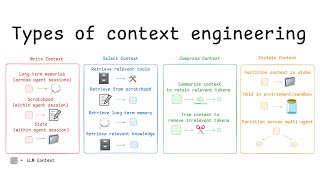
The third primitive is structural: sub-agents as context firewalls. Isolating a noisy task — a long search, a brittle parse — inside a child agent prevents intermediate junk from polluting the parent thread, an idea LangChain's developer-facing taxonomy (write, select, compress, isolate) puts at the same level as retrieval and compression. Manus's framework rebuilds, repeated four times, are essentially an evolution of which primitives bear weight: 'you can't reliably predict which observation might become critical ten steps later,' so structure must absorb the unpredictability that prompts cannot. These abstractions are the real artefact of the rebrand. Calling something 'context engineering' is just vocabulary; treating filesystems, harnesses, and isolated sub-agents as first-class building blocks is the actual change.

Follow the Money: Context Engineer Is Becoming a Real Job Title

Follow the Money: Context Engineer Is Becoming a Real Job Title
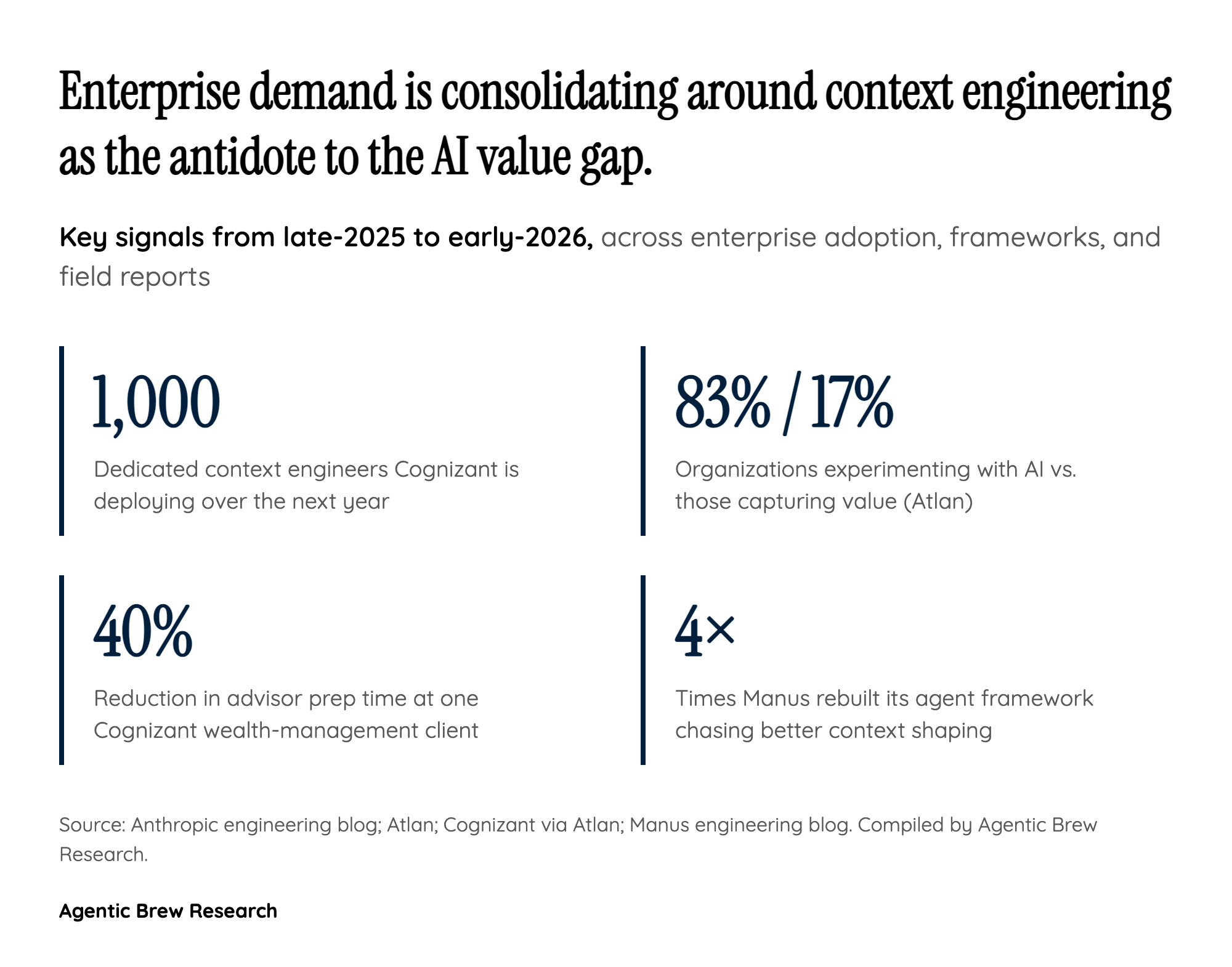
Cognizant's 1,000-engineer commitment, the 83/17 value gap, and Manus's four framework rebuilds anchor why enterprise budgets are moving.

Vocabulary shifts only matter when payroll moves with them, and on this score the case is unusually clear. Cognizant has committed to deploying 1,000 dedicated context engineers over the next year — a single-vendor headcount number large enough to redefine the role's labor market. The justification is operational, not aspirational: one of Cognizant's wealth-management clients reported a 40% reduction in advisor prep time, the kind of number that lets a services firm price a practice. Gartner's July 2025 declaration that 'context engineering is in, prompt engineering is out' gave enterprise buyers analyst cover to relabel their AI programs.

The demand-side reasoning is in Atlan co-founder Prukalpa Sankar's framing: '83% of organizations are actively experimenting with AI, yet only 17% are able to drive value,' with data quality, governance, and disconnected systems acting as the major barriers. That 83/17 gap is exactly the territory context engineering claims — and it explains why the role is forming inside large enterprises rather than at frontier-model labs. Frontier models have plateaued enough that further capability gains come from what surrounds them; the marginal hire is no longer a researcher but someone who can wire retrieval, memory, governance, and tooling into a coherent context substrate. When a Box CEO calls context engineering 'the long pole in the tent for AI Agents adoption' on X, what he is really describing is a budget line that did not exist a year ago and now does.

The Skeptics' Case: Rebrand or Real Discipline?

The contrarian read deserves a fair hearing because it is internally consistent. On Reddit, an r/AIMemory thread titled 'Is Context Engineering the new hype?' captured a mixed reception, with a vocal minority arguing the term is little more than rebranded prompt engineering — the same activity (curating what goes into the model) under a more legitimate-sounding name. A parallel critique in the same community holds that 'AI memory engineering' is the more honest framing, because what builders actually need is durable memory across sessions, not just better single-shot context curation. From this angle, the filesystem and harness vocabulary is a halfway house: it admits prompts are not enough, but stops short of treating memory as the real primitive.

The steelmanned counter is that the displacement is not about a word swap but about scope. Prompt engineering optimizes a single call; context engineering optimizes an ongoing process across tools, retrieval, sub-agents, and persistent files — what KDnuggets called the move from teaching machines to speak to 'building the worlds they think within.' Manus's four framework rebuilds, Anthropic's pair of essays, and the academic formalization in 'Everything is Context' are all evidence that practitioners are doing materially different work, not renaming old work. The honest answer is probably that both readings have weight: the term 'context engineering' is loose enough to absorb prompt-craft as a subset, which is why the Reddit critique lands; and the abstractions underneath it — filesystems, harnesses, context firewalls — are concrete enough that calling the whole thing rebrand undersells what changed. The memory-engineering camp may simply be early to the next rename.

Historical Context

2022-11-30
ChatGPT launches and prompt engineering rapidly emerges as a named job title, anchoring three years of practice around prompt-craft.
2025-06-30
Publishes 'The New Skill in AI is Not Prompting, It's Context Engineering,' kicking off the rebrand and seeding the 'context failures, not model failures' framing.
2025-07-18
Publishes 'Context Engineering for AI Agents: Lessons from Building Manus,' giving the field its canonical practitioner case study, including four full agent-framework rebuilds.
2025-09-29
Publishes 'Effective context engineering for AI agents,' the canonical essay that defines context as a finite token resource and codifies the discipline.
2025-11-21
Nick Huang's filesystem post argues a filesystem is a single interface through which an agent can flexibly store, retrieve, and update an infinite amount of context.
2025-11-26
Follow-up essay 'Effective harnesses for long-running agents' formalizes the harness as the scaffolding that replaces the missing memory of fresh sessions.
2025-12-01
Publishes 'Context Engineering is the New Prompt Engineering,' summarizing the consensus and reaching a wider data-science audience.
2025-12-05
'Everything is Context: Agentic File System Abstraction for Context Engineering' formalizes the file-system metaphor academically and declares the emerging challenge is no longer model fine-tuning but context engineering.

Power Map

Key Players
Subject

Context Engineering for Reliable AI Agents

AN

Anthropic (Applied AI team)

Frame-setter for the field via two flagship engineering essays in September and November 2025 that defined the vocabulary (context as finite tokens, harnesses for long-running agents) the rest of the industry is now adopting.

LA

LangChain

Toolmaker turning the discipline into shipped abstractions, promoting filesystem-backed memory and the write/select/compress/isolate taxonomy of context strategies.

MA

Manus (Yichao 'Peak' Ji)

Practitioner whose lessons-learned post is widely cited; rebuilt its agent framework four times after each context-shaping discovery, making it the canonical 'this is empirical, not theoretical' reference.

HU

HumanLayer

Coined 'harness engineering' as the discipline of permanently fixing every class of agent mistake in the surrounding scaffolding rather than the prompt.

CO

Cognizant

Enterprise adopter committing to 1,000 dedicated context engineers and reporting a 40% reduction in advisor prep time for one wealth-management client, signalling that the role is operational, not theoretical.

GA

Gartner

Analyst-side validator that declared in July 2025 that 'context engineering is in, prompt engineering is out,' giving CIOs cover to redirect headcount.

Source Articles

Top 5

THE SIGNAL.

Analysts

"Calls context engineering 'the delicate art and science of filling the context window with just the right information for the next step,' framing it as deliberate curation rather than prompt-stuffing."

Andrej Karpathy
Founding member, OpenAI; former Director of AI, Tesla

"Defines context engineering as 'the art of providing all the context for the task to be plausibly solvable by the LLM,' centering the operator's responsibility to make problems solvable in the first place."

Tobi Lutke
CEO, Shopify

"Argues 'most agent failures are not model failures anymore, they are context failures,' shifting the diagnostic lens from model choice to context design."

Philipp Schmid
AI Developer Relations engineer

"Defines harness engineering as the practice that 'anytime you find an agent makes a mistake, you take the time to engineer a solution such that the agent never makes that mistake again.'"

Mitchell Hashimoto
Co-founder, HashiCorp

"Warns that in long-horizon agent runs 'you can't reliably predict which observation might become critical ten steps later,' which is why Manus rebuilt its framework four times."

Yichao 'Peak' Ji
Co-founder, Manus

"Notes that '83% of organizations are actively experimenting with AI, yet only 17% are able to drive value,' attributing the gap to data quality, governance, and disconnected systems — the substrate context engineering must fix."

Prukalpa Sankar
Co-founder, Atlan
The Crowd

"New on the Anthropic Engineering Blog: Most developers have heard of prompt engineering. But to get the most out of AI agents, you need context engineering. We explain how it works: https://t.co/sox8yyOBs4"

@@AnthropicAI0

"Context engineering is increasingly the most critical component for building effective AI Agents in the enterprise right now. This will ultimately be the long pole in the tent for AI Agents adoption in most organizations. We need AI Agents that can deeply understand the context"

@@levie0

""everything that makes agents good is context engineering" excited to release @dexhorthy's talk at @aiDotEngineer, coiner of Context Engineering which has captured the zeitgeist of some of the most important problems in AI Engineering today!"

@@swyx0

"Is Context Engineering the new hype? Or just another term for something we already know?"

@u/hande__143
Broadcast
Context Engineering is the New Vibe Coding (Learn this Now)

Context Engineering is the New Vibe Coding (Learn this Now)

Advanced Context Engineering for Agents

Advanced Context Engineering for Agents

Context Engineering for Agents

Context Engineering for Agents