U.S. CHIPS Act $2B quantum computing grants and equity stakes
TECH

U.S. CHIPS Act $2B quantum computing grants and equity stakes

36+
Signals

Strategic Overview

  • 01.
    The U.S. Department of Commerce announced letters of intent with nine quantum computing companies on May 21, 2026, totaling approximately $2.013 billion in CHIPS and Science Act federal incentives, with the federal government taking a minority, non-controlling equity stake in each recipient.
  • 02.
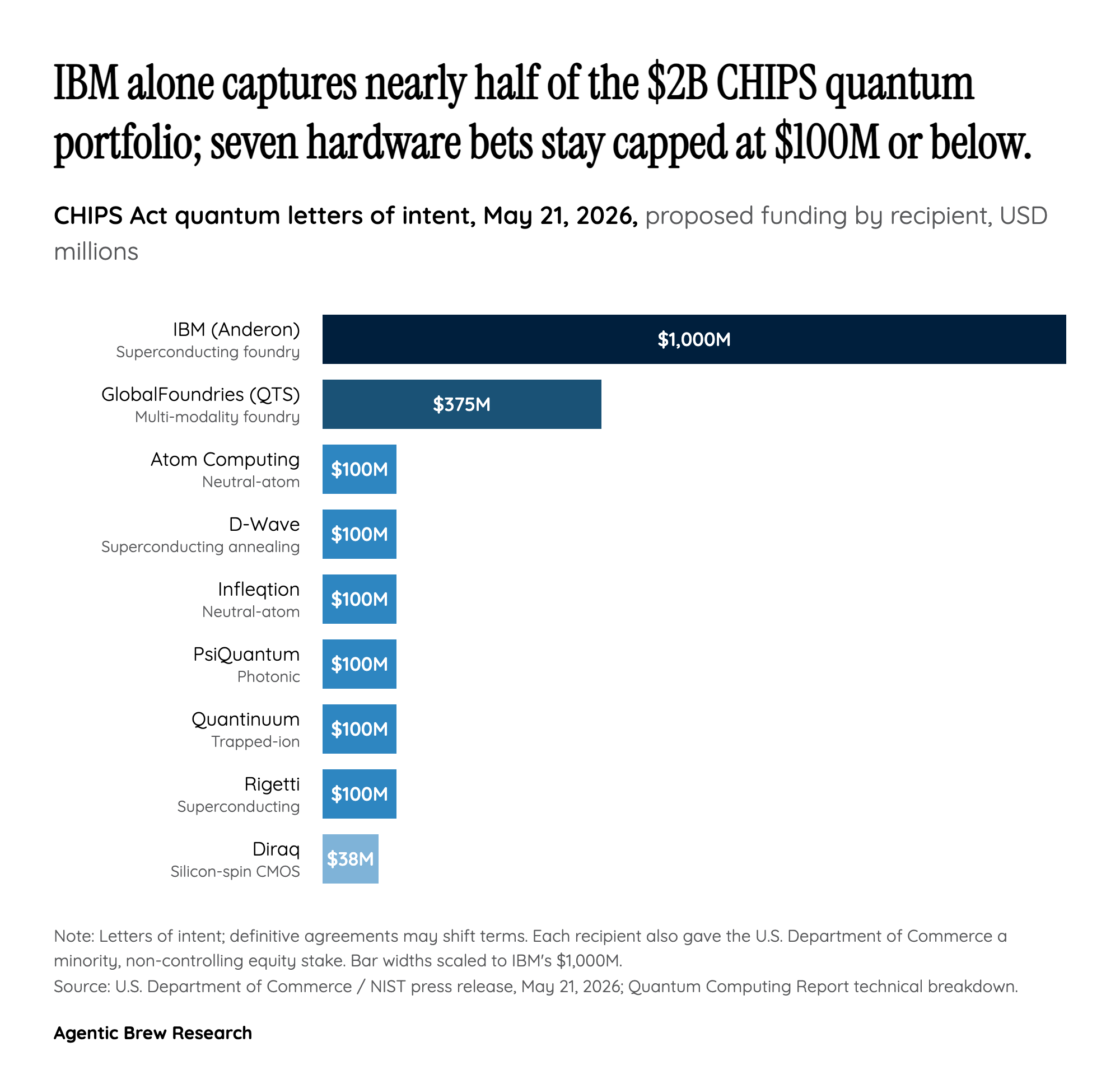
    The portfolio funds two domestic quantum foundries (IBM at $1B, GlobalFoundries at $375M) and seven hardware companies spanning superconducting, trapped-ion, neutral-atom, silicon-spin, photonic, and topological modalities, explicitly hedging across approaches rather than picking a winner.
  • 03.
    Atom Computing, D-Wave, Infleqtion, PsiQuantum, Quantinuum, and Rigetti each received planned awards of up to $100 million; Diraq received up to $38 million for silicon-spin work using standard CMOS nodes in partnership with GlobalFoundries.
  • 04.
    Quantum stocks surged on the announcement: D-Wave (QBTS) closed +33.37% at $25.74, Rigetti (RGTI) +30.57% at $22.04, and IBM +12.48% at $252.97, repricing the sector from speculative R&D to declared national strategic priority overnight.

Deep Analysis

Six modalities, one checkbook: Commerce refuses to pick a qubit winner
Six modalities, one checkbook: Commerce refuses to pick a qubit winner
CHIPS Act quantum funding by recipient: IBM $1B anchors the portfolio while seven hardware bets cluster at $100M.

The most revealing detail in the CHIPS Act quantum package is not the dollar figure but the spread. Commerce funded superconducting (IBM, Rigetti, D-Wave), trapped-ion (Quantinuum), neutral-atom (Atom Computing, Infleqtion), silicon-spin (Diraq), photonic (PsiQuantum), and through the GlobalFoundries foundry, topological architectures in a single announcement [5]. That is every commercially credible qubit modality on Earth, funded simultaneously. Bill Frauenhofer, who runs semiconductor investment at the CHIPS R&D Office, framed this explicitly: "The CHIPS R&D Office is taking a portfolio approach to strengthen and accelerate U.S. leadership across multiple quantum modalities at once." [1]

This is an unusual posture for a U.S. industrial policy that historically prefers anointing a national champion. The reading: nobody, not Commerce, not IBM, not the venture community, knows which modality will scale to fault-tolerant quantum computing first. Superconducting has the most qubits today but suffers coherence-time ceilings; neutral atoms promise tens of thousands of qubits but lag on gate fidelity; photonics need cryogenic single-photon detectors that don't quite exist at scale; silicon-spin would inherit the entire CMOS supply chain if it works. By splitting $2B across all of them and capping individual hardware bets at $100M, the federal government is functionally writing seed checks on a venture risk profile. Diraq's $38M for CMOS-native silicon-spin scaling, the smallest award but the one most likely to ride GlobalFoundries' fab infrastructure, is the cleanest example of optionality buying [8].

The Intel template, generalized: government as VC

The mechanical innovation here is the equity stake. Every recipient gave Commerce a minority, non-controlling position in exchange for the cash. The blueprint comes from August 2025, when the Trump administration converted $5.7B in Intel CHIPS grants into roughly 433M Intel shares, about a 10% stake [4]. The May 21 announcement formally extends that arrangement from a one-off rescue of a struggling incumbent to an entire emerging sector. Jefferies captured the policy shift bluntly: "With China accelerating state-backed quantum investment, [the DOC's announcement] reinforces the administration's growing use of equity stakes as a tool of industrial policy." [4]

The consequences are not symmetric. For IBM, which is contributing $1B of its own cash alongside the $1B CHIPS award to capitalize Anderon, the federal stake is functionally a co-investor riding alongside a roughly $250B market-cap company [2]. For Rigetti and D-Wave, where the $100M awards are large relative to market caps and annual burn, the equity dilution is structurally different, and the market priced it accordingly, with QBTS closing +33.37% and RGTI +30.57% on the day [9]. There is also litigation overhang: Intel currently faces shareholder suits over its government-equity deal, signaling the model may face legal challenges as it scales [6]. Senator Elizabeth Warren and colleagues flagged additional conflict-of-interest concerns: 1789 Capital, linked to Donald Trump Jr., holds PsiQuantum exposure, and former Pentagon tech official Emil Michael previously took D-Wave public [7].

The IonQ puzzle: a $2B private raise lets you say no

The most-discussed absence in the announcement is IonQ. Commerce funded D-Wave, Rigetti, Quantinuum, and Atom Computing but not the trapped-ion company whose name is on most analyst quantum baskets. The Reddit r/IonQ thread surfaced the operational answer that mainstream coverage missed: the CHIPS quantum program required recipients to issue equity at a 15% discount to a recent reference price, and IonQ had already raised $2B at $93/share through Heights Capital with no dilution attached, plus closed a $1.8B acquisition of SkyWater Technology's foundry operations. With a balance sheet that deep, accepting a $100M check with a 15% discount-pricing clause would have been dilutive on net.

The absence matters beyond IonQ's own story. It reveals the implicit cost of the equity model: companies with strong private-market access can opt out, leaving Commerce's portfolio tilted toward firms that needed the capital and accepted the dilution terms. That is a real selection effect on a $2B taxpayer commitment, the program may end up funding the second-best execution in each modality if the best-funded players self-exclude. SkyWater Technology, meanwhile, is a downstream winner from both sides: two of its major customers received $100M each in the program, and IonQ now owns its foundry capacity outright [11].

The Albany hub: $1.375B lands inside one zip code

IBM's Anderon foundry and GlobalFoundries' new Quantum Technology Solutions subsidiary will both anchor in the Albany NanoTech ecosystem in upstate New York, concentrating roughly $1.375B of CHIPS quantum funding in a single Capital Region cluster [12]. Senator Chuck Schumer, the CHIPS Act's principal Senate architect, claimed the GlobalFoundries award as a direct payoff of the law he wrote [3]. Anderon will operate a 300mm quantum wafer foundry, the same wafer diameter as leading-edge classical CMOS fabs, and is positioned to sell fabrication services to external quantum companies, not just supply IBM internally [2].

The concentration is deliberate. Quantum hardware shares supply-chain physics with semiconductors: clean rooms, lithography, deposition equipment, cryogenic packaging, RF testing. Putting two foundries inside Albany NanoTech means the talent base, equipment vendors, and second-tier suppliers compound. It also creates a single point of policy risk: if a future administration unwinds the equity stakes or redirects the funding, the geographic concentration becomes a vulnerability rather than a moat. For now, the bet is that quantum manufacturing scales the way semiconductor manufacturing did, with regional ecosystems beating distributed footprints.

Repricing the sector overnight: from R&D to strategic asset class

Quantum equities had been trading on a venture-style narrative: long horizons, optionality on technical milestones, periodic blowups on missed roadmaps. The May 21 announcement reset the valuation frame in a single session. D-Wave closed +33.37% at $25.74, Rigetti +30.57% at $22.04, IBM +12.48% at $252.97, with Infleqtion and GlobalFoundries also rising sharply [9]. TradingKey analysts described the move as a "policy premium", the market now prices quantum names with a baseline assumption of federal underwriting [10]. IBM itself cited an industry projection of up to $850B by 2040, a figure that only makes sense as a long-duration thesis if national-strategic capital is in the trade [4].

The Reddit reaction was sharper than the equity move suggested. r/ValueInvesting's top comment dismissed the announcement as "a penny stock scam on a larger scale," noting that $100M is meaningful capital but small relative to the $150-200M annual cash burn at D-Wave and Rigetti. Contrarian threads warned that government equity stakes are themselves a risk: political administrations change, and a non-controlling stake held by Commerce could become a governance variable in five years that nobody priced today. The X.com coverage from breaking-news accounts was factual and ticker-driven, with one quantum-industry commentator publicly framing the deal as "smart or desperate?", a question the market answered with capital on the day but has not actually resolved on the merits.

Historical Context

2022-08-09
Signed the CHIPS and Science Act into law, allocating $52B for chip manufacturing subsidies and roughly $200B authorization for AI, quantum, and robotics research, about $280B total over 10 years.
2025-08
Commerce converted $5.7B in CHIPS Act grants into roughly 433M Intel shares (~10% stake), establishing the passive minority-equity precedent later applied wholesale to quantum.
2025-10-23
First reports surfaced that Commerce was negotiating equity stakes with quantum firms in exchange for grants of at least $10M per company, foreshadowing the May 2026 package.
2026-05-21
Announced the $2.013B letters of intent across nine quantum companies, the largest single federal commitment to U.S. quantum hardware to date, formally extending the Intel equity model to an entire sector.

Power Map

Key Players
Subject

U.S. CHIPS Act $2B quantum computing grants and equity stakes

U.

U.S. Department of Commerce (CHIPS R&D Office)

Funding authority deploying $2.013B across nine companies; takes minority non-controlling equity stake in each recipient as a condition of award.

IB

IBM (Anderon subsidiary)

Receives proposed $1B CHIPS award plus $1B IBM matching cash to launch Anderon, a standalone subsidiary described as America's first pure-play 300mm quantum wafer foundry in Albany, NY, focused on superconducting qubit wafers.

GL

GlobalFoundries (Quantum Technology Solutions)

$375M letter of intent to launch a multi-modality secure quantum foundry covering superconducting, trapped-ion, photonic, topological, and silicon-spin architectures; Commerce holds ~1% equity in the subsidiary.

PS

PsiQuantum

Up to $100M for photonic modality work including electro-optic switches and single-photon detectors, representing the photonic bet in the portfolio.

AT

Atom Computing

Up to $100M for scaling neutral-atom qubit arrays to tens of thousands of qubits, representing the neutral-atom modality.

DI

Diraq

Up to $38M for silicon-spin qubit scaling on standard CMOS nodes; partnering with GlobalFoundries on cryo-CMOS, the smallest award but the most semiconductor-native modality.

Fact Check

12 cited
  1. [1] Department of Commerce Announces Letters of Intent with 9 Companies for $2 Billion in CHIPS R&D Investments in Quantum Computing
  2. [2] IBM and U.S. Department of Commerce Announce America's First Purpose-Built Quantum Foundry
  3. [3] Schumer Applauds $375 Million for GlobalFoundries to Launch New Quantum Business
  4. [4] Commerce Department announces $2B for 9 companies under CHIPS Act, including IBM, GlobalFoundries
  5. [5] U.S. Department of Commerce Proposes $2 Billion CHIPS Investment Across Nine Quantum Hardware and Foundry Developers
  6. [6] US quantum computing funding under CHIPS Act
  7. [7] US is taking equity stakes in IBM and other quantum computing companies
  8. [8] Diraq Signs $38M Letter of Intent with the U.S. Department of Commerce under CHIPS Act
  9. [9] IBM Stock Surges 12% as US Government Bets on Quantum Computing
  10. [10] Rigetti, D-Wave, IBM, GlobalFoundries: Quantum's Intel-Model Policy Premium
  11. [11] Trump quantum computing investment ripples to SkyWater Technology
  12. [12] IBM and GlobalFoundries funding lands in Albany NanoTech

Source Articles

Top 5

THE SIGNAL.

Analysts

"Frames the awards as positioning the U.S. at the front of a quantum-led innovation era and emphasizes domestic job creation: "These strategic quantum technology investments will build on our domestic industry, creating thousands of high-paying American jobs while advancing American quantum capabilities.""

Howard Lutnick
U.S. Secretary of Commerce

"Defends the multi-modality strategy as a deliberate hedge: "The CHIPS R&D Office is taking a portfolio approach to strengthen and accelerate U.S. leadership across multiple quantum modalities at once." Rather than picking a single technology winner, Commerce is funding every leading approach in parallel."

Bill Frauenhofer
Executive Director of Semiconductor Investment and Innovation, CHIPS R&D Office

"Frames Anderon as foundry infrastructure for the broader quantum ecosystem, not just IBM: "IBM has pioneered quantum computing for decades. Our work in silicon wafer fabrication has been a key to IBM's success and will be critical to enable a broader quantum technology landscape that will reshape global innovation and economic competitiveness.""

Arvind Krishna
Chairman and CEO, IBM

"Read the deal as industrial policy escalation in response to Beijing: "With China accelerating state-backed quantum investment, [the DOC's announcement] reinforces the administration's growing use of equity stakes as a tool of industrial policy.""

Jefferies analysts
Investment bank research team
The Crowd

"U.S. TO AWARD $2B TO 9 QUANTUM COMPANIES AND TAKE EQUITY STAKES $IBM: $1B $GFS: $375M Other recipients ($100M each): D-Wave $QBTS, Rigetti $RGTI, Infleqtion $INFQ, Atom Computing, PsiQuantum, Quantinuum Diraq: $38M Funding source: Chips and Science Act Deal structure: grants + minority government equity stakes"

@@wallstengine704

"The U.S. is reportedly awarding $2B to quantum companies through CHIPS Act grants plus minority equity stakes. Reported awards: • $IBM ~$1B • $GFS ~$375M • $QBTS ~$100M • $RGTI ~$100M • $INFQ ~$100M • Atom Computing: $100M • PsiQuantum: $100M • Quantinuum: $100M"

@@PolymarketMoney296

"NEW: Trump admin awards $2B in CHIPS Act grants to 9 quantum computing firms, US will take equity stakes in each company, per WSJ"

@@CoinDesk164

"US to award Quantum Computing Firms 2 Billion and take Equity Stakes"

@u/sethkor85
Broadcast
The U.S. Just Went All In on Quantum Computing

The U.S. Just Went All In on Quantum Computing

U.S. Will Invest $2 Billion In Quantum Computing Firms And Take Equity, Report Says

U.S. Will Invest $2 Billion In Quantum Computing Firms And Take Equity, Report Says

IBM Stock Surges After Trump's Massive Quantum Move

IBM Stock Surges After Trump's Massive Quantum Move