Big Tech Q3 Earnings and AI Spending Amid OpenAI Partnership Shifts
TECH

Big Tech Q3 Earnings and AI Spending Amid OpenAI Partnership Shifts

36+
Signals

Strategic Overview

  • 01.
    Microsoft posted Q3 FY2026 revenue of $82.9B (+18% YoY), with Azure and other cloud services up 40% and an AI business now running at a $37B annualized rate, more than doubling year-over-year.
  • 02.
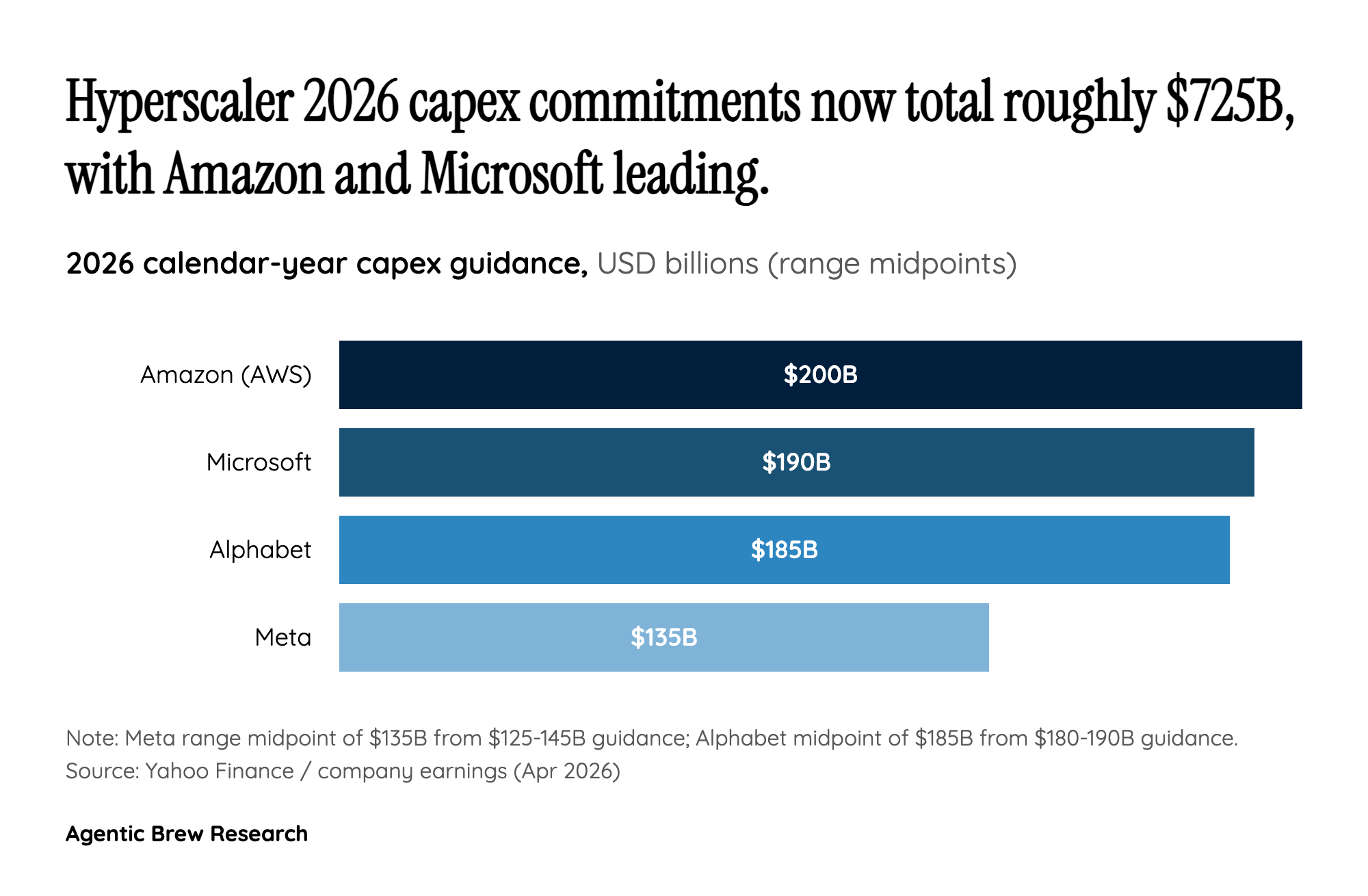
    Combined hyperscaler AI capex projections for 2026 jumped to roughly $725B (from a prior ~$670B high-end estimate) after Microsoft, Alphabet, Meta, and Amazon reported within a tightly compressed earnings window.
  • 03.
    On April 27, 2026 Microsoft and OpenAI restructured their partnership: OpenAI is no longer Azure-exclusive, Microsoft holds a non-exclusive license to OpenAI IP through 2032, and OpenAI's revenue share to Microsoft continues through 2030 but is now subject to a total cap.
  • 04.
    OpenAI's seven-year, $38B compute pact with AWS gives it access to hundreds of thousands of Nvidia GPUs on EC2 UltraServers, anchoring a multi-cloud strategy now spanning AWS, Google Cloud, Oracle, and Microsoft.

Deep Analysis

The 80-Second Window That Re-Rated AI Capex by $55 Billion
The 80-Second Window That Re-Rated AI Capex by $55 Billion
2026 calendar-year capex guidance by hyperscaler, USD billions. Source: Yahoo Finance / company earnings (Apr 2026).

Big Tech's earnings cluster on April 29, 2026 was choreographed almost to the second — Bloomberg called the moment when Alphabet, Meta, Microsoft, and Amazon prints landed inside a roughly 80-second window the night that 'will decide the stock market's fate.' Inside that window, the high-end consensus estimate for 2026 hyperscaler AI capex jumped from around $670B to roughly $725B. That is a $55B re-rating, larger than the entire annual capex of every non-hyperscaler in the S&P 500 except a handful of utilities, absorbed by the market in real time.

The drivers were specific. Microsoft guided to $190B for calendar 2026, explicitly flagging $25B of that as the cost of higher GPU and component pricing rather than incremental capacity. Alphabet raised both ends of its range by $5B to $180-190B. Meta lifted its band by $10B at both ends to $125-145B. Amazon stayed near the top of the pack at roughly $200B. The takeaway is that 'AI capex' is now structurally a four-handed bid into a constrained component supply chain — every hyperscaler is signaling they would rather build ahead of demand than risk being short of GPUs in 2027, which is why the line went up at all four companies on the same night.

What Microsoft Actually Traded: Exclusivity for a 27% Equity Stake

The headline two days before the earnings prints was that Microsoft had given up the most valuable piece of its 2019 deal: OpenAI's cloud exclusivity. The actual mechanics matter more than the headline. Under the April 27 restructuring, Microsoft retains a non-exclusive license to OpenAI IP — including models and products — through 2032. OpenAI's revenue share to Microsoft continues through 2030 at the same percentage, but it is now subject to a total cap, and Microsoft will no longer pay a revenue share back to OpenAI. Azure also keeps first-shipping rights for new OpenAI products unless Microsoft is unable or unwilling to support the workload.

In exchange, Microsoft is reported to have crystallized its position into roughly a 27% equity stake in the restructured OpenAI, valued at approximately $135B against a cumulative cash investment of more than $13B since 2019. Bloomberg's TV segment dominated the high-engagement YouTube coverage and reframed the trade in exactly those terms — Microsoft swapped a contractual moat (you must run on Azure) for a financial one (you owe us a slice of every dollar). The asymmetry of this trade is the thing investors are now pricing: a contractual moat ages badly when the counterparty wants to scale beyond your supply, but an equity stake compounds with whatever cloud OpenAI runs on next.

Multi-Cloud OpenAI: Who Wins, Who Loses

Strip the Azure-exclusivity clause out of the OpenAI relationship and an obvious beneficiary appears: AWS. The seven-year, $38B compute pact OpenAI signed with Amazon last November now reads less like a hedge and more like the centerpiece of a new architecture, with hundreds of thousands of Nvidia GPUs on EC2 UltraServers and the explicit option to scale into 'tens of millions of CPUs.' AWS's 24% revenue growth last quarter — its fastest pace in thirteen quarters — was already reflecting that demand. Matt Garman's framing that AWS is 'uniquely positioned' for OpenAI's most demanding workloads should be read as a marketing claim, but the dollar commitment behind it is real.

The quieter winner is OpenAI itself. By spreading frontier training and inference across AWS, Google Cloud, Oracle, and Microsoft, it eliminates single-vendor concentration risk on the supply side that matters most to a frontier lab — GPU allocation. The loser is anyone whose competitive thesis required Azure to be the sole place to run GPT-class models. Reddit's r/Economics community, with nearly a thousand upvotes on a single post, latched on to a related signal: Anthropic's traction inside AWS Bedrock, which now turns into a directly competitive distribution channel against an OpenAI that is itself moving into AWS. The 'one model, one cloud' era of frontier AI is over, and pricing power inside enterprise AI procurement is shifting from the cloud provider to the model that the customer actually wants.

The Skeptics' Read: Utility-Like Free Cash Flow Meets Record Capex

Microsoft's CFO Amy Hood says the company remains 'confident in the return on these investments, given higher demand signals and increasing product usage, as well as the efficiencies we're already driving across the platform.' The skeptical community is fixated on the same income statements but reading them from the cash-flow side. The dominant frame on r/stocks ahead of these prints was that hyperscaler free-cash-flow yields are now utility-like — Amazon at roughly 0.5% with $200B of capex on the way, Alphabet around 2.1% with $180B+, Microsoft around 1.8% — and that markets are underpricing the multiple compression risk if AI demand growth decelerates even slightly.

The r/Economics thread that gathered the most traction added a sharper point: OpenAI itself missed its revenue target in the most recent disclosure, dragging Nvidia and Oracle with it. If the central buyer of GPU capacity is missing on revenue while the central sellers of cloud are guiding capex up by tens of billions, the bridge between those two facts is investor patience. Bank of America projects a $28B Amazon free-cash-flow deficit in 2026; Morgan Stanley puts it closer to negative $17B. Retail-investor channels like Dividend Talks framed this week's seven-name reporting cluster as a moment to buy only one of the cohort, citing valuation risk against capex commitments. None of this disproves the bull case — Azure +40%, Google Cloud +63%, AWS +24% are real demand signals — but it explains why the same earnings night that re-rated capex up by $55B left a non-trivial set of voices calling for the bubble framing rather than the breakout framing.

The Second-Order Story: Why the Cap on OpenAI's Revenue Share Matters

Most coverage of the Microsoft-OpenAI restructuring stopped at 'no longer exclusive.' The structurally interesting clause is buried deeper: the revenue share OpenAI owes Microsoft through 2030 is now subject to a total cap. This is the financial mechanism that lets OpenAI grow into a much larger company without a perpetual tax on its income statement, which in turn is what makes a path-to-IPO or a path-to-independence financially coherent. Without the cap, every incremental dollar of OpenAI revenue carried a contractual claim back to Redmond, and every cloud OpenAI added — AWS, Google, Oracle — would have been a cost center on top of an existing royalty.

The second-order effect is on Microsoft's reported AI revenue itself. Satya Nadella's headline metric this quarter — a $37B annualized AI run rate, up 123% YoY — is partly a function of OpenAI's growth, not just Copilot and Azure-native AI. As OpenAI ships first on AWS in cases where Azure 'cannot or chooses not to' support the workload, the share of OpenAI revenue Microsoft sees flowing through Azure consumption will gradually decouple from OpenAI's actual top line. The license-through-2032 and the equity stake protect Microsoft on the IP and balance-sheet side. But the day-to-day AI-revenue line investors have been celebrating was built on the old exclusivity regime, and the next four quarters will be the first time anyone gets to see what it looks like under the new one.

Historical Context

2019-07-01
Microsoft made an initial $1B investment in OpenAI and became its exclusive cloud provider.
2023-01-23
Microsoft announced a multibillion-dollar third-phase investment (reported at $10B), bringing cumulative commitment above $13B.
2025-11-03
OpenAI announced a seven-year, $38B compute partnership with AWS, kicking off its multi-cloud era.
2026-04-27
Microsoft and OpenAI announced a restructured partnership ending Microsoft's exclusive cloud and IP rights, with a non-exclusive IP license through 2032 and capped revenue share through 2030.
2026-04-29
Big Tech reported earnings within a roughly 80-second window, lifting combined 2026 hyperscaler AI capex projections to ~$725B.

Power Map

Key Players
Subject

Big Tech Q3 Earnings and AI Spending Amid OpenAI Partnership Shifts

MI

Microsoft

Hyperscaler reporting Q3 FY26 results; trades OpenAI cloud exclusivity for a non-exclusive IP license through 2032 plus a reported ~27% equity stake; guides $190B in 2026 capex including $25B from higher component pricing.

AL

Alphabet

Reports Q1 2026 with Google Cloud revenue up 63%, a $460B cloud backlog, and net income of $62.57B; raises 2026 capex range to $180-190B.

ME

Meta

Posts Q1 2026 revenue of $56.31B (+33% YoY) and net income of $26.8B, raising full-year capex to $125-145B to fund AI infrastructure.

AM

Amazon (AWS)

Major beneficiary of OpenAI's multi-cloud shift via a $38B seven-year compute deal; AWS grew 24% last quarter (fastest in 13 quarters); ~$200B 2026 capex plan.

OP

OpenAI

Counterparty to the restructured Microsoft deal; gains the right to ship products on any cloud; multi-cloud strategy now spans AWS, Google Cloud, Oracle, and Microsoft.

Source Articles

Top 5

THE SIGNAL.

Analysts

"Frames AI as a major and rapidly scaling line of business at Microsoft, supporting the case for continued elevated capex: 'Our AI business surpassed an annual revenue run rate of $37 billion, up 123% year-over-year.'"

Satya Nadella
CEO, Microsoft

"Reaffirms confidence in AI ROI: 'We remain confident in the return on these investments, given higher demand signals and increasing product usage, as well as the efficiencies we're already driving across the platform.'"

Amy Hood
CFO, Microsoft

"Positions AWS as essential to scaling frontier compute beyond a single provider: 'Scaling frontier AI requires massive, reliable compute. Our partnership with AWS strengthens the broad compute ecosystem that will power this next era.'"

Sam Altman
CEO, OpenAI

"Argues AWS scale and maturity make it the natural home for OpenAI's largest workloads: 'AWS brings both scale and maturity to AI infrastructure. This agreement demonstrates why AWS is uniquely positioned to support OpenAI's demanding AI workloads.'"

Matt Garman
CEO, AWS

"Acknowledged OpenAI's restructured partnership announcement publicly: 'Very interesting announcement from OpenAI this morning.'"

Andy Jassy
CEO, Amazon
The Crowd

"OpenAI investors Nvidia and Oracle plunge after AI giant misses revenue target. Is the bubble about to burst?"

@u/InterestingCat308947

"The AI Splurge Is Costing Big Tech Its Workforce"

@u/FewWatercress4917155

"Market and traders are vastly underestimating the risks here with mega cap tech earnings coming up. Specifically the software names."

@u/the_dalailama1340
Broadcast
Microsoft to Get 27% Stake of OpenAI, AI Model Access Until 2032

Microsoft to Get 27% Stake of OpenAI, AI Model Access Until 2032

The Biggest Earnings Week of the Year Is Here. I'd Only Buy 1 Stock.

The Biggest Earnings Week of the Year Is Here. I'd Only Buy 1 Stock.

Microsoft, OpenAI Sever Their Exclusive AI Pact

Microsoft, OpenAI Sever Their Exclusive AI Pact