The Coefficient That Decided the Race
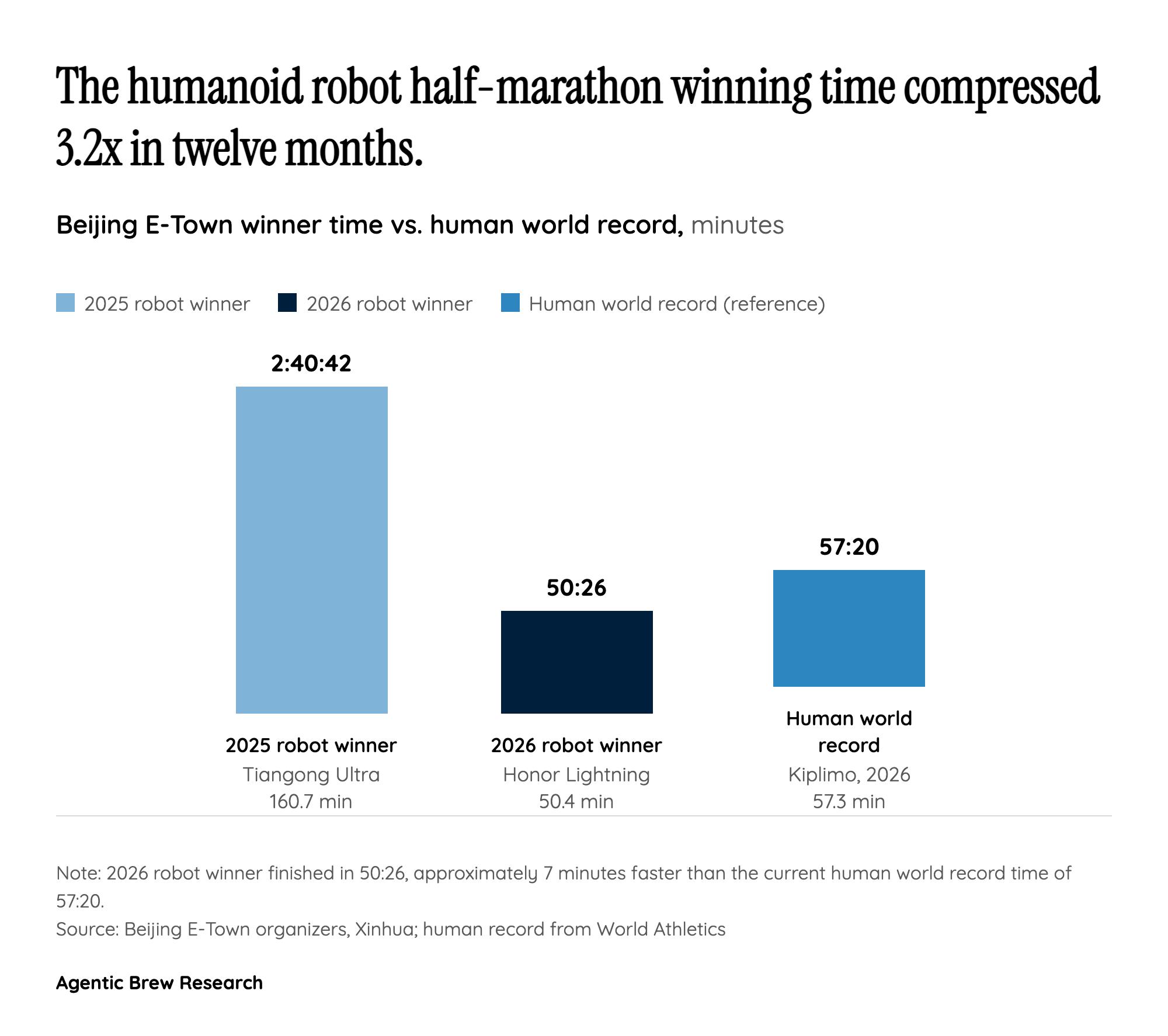
The headline 'humanoid robot beats human world record' obscures a more interesting story buried in the race rules: the fastest robot on the course did not win. A separate Honor entry in the remote-controlled category crossed the line in 48 minutes 19 seconds — nearly a minute and a half faster than Lightning's 50:26. Under the race's 1.2x time-penalty coefficient applied to remote-controlled robots, however, that faster machine's adjusted time pushed it behind the autonomous Lightning, handing the overall win to the self-navigating entry.
Chinese Institute of Electronics official Liang Liang was explicit about what this coefficient is for: 'The setting of coefficient aims to guide and encourage autonomous navigation research.' In other words, this is not a handicap to make the race fairer — it is an industrial policy nudge dressed as a sporting rule. Beijing's organizers are deliberately engineering the outcome to reward the capability that matters most to the downstream industrial use case, namely robots that can perceive and plan in the real world without a human with a joystick.
That policy lens also explains why the top three autonomous finishers were all Lightning models operated by different teams, and why Honor's internal 48:19 machine is a footnote rather than the record. The race is doing what Chinese infrastructure-era competitions have historically done: not finding the best machine that exists today, but pulling the industry toward the machine that policymakers want to exist tomorrow.