Karpathy: Vibe Coding vs Agentic Engineering
TECH

Karpathy: Vibe Coding vs Agentic Engineering

29+
Signals

Strategic Overview

  • 01.
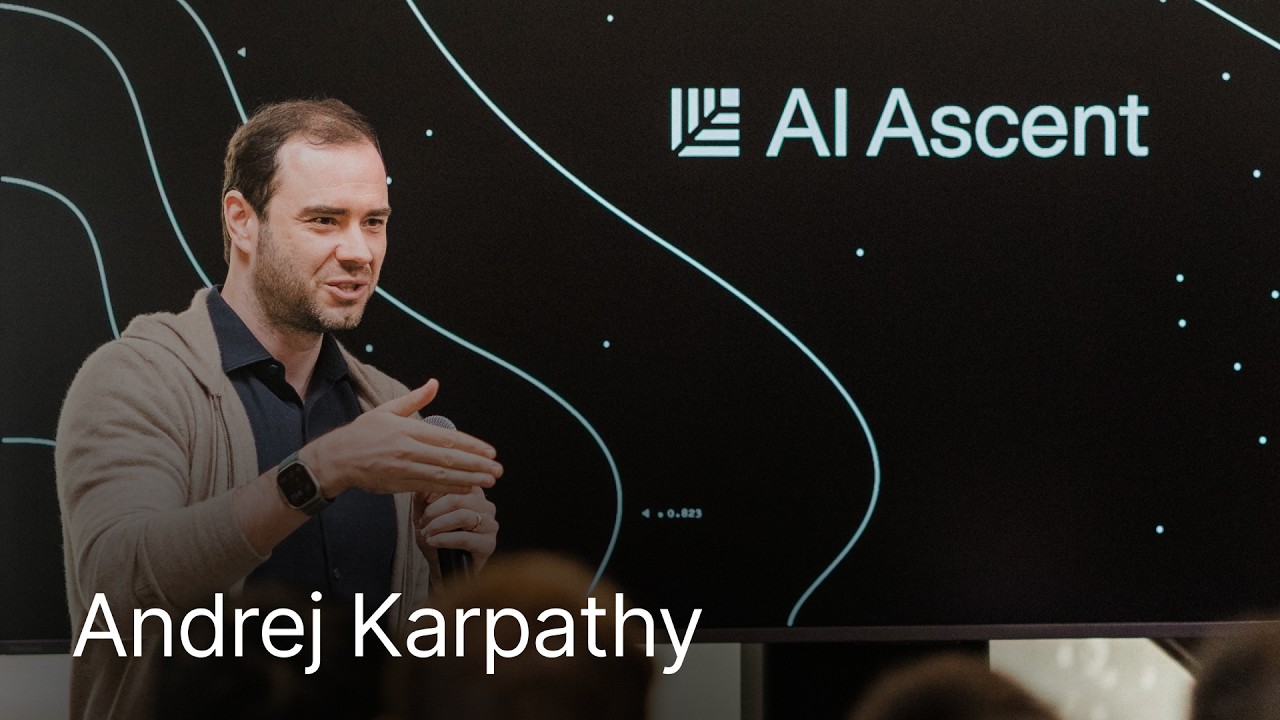
    At Sequoia Capital's AI Ascent 2026 fireside chat, Andrej Karpathy reframed the AI coding stack with a two-tier formulation: 'vibe coding raises the floor' so anyone can build software, while 'agentic engineering raises the ceiling' and preserves the professional quality bar.
  • 02.
    Karpathy defines agentic engineering as the professional discipline of coordinating fallible agents while preserving correctness, security, taste, and maintainability — not just letting the model run.
  • 03.
    Karpathy pinpoints December 2025 as a step change: generated code chunks became large, coherent, and reliable enough that he stopped routinely correcting them, with his self-written-vs-delegated ratio inverting from ~80/20 to ~20/80.
  • 04.
    Despite coining 'vibe coding' in February 2025 and watching Collins name it Word of the Year, Karpathy says he has 'never felt more behind as a programmer' as the human contribution to code becomes increasingly sparse.

Deep Analysis

The Floor-and-Ceiling Trick: Why Karpathy Killed His Own Buzzword

The cleanest way to read Karpathy's Sequoia Ascent 2026 talk is as a deliberate self-correction. A year after he coined 'vibe coding' — a phrase that went so viral it accumulated 4.5M+ views, was logged by Merriam-Webster, and was named Collins English Dictionary's 2025 Word of the Year — he stood on a Sequoia stage and told the room that vibe coding only describes one half of what's happening. 'Vibe coding raised the floor. Agentic engineering raises the ceiling,' he said. The first phrase democratized creation; the second is, in his words, 'the professional discipline of coordinating fallible agents.'

The two-tier framing is doing real editorial work. It answers a question the original meme could not: what happens to professional software engineers when anyone can ship something that compiles? Karpathy's answer is that the profession bifurcates. The bottom is wider — non-coders can now build working apps with prompts. The top is also higher — engineers who learn to direct fleets of agents while holding the line on correctness, security, taste, and maintainability compound into something he likens to the legendary '10x engineer.' Crucially, the middle gets squeezed. The framing implicitly retires the romantic version of vibe coding ('going with the vibes and not reviewing the code,' as Addy Osmani puts it) as a hobbyist mode rather than a production practice — and recasts the people who scaled it into a workflow as the new craftsmen of the field.
December 2025: The Month the Ratio Flipped

Most of the conversation around AI coding talks in vague trajectories. Karpathy gave it a date. 'Around December 2025, I felt a step change: the generated chunks got larger, more coherent, and more reliable.' He describes a personal threshold crossed — 'I can't remember the last time I corrected it. I just trusted the system more and more' — and quantifies it: his code-writing ratio inverted from roughly 80% self-written to roughly 80% delegated to agents. Coverage of the talk specifically pegs this inversion to late 2025, with Claude Opus reportedly capable of refactoring ~100,000-line codebases.

That's a stronger claim than 'AI is getting better.' It's a workflow inversion. When the ratio of human-authored to agent-authored bits flips, the bottleneck moves with it. The hard part is no longer typing the code; it's deciding what code should exist, framing the context window so the model produces the right thing, reviewing what comes back, and catching the silent failures that don't trip a stack trace. This is also why Karpathy says, in the same breath, that he has 'never felt more behind as a programmer' — the bits humans contribute are getting sparser, and the leverage from properly stringing together agentic tooling is, by his own estimate, on the order of 10x. The discomfort is the point: the people who feel most behind are the ones closest enough to the frontier to see how far they could already be.

Software 3.0 and the Verifiability Principle

Underneath the floor/ceiling slogan sits a more technical thesis: this is 'Software 3.0.' Software 1.0 was hand-written code; Software 2.0 was learned weights inside trained neural networks; Software 3.0 is programming through prompting, where 'what's in the context window is your lever over the interpreter that is the LLM.' In this frame, the context window becomes a first-class engineering surface — not a chat box but a programmable environment where specs, tests, retrieved code, and tool descriptions are the actual program text.

The second half of the thesis is the verifiability principle: AI automates what you can verify, not just what you can specify. Domains with cheap, mechanical reward signals — code that compiles and tests that pass, math with checkable answers — progress fastest, which is exactly why coding flipped first. This explains the asymmetry observers keep noticing: agents can refactor a six-figure-line codebase but still struggle in domains where ground truth is fuzzy or expensive to check. It also reframes the build-vs-buy decision Karpathy raised with his MenuGen example: 'ask what AI makes unnecessary, not just what it makes faster.' Many of today's AI products are scaffolding around current model limitations; when verifiability gets cheaper inside the base model, the wrapper stops needing to exist. Agentic engineering, in this view, is partly the craft of betting on which side of that line your work sits.

The Practitioner Counter-Current: Harness Wars, Silent Failures, and Skill Atrophy

The reception on Reddit and the engineering podcast circuit is admiring but pointed, and worth taking seriously because it complicates the clean narrative. The loudest practitioner consensus is that the model isn't the whole story: 'It's been more harness than model for a while now,' as one r/ClaudeCode commenter put it, with compaction-via-sub-agent-summarization treated as a bigger unlock than any single weight update. Practical patterns circulate alongside the theory — the 'Ralphie Loop' where an agent first enumerates problems then fixes each with targeted instructions; Cursor rules that force the model to stop and ask clarifying questions on inconsistencies; comparisons of Codex-CLI versus Codex-inside-Cursor as harness choices that matter as much as model choice. Heavy upfront infrastructure — deterministic plus non-deterministic tools, sub-agents, careful context plumbing — is treated as the actual unlock.

The skeptical thread is sharper. Practitioners point out that current models 'don't manage their confusion, don't seek clarifications, don't surface inconsistencies, don't push back,' which makes silent failures — the kind that don't throw errors but quietly corrupt data, like Karpathy's own example of mismatched Stripe and Google account emails — the dominant risk. Others warn of skill atrophy for junior developers who skip the design-thinking layer, and of a 'lump of cognition' fallacy that conflates volume with quality (the chair-factory analogy: 1000 chairs an hour, but worse chairs). A minority openly questions the messenger — noting that an OpenAI co-founder has obvious incentives to argue that LLMs are transformative — and a stubborn linguistic camp insists 'It will forever be vibe coding now. You can't just come up with a better name.' The honest read is that Karpathy's framing is descriptively useful but contingent: agentic engineering as a discipline only delivers on the ceiling claim if the harness, the review culture, and the verification scaffolding actually get built around the model. Without that, raising the floor without raising the ceiling is exactly what people are afraid of.

Historical Context

2025-02-02
Karpathy coins 'vibe coding' in an X post describing fully giving in to the vibes with Cursor Composer + Sonnet; the post accumulates 4.5M+ views.
2025-03-08
Merriam-Webster lists 'vibe coding' as a slang and trending expression.
2025-11-06
'Vibe coding' is named Collins English Dictionary Word of the Year for 2025.
2025-12-01
Karpathy says December 2025 was the step change when his code-writing ratio inverted from ~80% self-written to ~80% delegated to agents.
2026-04-01
Sequoia AI Ascent 2026 fireside chat where Karpathy introduces 'agentic engineering' as the successor framing to vibe coding.

Power Map

Key Players
Subject

Karpathy: Vibe Coding vs Agentic Engineering

AN

Andrej Karpathy

Founder of Eureka Labs, OpenAI co-founder, and former Tesla AI head; coined 'vibe coding' on Feb 2, 2025 and now coined 'agentic engineering' at Sequoia AI Ascent 2026.

SE

Sequoia Capital

Hosted the AI Ascent 2026 conference where Karpathy's fireside chat introduced 'agentic engineering' as the successor framing to vibe coding.

AN

Anthropic / Claude Code

Maker of Claude Code, an agentic coding system handling repository-level changes; cited as a tool enabling agentic engineering at production scale, with Claude Opus referenced as capable of refactoring ~100,000-line codebases.

CU

Cursor

AI-native code editor whose Composer + Sonnet integration was the trigger for Karpathy's original vibe-coding tweet, now positioned as an agentic IDE for professional engineering workflows.

AD

Addy Osmani

Engineering leader at Google Chrome whose 'Agentic Engineering' essay articulates the discipline as planning-led, review-heavy AI-assisted development; widely cited alongside Karpathy's framing.

Source Articles

Top 1

THE SIGNAL.

Analysts

"Vibe coding democratized creation, but agentic engineering — coordinating fallible agents while preserving the quality bar — is what separates shippable, production-grade developers from the rest. Karpathy stresses that 'you can outsource your thinking, but you can't outsource your understanding,' and argues there is a very high ceiling on agentic-engineer capability, comparable to the legendary '10x engineer' archetype."

Andrej Karpathy
Founder, Eureka Labs; OpenAI co-founder; former Director of AI at Tesla

"Trust in agents has crossed a threshold for him personally — he has stopped correcting agent output line-by-line — but he frames programming as having shifted into 'Software 3.0,' where the context window is the lever over the LLM interpreter."

Andrej Karpathy
Founder, Eureka Labs

"Agentic engineering is fundamentally different from vibe coding because it requires upfront planning, rigorous code review, comprehensive testing, and human ownership of architecture and quality. The discipline amplifies the value of senior engineers, because the model is only as good as the specs and tests around it."

Addy Osmani
Engineering leader, Google Chrome; author and blogger
The Crowd

"Fireside chat at Sequoia Ascent 2026 from a ~week ago. Some highlights: The first theme I tried to push on is that LLMs are about a lot more than just speeding up what existed before (e.g. coding). Three examples of new horizons: 1. menugen: an app that can be fully engulfed by [...]"

@@karpathy0

"It is hard to communicate how much programming has changed due to AI in the last 2 months: not gradually and over time in the 'progress as usual' way, but specifically this last December. There are a number of asterisks but imo coding agents basically didn't work before December [...]"

@@karpathy0

"OpenAI cofounder Andrej Karpathy says 'agentic engineering' is the next evolution in AI coding as vibe-coding marks its first anniversary."

@@BusinessInsider0

"Karpathy proposes 'Agentic Engineering' as the successor to 'vibecoding' for the future of human-AI collaboration"

@u/nekofneko115
Broadcast
Andrej Karpathy: From Vibe Coding to Agentic Engineering

Andrej Karpathy: From Vibe Coding to Agentic Engineering

Skill Issue: Andrej Karpathy on Code Agents, AutoResearch, and the Loopy Era of AI

Skill Issue: Andrej Karpathy on Code Agents, AutoResearch, and the Loopy Era of AI

Karpathy vs. McKinsey: The Truth About AI Agents (Software 3.0)

Karpathy vs. McKinsey: The Truth About AI Agents (Software 3.0)