Pentagon's $500M Scale AI Contract and DeepMind Worker Unionization Over Military AI
TECH

Pentagon's $500M Scale AI Contract and DeepMind Worker Unionization Over Military AI

38+
Signals

Strategic Overview

  • 01.
    The Pentagon awarded Meta-backed Scale AI a $500 million contract through the Chief Digital and AI Office (CDAO) for data analysis and decision-making support — a five-fold expansion of the $100 million deal Scale AI received in September 2025.
  • 02.
    Google DeepMind's UK staff voted to launch a unionization bid with 98% of CWU members backing it, what would be the world's first union at a frontier AI lab, citing Pentagon Gemini deals and Israeli military contracts.
  • 03.
    On May 1, 2026, the Pentagon announced classified-network AI agreements with eight tech firms — AWS, Google, Microsoft, OpenAI, SpaceX, NVIDIA, Reflection, and Oracle — while notably excluding Anthropic after a dispute over Claude's restrictions on mass surveillance and autonomous weapons.
  • 04.
    Google agreed to let the U.S. Department of Defense use its Gemini AI models inside classified IL6/IL7 networks 'for any lawful purpose,' a phrasing critics warn could open the door to autonomous weapons and domestic mass surveillance.

Deep Analysis

The 5x Procurement Velocity: How Scale AI Went From $100M to $500M in Eight Months
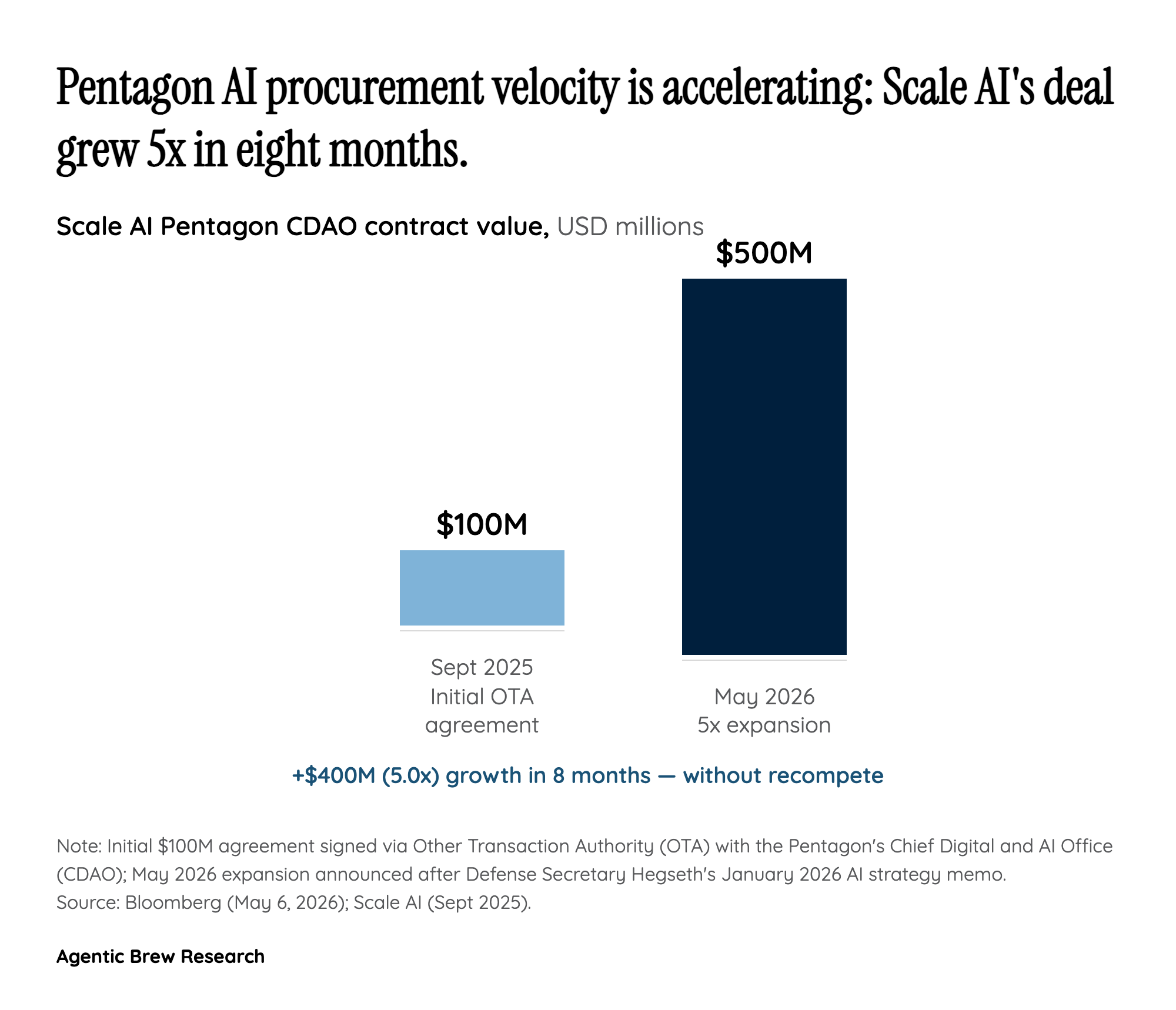
The 5x Procurement Velocity: How Scale AI Went From $100M to $500M in Eight Months
Scale AI Pentagon CDAO contract value, USD millions (Sept 2025 vs May 2026)

Scale AI's contract did not grow through a new RFP, a fresh competition, or a public reckoning over scope. It grew because Defense Secretary Pete Hegseth's January 2026 AI strategy memo explicitly directed the Department of Defense to dismantle what he called 'bureaucratic barriers' to AI adoption — and the Chief Digital and AI Office (CDAO) had a vehicle ready to scale. The September 2025 Other Transaction Authority (OTA) deal that gave Scale AI access to TS/SCI environments was a plumbing job. The May 2026 expansion is what flows through the plumbing once the valve is opened.

That tempo matters. A 5x expansion of a defense AI contract inside eight months is not how the Pentagon has historically purchased software, and it tells frontier AI labs that the procurement bottleneck is no longer the constraint. Scale AI's Dan Tadross telegraphed exactly that read: the contract is 'proof that the department is eager to adopt this technology.' For competitors watching, the lesson is that landing a foothold OTA in 2025 was the actual prize — not the dollar value at signing, but the option value of expansion-without-recompete once a friendly DoD strategy memo lands. Every AI lab that did not get an OTA in time is now structurally a year behind.

Why DeepMind, and Why a Union: The Mechanics of the First Frontier-AI Lab Organizing Bid

The DeepMind unionization bid is not a generic tech-worker protest; it is a structurally specific response to a structurally specific problem. UK labor law gives unions a legally enforceable path to recognition: if Google does not voluntarily recognize the Communication Workers Union (CWU) and Unite within 10 working days, the unions can pursue statutory recognition. That is leverage that California-based Googlers have never had. The 2018 Project Maven petition mobilized 3,100-4,000 employees and successfully killed contract renewal — but it was a one-off, dependent on viral momentum and Google's then-public AI ethics pledge. By 2024, Google felt confident enough to fire 28 employees protesting Project Nimbus. The petition era ended.

Unionization re-engineers the leverage equation. Workers organizing through CWU's John Chadfield can credibly threaten research strikes that would halt contributions to Gemini — Google's flagship AI product, the same model now embedded in classified Pentagon networks. That is a different category of pressure than an open letter. It is also why this matters beyond DeepMind: if recognition succeeds, every other UK-based AI lab becomes a potential organizing target, and the precedent that ethics-driven work stoppages are a normal part of frontier AI labor relations gets established at the source. The 98% CWU vote, the ~1,000 London staff covered, and the 100+ DeepMind signatures on a separate internal letter all point to a base that is unusually concentrated and unusually high-leverage compared to general tech-worker organizing.

The Anthropic Exclusion: A Tell About Which AI Labs the Pentagon Will Tolerate

When the Pentagon announced its classified-network AI agreements on May 1, 2026, the most informative item was not who was on the list — AWS, Google, Microsoft, OpenAI, SpaceX, NVIDIA, Reflection, and Oracle — but who was off it. Anthropic, the lab whose models compete head-to-head with Gemini and GPT, was excluded after a dispute over Claude's usage policies restricting mass surveillance and autonomous-weapons applications. Google's Gemini deal, by contrast, runs on 'any lawful governmental purpose' framing — language that Fortune's coverage of the deal warned 'could open the door to autonomous weapons and mass surveillance of American citizens with few enforceable limits.'

The revealed preference is sharp: the Pentagon will pay frontier-AI prices for frontier-AI capability, but only from vendors willing to sign permissive end-use agreements. That creates a two-tier market. Labs that retain hard usage restrictions — the kind Anthropic publishes in its acceptable use policy — get walled off from the largest classified-AI buyer in the world. Labs that loosen those restrictions get the contract and the IL6/IL7 access. Google's February 2025 removal of its no-weapons-or-surveillance pledge looks, in hindsight, less like a values drift and more like commercial pre-positioning for exactly this moment. For Anthropic, the cost of principle is now legible in dollars; for everyone else, the cost of capitulation is now legible in worker uprisings.

Meta's 49% Stake in Scale AI Quietly Re-Wires Frontier-AI Economics Around Defense Buyers

Meta's $14.3 billion investment for roughly 49% of Scale AI in June 2025 was framed at the time as a superintelligence bet — Alexandr Wang departing Scale to lead Meta's frontier efforts, with Scale's data labeling pipeline becoming a captive resource. The Pentagon contract reframes it. Meta now holds a near-majority economic interest in the largest CDAO contractor and a direct line into Defense Llama, the defense-tuned variant of its open-weights models. The data pipeline that trains consumer-facing Llama and the data pipeline that trains classified-network AI for the U.S. military are no longer separable cost centers — they are entwined balance-sheet items.

That changes the math for the entire frontier. When defense revenue becomes structurally important to a top-three AI lab, every other lab faces an investor question they did not face in 2018: why are you not pursuing this revenue stream? OpenAI, already on the Pentagon's classified list, has a Microsoft channel into the same pipeline. Google has its Gemini deal. Anthropic, by virtue of its policies, is now visibly missing the most aggressive growth tier of the AI market. Workers at DeepMind reading these numbers are seeing a future where ethical AI commitments are not rolled back through ideology but through cap-table gravity — and unionization becomes the only remaining mechanism for resisting a financial pull that engineering memos and AI principles documents cannot withstand.

Project Maven's Echo: Why the 2018 Playbook No Longer Works, and What Worker Organizing Looks Like When Petitions Fail

The eight-year arc from Project Maven to today is the story of a worker leverage curve bending in the wrong direction. In 2018, Google employees signed a letter, the company declined contract renewal, and AI principles were published with explicit no-weapons commitments. In 2024, Google fired 28 protesters of Project Nimbus and faced no comparable internal revolt. In 2025, the AI weapons pledge was quietly removed. By May 2026, Fortune's coverage notes that internal mailing lists and social tools have been curtailed since Project Maven, that petitions with hundreds of signatures are now ignored, and that 580+ Google employees signing an open letter against the classified Pentagon deal — including 20+ directors and VPs — produced no policy change.

This is the context in which unionization stops being one tactic among many and becomes the only tactic with structural teeth. Developer-leaning Reddit threads in r/google and r/ArtificialInteligence capture the skepticism — that DeepMind's headcount is too small, that Google may retaliate via layoffs or H-1B replacement, that the existing 2021 Alphabet Workers Union holds only minority membership and has not changed company behavior. Labor-leaning communities in r/antiwork frame it differently: the US-vs-UK labor culture gap matters because UK statutory recognition is enforceable, and DeepMind's research talent is uniquely concentrated and uniquely hard to replace. The Project Maven playbook — petition, viral letter, public shaming — exhausted its returns somewhere between 2018 and 2024. What replaces it is the slow, structural, legally-backed grind of recognized collective bargaining at the exact engineering layer where frontier AI gets built. That is the bet DeepMind workers are making, and it is the bet the rest of the industry will be watching.

Historical Context

2017-04-01
Project Maven (Algorithmic Warfare Cross-Functional Team) is established to apply machine learning to drone footage analysis, originally targeting ISIS imagery.
2018-04-01
Roughly 3,100-4,000 Google employees sign a letter to CEO Sundar Pichai protesting Project Maven, leading Google to decline contract renewal.
2024-01-01
Google fires 28 employees who protested Project Nimbus, the $1.2B joint contract with Amazon serving the Israeli government and military.
2025-02-01
Google removes its prior pledge not to develop AI weapons or surveillance tools from its publicly published AI principles.
2025-06-01
Meta announces a $14.3B investment for ~49% of Scale AI; founder Alexandr Wang departs to lead Meta superintelligence efforts.
2025-09-01
Scale AI signs a $100M five-year OTA agreement with the Pentagon's CDAO covering Scale Data Engine, Donovan, and the GenAI Platform up to TS/SCI environments.
2026-05-01
Pentagon announces classified-network AI agreements with eight tech firms (AWS, Google, Microsoft, OpenAI, SpaceX, NVIDIA, Reflection, Oracle); Anthropic is absent.
2026-05-05
DeepMind UK staff publicly demand union recognition with 98% CWU support, citing Pentagon and Israeli military contracts.
2026-05-06
Bloomberg reports the $500M Scale AI contract — a 5x expansion of the September 2025 deal — administered through CDAO.

Power Map

Key Players
Subject

Pentagon's $500M Scale AI Contract and DeepMind Worker Unionization Over Military AI

SC

Scale AI

Recipient of the $500M Pentagon CDAO contract; provides data curation, the Donovan platform, and Scale GenAI Platform to DoD; Meta owns roughly 49% of the company.

ME

Meta Platforms

Holds ~49% of Scale AI following its $14.3B June 2025 investment; founder Alexandr Wang moved to Meta to lead superintelligence efforts, tightly linking Meta's AI economics to defense procurement.

U.

U.S. Department of Defense / CDAO

Awarding agency executing Defense Secretary Hegseth's January 2026 AI strategy memo to accelerate AI adoption and remove procurement barriers.

GO

Google DeepMind

Target of the unionization bid covering ~1,000 London staff; under internal pressure from open letters over its Pentagon Gemini deal and Israeli military contracts.

CO

Communication Workers Union (CWU) and Unite the Union

UK unions seeking voluntary recognition at DeepMind within a 10-working-day deadline; CWU's John Chadfield is the public face of the campaign.

AN

Anthropic

Notably excluded from the Pentagon's classified-network AI agreements after disputes over Claude's restrictions on mass surveillance and autonomous-weapons use cases.

Source Articles

Top 1

THE SIGNAL.

Analysts

"Frames the expanded contract as evidence of Pentagon eagerness to adopt AI at scale and as a signal the DoD is pushing the boundaries of the original deal."

Dan Tadross
Head of Public Sector, Scale AI

"Argues collectivization gives DeepMind workers leverage to demand the company 'stop circling the ethical drain of military-industrial contracts.'"

John Chadfield
National Officer for Tech Workers, Communication Workers Union (CWU)

"Joined the union over concerns that AI is being used to empower authoritarianism through military and surveillance applications, both foreign and domestic."

Anonymous DeepMind employee
DeepMind worker (cited in Gizmodo coverage)

"Defends the Pentagon partnership as part of a broad consortium of AI labs and cloud companies supporting national security, and disputes the union's framing of a completed vote."

Google spokesperson
Google corporate communications

"On Carnegie Endowment's podcast, argues the U.S. is fighting its 'first full-scale AI war,' with Project Maven's lineage now running through Scale AI/Microsoft's Thunderforge program and humans-in-the-loop guardrails eroding."

Katrina Manson
Bloomberg reporter and author of 'Project Maven: A Marine Colonel, His Team, and the Dawn of AI Warfare'

"On DW News, situates the Pentagon's classified-network AI deals within an emerging US-China AI arms race and warns about autonomous-weapons red lines becoming harder to defend."

Andrew Reddie
Founder, Berkeley Risk and Security Lab
The Crowd

"Workers at the UK branch of Google's AI lab, DeepMind, have voted to unionise – partly in a bid to resist deals with the US and Israeli militaries. The workers wrote to management on Tuesday to request the Communication Workers Union and Unite the Union be recognised as their representatives."

@@novaramedia0

"Google DeepMind workers unionize to block AI deployment in US-Israeli warfare —— In a landmark challenge to the tech giant's military ambitions, hundreds of workers at Google's elite artificial intelligence division have voted to unionize over the use of their technology in warfare."

@@TheCradleMedia0

"The British-based Google DeepMind employees – who aim to become the first frontier AI lab worldwide to unionise – sent a letter to management this morning requesting recognition of the Communication Workers Union and Unite the Union as their official representatives."

@@The_NewArab0

"Google DeepMind Workers Vote to Unionize Over Military AI Deals in the UK. Should Google Workers in the US Unionize as well? Why a lack of unions in US tech companies?"

@u/RandomUwUFace603
Broadcast
Inside the Pentagon's AI War Machine

Inside the Pentagon's AI War Machine

US strikes deal with tech giants to deepen AI military ties | DW News

US strikes deal with tech giants to deepen AI military ties | DW News

Pentagon taps 7 tech companies for classified AI, shuns Anthropic

Pentagon taps 7 tech companies for classified AI, shuns Anthropic