Amazon Bedrock AgentCore production patterns
TECH

Amazon Bedrock AgentCore production patterns

38+
Signals

Strategic Overview

  • 01.
    Amazon Bedrock AgentCore is AWS's managed, serverless platform for production agents, exposing seven primitives — Runtime, Memory, Identity, Gateway, Code Interpreter, Browser Tool, and Observability — designed to replace bespoke agent infrastructure.
  • 02.
    AgentCore reached general availability on October 13, 2025 with a customer launch roster that included Clearwater Analytics, Cox Automotive, Druva, Ericsson, Experian, Heroku, National Australia Bank, Sony, and Thomson Reuters.
  • 03.
    On May 21, 2026 AWS published a coordinated wave of production-pattern blogs covering multi-tenant SaaS (silo/pool/bridge), recursive language models via Code Interpreter, sales BI at OPLOG, dashboard automation via QuickSight, and natural-language AWS CLI through MCP.
  • 04.
    On December 2, 2025 AWS added Policy controls and AgentCore Evaluations in preview, plus episodic Memory and bidirectional Runtime streaming for voice agents, framing the additions as the path to 'trusted' agent deployment.

The 10-Month Sprint From Preview to a Five-Pattern Playbook

AgentCore moved from preview to general availability in roughly three months — AWS introduced it on July 16, 2025 [1]and shipped it to GA on October 13, 2025 with seven managed components and a who's-who launch roster including Clearwater Analytics, Cox Automotive, Druva, Ericsson, Experian, Heroku, National Australia Bank, Sony, and Thomson Reuters [2]. That speed alone wasn't surprising; AWS routinely runs that cycle. What was surprising is what came next.

On May 21, 2026, AWS dropped five distinct production-pattern blogs the same day — multi-tenant SaaS using silo/pool/bridge isolation [3], recursive language models running inside the Code Interpreter sandbox to process arbitrarily-long documents [4], OPLOG's full sales BI deployment [5], QuickSight dashboard automation via natural language [6], and the AWS API MCP Server fronted by AgentCore Runtime [7]. Sandwiched in between, on December 2, 2025, AWS added Policy controls and AgentCore Evaluations in preview, plus episodic Memory and bidirectional Runtime streaming for voice agents [8]. The message: the platform isn't just shipping — it has an opinionated production playbook with concrete recipes, and AWS is willing to put customer names against the outcomes.
Why Silo, Pool, and Bridge Are the Whole Game

The multi-tenant reference is where AgentCore's design philosophy is least disguised. Patel et al. argue that production agents for SaaS converge on three deployment patterns — silo (dedicated runtime, memory, and data per tenant), pool (shared infrastructure with namespace partitioning), and bridge (hybrid) [3]. AgentCore Runtime backs all three with a structural trick the post is explicit about: "AgentCore Runtime launches lightweight microVMs on a per-session basis...Each session carries its own persistent file system, so agents can read and write session-scoped files" [3]. That microVM-per-session boundary is what makes pool mode safe — tenant context flows in via JWT, tenant tier and entitlements ride custom HTTP headers, and Identity enforces scoped OAuth tokens before any tool call reaches a downstream service.

The second design pivot is acting under delegated identity, not impersonation. The AWS-canonical guidance is to use scoped token delegation — the agent calls downstream services as itself with rights delegated from the user — rather than impersonating the user, because impersonation collapses the audit story and breaks least-privilege. Around that core, Memory partitions by tenant namespace, Gateway abstracts MCP-compatible tools, and Observability tags every OpenTelemetry span with tenant ID so cost attribution and incident scoping survive the pooled deployment. The whole stack is engineered around a single question: when 5,000 tenants share the same control plane, what protects tenant N from tenant N+1 — and how do you bill them separately?

By The Numbers: What Customers Actually Got

By The Numbers: What Customers Actually Got
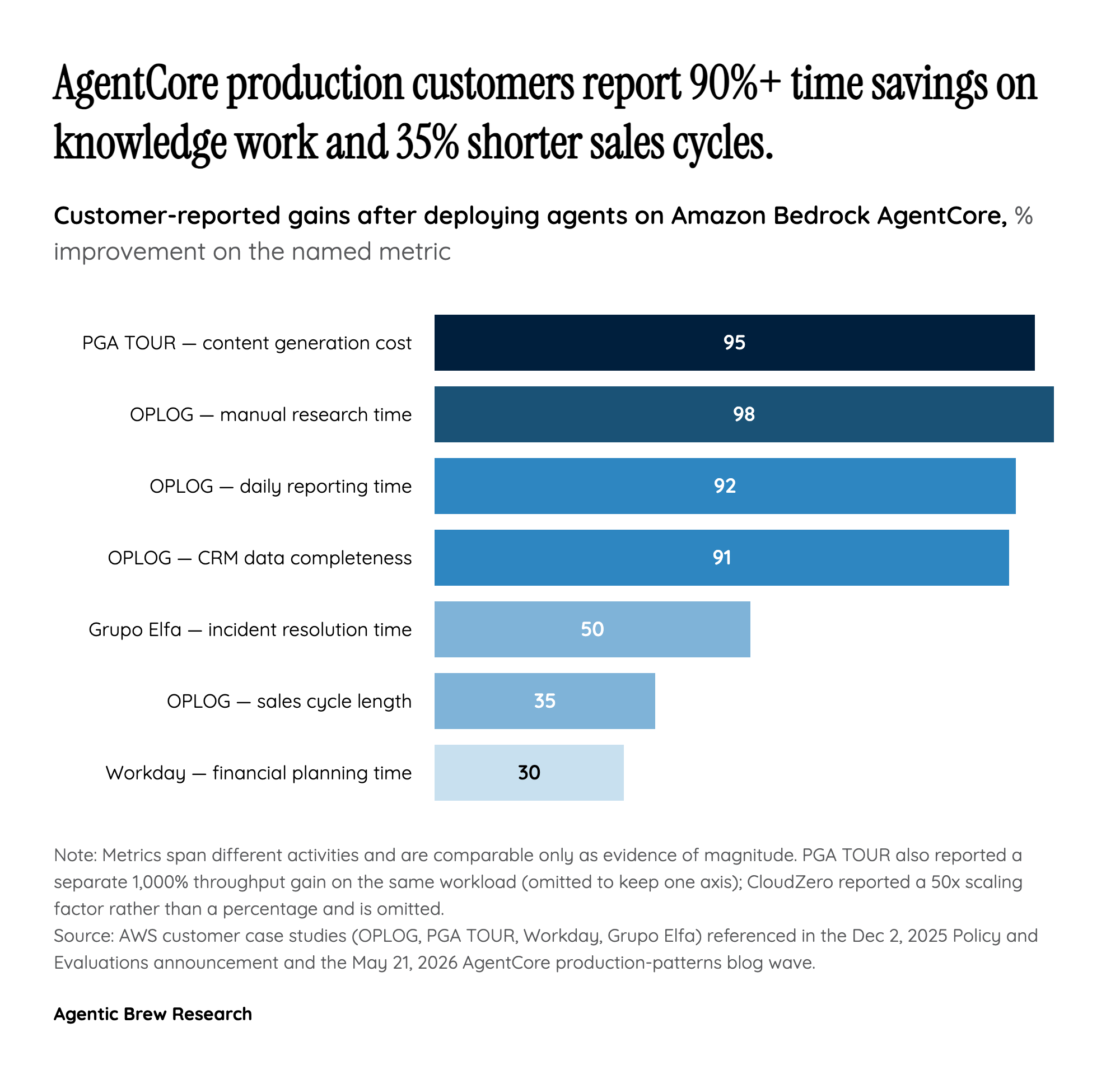
AgentCore customer-reported gains: knowledge-work tasks compress 90%+, while higher-judgment activities like deal velocity and incident resolution land in the 30-50% range.

The outcomes AWS chose to publish are aggressive enough that the numbers are themselves the story. OPLOG, deploying three Strands-built agents on AgentCore Runtime, reports a 35% reduction in sales-cycle length, a 91% improvement in CRM data completeness, a 98% reduction in manual research time, and 99.9% system availability [5]. The standalone OPLOG case study layers in another set: a 90% reduction in decision-making time, 85–95% resource utilization versus a 60–70% industry baseline, 30–40% lower opex, and 75% faster time-to-production (one month down to one week) [9]. PGA TOUR's multi-agent content generation cites a 1,000% speed increase and a 95% cost reduction [8], and Workday's financial-planning agent on the Code Interpreter saves roughly 100 hours per month [8]. CloudZero Advisor scaled 50x on Runtime; Grupo Elfa's Observability deployment delivered 100% decision traceability and 50% faster resolution [8].

The numbers cluster on a recognizable shape: 90%+ time savings on knowledge-work activities that used to require humans waiting on data or sitting in tools, with 30–50% gains on higher-judgment activities like sales cycles and incident resolution. The Recursive Language Models paper from the same May 21 wave makes the most extreme structural claim — by treating the Code Interpreter sandbox as persistent working memory and calling sub-LLMs from inside it, the root model never has to fit a long document into its context window, and the technique reports a 100% success rate on the LongBench v2 Financial Multi-Document QA evaluation [4].

What Practitioners Are Saying That AWS Isn't

AWS's narrative is unified; the community's is more skeptical. On r/aws, the headline thread is literally titled "Amazon Bedrock AgentCore in production" — a developer asking, with their primary cloud stack already on AWS, whether anyone is genuinely running AgentCore for client work or PoCs and what challenges they have hit. The framing is telling: nine months after GA, production-readiness is still a real question in the community rather than a settled fact.

The IaC gap is the loudest practical signal. A community Terraform module published in r/Terraform — billed as a BYO-image runtime plus optional CodeBuild pipeline, with Memory and Gateway as opt-in flags — exists precisely because the official deployment path is CLI- and script-first rather than something a platform team can drop into an existing infrastructure-as-code repo. That gap is a tell: AWS shipped the service ahead of the production tooling story, and the community is filling in. The Agent Registry, AWS's answer to the MCP registry, drew a parallel question on r/mcp asking whether anyone has actually been listed there yet — a sign that, as of this writing, the discovery surface is closer to internal showcase than open marketplace.

Developer YouTube confirms the same skew. The most-viewed onboarding content is AWS-produced — Show & Tell episodes covering first production deployments and Runtime internals — alongside a community crash-course tutorial that walks builders through getting an agent into the Runtime-Gateway-Memory-Identity-Observability stack. The niche patterns AWS now markets (OPLOG sales BI, RLM, healthcare reference) live almost entirely inside AWS's own blog and re:Invent corpus rather than in independent practitioner content, which means the framing reaching most builders is the framing AWS chose.

The Lock-In Calculus Just Tilted

The strategic question for builders is whether AgentCore is a managed convenience or a capture device, and the December 2 release moved that needle. Adding Policy and Evaluations as services outside the agent reasoning loop [8]means the parts that determine whether a regulated enterprise will deploy at all — what actions an agent can take, whether its outputs are correct enough — now run as managed AWS services rather than as portable in-process libraries. Combine that with Identity (scoped OAuth delegation), Gateway (MCP-compatible tool abstraction), Memory (namespaced personalization), and Observability (OpenTelemetry with tenant tags), and the operational dependencies that make an agent shippable accrete on the AWS side of the line.

The counter is the price tag and the openness gestures. AWS's own QuickSight + MCP example sizes a single enterprise user at roughly $292/month at 500 queries/month [7], mostly QuickSight and infrastructure rather than AgentCore itself — meaningful at scale but not blocking. The open-source AgentCore MCP Server [10]plus framework-agnostic Runtime (Strands, LangGraph, the AgentCore Python SDK) keep the agent code portable in principle. The pragmatic read for most enterprise builders is the one PwC's published reference architecture already encodes [11]: the productivity wins are concrete enough today that the cost of not adopting AgentCore — building Runtime, Identity, Memory, Gateway, and Observability themselves — exceeds the cost of single-vendor concentration. The hyperscaler with the deepest enterprise sales motion just made the path of least resistance run through its own primitives.

Historical Context

2025-07-16
AWS introduces Amazon Bedrock AgentCore in preview as the way to securely deploy and operate AI agents at any scale.
2025-09-26
First healthcare reference architecture on AgentCore published, focused on pediatric immunization scheduling.
2025-10-02
Open-source AgentCore MCP Server released so Kiro, Cursor, Claude Code, and Amazon Q Developer CLI users can provision and deploy agents from natural language.
2025-10-13
AgentCore reaches general availability with seven components and a launch roster of large enterprise customers and partners.
2025-12-02
AgentCore adds Policy controls and Evaluations (preview), episodic Memory, and bidirectional Runtime streaming for voice agents.
2026-05-21
Coordinated production-pattern blog wave: multi-tenant SaaS, recursive language models via Code Interpreter, OPLOG sales BI, QuickSight dashboard automation, AWS API MCP via Amazon Quick.

Power Map

Key Players
Subject

Amazon Bedrock AgentCore production patterns

AM

Amazon Web Services

Vendor and platform operator. Ships AgentCore as a managed serverless service and publishes the reference architectures that define how customers are expected to deploy multi-tenant agents on AWS.

OP

OPLOG

Reference customer in fulfillment SaaS running three Strands-built agents (Deal Analyzer, Sales Coach, Lead Insight) on AgentCore Runtime, supplying the most cited production outcome numbers AWS uses to justify the platform.

PW

PwC

Systems integrator that built a FinOps multi-agent system on AgentCore for a global enterprise; their published reference shows how Big-Four partners are packaging AgentCore into enterprise consulting engagements.

IN

Innovaccer

Large US healthcare data platform partner that supplies the canonical healthcare agent reference (pediatric immunization scheduling) on AgentCore.

PG

PGA TOUR and Workday

Headline-quote customers that supply the platform's biggest impact numbers — PGA TOUR's 10x content generation speed and 95% cost reduction, Workday's ~100 hours/month saved on financial planning via Code Interpreter.

IN

Independent Strands and LangGraph adopters

Practitioners (visible on Reddit r/aws, r/Terraform, r/mcp) shaping the production reality of AgentCore — building community Terraform modules, deploying for MCP hosting and observability, and openly questioning whether external publishers can list agents in AWS's Agent Registry.

Fact Check

12 cited
  1. [1] Introducing Amazon Bedrock AgentCore: Securely deploy and operate AI agents at any scale
  2. [2] Amazon Bedrock AgentCore is now generally available
  3. [3] Building multi-tenant agents with Amazon Bedrock AgentCore
  4. [4] Break the context window barrier with Amazon Bedrock AgentCore
  5. [5] Build AI agents for business intelligence with Amazon Bedrock AgentCore
  6. [6] Build AI-powered dashboard automation agents with NLP on Amazon Bedrock AgentCore
  7. [7] Integrating AWS API MCP Server with Amazon Quick using Amazon Bedrock AgentCore Runtime
  8. [8] Amazon Bedrock AgentCore adds quality evaluations and policy controls for deploying trusted AI agents
  9. [9] OPLOG fulfillment automation case study
  10. [10] Accelerate development with the Amazon Bedrock AgentCore MCP Server
  11. [11] Deploying agentic AI at enterprise scale with Amazon Bedrock AgentCore
  12. [12] AWS Partners demonstrate enterprise AI agent solutions with Amazon Bedrock AgentCore

Source Articles

Top 5

THE SIGNAL.

Analysts

"Frames the GA milestone as removing infrastructure as the gating factor: "AgentCore, now generally available, makes it possible for every developer to get agents from pilots to full-scale production fast.""

Swami Sivasubramanian
Vice President for Agentic AI, AWS

"Positions AgentCore as competitive infrastructure, not optimization: "With Amazon Bedrock AgentCore as our foundation, we're not just improving sales cycles — we're redefining how fulfillment companies compete at scale.""

Halit Develioglu
Founder and CEO, OPLOG

"Argues that agent autonomy itself is the deployment problem: "The autonomy that makes agents powerful also makes them hard to confidently deploy at scale," justifying the addition of Policy controls and Evaluations outside the reasoning loop."

Danilo Poccia
Principal Evangelist, AWS

"Lead author of the multi-tenant reference architecture; argues AgentCore primitives (Runtime, Identity, Memory, Gateway, Observability) map directly onto the silo, pool, and bridge SaaS isolation models."

Dhawalkumar Patel
Principal Generative AI Tech Lead, AWS
The Crowd

"Introducing Amazon Bedrock AgentCore—Accelerate AI Agents into production faster! Eliminate infrastructure complexity. Use any framework and model. Deploy with enterprise-grade security & controls. Learn more about AgentCore today!"

@@awsdevelopers30

"New preview: AWS Agent Registry, available through Amazon Bedrock AgentCore. Discover and manage agents regardless of where they're built or hosted with a searchable registry. The agent registry provides the discovery and governance layer to manage agents at scale."

@@awscloud87

"As AI agents take on complex tasks, identity is the new trust boundary. Amazon Bedrock AgentCore Identity brings scoped permissions, delegated access, & identity-aware authorization to your agents."

@@AWSIdentity4

"Amazon Bedrock AgentCore in production"

@u/Fantastic_Quiet183815
Broadcast
Building your first production-ready AI agent with Amazon Bedrock AgentCore | AWS Show & Tell

Building your first production-ready AI agent with Amazon Bedrock AgentCore | AWS Show & Tell

Amazon Bedrock AgentCore Tutorial | Build, Deploy, Operate AI Agents using AgentCore

Amazon Bedrock AgentCore Tutorial | Build, Deploy, Operate AI Agents using AgentCore

Amazon Bedrock AgentCore Deep dive series: Runtime | AWS Show and Tell

Amazon Bedrock AgentCore Deep dive series: Runtime | AWS Show and Tell