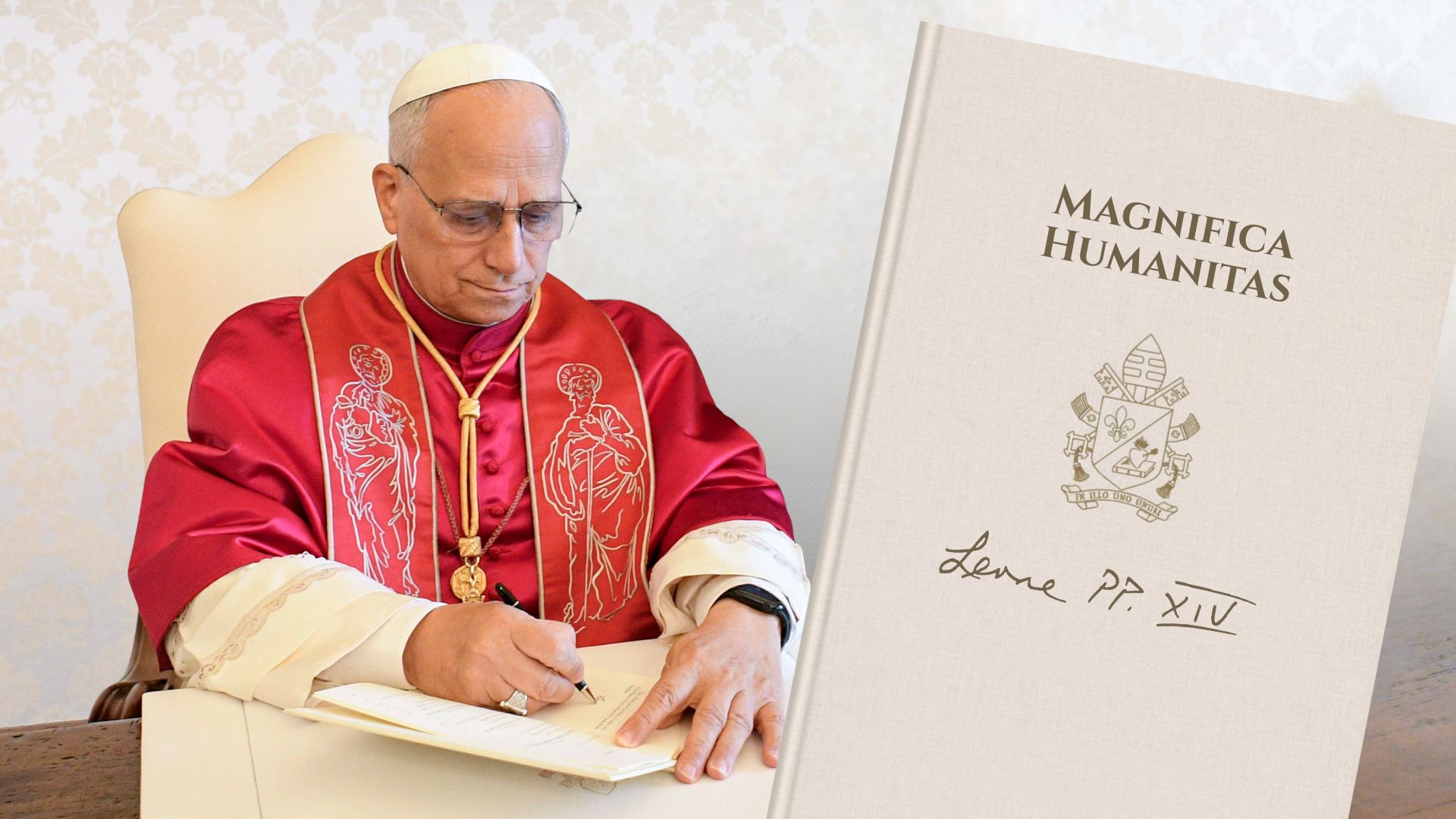
Pope Leo XIV's AI encyclical 'Magnifica Humanitas' with Anthropic's Chris Olah
TECH

Pope Leo XIV's AI encyclical 'Magnifica Humanitas' with Anthropic's Chris Olah

35+
Signals

Strategic Overview

  • 01.
    Pope Leo XIV will personally present his first encyclical, 'Magnifica Humanitas: On the Protection of Human Dignity in the Age of Artificial Intelligence,' on May 25, 2026 at 11:30 a.m. Rome time in the Vatican's Synod Hall.
  • 02.
    The document was signed on May 15, 2026, the 135th anniversary of Pope Leo XIII's 1891 labor encyclical Rerum Novarum.
  • 03.
    Anthropic co-founder Christopher Olah, an AI interpretability researcher, will be a lay speaker at the launch alongside Cardinals Victor Manuel Fernandez, Michael Czerny, and Pietro Parolin, and theologians Anna Rowlands and Leocadie Lushombo.
  • 04.
    On May 16, 2026, Pope Leo XIV approved a new Interdicasterial Commission on Artificial Intelligence spanning seven Vatican departments, the first time the Catholic Church has centralized AI engagement under a single body.

Deep Analysis

Why Anthropic — and not OpenAI — got the Vatican invite

The lay speaker chosen to share the stage with Pope Leo XIV is not a generalist AI executive but Christopher Olah, an interpretability researcher and Anthropic co-founder whose technical work is specifically about being able to see inside neural networks [1][2]. That choice reads as theology, not optics. Anthropic has spent the last year publicly refusing to loosen safeguards on lethal autonomous warfare and mass surveillance, and was penalized for it: the Trump administration ordered U.S. agencies in February 2026 to stop using Anthropic technology, and the Pentagon designated the company a supply-chain risk [3].

By inviting Olah specifically, the Vatican is endorsing a posture — interpretability plus deployment restraint — rather than a vendor. Catholic discussion forums have picked up the same signal, contrasting Anthropic with what they describe as OpenAI's pivot from safety toward consumer growth and treating Olah's seat as evidence that Magnifica Humanitas will not be uniformly anti-AI but will distinguish between safety-first labs and the rest. The fact that one of the launch theologians, Leocadie Lushombo, holds her chair at Santa Clara — the Jesuit university embedded in Silicon Valley — reinforces that the Holy See is trying to engage the industry from the inside, not denounce it from the outside [4].
The Rerum Novarum bridge: AI as the new industrial revolution

Leo XIV signed Magnifica Humanitas on May 15, 2026 — the 135th anniversary, to the day, of Leo XIII's 1891 Rerum Novarum, the encyclical that defined modern Catholic social teaching on capital, labor and the rights of workers during the Industrial Revolution [5]. Choosing the same name as the prior Leo and the same calendar date is not coincidence; it is doctrinal scaffolding. Andrew Chesnut of Virginia Commonwealth University reads the parallel literally, telling Axios that the animating fear of Rerum Novarum was 'exactly the fear ... that machines were replacing human labor' [6].

The new document is expected to argue that technology must remain subordinate to the human person and that AI systems should protect workers, creativity and moral agency [6]. That puts labor-displacement and dignity at the center of the AI debate inside one of the largest moral institutions on earth, and it does so using a frame the Catholic Church has spent 135 years developing case law around. The advantage of using Rerum Novarum as the bridge is vocabulary: concepts like the universal destination of goods, subsidiarity, and the just wage exist in Catholic social teaching as developed doctrine — the Vatican can apply them to model training, content, and automation without inventing ethics from scratch.

A Vatican-Washington flashpoint over who gets to define AI

Standing next to the pope on May 25 will be a representative of a company the U.S. executive branch has effectively sanctioned. The South China Morning Post reads this as a deliberate counter-position, calling Olah's presence 'significant' and suggesting 'that the US pope's position on AI will become a new flashpoint with the Trump administration' [3]. The day before signing Magnifica Humanitas, Leo XIV used a La Sapienza University address to call AI-directed warfare in Ukraine, Gaza, Lebanon and Iran an 'inhuman evolution of the relationship between war and new technologies in a spiral of annihilation' [7].

That is not generic concern; it is a direct critique of the policy environment that has been pushing AI into military and surveillance use. World-news Reddit threads framed the Vatican as filling a moral-policy vacuum the U.S. has abandoned, and the timing — La Sapienza speech on May 14, encyclical signed May 15, AI commission approved May 16, launch May 25 — looks like a coordinated diplomatic posture rather than a single document drop. For frontier-AI labs navigating between U.S. export-control politics and global perception, the Vatican has now offered an alternative source of legitimacy that does not require Washington's blessing.

Operational teeth: a permanent AI commission, not just rhetoric

What separates Magnifica Humanitas from a one-off pastoral document is what landed alongside it. On May 16, the day after signing, Pope Leo XIV approved a new Interdicasterial Commission on Artificial Intelligence drawing representatives from seven Vatican departments — including the Dicastery for the Doctrine of the Faith and the Pontifical Academy of Sciences — coordinated by the Dicastery for Promoting Integral Human Development under Cardinal Michael Czerny [1]. Fortune describes it as the first time the Catholic Church has formally coordinated its AI engagement under a single body, with a remit framed as both internal Church governance and outward engagement with 'the whole world' [1].

That matters because the Vatican is not just publishing principles; it is creating a standing organ that can issue follow-on guidance, engage labs, and produce position papers on specific issues like lethal autonomous weapons, labor automation, and content moderation. America magazine reports the Vatican created the body because of the acceleration in AI's use and its 'potential effects on human beings and on humanity as a whole' [2]. For policymakers and AI labs used to one-off papal statements that fade, the standing commission means the Church now has institutional bandwidth to keep showing up — and a single contact surface for industry engagement that other policy bodies have not provided.

Historical Context

1891-05-15
Issued Rerum Novarum, the first modern Catholic social encyclical, addressing the rights and duties of capital and labor amid the Industrial Revolution.
2026-02
Ordered U.S. agencies to stop using Anthropic's AI technology after Anthropic restricted military uses; Pentagon designated Anthropic a supply-chain risk.
2026-05-14
At La Sapienza University, condemned AI-directed warfare as a 'spiral of annihilation,' citing Ukraine, Gaza, Lebanon and Iran.
2026-05-15
Signs Magnifica Humanitas on the 135th anniversary of Rerum Novarum, deliberately framing AI as the new industrial revolution.
2026-05-16
Approves the new Interdicasterial Commission on Artificial Intelligence, coordinated by the Dicastery for Promoting Integral Human Development and spanning seven Vatican departments.
2026-05-25
Personally presents Magnifica Humanitas at 11:30 a.m. Rome time in the Synod Hall, alongside Anthropic's Chris Olah, Cardinals Fernandez, Czerny, Parolin, and theologians Rowlands and Lushombo.

Power Map

Key Players
Subject

Pope Leo XIV's AI encyclical 'Magnifica Humanitas' with Anthropic's Chris Olah

PO

Pope Leo XIV

Author of Magnifica Humanitas; breaks Vatican tradition by personally presenting his first encyclical and delivering the final address, positioning the Holy See as a global moral voice on AI.

CH

Christopher Olah

Anthropic co-founder and AI interpretability specialist; lay speaker at the launch, providing technical credibility from a frontier-AI lab known for safety research.

AN

Anthropic

Developer of Claude; refused to loosen safeguards on lethal autonomous warfare and mass surveillance, triggering a February 2026 Trump-administration order to halt U.S. agency use and a Pentagon supply-chain risk designation.

CA

Cardinal Victor Manuel Fernandez

Prefect of the Dicastery for the Doctrine of the Faith; doctrinal presenter at the encyclical launch.

CA

Cardinal Michael Czerny, S.J.

Prefect of the Dicastery for Promoting Integral Human Development; coordinates the new Vatican AI commission's work across seven departments.

LE

Leocadie Lushombo

Professor of theological ethics, Jesuit School of Theology at Santa Clara University; lay theologian whose Silicon Valley posting underlines the Vatican's intent to engage the AI industry from the inside.

TR

Trump administration / Pentagon

Antagonist context: ordered U.S. agencies to stop using Anthropic technology in February 2026 after the lab restricted military uses, and designated Anthropic a supply-chain risk.

Fact Check

7 cited
  1. [1] Pope Leo launches an AI commission ahead of papal letter release with Anthropic cofounder
  2. [2] Pope Leo will publish first encyclical, 'Magnifica Humanitas,' on preserving humanity in the A.I. age on May 25
  3. [3] Pope Leo, Anthropic to launch pontiff's first AI document, focusing on human dignity
  4. [4] Vatican to publish Pope Leo XIV's first encyclical May 25
  5. [5] Pope Leo XIV to publish encyclical on artificial intelligence May 25
  6. [6] Pope Leo sets Catholics on collision course with AI
  7. [7] Pope Leo XIV calls AI-directed warfare a spiral of annihilation in historic La Sapienza address

Source Articles

Top 5

THE SIGNAL.

Analysts

"Frames Magnifica Humanitas as a direct echo of the labor-displacement fears that animated Rerum Novarum: 'This is exactly the fear ... that machines were replacing human labor.'"

Andrew Chesnut
Chair of Catholic Studies, Virginia Commonwealth University

"Reads Olah's seat at the launch as a deliberate Vatican signal: 'The presence of Anthropic's Christopher Olah at the Vatican is significant, and suggests that the US pope's position on AI will become a new flashpoint with the Trump administration.'"

South China Morning Post
News analysis
The Crowd

"JUST IN: Vatican announces that Pope Leo XIV's first encyclical — titled Magnifica Humanitas, on the safeguarding of the human person in the age of AI — will be presented at 11:30am on Monday, May 25, in the Vatican's Synod Hall, in the presence of the Holy Father."

@@dianemontagna0

"The presentation of Magnifica Humanitas will take place on May 25, at 11.30 a.m Rome time, in the Synod Hall, in the presence of the Holy Father Pope Leo XIV, who will be speaking at the event. Also speaking: Christopher Olah, co-founder of @AnthropicAI, Card. Parolin, Vatican's..."

@@inesanma0

"The Vatican says Anthropic co-founder Christopher Olah will join Pope Leo on May 25 to launch the pope's first encyclical, setting out his views on the AI age (@flaviarotondi / Bloomberg)"

@@Techmeme0

"Pope Leo XIV will personally present his 1st encyclical on May 25. "Magnifica Humanitas, on the protection of the human person in the age of artificial intelligence," was signed on May 15."

@u/ThinWhiteDuke00254
Broadcast
Pope Leo XIV Takes on A.I. | EWTN News In Depth May 23, 2025

Pope Leo XIV Takes on A.I. | EWTN News In Depth May 23, 2025

Pope Leo's first encyclical will reportedly warn about dangers of AI

Pope Leo's first encyclical will reportedly warn about dangers of AI

Catholic AI and Human Dignity | EWTN Vaticano

Catholic AI and Human Dignity | EWTN Vaticano