Roblox agentic AI creator tools
TECH

Roblox agentic AI creator tools

30+
Signals

Strategic Overview

  • 01.
    Roblox is rolling out agentic features inside Roblox Assistant that let creators plan, build, and test games using plain language rather than single-shot prompts.
  • 02.
    A new Planning Mode reads a game's existing code and data model, asks clarifying questions, and produces an editable action plan before any code runs.
  • 03.
    Mesh Generation drops fully textured 3D objects directly into the world from text prompts, and upcoming Procedural Models will encode objects as parameterized code that understands physical relationships between parts.
  • 04.
    A self-correcting playtest loop lets Assistant read logs, capture screenshots, drive keyboard and mouse input, spot bugs, and feed fixes back into planning iterations with decreasing human intervention.
  • 05.
    Roblox is adding a built-in MCP client so creators can drive Studio from Claude, Cursor, Codex, and other third-party agents, and is working on parallel agents that run long cloud workflows for coding, testing, and character creation.
  • 06.
    A March 19, 2026 DevForum update added batch mesh generation, bounding boxes, triangle count limits, a screen_capture tool, and new MCP server tools including insert_from_creator_store, generate_mesh, and generate_material.

Catching Up to Its Own Power Users

The most revealing thing about this launch is how much of it already existed outside of Roblox. For months, the top-performing Roblox-developer YouTube channels have been teaching creators to bypass the in-Studio Assistant entirely: wire VSCode to the community robloxstudio-mcp server, point Claude Code or OpenAI Codex at it, and work from an external IDE. The educator consensus, echoed in tutorials with tens of thousands of views, was that Claude plus Codex plus a community MCP bridge outperformed the stock Assistant on real productivity tasks.

Roblox's announcement effectively formalizes that stack. A built-in MCP client, planned integrations with Claude, Cursor, and Codex, and an open-source Studio MCP server (shipped at RDC 2025) together say the quiet part loud: the reference architecture for agentic Roblox development is external model plus MCP tools, and Roblox is choosing to be the MCP host rather than watch power users route around it. The competitive question is no longer whether creators will use Claude in Studio — they already do — but whether Roblox's first-party Planning Mode and parallel-agent orchestration become the preferred surface, or remain a fallback for creators who do not want to configure Node.js, Git, and API keys.

The 4-Hour Revert: Why Developers Don't Trust the Agent Yet

Under the launch-day optimism sits a community that has been burned. A widely-read r/ROBLOXStudio rant described Assistant running destructive loops that broke a shop system and then reverted four hours of work with no backups, closing with "i do not trust this ai anymore." Other threads catalog hallucinated EditableImage and IK controller APIs, broken Motor6D rigs, and the distinctive agentic failure mode where the model runs tests in a loop, issues a shallow apology ("I panicked and overreacted"), and then destructively rewrites files it should not have touched.

That is the exact failure surface Planning Mode and the self-correcting playtest loop have to fix. Planning Mode's pitch — analyze the existing code and data model, ask clarifying questions, commit to an editable plan before touching files — is a direct response to unconstrained agents that happily overwrite working systems. The self-correcting loop's pitch — read logs, capture screenshots, drive inputs, converge on a fix — is the same idea applied to runtime. But those are engineering claims, and the skeptic reading is that an agent with more tools and less supervision is also an agent with more ways to destroy work. Until Roblox can demonstrate non-destructive editing and reliable rollbacks on the exact rig-and-script cases developers are complaining about, the Reddit default will remain: use Opus to plan, Sonnet to execute, and keep your own version control.

A Content-Supply Lever for a $6.79B Economy

A Content-Supply Lever for a $6.79B Economy
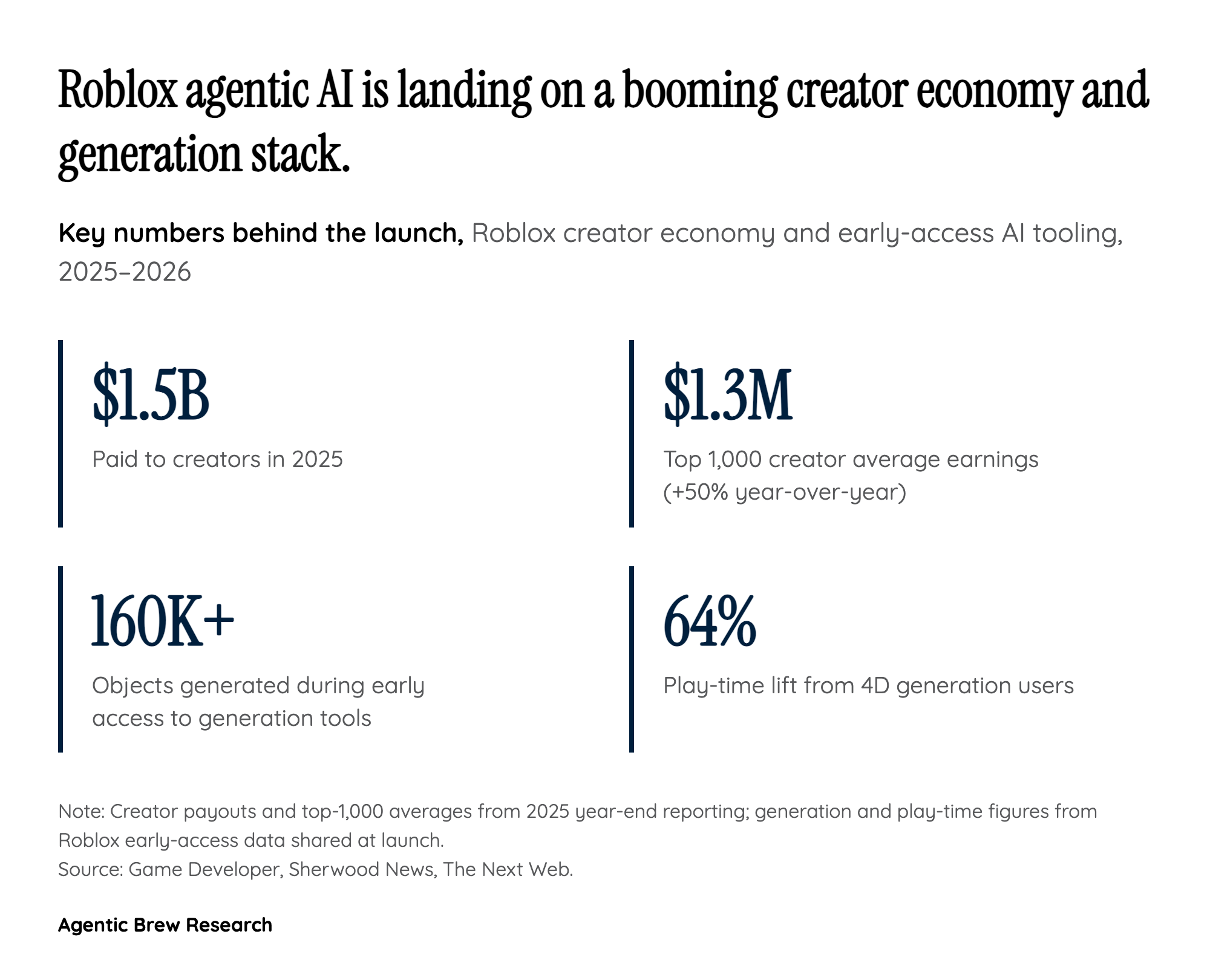
Key Roblox creator-economy and generation metrics that frame the agentic launch.

This is not primarily a creator-empowerment story; it is a platform-supply story. Roblox paid creators more than $1.5 billion in 2025, the top 1,000 creators averaged $1.3 million (up more than 50% year-over-year), total Robux purchases hit $6.79 billion, and Q4 bookings grew 63% year-over-year. Full-year 2025 revenue was $4.9 billion with 2026 guidance of $6 to $6.2 billion. Every incremental hour of creator productivity drops into that flywheel.

The agentic features are engineered exactly where that flywheel bottlenecks. Mesh Generation turns a text prompt into a textured asset; Procedural Models turn a text prompt into a parameterized object that understands its own physics; the playtest loop removes a human from the QA cycle. Early-access numbers support the framing — more than 160,000 objects were generated during preview and 4D generation users saw a 64% increase in play time. In that light, the integration with Claude, Cursor, and Codex is not generosity, it is a content-supply hedge: whichever agent a creator prefers, Roblox captures the output inside Studio and, eventually, a 30% cut of whatever monetizes on top of it.

Agentic Creation Meets a Child-Safety Spotlight

The launch lands on a platform already under sustained regulatory and legal pressure over youth safety. CNN and CNBC coverage from late 2025 documented age-verification scrutiny, short-video AI concerns, and ongoing lawsuits — the exact context in which Roblox is now letting autonomous agents generate 3D assets, write Luau, and playtest games with reduced human oversight.

Two risk vectors follow. The first is content: procedural models and mesh generation dramatically lower the cost of producing publishable in-world objects, which strains whatever moderation stack sits downstream. The second is behavioral: a self-correcting playtest loop that drives keyboard and mouse inputs and reads screenshots looks a lot like a synthetic player, and the same tooling that lets a creator auto-verify their game will be attractive to bad actors who want to probe other people's. Roblox's December 2025 release of OpenGameEval, a 47-test-case benchmark for agentic assistants, suggests the company knows evaluation is the long pole. Whether that benchmark extends from "does the agent build the game correctly" to "does the agent produce content that is safe for a platform with tens of millions of minors" is the harder open question.

The MCP Bet: Roblox as an Agent Host

The strategically interesting choice here is that Roblox is leaning into bring-your-own-model rather than trying to win on a proprietary Assistant. One member of the Roblox team described Assistant as having been rewritten to be "fully deeply agentic and based on MCP," and the Studio MCP server is open source. A skeptical voice on X went further, framing the product as essentially Claude Code or OpenCode with BYOK rather than a bespoke harness — which, uncharitably, is a complaint, and charitably, is the point.

If the agent layer is commoditizing, the durable moat is the tool surface, not the model. Roblox exposes a proprietary asset pipeline, a Luau runtime, a creator-store economy, and now a growing catalog of MCP tools — batch mesh generation, bounding boxes, triangle limits, screen_capture, insert_from_creator_store, generate_mesh, generate_material, and (per a third-party project) 54 tools total exposed to external agents like Claude Code. The bet is that whichever frontier model wins next quarter, creators will still need Roblox's tools to ship on Roblox, and Roblox can monetize the workflow regardless of who trained the weights. That is a more defensible position than trying to out-Claude Claude inside a chat panel.

Historical Context

2023-10
Released Assistant for Docs, an early AI assistance feature for Roblox documentation.
2023-12
Brought Assistant into Roblox Studio as a beta, supporting script creation and insertion, code explanations, and material generation.
2024-12
Assistant exited beta and became generally available in Studio with four new capabilities.
2025-03
Introduced Cube, a 1.8B-parameter foundation model for 3D/4D creation trained on 1.5M 3D assets, alongside text-to-mesh generation in beta.
2025-09
At RDC 2025, open-sourced the Studio MCP server so developers could point their preferred LLMs at Assistant.
2025-12
Released OpenGameEval, an open-source evaluation framework with a 47-test-case benchmark for agentic AI assistants inside Roblox Studio.
2026-02
Launched the open beta of 4D generation powered by Cube, adding an interactivity dimension to generated objects.
2026-03-19
DevForum update added batch Mesh Generation, MCP insert/generate tools, and a screen_capture tool for playtest automation.
2026-04-16
Publicly announced the agentic Planning Mode, Procedural Model Generation, self-correcting playtest loops, and planned parallel agents with Claude, Cursor, and Codex integration.

Power Map

Key Players
Subject

Roblox agentic AI creator tools

RO

Roblox Corporation

Platform operator launching the agentic stack inside Studio and revamping Roblox Assistant into a multi-turn development partner.

RO

Roblox creators and developers

Primary users of the tools; Roblox paid creators more than $1.5 billion in 2025 and the top 1,000 averaged $1.3 million in earnings, so throughput gains translate directly into creator income and platform content supply.

AN

Anthropic (Claude), Cursor, OpenAI (Codex)

Third-party AI coding agents Roblox plans to wire into Studio through MCP so external agents can act against Roblox projects.

NI

Nick Tornow

Roblox Senior Vice President of Engineering and public spokesperson for the launch.

RU

Rusi (Rusi_002)

Roblox staff member who posted the March 19, 2026 DevForum announcement detailing Mesh Generation upgrades and new MCP server tools.

THE SIGNAL.

Analysts

"Frames the launch as reducing barriers between creative vision and execution, and calls Planning Mode combined with Procedural Generation a powerful new method for creators to turn concepts into gameplay."

Nick Tornow
Senior Vice President of Engineering, Roblox

"Argues that single-step prompt-to-output AI tools often fail to capture a creator's original intent, which is the justification for moving to a collaborative Planning Mode that refines plans before execution."

Roblox (corporate product messaging)
Official launch rationale
The Crowd

"Studio MCP Server now supports full agentic loops, and Assistant can connect to external LLMs via Bring Your Own Key (BYOK). This allows creators to automatically edit, test, and refine their code with AI in plain language on Roblox using their preferred tools."

@@DavidBaszucki1000

"Roblox's AI assistant gets new agentic tools to plan, build, and test games | TechCrunch"

@@TechCrunch8300

"Enhancements released today to the open source MCP Server for Studio allow for complete agentic loops from any MCP client (e.g. Claude Code) to Studio -- prompt to drive complete edit/run/test/stop loops, converging on outcomes. Studio MCP Server Updates and External LLM Support for Assistant"

@@nicktornow137

"For those of you worried about AI"

@u/Goldswitch27
Broadcast
Tech Talks EP33 | The Future of Agentic Game Creation

Tech Talks EP33 | The Future of Agentic Game Creation

10x Your Roblox Studio Productivity - Claude Code & OpenAI Codex Integration Guide

10x Your Roblox Studio Productivity - Claude Code & OpenAI Codex Integration Guide

How to Build Roblox Games With AI in 2026

How to Build Roblox Games With AI in 2026