Pentagon adopts Palantir Maven AI as program of record
TECH

Pentagon adopts Palantir Maven AI as program of record

28+
Signals

Strategic Overview

  • 01.
    Deputy Secretary of Defense Steve Feinberg designated Palantir's Maven AI as an official program of record on March 9, 2026, enabling deployment across all military branches for targeting and decision-making.
  • 02.
    Maven is a command-and-control platform that analyzes data from satellites, drones, radars, and sensors using AI to identify threats and targets, currently used by 10 of 11 U.S. combatant commands with tens of thousands of users.
  • 03.
    The Pentagon deemed Anthropic a supply chain risk on March 6, 2026, requiring Palantir to replace Claude AI models powering Maven, creating potential execution risk for the platform's transition.
  • 04.
    Palantir's defense contract portfolio has grown dramatically, from a $480M Maven contract in 2024 to a $1.3B expanded ceiling in 2025, plus a separate $10B U.S. Army contract, fueling the company's market cap to approximately $360 billion.

Deep Analysis

Why This Matters

The designation of Palantir's Maven as a program of record marks a watershed moment in the Pentagon's approach to artificial intelligence. Unlike experimental or pilot programs, a program of record carries formal budgetary authority, institutional permanence, and mandated deployment across the Department of Defense. This means Maven is no longer a technology demo or limited initiative -- it is now embedded in the structural fabric of U.S. military planning and operations, on par with weapons systems like the F-35 or Patriot missile defense.

This decision also signals a broader strategic shift: the U.S. military is betting that AI-driven command-and-control will be the decisive advantage in future conflicts. By making Maven the unified platform across all branches, the Pentagon is consolidating its AI infrastructure under a single commercial provider, a move that reduces fragmentation but also concentrates risk. The decision to sole-source this to Palantir, rather than opening competitive bidding, underscores both urgency and the limited number of vendors capable of operating at this scale and classification level.

How It Works

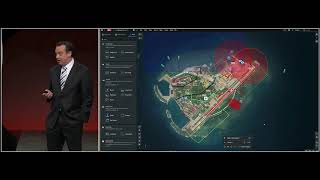
Maven functions as an AI-powered command-and-control platform that ingests and fuses data from satellites, drones, ground-based radars, signals intelligence, and other sensor networks. Using machine learning models, it identifies potential threats, tracks targets, and presents decision options to human operators. The system consolidates what previously required 8 to 9 separate software tools into a single interface, dramatically compressing the decision cycle -- what the military calls the 'kill chain' -- from hours to minutes.

At the technical level, Maven runs on Palantir's existing software stack, including its Foundry and Gotham platforms, with AI models layered on top for real-time analysis. Until the recent supply chain decision, those AI models were powered by Anthropic's Claude. The requirement to replace Claude introduces a significant engineering challenge: Palantir must either develop proprietary models, integrate alternative commercial models (from providers like OpenAI, xAI, or open-source alternatives), or build a model-agnostic architecture. The September 2026 deadline for full implementation adds urgency to this transition. Human operators remain in the loop for all targeting decisions, but the AI dramatically accelerates the speed at which options are surfaced and evaluated.

By The Numbers

By The Numbers
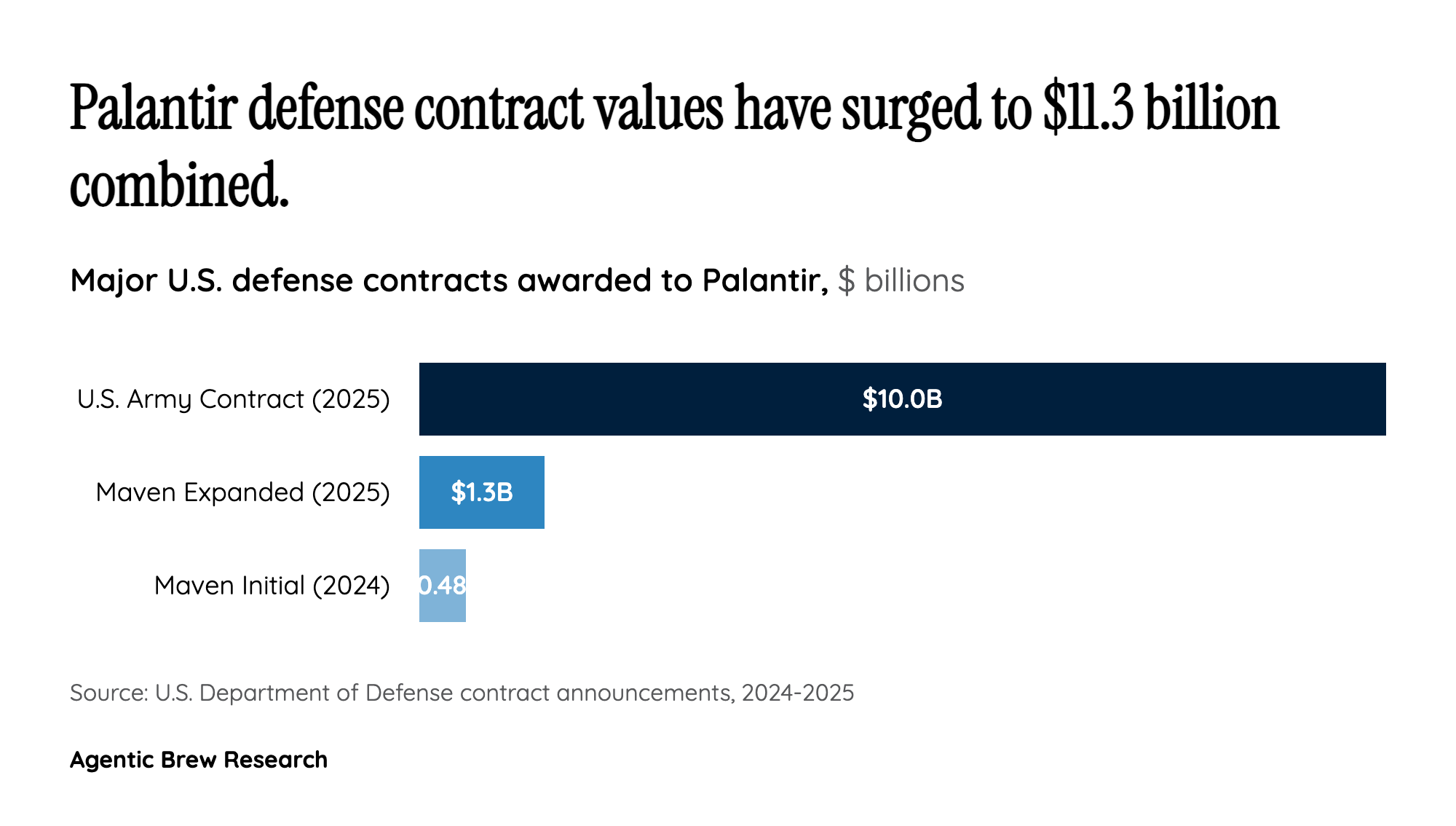
Palantir defense contract values have surged to $11.3 billion combined.

The financial scale of Palantir's defense business has grown at a remarkable pace. Maven's initial 2024 contract was valued at up to $480 million over five years. By 2025, the Pentagon had increased that ceiling to $1.3 billion -- nearly tripling the commitment in just one year. Separately, Palantir secured a $10 billion contract with the U.S. Army, bringing total identifiable defense contract value to over $11.3 billion. The company's stock has doubled over the past year, pushing its market capitalization to approximately $360 billion.

Maven is now used by 10 of 11 U.S. combatant commands, with Palantir CTO Shyam Sankar testifying the platform has 'tens of thousands' of users. On the commercial side, Palantir reported 71% year-over-year U.S. commercial revenue growth, indicating that defense momentum is spilling over into its broader business. The implementation deadline for the program-of-record designation is September 2026, the end of fiscal year 2026.

Impacts & What's Next

The immediate impact is threefold. First, Palantir's position as the dominant defense AI provider is now institutionally cemented, making it extraordinarily difficult for competitors to displace. Second, the Anthropic supply chain decision forces a rapid AI model transition that could either strengthen Maven (by reducing dependency on a single AI vendor) or introduce instability if the replacement models underperform. Third, the program-of-record status opens the door for significantly larger future appropriations, as Congress now has a formal budget line to fund.

Looking ahead, several developments bear watching. The Pentagon's Chief Digital AI Office, which assumes oversight within 30 days, will shape how Maven evolves and whether additional vendors can participate in the ecosystem. The ethical and legal dimensions remain contentious: UN expert panels have warned about the risks of AI-assisted weapons targeting, and the speed at which Maven compresses kill chains raises questions about meaningful human oversight. On the competitive landscape, Anduril, AWS, OpenAI, and xAI are all positioning for defense AI contracts, but Maven's head start and institutional entrenchment give Palantir a formidable moat. The September 2026 deadline for full implementation will be the first major test of whether this ambitious program can deliver on its promise.

The Bigger Picture

Maven's trajectory from a small drone-imagery labeling project in 2017 to a multi-billion-dollar program of record in 2026 tells the story of how Silicon Valley's relationship with the military has been fundamentally rewritten. When Google withdrew from Maven in 2018 under employee pressure, it appeared that tech companies would resist military AI work. Instead, a new generation of defense-focused companies -- led by Palantir and Anduril -- stepped in, and the broader tech industry's resistance softened as geopolitical tensions with China intensified and government contracts became too lucrative to ignore.

The Maven decision also reflects a global AI arms race. China's military AI programs, Russia's autonomous weapons development, and the proliferation of drone warfare in Ukraine and the Middle East have convinced U.S. defense leaders that AI superiority is existential. Secretary Hegseth's framing -- 'Military AI is a race; speed wins' -- captures the urgency driving these decisions. Social media sentiment reflects this tension: investors on Reddit and X are overwhelmingly bullish on Palantir's defense positioning, while critics raise concerns about surveillance, autonomous targeting, and the concentration of military AI in a single company's hands. The YouTube discourse, particularly Democracy Now's 'Speeding Up the Kill Chain' analysis, highlights how Maven's deployment in real-world operations like those against Iran's Houthi proxies has moved these debates from theoretical to operational.

Historical Context

2017-04-01
Project Maven launched as a Pentagon initiative to apply AI and machine learning to drone imagery labeling and analysis.
2018-06-01
Google withdrew from Project Maven after employee protests over the military application of AI technology.
2024-05-01
Palantir won a 5-year Maven contract worth up to $480 million, establishing itself as the platform's primary contractor.
2025-05-01
The Pentagon increased Maven's contract ceiling to $1.3 billion, reflecting expanded scope and growing reliance on the platform.
2025-07-01
Palantir secured a separate contract with the U.S. Army worth up to $10 billion for next-generation command systems.
2026-03-06
The Pentagon deemed Anthropic a supply chain risk, requiring Palantir to replace Claude AI models within Maven.
2026-03-09
Deputy Secretary of Defense issued a memo designating Maven as an official program of record, with oversight transferring to the Chief Digital AI Office.

Power Map

Key Players
Subject

Pentagon adopts Palantir Maven AI as program of record

PA

Palantir Technologies

Primary contractor and sole-source provider of the Maven AI platform across all U.S. military branches

ST

Steve Feinberg

Deputy Secretary of Defense who authored the program-of-record memo designating Maven

PE

Pete Hegseth

Secretary of Defense and champion of military AI adoption across the Pentagon

AN

Anthropic

Developer of Claude AI models currently used in Maven, deemed a supply chain risk by the Pentagon

SH

Shyam Sankar

Palantir CTO who testified that Maven had tens of thousands of users across combatant commands

CA

Cameron Stanley

Pentagon Chief AI Office leader who demonstrated Maven's speed advantage in multi-domain operations

THE SIGNAL.

Analysts

"Stated it is 'imperative that we invest now' and called for establishing 'AI-enabled decision-making as the cornerstone of our strategy,' reflecting the Pentagon's urgency in deploying military AI at scale."

Steve Feinberg
Deputy Secretary of Defense, U.S. Department of Defense

"Declared 'Military AI is a race; speed wins. We must weaponize learning speed,' signaling a shift toward treating AI superiority as a core component of U.S. military strategy."

Pete Hegseth
Secretary of Defense, U.S. Department of Defense

"Warned that stripping Anthropic's Claude models from Maven 'creates execution risk' for Palantir, as replacing the AI backbone of a live military system introduces technical and timeline uncertainty."

Bailey Pemberton
Analyst, Simply Wall St

"Stated Maven is going 'from hundreds to thousands' of users, indicating rapid scaling of the platform across military operations and combatant commands."

Shannon Clark
Spokesperson, Palantir Technologies
The Crowd

"This is Maven Smart System—Palantir's software as a service product that we are deploying across the entire department."

@@PalantirTech10000

"Probably the most current look at Palantir's maven smart system software. Here's the DoW's Chief AI officer showing how it works:"

@@bilawalsidhu9500

"The US Defense Department will establish Palantir's Maven AI system as a 'program of record,' Reuters reported on Friday night, as the Pentagon rapidly integrates the technology into its combat operations"

@@business289

"Bull Thesis Alive and Well!"

@u/One-Hovercraft-193547
Broadcast
Speeding Up the Kill Chain: Pentagon Bombs Thousands of Targets in Iran Using Palantir AI

Speeding Up the Kill Chain: Pentagon Bombs Thousands of Targets in Iran Using Palantir AI

Multi-Domain AI: The Future of Command and Control | CDAO at AIPCon 9

Multi-Domain AI: The Future of Command and Control | CDAO at AIPCon 9

Pentagon CTO demonstrates Palantir's Maven system, used for military operations

Pentagon CTO demonstrates Palantir's Maven system, used for military operations