OpenAI Codex major update with desktop control, memory, and plugins
TECH

OpenAI Codex major update with desktop control, memory, and plugins

36+
Signals

Strategic Overview

  • 01.
    OpenAI shipped Codex v26.415 on April 16, 2026, adding macOS computer use that lets the agent see, click, and type inside any app, plus persistent memory, an in-app browser, thread automations, and an artifact viewer for previewing PDFs and spreadsheets.
  • 02.
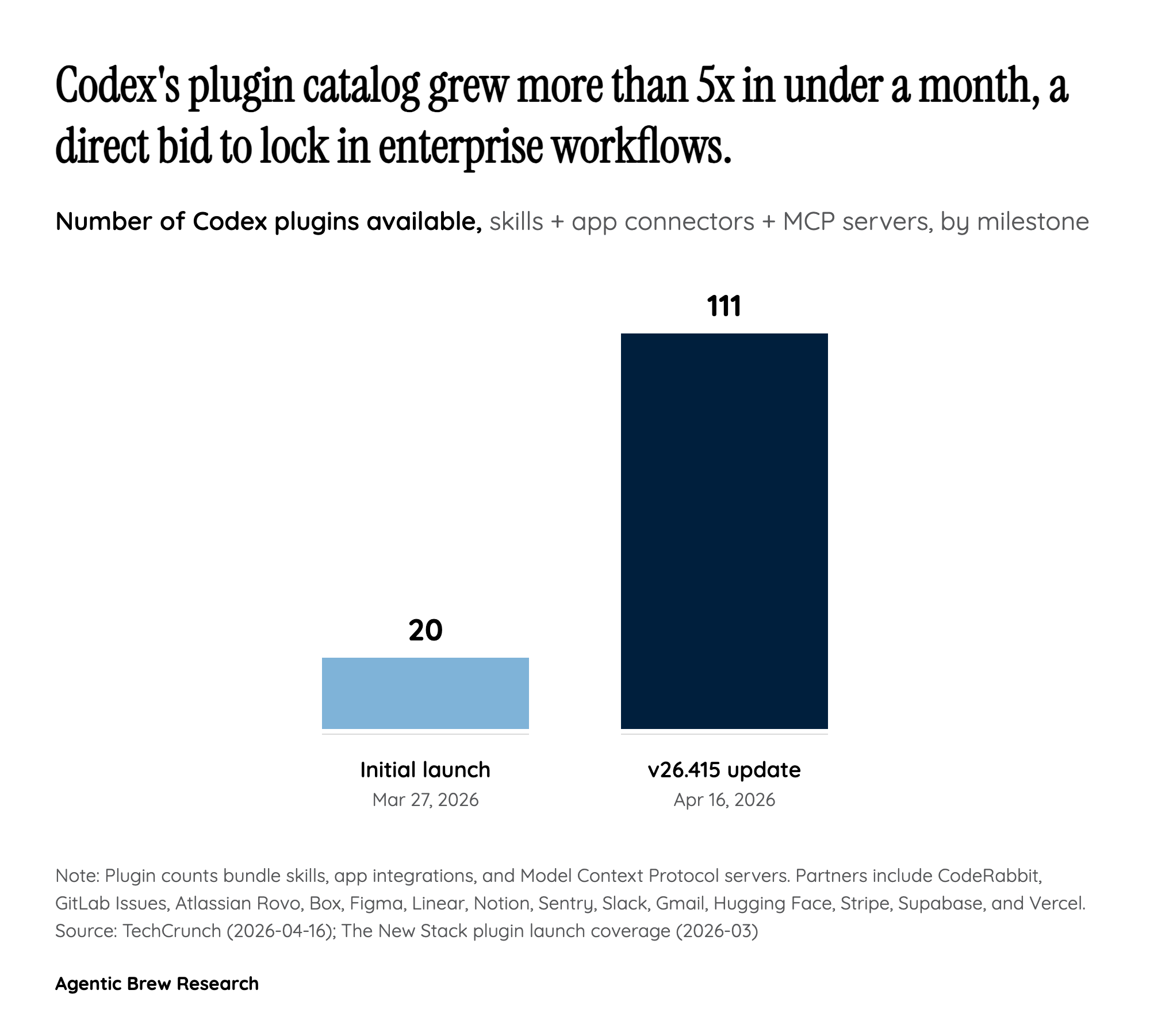
    The release expands the plugin catalog to 111 integrations spanning skills, app connectors, and Model Context Protocol servers, bundling partners like GitLab Issues, CodeRabbit, Box, Figma, Linear, Notion, Sentry, Slack, Gmail, Stripe, Supabase, Vercel, and Atlassian Rovo.
  • 03.
    Codex now integrates gpt-image-1.5 for mockups and game assets, and computer use runs multiple agents in parallel in the background without hijacking the user's active session.
  • 04.
    Computer use is macOS-only at launch and unavailable in the EEA, UK, and Switzerland, while ChatGPT Enterprise and Business customers receive a new pay-as-you-go pricing option.

The one-hour ambush: release timing as product strategy

The Codex update landed roughly one hour after Anthropic's Opus 4.7 drop, a cadence that X observers and Reddit threads have now flagged as a recurring OpenAI tactic. The subtext is that OpenAI no longer wants Anthropic to own a single news cycle; every raw-model announcement is immediately smothered by a workflow-layer counter-release. One widely shared tweet distilled the framing bluntly: Anthropic bets on raw model power, OpenAI wants your whole workflow.

That's not merely spin. The features chosen for this drop — computer use, memory, browser, plugins — are explicitly the surface area a benchmark-leading model alone cannot capture. By shipping the same hour Anthropic emphasizes model quality, OpenAI reframes the competition from 'which model is smarter' to 'which agent already lives inside your Mac.' The r/codex community noted the pattern immediately in the update announcement thread, and it reinforces that Codex's roadmap is being paced to Anthropic's calendar as much as to its own.
The adoption paradox: enterprise plugins versus developer mindshare

The adoption paradox: enterprise plugins versus developer mindshare
Codex plugin catalog: 20 at initial launch (Mar 2026) vs 111 in the April 2026 v26.415 update.

Underneath the feature list sits a real structural problem for OpenAI. Columnist David Gewirtz reports that not one of the working programmers he has surveyed uses Codex, and Ars Technica's Samuel Axon echoes that Claude Code has meaningfully more grassroots developers. Codex is reported at roughly 2 million weekly active users, while Claude Code carries a far larger narrative footprint with a ~$2.5B annualized run rate and an estimated 135,000 daily GitHub commits. GPT-5.3-Codex does lead Terminal-Bench 2.0 at 77.3% versus Claude's 65.4%, yet Claude Code still edges HumanEval at 92% to 90.2% — close enough that benchmarks alone won't flip mindshare.

So OpenAI is routing around the developer bottleneck. The 111-plugin catalog, the IT-governance framing, and the new pay-as-you-go Enterprise pricing are all designed to let CIOs and IT admins deploy Codex top-down — Jira, GitLab, Microsoft Suite coverage matters to procurement, not to a solo developer choosing a terminal companion. Forrester's Charlie Dai captures the tension: the platform aligns with enterprise governance, but without self-serve third-party publishing, Codex risks staying bottled up inside engineering. It's a bet that enterprise contracts can be won even while grassroots developer love is lost.

Codex is the super-app Trojan horse

Thibault Sottiaux said the quiet part out loud: 'We're building the super app out in the open. This release is about developers.' Read with the Engadget reporting — which describes the update as groundwork for a unified surface combining ChatGPT, Codex, and the Atlas browser — and the architecture of this release starts to make sense as something other than a developer tool. Memory, computer use, thread automations, an in-app browser, and image generation aren't coding primitives. They're the components of a general-purpose desktop agent that happens to be shipping under a developer-branded wrapper first.

That sequencing matters. Developers are the tolerant early userbase that will accept rough edges, file bugs, and stress-test computer-use sandboxing before the same primitives reach ChatGPT's hundreds of millions of consumer users. Once memory and computer use are hardened inside Codex, nothing technical stops them from being surfaced in ChatGPT proper or stitched into Atlas. The Codex update is less a product launch and more a staged rollout of OpenAI's desktop operating layer, using the developer audience as the beachhead.

Pricing tremors the keynote didn't mention

While tech press covered the feature list, the r/codex subreddit was dominated by backlash over the updated plan structure. The community's most-upvoted response on the plans post pointed out that the new $100/month Pro tier advertising '5x more Codex usage than Plus' is measured against an undefined baseline — echoing the vague quotas that have dogged competing products. Plus-tier users simultaneously reported tighter rate limits, with threads titled 'Exciting update — your Plus plan just got worse' capturing the mood. The friction has a technical undercurrent too: plugin-level costs vary wildly, and community reports flag the Notion plugin burning roughly 50,000 tokens just to flip a single table status — the kind of hidden cost that makes Plus-tier rate limits feel punishing.

This is the fault line OpenAI's super-app narrative has to navigate. Enterprise buyers get a clean pay-as-you-go story, but the individual-developer tier that builds grassroots advocacy is the one getting squeezed. Given that Claude Code already holds the developer-loyalty advantage, alienating Plus users at the exact moment you're asking them to try computer use and 111 plugins is a timing problem. The feature set is ambitious; the pricing optics, less so.

Crossing the autonomy threshold — and why Europe is excluded

Computer use lets Codex operate macOS apps in the background by seeing, clicking, and typing with its own cursor, running multiple agents in parallel without interfering with the user's own work. That capability crosses a meaningful line: the agent is no longer a chat box recommending actions, it is an autonomous operator of the same apps storing credentials, customer data, and production-system access. The TechCrunch coverage flags new concerns around sandboxing, auditability, and accidental actions in regulated environments, and those concerns are nontrivial when the agent can parallelize across applications.

That context makes the regional gating revealing. Computer use and memory are unavailable in the EEA, UK, and Switzerland at launch — jurisdictions with the most developed regimes around automated decision-making, data retention, and AI transparency. OpenAI hasn't explained the carve-out, but it's hard to read the exclusion as anything other than a compliance-posture tell: the features aren't yet defensible under EU AI Act and UK regulatory scrutiny. Enterprise buyers in Europe will watch closely whether this becomes a permanent split experience or a temporary staging issue.

Historical Context

2026-02
Launched the Codex desktop app for macOS with parallel multi-agent workflows, worktree support, and early automations, laying the shell this update fills in.
2026-03
Announced Claude could remotely control Mac and desktop environments while the user was away from the keyboard, setting the benchmark Codex's computer use is now chasing.
2026-03-27
Introduced the initial Codex plugin system with roughly 20 integrations spanning skills, app connectors, and MCP servers, including Box, Figma, Linear, Notion, Sentry, Slack, Gmail, Hugging Face, Stripe, Supabase, and Vercel.
2026-04-16
Released Codex v26.415 with computer use, persistent memory, in-app browser, thread automations, artifact viewer, gpt-image-1.5, and 111 total plugins.

Power Map

Key Players
Subject

OpenAI Codex major update with desktop control, memory, and plugins

OP

OpenAI

Ships Codex as the first public piece of a unified desktop 'super app' combining ChatGPT, Codex, and the Atlas browser.

TH

Thibault Sottiaux (Head of Codex, OpenAI)

Public face of the release; frames Codex as developer-first groundwork for the super app and targets enterprise default-agent status.

AN

Anthropic (Claude Code)

Primary competitor with stronger developer mindshare whose recent remote-Mac-control announcement forced OpenAI's desktop-control response.

PL

Plugin ecosystem partners

Third-party apps and MCP providers including CodeRabbit, GitLab Issues, Box, Figma, Linear, Notion, Sentry, Slack, Gmail, Hugging Face, Stripe, Supabase, Vercel, and Atlassian Rovo bundled into Codex to broaden enterprise workflow coverage.

CH

ChatGPT Enterprise and Business customers

Target buyers for the new pay-as-you-go pricing and IT-governance-aligned plugin catalog intended to drive top-down corporate deployment.

EU

European users

Excluded from computer use and memory at launch in the EEA, UK, and Switzerland, producing a split regional experience for enterprise buyers.

THE SIGNAL.

Analysts

"Positions the release as developer-first scaffolding for a broader super app while aiming to install Codex as the default enterprise agent. Quote: 'We're building the super app out in the open. This release is about developers.'"

Thibault Sottiaux
Head of Codex, OpenAI

"Says the plugin platform aligns AI agents with IT governance, but warns Codex's reach will be capped if self-serve third-party publishing stays closed: 'Without this external ecosystem, Codex risks limited extensibility beyond core engineering use cases.'"

Charlie Dai
VP, Forrester

"Reports a stark adoption gap: 'Every programmer I talk to uses Claude Code. So far, of all the programmers I've talked to in the general programming populace, not one has said they're a Codex user.'"

David Gewirtz
Columnist, ZDNet

"Corroborates that Claude Code holds stronger grassroots developer mindshare than Codex: 'If you talk to developers, you'll find a lot more Claude Code users than Codex users.'"

Samuel Axon
Senior Editor, Ars Technica

"Personally endorsed computer use on launch day: 'Computer use is a real update for me; it feels even more useful than I expected. It can use all of the apps on your Mac, in parallel and without interfering with your direct work.'"

Sam Altman
CEO, OpenAI
The Crowd

"With computer use on macOS Codex can now use any app by seeing, clicking, and typing with its own cursor. It runs in the background without taking over your computer, working on tasks like frontend iteration, app testing, or any workflow that doesn't expose an API."

@@OpenAI1100

"Lots of major improvements to Codex! Computer use is a real update for me; it feels even more useful than I expected. It can use all of the apps on your Mac, in parallel and without interfering with your direct work."

@@sama801

"OpenAI just stole the spotlight one hour after Opus 4.7 dropped. Codex now controls your Mac, has in-app browser, gpt-image-1.5, memory, long automations and 90+ plugins. Anthropic bets on raw model power, OpenAI wants your whole workflow."

@@birdabo293

"A major update has been released for the Codex app. ( Computer use , image generation , 90+ new plugins , multi-terminal, SSH into devboxes, thread automations)"

@u/Distinct_Fox_6358138
Broadcast
OpenAI just made your entire tech stack obsolete...

OpenAI just made your entire tech stack obsolete...

Introducing the Codex app

Introducing the Codex app

Automate tasks with the Codex app

Automate tasks with the Codex app