Google AI Product Updates April 2026
TECH

Google AI Product Updates April 2026

32+
Signals

Strategic Overview

  • 01.
    On April 2, 2026, Google released Gemma 4 in four variants (E2B, E4B, 26B-A4B MoE, 31B Dense) under an Apache 2.0 license, calling it 'byte for byte the most capable open model.'
  • 02.
    At Google Cloud Next '26 on April 22, Google launched the Gemini Enterprise Agent Platform as the evolution of Vertex AI, with built-in agent integration, DevOps, orchestration, and security.
  • 03.
    Google introduced two specialized 8th-generation TPUs: TPU 8t for training (9,600 chips per superpod, 121 ExaFlops, 2 PB shared HBM) and TPU 8i for inference (288 GB HBM per chip, 80% better performance per dollar).
  • 04.
    Google opened Veo 3.1 video generation in Google Vids to all account holders for free, with 10 generations per month at up to 720p and 8 seconds.
  • 05.
    Deep Research and Deep Research Max launched April 21 in public preview via the Gemini API, built on Gemini 3.1 Pro with native chart and infographic generation plus Model Context Protocol support.
  • 06.
    A small business AI bundle includes a 95% Workspace discount for the first three months, a 30-day free Gemini Enterprise trial, up to $6,000 in Google Ads credits, and access to Pomelli and Nano Banana design tools.
  • 07.
    Cloud Next '26 hosted more than 32,000 attendees and produced over 260 announcements anchored on the 'Agentic Enterprise' theme.

A Vertically Integrated Bet on the Agentic Stack

April 2026's announcements only make sense when read as one stack rather than a list of products. Gemma 4 occupies the open-weight tier, Gemini 3.1 Pro powers the closed frontier (including Deep Research Max), the Gemini Enterprise Agent Platform packages models into deployable agents, and TPU 8t/8i provide the silicon underneath. Each layer is engineered to feed the next: Gemma 4 shares research lineage with Gemini 3, Deep Research's MCP support hooks into the same agent runtime that enterprises configure inside the platform, and the Agentic Data Cloud assumes that the agents above it will be calling for governed data at scale.

The 'Agentic Enterprise' framing at Cloud Next '26 — 32,000 attendees, 260+ announcements — is therefore less a marketing wrapper than a deliberate alignment of every Google AI surface around the same noun. When Thomas Kurian's team describes the Gemini Enterprise Agent Platform as 'the evolution of Vertex AI,' they are conceding that the prior MLOps framing has been retired in favor of an agent-first one. That repositioning matters because it tells customers Google has chosen its lane: not just a model vendor, not just a cloud, but the place to build, govern, and run agents end-to-end.
Why Gemma 4's License Is the Real Story

Why Gemma 4's License Is the Real Story
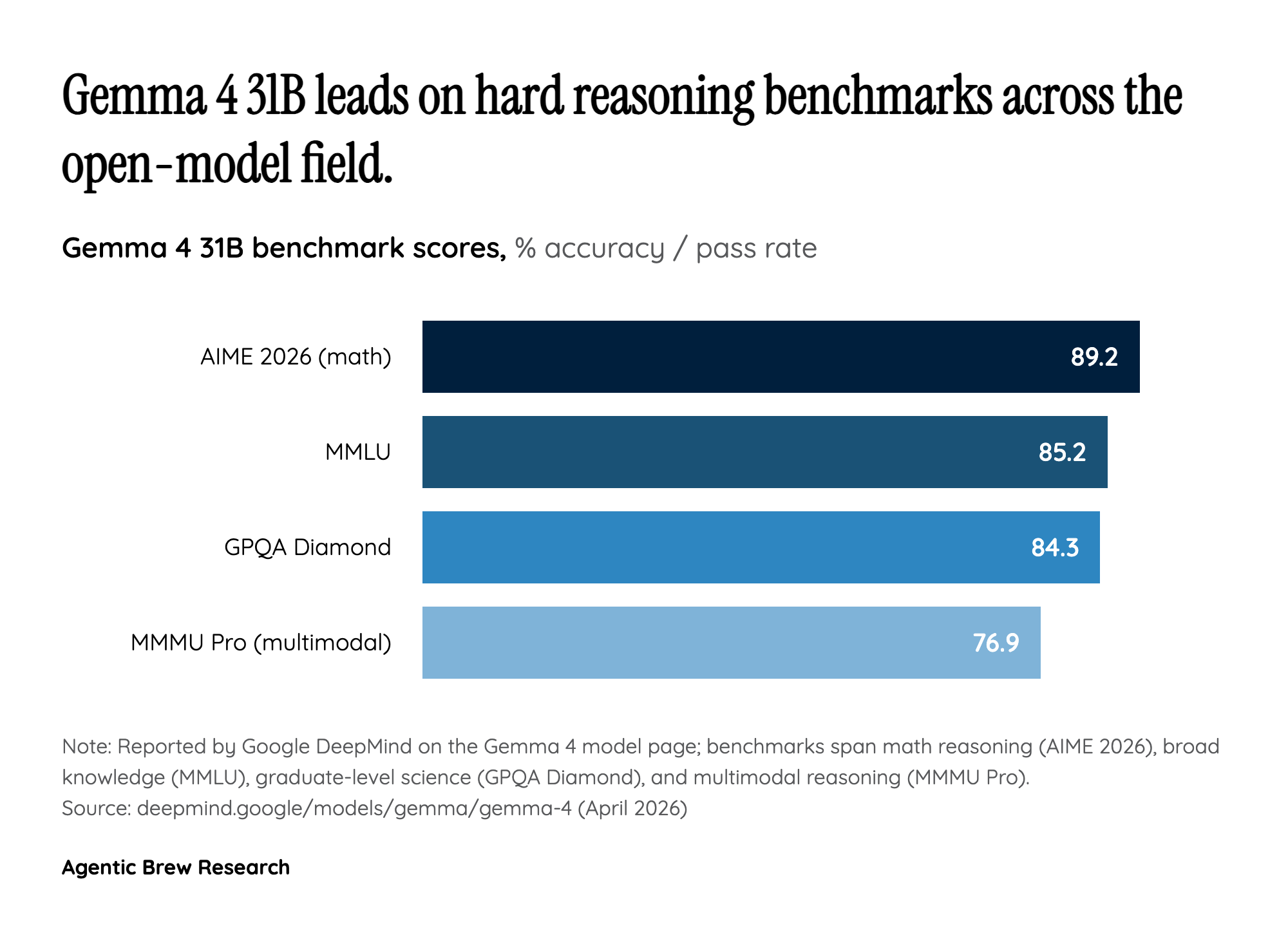
Gemma 4 31B benchmark scores reported by Google DeepMind (April 2026).

Benchmarks tell part of the story — 31B at #3 on the Arena open-model text leaderboard, 26B at #6, MMLU 85.2%, AIME 2026 89.2% — but the strategic move is the Apache 2.0 license. Nathan Lambert's read is unusually blunt: 'Gemma 4's success is going to be entirely determined by ease of use, to a point where a 5-10% swing on benchmarks wouldn't matter at all.' Combined with model sizes that fit comfortably on a single GPU (or 6GB of RAM for the edge variants) and U.S. provenance, Gemma 4 lands precisely where enterprise procurement teams have been stuck for two years.

The MoE design choice is also notable: the 26B-A4B model activates only 3.8B parameters at inference, giving roughly 4B-class latency with 26B-class quality. That is the sweet spot for inference-cost-conscious teams who previously had to choose between Llama-class dense models and proprietary APIs. With 400 million cumulative Gemma downloads and 100,000+ community variants already in the wild, distribution is not a question — Hugging Face's framing of 'frontier multimodal intelligence on device' captures why this release lands harder than a marginal benchmark bump would suggest.

Splitting the TPU into Training and Inference Reveals Where the Money Is

Google's decision to fork the 8th-generation TPU into TPU 8t (training) and TPU 8i (inference) is the most underrated announcement of the month. TPU 8t scales to a 9,600-chip superpod delivering 121 ExaFlops with 2 PB of shared HBM and is positioned to compress 'the frontier model development cycle from months to weeks.' TPU 8i goes the other direction: 288 GB HBM per chip, 19.2 Tb/s interconnect, and an 80% improvement in performance per dollar versus the prior generation.

The split is an admission that agentic workloads have a fundamentally different cost curve than training. Agents make many small, latency-sensitive calls with long contexts and aggressive memory residency requirements — exactly the workload TPU 8i was tuned for. By optimizing inference silicon separately, Google is signaling that the next phase of competition is unit economics, not parameter counts. Customer-reported wins like Gurunavi's 30% satisfaction lift and Payhawk's 50% reduction in expense submission time become more credible when the underlying inference economics are this much better — that 80% perf-per-dollar headline is the number that quietly determines whether building on Gemini Enterprise pencils out against do-it-yourself stacks on Nvidia.

The SMB Land Grab That Wraps the Whole Wave

Easily missed amid the enterprise theatrics is a coordinated small-business push: a 95% Workspace discount for the first three months, a 30-day free trial of the Gemini Enterprise app, up to $6,000 in Google Ads credits for new accounts, and free access to Pomelli and Nano Banana for design and product photography. Each piece, in isolation, looks like a routine promotion. Stacked together, they amount to Google effectively underwriting the cost of an SMB's first quarter on Google AI.

This is a flank that model-only competitors have largely ignored, and the strategy is asymmetric: the same agent platform that runs Home Depot or Mars in production is being subsidized down to the corner consultancy. If the SMB cohort sticks, Google captures distribution into a long tail that is essentially impossible for a model-only vendor to reach. The Pomelli + Nano Banana 2 lineage — the Photoshoot feature shipped in February 2026 — shows this was not improvised; the small-business surface area has been quietly building for months.

The Skeptical Read From the Floor

Sentiment in developer communities is split in an instructive way. Local-AI subreddits and developer YouTube treat Gemma 4 as the runaway winner of the cycle, emphasizing that all four variants are multimodal-and-thinking, that the smaller models genuinely run on phones and 6GB-RAM laptops, and that quality 'reminds me of that first release of Gemini Pro that could actually produce code that would run.' The early chat-template bug that required updated GGUFs days after launch was treated as a minor footnote, not a credibility hit. There is also an undercurrent of comparison with Qwen — one widely-upvoted r/LocalLLaMA post explicitly framed switching from a Qwen 3.5 setup to Gemma 4 as a usability shift on par with what DeepSeek brought with thinking models.

Gemini Enterprise drew a cooler reception from the same crowd, with skeptics positioning it as 'one of 50 AI products from Google' and questioning whether the Agent Platform brand will outlive the next reorg. The contrast matters: Google has clearly won the open-model release of the cycle, but the enterprise narrative still has to prove itself with shipped customer outcomes beyond the case studies highlighted on stage.

Historical Context

2024-02-21
Launched the original Gemma family as its first open-weight model series, establishing the lineage that Gemma 4 now extends.
2025-03-01
Released Gemma 3, the prior generation; Gemma 4 follows roughly a year later with a stricter Apache 2.0 license and a Mixture-of-Experts variant.
2025-12-01
Introduced the Interactions API, the surface through which Deep Research and Deep Research Max are now exposed.
2026-02-01
Added the Photoshoot feature to Pomelli powered by Nano Banana 2, foreshadowing the small-business AI push expanded in April.
2026-04-22
Cloud Next '26 in Las Vegas served as the umbrella event for the Gemini Enterprise Agent Platform, TPU 8t/8i, and Agentic Data Cloud announcements.

Power Map

Key Players
Subject

Google AI Product Updates April 2026

GO

Google DeepMind

Co-designed Gemma 4 and the 8th-generation TPUs and supplied the underlying research foundation shared with Gemini 3 and the Nano Banana imagery powering Pomelli.

GO

Google Cloud (Thomas Kurian, CEO)

Unveiled the unified 'Agentic Enterprise' stack at Next '26, combining the Gemini Enterprise Agent Platform with the Agentic Data Cloud and the new TPU 8t/8i lineup.

AN

Anthropic

Third-party model partner whose Claude Opus, Sonnet and Haiku models are accessible alongside Gemini through the new Model Garden inside Gemini Enterprise Agent Platform.

HU

Hugging Face and the open-source community

Hosting and distributing Gemma 4; the Gemma family has surpassed 400 million downloads with more than 100,000 community variants.

WI

Wiz (now part of Google Cloud)

Powers the Agentic Defense capabilities announced at Next '26, integrating cloud and AI security with Google's Threat Intelligence service.

EN

Enterprise customers (Home Depot, Papa John's, Mars, Citadel Securities, Unilever, Gurunavi, Payhawk)

Early deployers showcased on stage running Gemini Enterprise agents in production for ordering, expense management, and other operational workflows.

SM

Small and medium businesses

Target audience for Pomelli, Nano Banana, the 95% Workspace discount and the $6,000 Ads credit offer aimed at expanding AI adoption beyond large enterprises.

Source Articles

Top 4

THE SIGNAL.

Analysts

"Argues Gemma 4's success will hinge on usability and licensing rather than benchmark wins, calling the Apache 2.0 license, ~30B size, and U.S. provenance a strong fit for enterprise adoption: 'Gemma 4's success is going to be entirely determined by ease of use, to a point where a 5-10% swing on benchmarks wouldn't matter at all.'"

Nathan Lambert
Author, Interconnects AI; lead, The ATOM Project

"Sees Gemma 4 unlocking broader open-model potential through tooling and license fit: 'It's strong enough, small enough, with the right license, and from the U.S., so many companies are going to slot it in.'"

Nathan Lambert
Author, Interconnects AI

"Frames Gemma 4 as 'frontier multimodal intelligence on device,' validating that the smaller variants meaningfully extend edge AI capability for laptops and phones."

Hugging Face team
Open-source AI platform
The Crowd

"GOOGLE: GOOGLE LAUNCHES A NEW AGENT PLATFORM FOR GEMINI ENTERPRISE! Gemini Enterprise users will get access to Projects, Skills, the new Agent Builder, Agents Gallery, Slides editor inside Canvas, and tons of other new features. > Gemini Enterprise is an end-to-end system"

@@testingcatalog0

"Google releases Gemma 4. Gemma 4 introduces 4 models: E2B, E4B, 26B-A4B, 31B. The multimodal reasoning models are under Apache 2.0. Run E2B and E4B on ~6GB RAM, and on phones. Run 26B-A4B and 31B on ~18GB."

@@UnslothAI0

"Google just announced its 8th-generation TPUs, and for the first time, it's releasing two separate chips instead of one. TPU 8t is built for training. TPU 8i is built for inference. The split signals where the AI race is actually heading: training the models is one war, running"

@@TFTC210

"You can now run Google's Gemma 4 model on your local device! (6GB RAM)"

@u/yoracale614
Broadcast
What's new in Gemma 4

What's new in Gemma 4

Google Gemma 4 Tutorial - Run AI Locally for Free

Google Gemma 4 Tutorial - Run AI Locally for Free

Gemma 4 - Google just made AI free forever

Gemma 4 - Google just made AI free forever