Anthropic launches Claude Design
TECH

Anthropic launches Claude Design

37+
Signals

Strategic Overview

  • 01.
    Anthropic launched Claude Design on April 17, 2026 as an Anthropic Labs product that generates prototypes, slide decks, one-pagers, and marketing collateral from conversational prompts, files, or a codebase.
  • 02.
    The product is powered by Claude Opus 4.7, Anthropic's most capable generally available vision model, and is available in research preview to Pro, Max, Team, and Enterprise subscribers with access counted against existing plan limits.
  • 03.
    Outputs can be shared as an internal URL, saved as a folder, or exported to Canva, PDF, PPTX, or standalone HTML, with Canva exports opening as fully editable collaborative files.
  • 04.
    Figma shares fell roughly 7% on launch day, with Adobe, Wix, and GoDaddy also declining on broader AI-risk repricing across design and website-builder software.

A Board Seat, A Resignation, and A Launch Three Days Later

The Krieger timeline is the detail that makes this more than a product release. Mike Krieger joined Anthropic as Chief Product Officer in 2024 after co-founding Instagram and Artifact, and subsequently took a seat on Figma's board. On April 14, 2026, The Information reported that Anthropic's next model would include design tools capable of competing with Figma's core product. Krieger resigned from the Figma board the same day. Three days later, Anthropic shipped Claude Design.

That sequence is not a coincidence of calendar — it is the governance signature of a planned competitive launch. Sitting boards receive roadmap, revenue detail, and customer-segment information that a public-market competitor cannot legally access. A resignation on the day a competing product surfaces in press is the cleanest exit a director can make, but it still raises the question of what Krieger knew, saw, or contributed to on the Figma side while Anthropic was building a near-replacement. Figma's stock rose 5% when the resignation was disclosed — the market read it as a non-event — before falling roughly 7% on launch day once the product was in users' hands. The three-day gap is the interesting part: it's the window in which the market failed to price in what the board had already learned.

The SaaSpocalypse That Wasn't Supposed to Arrive Today

Figma dropping 7% on the day a direct competitor launches is unsurprising. Adobe falling 2.7%, Wix falling 4.7%, and GoDaddy falling 3% on the same day is the more interesting tape. Adobe is not a one-pager tool. Wix and GoDaddy are website builders, not design systems. Their co-movement tells you investors treated Claude Design not as 'a Figma competitor' but as the first credible signal that conversational AI can now ingest a brand and emit production-grade visual output end-to-end.

That repricing logic works backwards from the export list. Claude Design exports to Canva, PDF, PPTX, and standalone HTML. Standalone HTML is the line that quietly threatens the website-builder category: if a non-designer can describe a landing page and get editable HTML, the lowest tier of the Wix and GoDaddy business — simple sites for small businesses — is the first to compress. Ramp's Ara Kharazian has documented exactly this dynamic on the buyer side, noting that Anthropic's growth has come from selling to 'less technical users and smaller contracts than it typically has.' The SaaS design stack had been priced as if AI would augment these tools. April 17 was the day the market started pricing the possibility that AI replaces the entry tier of several of them at once.

By The Numbers: A Sector-Wide Sell-Off

By The Numbers: A Sector-Wide Sell-Off
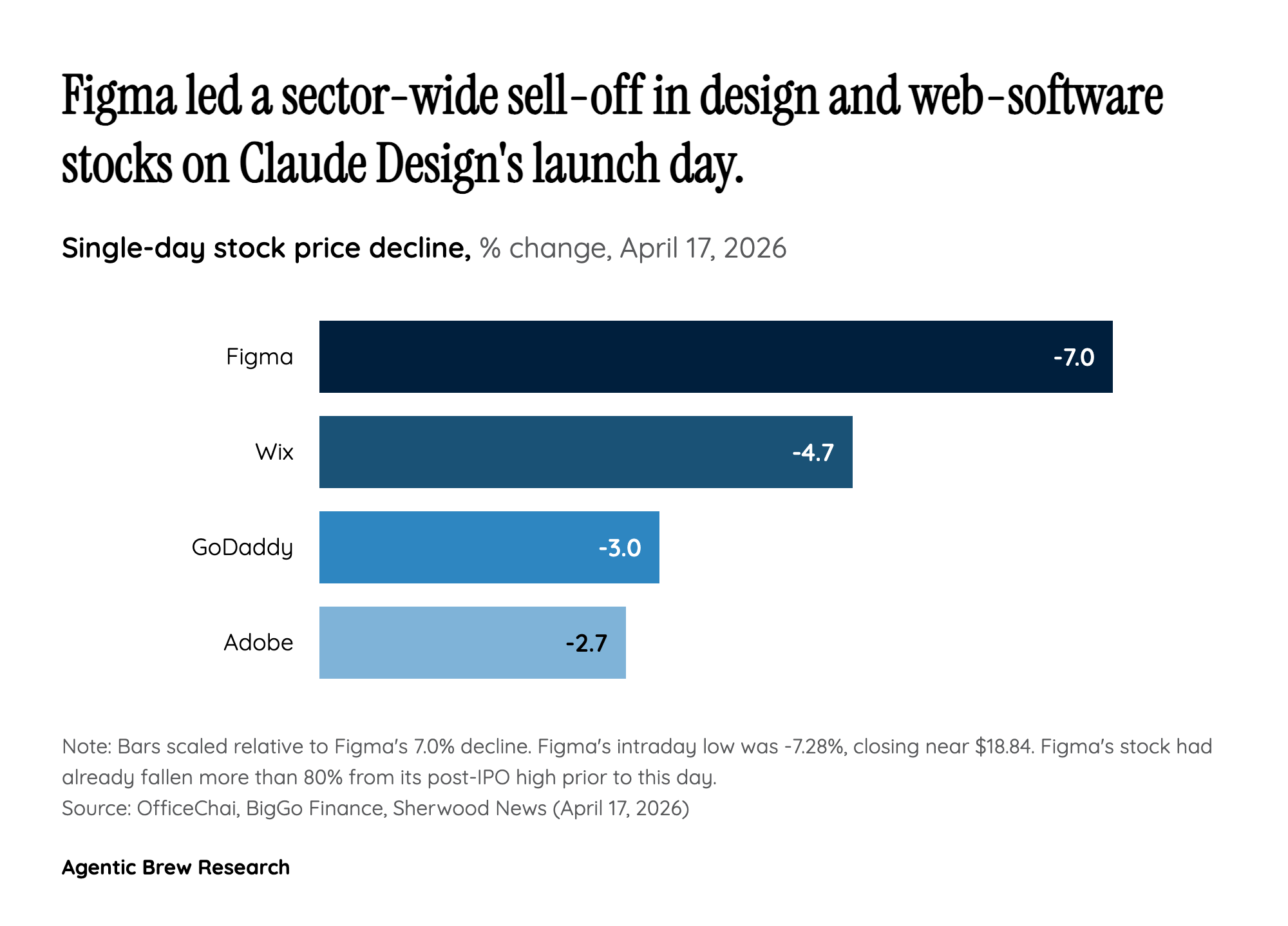
Single-day stock price decline for design and web-software companies, April 17, 2026. Figma led the sell-off at -7.0%, with Wix, GoDaddy, and Adobe also declining.

The stock tape on April 17 tells the clearest story. Figma led the decline at roughly 7% (intraday as much as 7.28%, closing near $18.84), but the reaction cascaded through the adjacent design and web-software complex — Wix fell 4.7%, GoDaddy fell 3%, and Adobe fell 2.7%. That pattern doesn't fit a 'Figma-specific' narrative; it fits a category-wide repricing.

Figma's particular situation is worth isolating: the stock is now down more than 80% from its post-IPO high after the summer 2025 IPO, and Google's 'Stitch' vibe-design launch in March 2026 had already knocked it down 12% over two days. Claude Design extended the pattern rather than broke new ground on it. The cleanest read: April 17 is the day the market stopped treating AI-native design tools as speculative risk and started treating them as baseline competitive reality, with the stock reaction shape (incumbents all down, exposure proportional to category overlap) consistent with a structural, not idiosyncratic, shock.

The Real Trick Is Ingesting a Codebase as a Design System

Strip the marketing language and Claude Design's differentiated mechanism is specific: it can read a company's codebase and existing design files, derive a reusable design system — typography, color tokens, components, spacing — and then apply that system to every subsequent generated asset. This is why demos that look like 'AI makes a slide deck' are missing the actual product. The slide deck is the output; the design system extracted from your GitHub repo is the asset.

That mechanism closes a loop that Figma's February 'Code to Canvas' release tried to close from the opposite direction. Figma converted Claude-generated code into editable Figma files. Claude Design goes code → design system → any format directly, then hands back to Claude Code for implementation. Developer-focused YouTube coverage has converged on this framing — walkthroughs treat the brand-system ingestion as the one-time setup cost, with every subsequent artifact inheriting consistent styling automatically. The critical reader should note the caveat: Reddit builders repeatedly warn that the derived system is only as good as the ingestion step, and one r/ClaudeAI commenter observed that LLMs still 'can't see what they are designing' at the pixel level. The design-system-from-code trick works; editing individual elements after the fact is where the product still shows seams.

The Token Meter Is Where This Launch Bites Its Own Users

Every early hands-on review converges on the same complaint: Claude Design consumes subscription allowance at a rate that makes the research preview barely usable for Pro-tier users. PCWorld's reviewer burned through 80% of a weekly Claude Design allowance in roughly half an hour. Reddit builders reported similar ratios — a week's worth of usage gone in ten minutes after uploading eleven current screens, 70% of weekly allowance consumed by a single Figma-file import. Usage is metered separately from chat and Claude Code, which helps in one direction (it doesn't cannibalize your coding budget) and hurts in the other (the meter is opaque until you hit it).

This is not a bug in the traditional sense — it's the economic shape of running Claude Opus 4.7 on vision-heavy, multi-turn iterative workflows. The tokens required to ingest eleven full-resolution screens, infer a design system, and generate coherent output are genuine. But the pricing communicates a product stance: Claude Design's real target customer is Team and Enterprise, not Pro. The Pro tier gets a taste, enough to propagate demos, not enough to complete a real deliverable. That asymmetry explains the split in community reception — builders who exhausted their quota in minutes register frustration, while analysts focused on the enterprise motion read the same usage pattern as evidence Anthropic is going after the budget that currently funds Figma Enterprise seats.

The Contrarian Read: GenAI Is Already Getting Pulled From Decks

The dominant frame on April 17 — on X, in launch coverage, in the stock tape — was unambiguous: design software is about to get disrupted. The sharpest counter-evidence in the community signal doesn't come from designers defending their craft; it comes from an r/UXDesign commenter reporting that her company is slashing GenAI initiatives after losing a $500K contract that a PM had hyped using Figma Make. 'GenAI is disappearing from executive decks,' she wrote. That's one anecdote, but it matches a broader pattern: the gap between demo quality and production reliability is becoming a procurement issue.

Stack that against other contrarian voices on Reddit — one commenter called Claude Design 'a shittier version of Cursor's design editor,' another called it 'basically a design system plugin / bundle of skills' that doesn't solve the core limitation that LLMs can't visually verify their own output — and a different reading becomes available. Claude Design may accelerate non-designers producing acceptable first drafts while simultaneously hardening the professional case that humans still own the last mile. Figma's 80-90% market share in UI/UX design wasn't built on first drafts; it was built on the thousandth iteration. The split sentiment between the builder communities (excited, technical, focused on the design-system mechanism) and professional designers (defensive, fatigued, focused on employer substitution) is the human mirror of the pricing split: the tool is genuinely useful for the people whose jobs aren't design, and genuinely insufficient for the people whose jobs are.

Historical Context

2024
Joined Anthropic as Chief Product Officer after co-founding Instagram and Artifact; later joined Figma's board less than a year before resigning.
2025
Completed its summer 2025 IPO; stock would subsequently fall more than 80% from its post-IPO high over the following months amid broader AI-driven repricing of design software.
2026-01
Released Claude Cowork and expanded agentic plugin integrations, setting up the product surface area that Claude Design now extends into visual work.
2026-02
Launched 'Code to Canvas,' converting Claude-generated code into editable Figma designs — a defensive integration that Claude Design now partially routes around.
2026-03-19
Released its 'vibe design' product Stitch, knocking Figma's stock down 12% over two days and establishing the pattern that Claude Design extended on April 17.
2026-04-14
Resigned from Figma's board the same day The Information reported Anthropic's upcoming design tool; Figma stock briefly rose 5% on the resignation before reversing three days later on the launch.
2026-04-17
Launched Claude Design in research preview, powered by Claude Opus 4.7.

Power Map

Key Players
Subject

Anthropic launches Claude Design

AN

Anthropic / Anthropic Labs

Built and launched Claude Design as its first significant push into the application layer of the design-tool stack, explicitly targeting non-designers as a broader addressable market.

MI

Mike Krieger

Anthropic's Chief Product Officer (and Instagram/Artifact co-founder) who resigned from Figma's board on April 14, 2026 — the same day The Information reported Anthropic's upcoming competing design tool, three days before launch.

FI

Figma

The category incumbent with an estimated 80-90% UI/UX design share whose stock fell ~7% on launch day; previously collaborated with Anthropic on integrating Claude into its products and launched 'Code to Canvas' two months earlier.

CA

Canva

Positioned as a partner rather than target — Claude Design exports to Canva open as fully editable, collaborative files via a dedicated connector, suggesting Anthropic has chosen where in the stack to compete and where to integrate.

AD

Adobe, Wix, GoDaddy

Adjacent incumbents repriced on the same day (Adobe -2.7%, Wix -4.7%, GoDaddy -3%) as investors treated the launch as a category-wide signal rather than a single-competitor event.

THE SIGNAL.

Analysts

"Expects major impact in formulaic corporate work but dismisses the tool for high-end design: 'When I dabbled with it, I was like, oh this is like a slot machine that doesn't hit.' Argues the design business is fundamentally relational and iterative in ways an LLM cannot replicate."

Molly McCoy
Professional graphic designer (25 years, Bay Area)

"Praised the initial output quality but warned the product is prohibitively token-hungry for Pro users: 'I'd already blown through 80 percent of my weekly Claude Design allowance' after roughly half an hour of active use."

PCWorld reviewer
Firsthand reviewer, Claude Pro subscriber

"Reads Claude Design through adoption data: 'Anthropic has definitely been on a tear. Its increase in adoption rates has been driven by its ability to sell to less technical users and smaller contracts than it typically has' — framing the launch as a continuation of that broadening, not a pivot."

Ara Kharazian
Economist, Ramp

"Flagged the familiar LLM reliability pattern for fine-grained visual editing: outputs look good on first generation, but 'when a user starts trying to edit individual elements, things can quickly fall apart' — a known weakness for production design work."

Gizmodo analysis
Tech publication, hands-on review
The Crowd

"Introducing Claude Design by Anthropic Labs: make prototypes, slides, and one-pagers by talking to Claude. Powered by Claude Opus 4.7, our most capable vision model. Available in research preview on the Pro, Max, Team, and Enterprise plans, rolling out throughout the day."

@@claudeai94000

"generated this email marketing template with claude design....DAMN"

@@Salmaaboukarr3200

"Anthropic just introduced Claude Design which is a tool that lets users create prototypes, slides & one-pagers by talking to Claude. This starts pushing into territory usually associated with $FIG $ADBE but through natural language & without needing much design experience."

@@StockSavvyShay397

"Claude Design just launched, this one looks interesting"

@u/Warframe-Enjoyer510265
Broadcast
Introducing Claude Design by Anthropic Labs

Introducing Claude Design by Anthropic Labs

Claude Design is INSANE

Claude Design is INSANE

Claude Design Just Became Unstoppable

Claude Design Just Became Unstoppable