OpenAI ChatGPT Images 2.0 (gpt-image-2) launch
TECH

OpenAI ChatGPT Images 2.0 (gpt-image-2) launch

65+
Signals

Strategic Overview

  • 01.
    OpenAI launched ChatGPT Images 2.0 on April 21, 2026, powered by the new gpt-image-2 model — the company's first image model with native 'thinking' / reasoning capabilities, plus live web search during generation and self-verification of outputs.
  • 02.
    The model produces up to 2K output (with 4K available in API beta), supports flexible aspect ratios from 3:1 to 1:3, and can generate up to 8 coherent images from one prompt with character and object continuity.
  • 03.
    On Artificial Analysis's Image Arena, gpt-image-2 scored 1,512 Elo in Text-to-Image — a +242 lead over Google's Nano Banana 2, described as the largest #1-to-#2 gap ever recorded on the leaderboard.
  • 04.
    Instant mode is available to all ChatGPT and Codex users, while thinking mode and 8-image generation are gated to Plus, Pro, and Business subscribers; DALL-E 2 and DALL-E 3 will be retired on May 12, 2026.

An Image Model That Actually Thinks — And Why That Changes the Product Category

An Image Model That Actually Thinks — And Why That Changes the Product Category
TechCrunch's product screenshot showing dense typography and UI-style layout rendering — the type of output gpt-image-2's reasoning step is tuned to produce.

The headline feature of gpt-image-2 is not resolution or speed — it is that ChatGPT Images 2.0 is, per OpenAI, the company's 'first image model with thinking capabilities.' In thinking mode the model reasons before it generates, spending variable compute on the plan, and crucially can pull live information from the web mid-generation and self-verify the output before returning it. The Decoder captures the qualitative shift bluntly: the model 'thinks before it generates,' and 'can even search the web during that process.' That is not a diffusion refinement; it is a different loop.

The downstream consequence is that gpt-image-2 behaves less like an image renderer and more like a visual agent. OpenAI's own framing — 'images are a language, not decoration' and the model 'moves image generation from rendering to strategic design' — is doing real work here. Character and object continuity across up to eight outputs, rendering of dense UI mockups with small text and iconography, and multilingual typesetting in non-Latin scripts are all downstream of having a reasoning step in the pipeline. The same architectural story OpenAI told with o-series reasoning models is now stapled onto pixels.
+242 Elo: A Benchmark Lead Without Precedent

+242 Elo: A Benchmark Lead Without Precedent
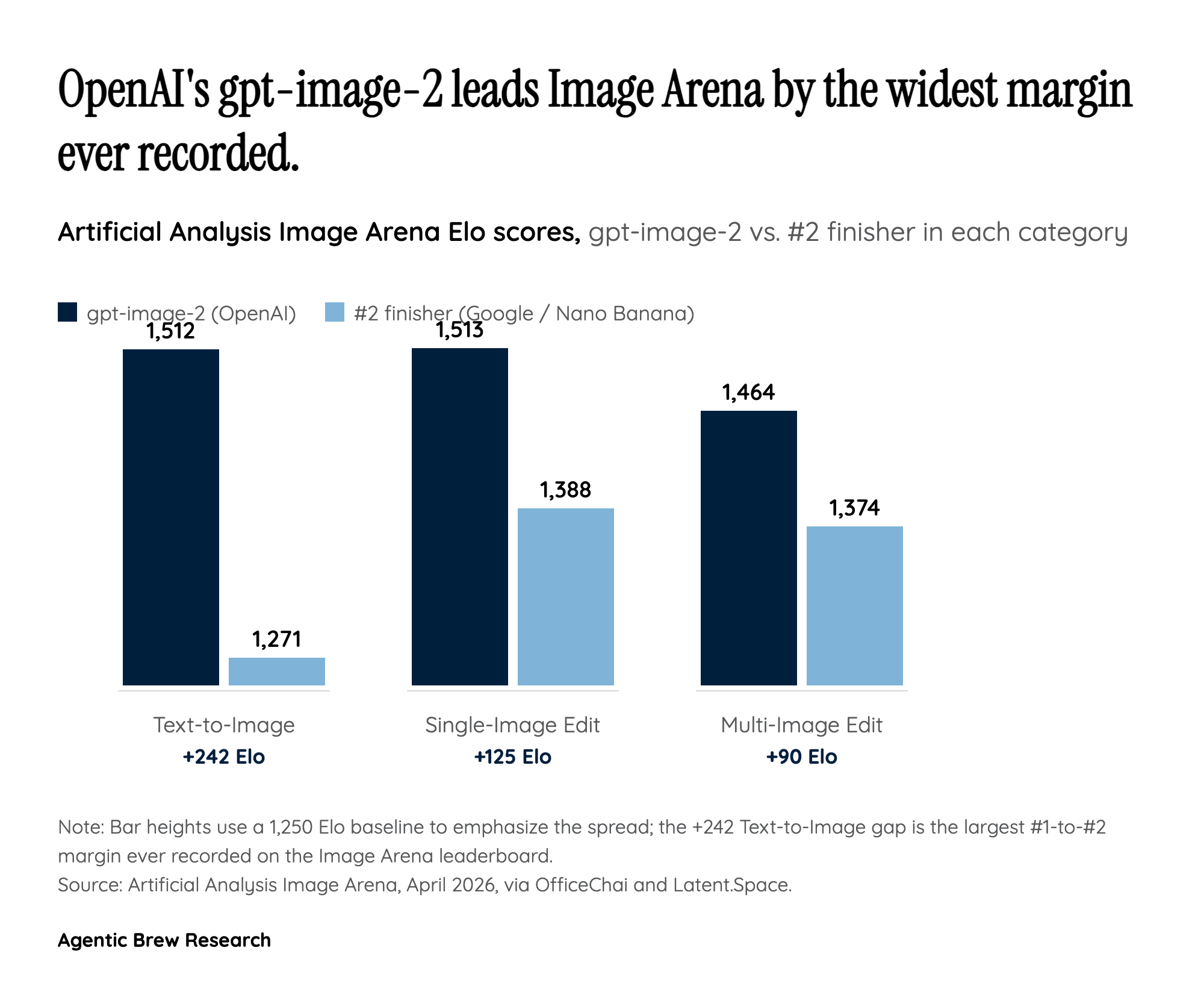
Image Arena Elo comparison: gpt-image-2 vs. Nano Banana 2 / Pro across Text-to-Image, Single-Image Edit, and Multi-Image Edit categories.

On Artificial Analysis's blind-preference Image Arena, gpt-image-2 posted a 1,512 Elo in Text-to-Image — a +242 point lead over Google's Nano Banana 2 at 1,271. OfficeChai reports that Arena itself called this 'the largest gap between #1 and #2 ever recorded on the leaderboard.' That is not just a new #1; it is an outlier data point in a benchmark where frontier models typically cluster within tens of points.

The dominance is broad, not narrow. Single-Image Edit landed at 1,513 (+125 over Nano Banana Pro), Multi-Image Edit at 1,464 (+90 over Nano Banana 2), and gpt-image-2 ranks #1 in all seven text-to-image sub-categories. The gain over OpenAI's own GPT-Image-1.5 ranges from +197 in Art to +316 in Text Rendering — indicating the biggest jump is in exactly the axis (legible text, multilingual glyphs) where diffusion models have historically been weakest. Latent.Space's read is consistent with the data: 'this is not merely prettier art, but a more usable model for UI, mockups, documentation, productivity visuals, and reference-driven design loops.' The benchmark gap and the product-shape gap are the same gap.

From Art Toy to Coding Front-End: The Codex Integration Tells the Real Story

The distribution choice is the tell. Alongside ChatGPT, gpt-image-2 ships inside Codex — OpenAI's coding agent. Latent.Space argues this is the strategic reframe: 'image generation is becoming a front-end for coding agents: generate a UI spec as an image, then have Codex or another code agent implement against that visual reference.' A model that can produce presentation-ready UI mockups with working small text, then hand that visual spec to a code agent that implements it, collapses the loop from designer-to-engineer handoff into a single prompt chain.

That framing explains several otherwise disconnected product decisions. The push on dense layouts, icons, UI elements, and subtle stylistic constraints — 'small text, iconography, UI elements, dense compositions, and subtle stylistic constraints' per TechCrunch — only matters if the image is a specification, not a deliverable. The 2K output ceiling (4K in API beta), the 3:1 to 1:3 aspect-ratio range (web hero, mobile, landing-page, card layouts), and the multi-image continuity (flow screens in one generation) are all specification-friendly, not gallery-friendly. On X, Fuser, Figma Weave, and Higgsfield all announced gpt-image-2 availability within roughly 20 hours of launch — the design-tool ecosystem is reading the signal the same way.

Multilingual Text Rendering Is the Underrated Geographic Unlock

Non-Latin script rendering has been the most embarrassing failure mode of diffusion image models — garbled kanji, scrambled Devanagari, nonsense Hangul. ChatGPT Images 2.0 treats this as a first-class upgrade: Engadget and TechCrunch both highlight 'stronger understanding of non-Latin text rendering in languages like Japanese, Korean, Hindi, and Bengali,' and the jump in the Text Rendering sub-category over GPT-Image-1.5 (+316 Elo) is the single largest sub-category gain recorded.

The field validation on social signals is what makes this credible rather than marketing. A Japanese creator on X explicitly praised that 'Japanese text doesn't glitch out' when generating 2K image assets, and Japanese/Chinese practitioners more broadly confirmed the multilingual claims hands-on. This matters commercially: entire regional design and advertising markets have effectively been unable to use Western diffusion models for finished output because the text would not survive. With gpt-image-2 rendering Japanese, Korean, Chinese, Hindi, and Bengali at presentation quality, OpenAI opens creative workflows in markets where its image tools were, until this week, non-starters — right as DALL-E 3 enters a May 12 sunset.

The Rollout Cracks: Tier Gating, Nerf Fears, and the Flaws Left Behind

The reception is not uniformly rapturous. Reddit threads — including a 1,700-upvote 'Yorkshire pub' realism post in r/OpenAI and a 579-upvote head-to-head against Nano Banana Pro — report a recurring pattern: early access that silently degrades back to the older 1.5 model after hours of use, plus the well-worn 'they will nerf it' meme. Close inspection catalogs residual flaws that survive even the thinking pass — reversed glasses nose pads, overlapping picture frames, three-armed babies, duplicate labels, strange chainmail artifacts, and a new splotchy-dots artifact on some generations. Image-to-image edits draw regression complaints; counting objects remains a weakness that YouTube reviewer Riley Brown flagged in hands-on testing.

The commercial design compounds the friction. Thinking mode — which Reddit users note is actually required to reliably hit v2 quality — is gated to Plus, Pro, and Business subscribers, as are 8-image outputs. Free users get instant mode, which is the version most likely to deliver the 'hype-to-reality' disappointment. Meanwhile DALL-E 2 and DALL-E 3 retire on May 12, 2026, so even hesitant customers are migrating onto gpt-image-2 under a deadline. The split verdict on Creative Bloq — graphic designers calling the capability 'terrifying' while simultaneously predicting '1-2 people per big company' will handle entire ad campaigns — is what a product with this shape tends to produce: a model good enough to restructure the job, shipped with enough rough edges that the restructuring is messy.

Historical Context

2021-01-01
OpenAI first announced DALL-E, a 12-billion-parameter GPT-3 variant for text-to-image generation — the starting point of the lineage that ends today.
2022-04-06
DALL-E 2 launched, moving to a diffusion + CLIP guidance architecture with higher-resolution, more realistic images and becoming the mass-market face of generative image AI.
2023-09-01
DALL-E 3 launched with markedly better nuance and prompt adherence, later integrated natively into ChatGPT Plus and Enterprise.
2025-03-01
DALL-E 3 was replaced in ChatGPT by GPT Image's native multimodal image generation, effectively merging image work into the main model.
2025-11-20
Google released Nano Banana Pro (Gemini 3 Pro Image) with 4K output, 14-image reference support, and SynthID watermarking — the leader in image generation until gpt-image-2 arrived.
2026-04-21
OpenAI launches ChatGPT Images 2.0 / gpt-image-2, topping every Image Arena leaderboard by record margins and adding thinking mode, web search, and up-to-8-image outputs.
2026-05-12
DALL-E 2 and DALL-E 3 are scheduled for retirement from OpenAI's product lineup, forcing remaining workflows to migrate onto gpt-image-2.

Power Map

Key Players
Subject

OpenAI ChatGPT Images 2.0 (gpt-image-2) launch

OP

OpenAI

Developer and distributor of gpt-image-2 / ChatGPT Images 2.0. Controls model access across ChatGPT, Codex, and the API, and defines tier gating between free instant mode and the Plus/Pro/Business thinking mode.

GO

Google DeepMind (Nano Banana 2 / Nano Banana Pro, Gemini 3 Pro Image)

Primary competitor that previously led the image-generation market; now displaced from the top of the Image Arena leaderboard by gpt-image-2 across text-to-image, single-image edit, and multi-image edit.

MI

Microsoft (Azure AI Foundry)

Enterprise distribution partner. gpt-image-2 is being offered inside Microsoft Foundry for enterprise and developer customers, extending OpenAI's reach into regulated corporate environments.

CH

ChatGPT Plus / Pro / Business subscribers

The only tier with access to thinking mode, up-to-8-image generation, and advanced reasoning features — a pointed upgrade incentive that turns image quality into a subscription lever.

AR

Artificial Analysis / Image Arena

Independent benchmarking body whose blind-preference leaderboard results are being used by OpenAI and press to validate gpt-image-2's dominance across all seven text-to-image sub-categories.

GR

Graphic designers and creative agencies

The workforce most directly affected. With the model now capable of presentation-ready menus, slides, infographics, and UI mockups, designer communities are openly debating whether the launch triggers rapid workforce compression.

THE SIGNAL.

Analysts

"Positions the release as a shift from decorative image generation to purposeful composition — a qualitative reframe of the entire category, not a pixel-quality upgrade. 'Images are a language, not decoration. A good image does what a good sentence does — it selects, arranges, and reveals.'"

OpenAI (company positioning)
Launch announcement authors

"Argues this is a productivity tool rather than an art toy, and predicts image generation will become the front-end of coding agents: 'image generation is becoming a front-end for coding agents: generate a UI spec as an image, then have Codex or another code agent implement against that visual reference.'"

Latent.Space (AI News analyst)
Industry analyst newsletter

"Characterizes the launch as a breakthrough in which reasoning plus live web search — the model 'can even search the web during that process' — is the real qualitative leap, not raw visual fidelity."

The Decoder (editorial)
AI news publication

"Frames the Arena leaderboard gap as historically unprecedented — 'Arena called it the largest gap between #1 and #2 ever recorded on the leaderboard.'"

OfficeChai (industry reporter)
AI industry trade publication

"Reactions split between existential dread and predicted workforce compression: 'Almost all graphic design jobs will be replaced in the next 5 years and you might just have 1-2 people per big company who will prompt these models to create whole ad campaigns in mere minutes.'"

Graphic designer community (Creative Bloq commenters)
Working graphic designers
The Crowd

"Introducing ChatGPT Images 2.0 A state-of-the-art image model that can take on complex visual tasks and produce precise, immediately usable visuals, with sharper editing, richer layouts, and thinking-level intelligence. Video made with ChatGPT Images"

@@OpenAI19000

"ChatGPT Images 2.0 just dropped. People can't believe it's 100% AI, it's insanely good. 10 wild examples: 1. "360 equirectangular image""

@@minchoi2200

"I got my hands on both ChatGPT Images 2.0 and Claude Design, and I was blown away. Combining these two makes it totally possible to handle LP production solo. The workflow is just this: 1. Generate image assets with ChatGPT (in 2K, and Japanese text doesn't glitch out)..."

@@koumei_ai5566624

"GPT Image 2 preview"

@u/Groundbreaking_Tap851700
Broadcast
Introducing ChatGPT Images 2.0

Introducing ChatGPT Images 2.0

ChatGPT Images 2.0 Is INSANE – Testing OpenAI's New Image Model!

ChatGPT Images 2.0 Is INSANE – Testing OpenAI's New Image Model!

ChatGPT Just Became the Best AI Image Model in the World

ChatGPT Just Became the Best AI Image Model in the World