OpenAI Codex expands beyond coding
TECH

OpenAI Codex expands beyond coding

39+
Signals

Strategic Overview

  • 01.
    On April 16, 2026, OpenAI shipped 'Codex for (almost) everything,' turning Codex from a coding agent into a general-purpose desktop agent that can see, click, and type with its own cursor across macOS apps.
  • 02.
    The release adds role-based onboarding with suggested prompts for research, planning, docs, slides, and spreadsheets, and bundles 90+ plugins covering Microsoft Suite, Google Workspace, Slack, Notion, Atlassian, GitHub, and GitLab.
  • 03.
    Multiple Codex agents can run in parallel in the background, resume work after pauses, and schedule future work across days or weeks, while computer use is initially macOS-only and unavailable in the EU, UK, and Switzerland.
  • 04.
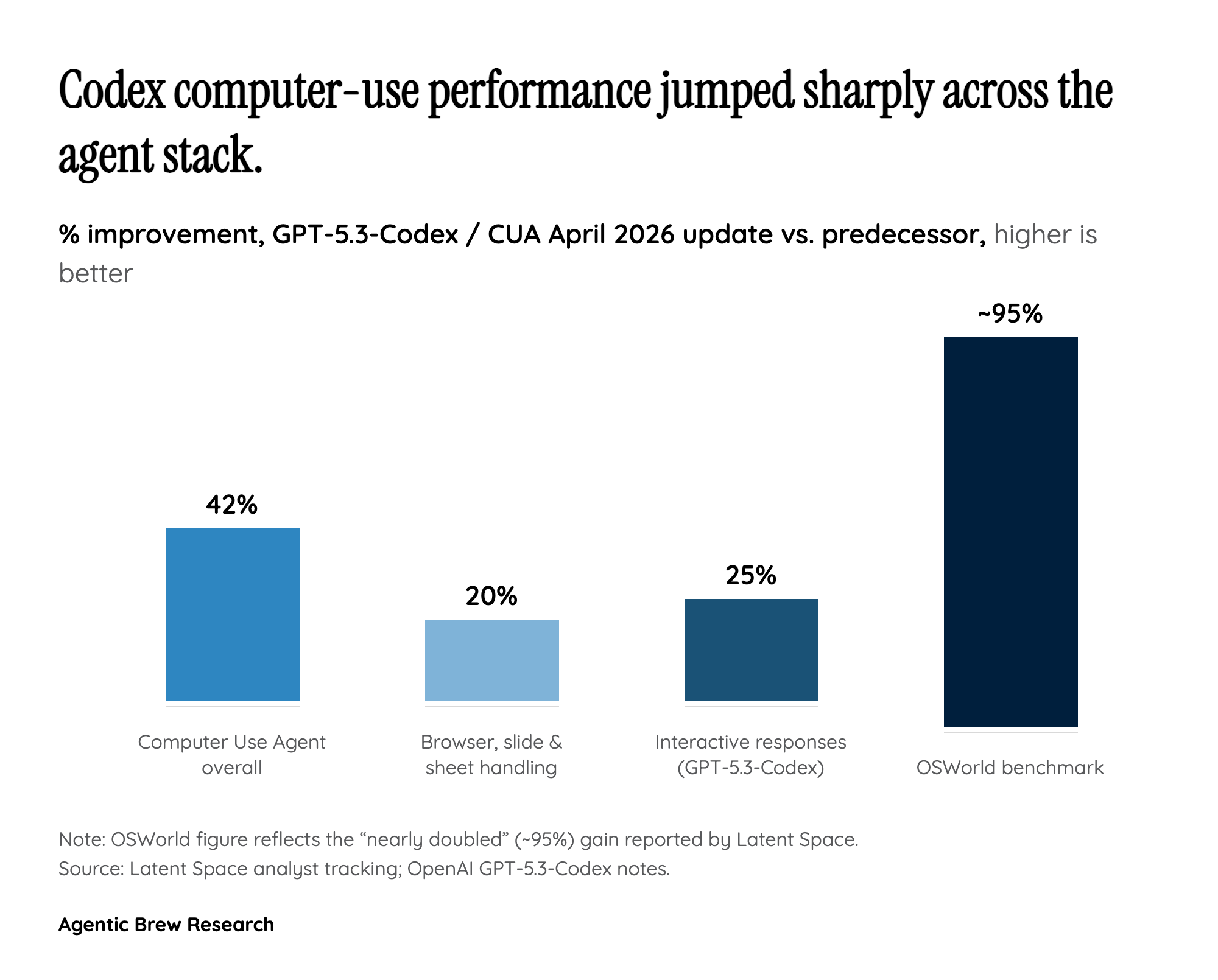
    Per analyst tracking, the Computer Use Agent (CUA) is 42% faster after the update, with roughly 20% additional gains on browser, slide, and sheet handling, and more than 3 million developers now use Codex weekly.

The Knowledge-Work Land Grab: Codex vs Claude Cowork

The most consequential thing about the April 16 release is not what Codex now does on your Mac — it is who OpenAI is openly admitting Codex is for. Greg Brockman has been telegraphing this for weeks: 'the underlying technology we produced is mostly not about code at all. It's mostly about solving problems,' and 'Codex you can think of as — right now it's been a tool that we built for software engineers, but it's becoming Codex for everyone.' The launch operationalizes that thesis. Role-based onboarding, suggested prompts for research, slides, and spreadsheets, and 90+ plugins covering Microsoft Suite, Google Workspace, Slack, Notion, Atlassian, and Salesforce-adjacent tooling are not features for the 3M weekly developer base. They are an explicit invitation to knowledge workers — the audience Anthropic has spent the last year cultivating with Claude's 'Digital Colleague' positioning under the Cowork brand.

Latent Space's swyx put a clean frame on it: 'Agents for Everything Else: Codex for Knowledge Work, Claude for Creative Work.' Anthropic's response — leaning into Adobe, Blender, Canva, and Ableton integrations — confirms the split is mutual rather than imagined. Independent analyst Mahdi Hasan summarized the underlying philosophical divide: 'Codex and Claude Cowork are fighting for the same territory — your desktop — but their philosophies are radically different,' with Codex pitched as a headless engineering platform and Claude as a digital colleague. The two-lane market is now drawn explicitly, and OpenAI's bet is that knowledge work — the larger, more monetizable lane — is where general computer use will pay off first.

What 'Computer Use' Actually Does on Your Mac

What 'Computer Use' Actually Does on Your Mac
Computer-use and benchmark gains from the April 2026 Codex update.

Underneath the marketing, the mechanism is concrete. Codex now operates desktop Mac apps with its own cursor, 'seeing what's on the screen, clicking, and typing to complete tasks,' as MacRumors phrased it from the release notes. Multiple Codex agents can run in parallel in the background without disrupting whatever the user is doing in the foreground, and threads can resume after pauses or schedule their own future work across days or weeks. The release also surfaces a memory preview that persists preferences and context across sessions. Practically, that means you can hand off a multi-step task — say, gather a competitive briefing, draft slides, and update a spreadsheet — and walk away from the laptop without freezing the UI you're actively using.

The performance numbers behind the launch matter for how well this actually feels. Per analyst tracking aggregated by Latent Space, the Computer Use Agent is 42% faster after the update with roughly 20% additional gains on browser, slide, and sheet handling, and GPT-5.3-Codex nearly doubled its predecessor's score on the OSWorld computer-use benchmark. Reddit threads in r/codex traced OpenAI's macOS implementation to its Sky acquisition, with the agent driving apps via accessibility AX-XML plus AppleScript — which explains both why Mac is the launch platform and why some power users have started uninstalling Playwright in favor of Codex's native skills support.

The Cost Rebellion in r/codex

The subreddit reaction is genuinely bifurcated, and that's the most under-told part of this story. The euphoric camp is loud — top posts call computer use 'INSANE,' a 'next GPT-3.5 moment,' and a Jarvis-like experience after watching it play Bloons Tower Defense. But the contrarian voices are sharper than usual for an OpenAI launch. One widely upvoted comment reads, 'Smart people don't use Computer Use. Dumb people upgrade to the $200 tier to use Computer Use.' Another, from a Top 1% commenter going by Reaper_1492, made the enterprise-governance case bluntly: it's not worth $1k/month in tokens to organize your email, and corporate IT is already shutting these tools down. A separate critique: OpenAI should fix coding-agent reliability — pushing it from roughly 60% to 90%+ — before chasing the computer-use horizon.

The cost frame is sharpened by a real comparison data point circulating with the launch: a documented Express.js refactor cost roughly $15 on Codex versus $155 on Claude Code. That's a 10x token-economics gap in Codex's favor for engineering tasks — exactly the reason the cost rebellion is about computer use specifically rather than Codex broadly. Many users in r/codex report burning more than half of a 5-hour Plus quota on a single trivial computer-use task, and that math collapses the 'for everyone' positioning into something closer to 'for everyone willing to pay for the Pro tier.' Hands-on YouTube demos echoed the unevenness: Paul Solt's live test showed real failures on Super Easy Timer and Apple Music alongside the wins.

Geography and Platform Gates

For a launch pitched as 'Codex for everyone,' the rollout is conspicuously narrow. Computer use is macOS-only at launch with Windows listed as 'coming soon' and Linux unaddressed; it is explicitly not available in the EU, UK, or Switzerland. That last gate is the load-bearing one. OpenAI has shipped EU-blocked features before — typically when a capability touches data-protection or AI-Act surface area in ways the legal posture isn't ready to defend — and a desktop agent that can see screens, read documents through plugins, and operate across Microsoft, Google, and Salesforce surfaces fits that profile cleanly.

The second-order read is that OpenAI is willing to ship a deliberately partial product to claim the knowledge-work category before Anthropic does, and accept that 'almost everything' really means almost-every-app on one OS in most-of-the-world. Fidji Simo, OpenAI's CEO of Applications, has framed the consolidation thesis directly: 'We recognized that we were dispersing our efforts across too many applications and platforms.' The superapp story is internally consistent — merge ChatGPT, Codex, and Atlas into one surface — but it currently has a hardware-and-jurisdiction footnote that the marketing copy understates. Whether the EU and Windows gaps close in weeks or quarters will determine whether the 'for everyone' framing ages well or becomes the asterisk competitors quote back.

Historical Context

2021-08-01
OpenAI introduced the original Codex, a GPT-3 descendant fine-tuned on public source code that powered GitHub Copilot's autocomplete.
2023-01-01
OpenAI retired the original Codex model line; Copilot transitioned to GPT-4-class models.
2025-04-01
Codex was relaunched as Codex CLI, an autonomous coding agent built on the codex-1 model (an o3 variant tuned for software engineering).
2025-10-14
Announced expanded strategic partnership: Codex tagging in Slack, OpenAI as a preferred LLM in Agentforce 360.
2026-02-05
Released the Codex desktop app and updated the underlying model to GPT-5.3-Codex.
2026-04-16
'Codex for (almost) everything' update ships: background computer use, in-app browser, image generation, memory preview, 90+ plugins, role selection, and suggested non-coding prompts.

Power Map

Key Players
Subject

OpenAI Codex expands beyond coding

OP

OpenAI

Vendor shipping the upgrade and reframing Codex from a coding-only product into a general computer-use agent for ~3M weekly developer users plus a new non-coder audience.

GR

Greg Brockman (OpenAI President)

Public spokesperson framing Codex as 'for everyone, for any task done with a computer' and pitching the OpenAI superapp narrative.

SA

Sam Altman (OpenAI CEO)

Endorsing the pivot and instructing users to 'try it for non-coding computer work' on launch day.

AN

Anthropic / Claude Cowork

Direct competitor whose 'Digital Colleague' product holds the position Codex is now contesting; Anthropic has responded by leaning into creative-tool integrations like Adobe, Blender, Canva, and Ableton.

SA

Salesforce

Strategic partner since October 2025; Codex can be tagged in Slack channels and Salesforce embeds OpenAI models as a preferred LLM in Agentforce 360.

FI

Fidji Simo (OpenAI, CEO of Applications)

Articulating the consolidation rationale — merging ChatGPT, Codex, and Atlas into one superapp environment.

Source Articles

Top 5

THE SIGNAL.

Analysts

"The underlying technology we produced is mostly not about code at all. It's mostly about solving problems."

Greg Brockman
President, OpenAI

"Codex you can think of as — right now it's been a tool that we built for software engineers, but it's becoming Codex for everyone."

Greg Brockman
President, OpenAI

"Try it for non-coding computer work."

Sam Altman
CEO, OpenAI

"Agents for Everything Else: Codex for Knowledge Work, Claude for Creative Work — the agent market is splitting into two lanes."

swyx (Latent Space)
AI industry newsletter

"Codex and Claude Cowork are fighting for the same territory — your desktop — but their philosophies are radically different."

Mahdi Hasan
Independent technology blogger

"We recognized that we were dispersing our efforts across too many applications and platforms."

Fidji Simo
CEO of Applications, OpenAI
The Crowd

"Codex for (almost) everything. It can now use apps on your Mac, connect to more of your tools, create images, learn from previous actions, remember how you like to work, and take on ongoing and repeatable tasks."

@@OpenAI0

"OpenAI is also preparing to release Computer Use for Codex. Computer use will have a dedicated section in settings, but will be working as an optional plugin. I will need to test Codex <> Claude Desktop recursion, where each app opens the other and asks it to open itself."

@@testingcatalog0

"Today we launched a major update to the OpenAI Agents SDK to help developers build and deploy long-running, durable agents in production. You can now build your own Codex-style agents using powerful primitives for modern agents - file and computer use, skills, memory and..."

@@snsf0

"Codex computer use is INSANE"

@u/mtrlst374
Broadcast
New ChatGPT Codex Update: Automate ANYTHING!

New ChatGPT Codex Update: Automate ANYTHING!

Codex App Update: What's New and Worth Using

Codex App Update: What's New and Worth Using

ChatGPT's New SUPER APP is Insane! (New Codex Upgrade)

ChatGPT's New SUPER APP is Insane! (New Codex Upgrade)