The Gap Between $134 Billion and $38 Million
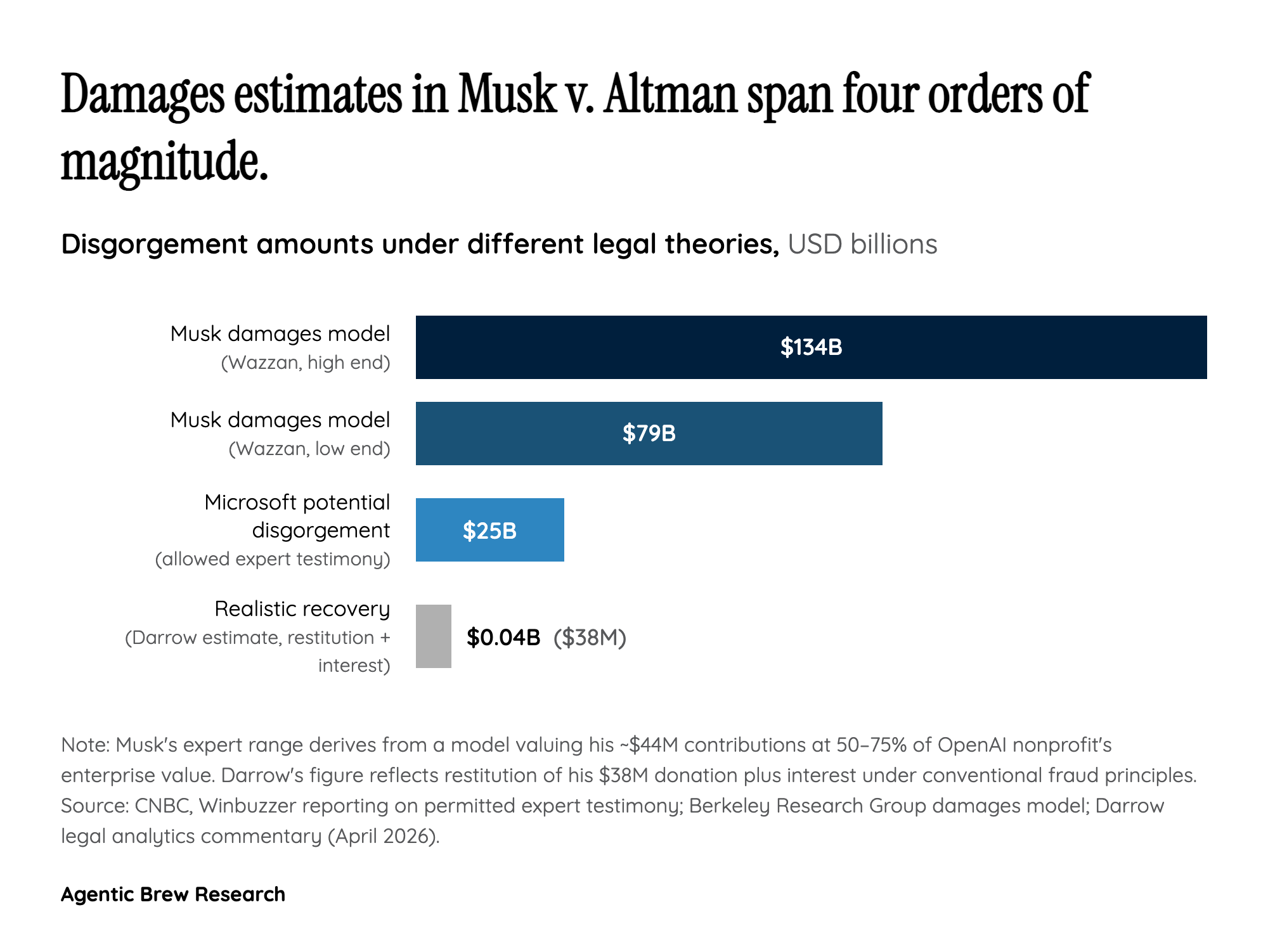
The single most striking number in this trial is the one almost no one believes. Musk's damages expert, Berkeley Research Group's Dr. C. Paul Wazzan, has built a model that values Musk's roughly $44M in early contributions at 50–75% of OpenAI nonprofit's enterprise value, producing a disgorgement range of $79B–$134B. The legal-analytics firm Darrow has separately concluded that under conventional fraud principles, restitution would cap Musk's recovery at his roughly $38M donation plus interest — a figure on the order of $20M to $38M. That is not a rounding error. It is a 3,500x gap between what Musk is asking for and what a sober estimator thinks he can actually win.
Judge Yvonne Gonzalez Rogers has not been subtle about which side of that gap she sits on. She admitted Wazzan's testimony but openly told the courtroom that 'a jury is going to understand that he is pulling these numbers out of the air.' That is an extraordinary line for a presiding judge to deliver before opening statements, and it tells you how the remedies phase — which she alone decides — is likely to go even if the advisory jury hands Musk a liability win. The $134B headline is doing real work in the press, but inside the courtroom it functions less as a damages estimate and more as an anchor: a number large enough to make any settlement or structural concession look like a discount.