Google DeepMind Gemini Robotics-ER 1.6 Launches with 93% Instrument Reading
TECH

Google DeepMind Gemini Robotics-ER 1.6 Launches with 93% Instrument Reading

32+
Signals

Strategic Overview

  • 01.
    Google DeepMind launched Gemini Robotics-ER 1.6 on April 14, 2026, describing it as an upgrade to their reasoning-first model that enables robots to understand their environments with unprecedented precision.
  • 02.
    The model uses a dual-architecture approach where ER 1.6 serves as a strategic reasoning layer providing high-level insights, while Gemini Robotics 1.5 acts as the vision-language-action executor that directly controls robotic limbs.
  • 03.
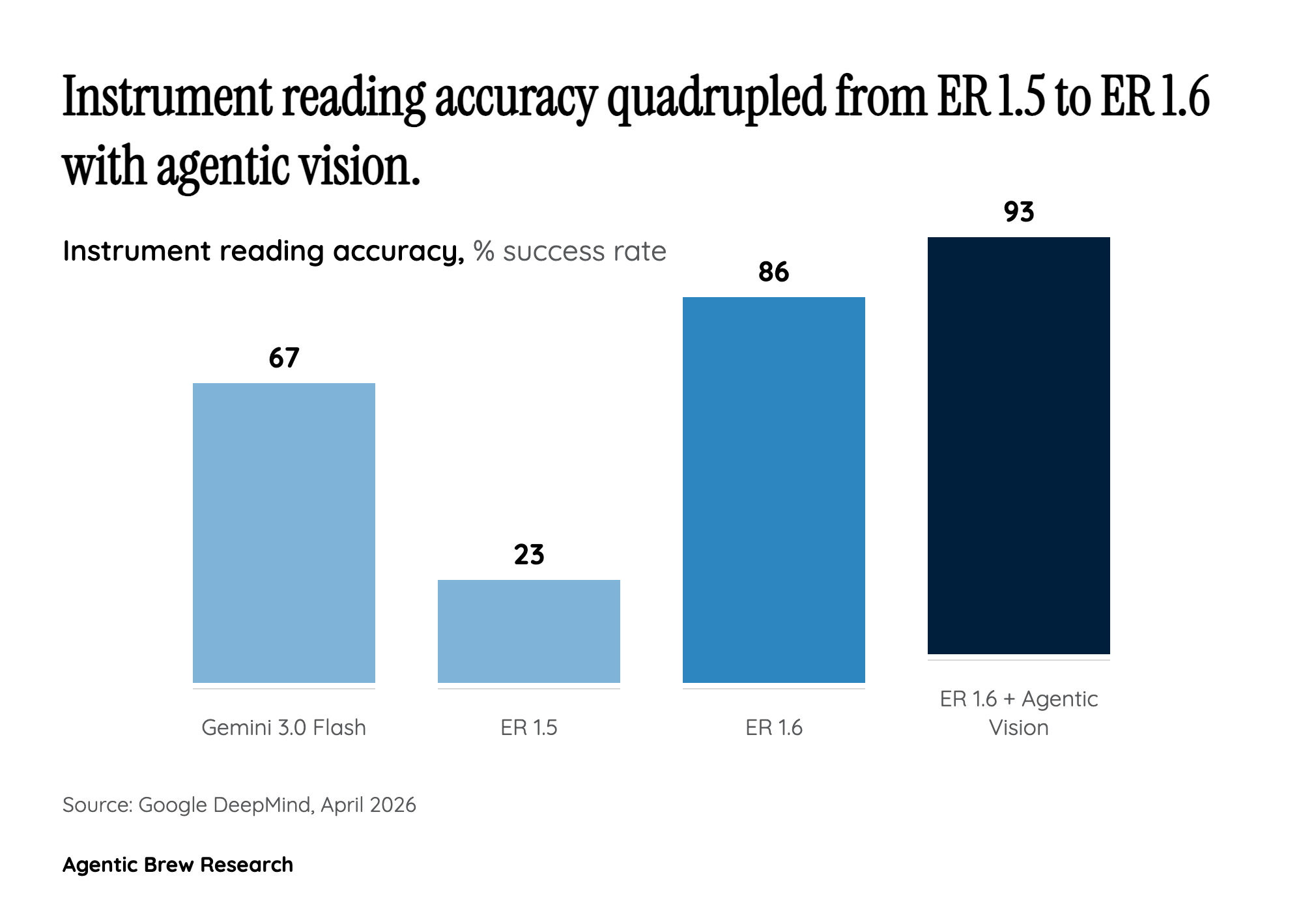
    Instrument reading accuracy jumped from 23% with ER 1.5 to 93% with agentic vision in ER 1.6, outperforming Gemini 3.0 Flash's 67% on the same benchmark.
  • 04.
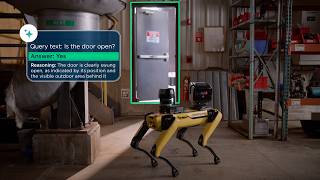
    Boston Dynamics has integrated ER 1.6 into its Orbit AIVI-Learning platform, powering autonomous inspection capabilities for its commercially deployed fleet of several thousand Spot robots.
  • 05.
    The model is Google DeepMind's safest robotics model to date, with a 10% improvement in video hazard identification and 6% in text hazard identification on the ASIMOV safety benchmark.
  • 06.
    Gemini Robotics-ER 1.6 is available immediately through the Gemini API and Google AI Studio under the model ID gemini-robotics-er-1.6-preview, with the previous ER 1.5 version scheduled for sunset on April 30, 2026.

From 23% to 93%: Why the Instrument Reading Leap Changes the Industrial Calculus
From 23% to 93%: Why the Instrument Reading Leap Changes the Industrial Calculus
Instrument reading accuracy across Gemini model versions

The headline number in ER 1.6 is not incremental improvement — it is a categorical shift. Moving from 23% to 93% accuracy in reading analog gauges means the difference between a system that fails more often than it succeeds and one that rivals trained human inspectors. In industrial contexts like oil refineries, chemical plants, and power stations, analog gauges remain ubiquitous precisely because they are mechanically reliable and do not require power. The irony has been that the simplest instruments were the hardest for AI to read.

Marco da Silva's candid admission that "somewhere north of 80 percent is the threshold where it's not annoying" provides a rare quantitative insight into deployment psychology. Below that threshold, human operators spend more time correcting the robot than they save by deploying it. At 93%, ER 1.6 clears this bar with margin, which is critical because real-world conditions — dust, glare, vibration, partial occlusion — will degrade performance below lab benchmarks. The 86% accuracy without agentic vision versus 93% with it also reveals that the model's self-directed visual search strategy (choosing where and how to look) accounts for a meaningful portion of its capability, not just raw vision quality.

The Brain-Body Split: Why DeepMind Chose Dual Architecture Over End-to-End Control

ER 1.6's most architecturally significant design choice is what it does not do: it does not directly control robotic limbs. Instead, it functions as a strategic reasoning layer that feeds high-level spatial understanding to Gemini Robotics 1.5, which handles the actual vision-language-action execution. This is a deliberate rejection of the end-to-end paradigm that dominates much of current AI development.

The rationale is both practical and philosophical. Practically, separating reasoning from execution allows each component to be optimized independently — ER 1.6 can take more time to think about what a gauge reading means while the VLA model maintains real-time motor control. The tunable thinking budgets reinforce this: developers can allocate minimal reasoning for fast pick-and-place tasks and deeper reasoning for precision inspection, all without retraining the motor control layer. Philosophically, it mirrors how human cognition works — deliberate analytical thought and automatic motor skills operate on different timescales and in different brain regions. This architecture also provides a natural safety boundary: the reasoning layer can veto or modify plans before they reach physical execution.

Safety as Competitive Moat: The ASIMOV Benchmark Strategy

Google DeepMind's emphasis on ER 1.6 being its "safest robotics model to date" is not just corporate liability management — it is a deliberate competitive positioning for regulated industries. The 10% improvement in video hazard identification and 6% in text hazard identification on the ASIMOV benchmark may seem modest compared to the instrument reading gains, but these numbers address the single largest barrier to robotic autonomy in industrial settings: trust.

Industrial facilities operating under OSHA, ATEX, or IEC 61508 standards require documented safety cases before autonomous systems can operate without continuous human supervision. A model that can demonstrably identify hazards — a leaking pipe, an abnormal pressure reading, a person in a restricted zone — provides the evidentiary basis for those safety cases. By publishing benchmark improvements against a named standard (ASIMOV), DeepMind is building the audit trail that procurement teams at energy companies and manufacturers will require. Carolina Parada's acknowledgment in her IEEE Spectrum interview that current models remain vision-only is notable honesty — it signals awareness that safety in physical environments ultimately requires multimodal sensing, and that ER 1.6 is a milestone, not a destination.

The API-First Robotics Era: Developer Access and Community Reception

Making ER 1.6 available immediately via the Gemini API and Google AI Studio under a preview model ID represents a significant strategic choice. Rather than limiting embodied reasoning to first-party hardware partners, DeepMind is commoditizing access to spatial understanding. Any developer with API credentials can now build applications that reason about physical spaces from camera feeds — not just robotics companies, but facilities management software vendors, insurance inspection platforms, and construction technology startups.

The tech community reception on X.com has been swift and uniformly positive. Google DeepMind's official account announced the release as an upgrade designed to help "robots reason about the physical world" with "significantly better visual and spatial understanding." Logan Kilpatrick of Google AI amplified the message, calling ER 1.6 the "new SOTA robotics model which excels at visual and spatial reasoning" and highlighting its immediate API availability. Glenn Gabe, an independent tech commentator, captured the broader market sentiment: "I keep saying robotics + AI = HUGE OPPORTUNITY. DeepMind is calling them physical agents." The "physical agents" framing is significant — it positions these models not as remote-controlled tools but as autonomous entities with environmental awareness.

YouTube coverage has been substantial, with Google DeepMind's video "Gemini Robotics: Bringing AI to the physical world" drawing 277K views and their earlier Gemini Robotics 1.5 explainer accumulating 183K views — over 460K combined views signaling strong developer and industry interest. Boston Dynamics published a dedicated video titled "Smarter Inspections Powered by Google Gemini Robotics" on April 14, 2026, coinciding with the launch and demonstrating real-world Spot inspection workflows powered by ER 1.6. Reddit has yet to pick up the topic, consistent with the release being less than 24 hours old.

The April 30, 2026 sunset date for ER 1.5 — just 16 days of migration window — signals that DeepMind intends to iterate on embodied reasoning at language-model speed, not traditional robotics cadence.

Historical Context

2025-03-01
Launched the original Gemini Robotics and Embodied Reasoning models as part of the Gemini 2.0 family, establishing the foundation for robotic spatial understanding.
2025-06-01
Released Gemini Robotics On-Device, enabling edge deployment of robotic reasoning capabilities without cloud dependency.
2025-10-01
Released Gemini Robotics 1.5 and ER 1.5, which achieved 23% instrument reading accuracy and established the dual-architecture reasoning approach.
2026-04-14
Launched Gemini Robotics-ER 1.6 with 93% instrument reading accuracy, improved safety benchmarks, and immediate API availability, alongside Boston Dynamics integration for Spot.

Power Map

Key Players
Subject

Google DeepMind Gemini Robotics-ER 1.6 Launches with 93% Instrument Reading

GO

Google DeepMind

Developer and publisher of Gemini Robotics-ER 1.6, advancing its embodied AI research program

BO

Boston Dynamics

Key integration partner deploying ER 1.6 on its Spot robot platform for industrial inspection via the Orbit AIVI-Learning system

AG

Agile Robots

Hardware partner integrating Gemini Robotics capabilities into the Agile ONE humanoid platform

AP

Apptronik

Hardware partner integrating Gemini Robotics capabilities into the Apollo humanoid robot

THE SIGNAL.

Analysts

""Capabilities like instrument reading and more reliable task reasoning will enable Spot to see, understand, and react to real-world challenges completely autonomously." Da Silva also noted that "somewhere north of 80 percent is the threshold where it's not annoying," suggesting ER 1.6's 93% accuracy crosses the viability bar for production deployment."

Marco da Silva
VP/GM of Spot, Boston Dynamics

""The benchmark we measure ourselves against when it comes to understanding is that the system should answer the way a human would." Parada also noted in the same IEEE Spectrum interview that the current models are vision-only, with other sensory modalities not yet integrated."

Carolina Parada
Head of Robotics, Google DeepMind

"Described ER 1.6 as Google's "new SOTA robotics model which excels at visual and spatial reasoning," emphasizing its immediate availability via the Gemini API."

Logan Kilpatrick
Google AI
The Crowd

"We're rolling out an upgrade designed to help robots reason about the physical world. Gemini Robotics-ER 1.6 has significantly better visual and spatial understanding in order to plan and complete more useful tasks."

@@GoogleDeepMind0

"Introducing Gemini Robotics ER 1.6, our new SOTA robotics model which excels at visual and spacial reasoning, now available via the Gemini API!"

@@OfficialLoganK0

"I keep saying robotics + AI = HUGE OPPORTUNITY. DeepMind is calling them physical agents. Google DeepMind introduces Gemini Robotics-ER 1.6 robotic reasoning model."

@@glenngabe0
Broadcast
Gemini Robotics: Bringing AI to the physical world

Gemini Robotics: Bringing AI to the physical world

Smarter Inspections Powered by Google Gemini Robotics | Boston Dynamics

Smarter Inspections Powered by Google Gemini Robotics | Boston Dynamics

Gemini Robotics 1.5: Enabling robots to plan, think and use tools to solve complex tasks

Gemini Robotics 1.5: Enabling robots to plan, think and use tools to solve complex tasks