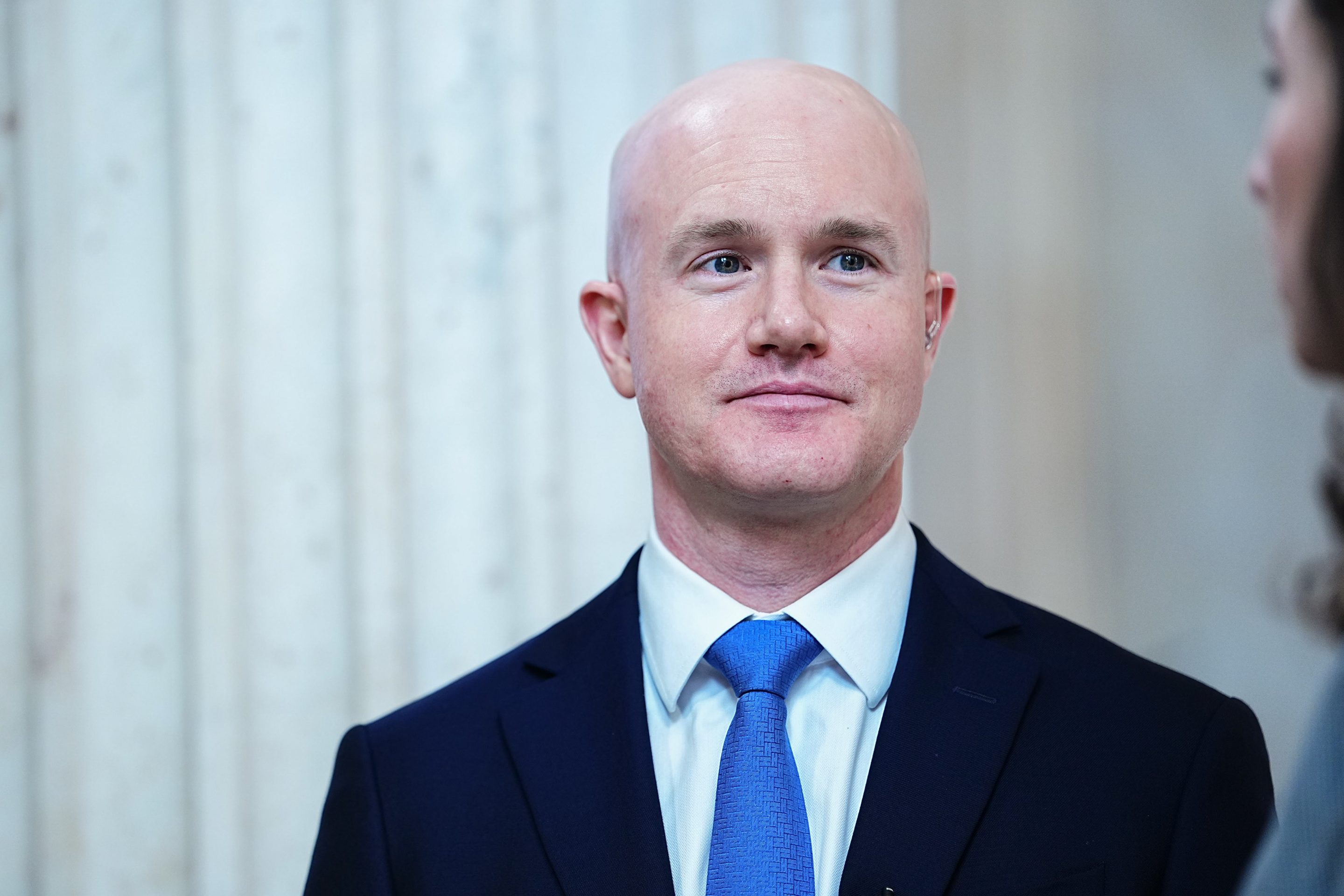
Coinbase 14% layoffs citing AI
TECH

Coinbase 14% layoffs citing AI

34+
Signals

Strategic Overview

  • 01.
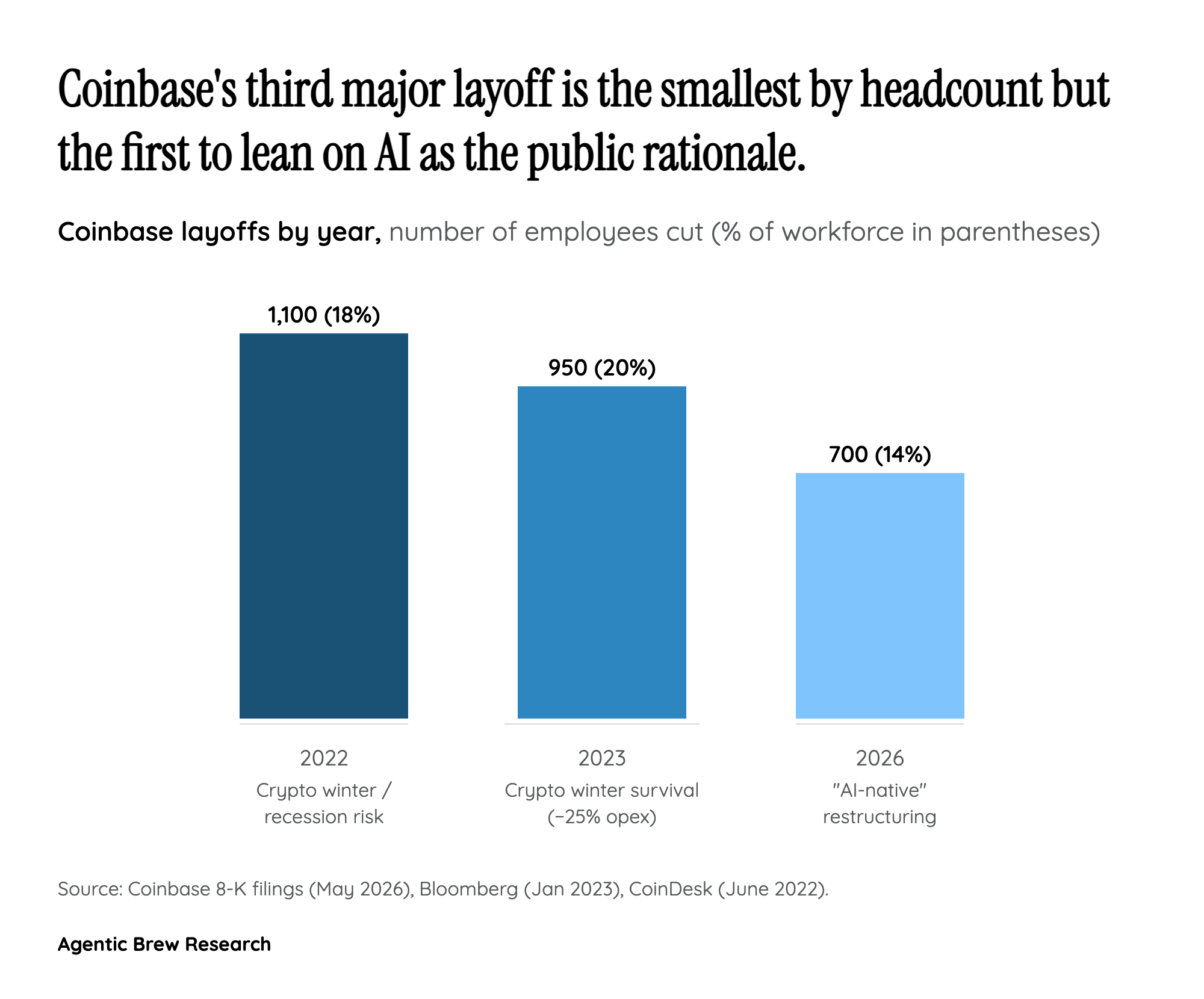
    Coinbase announced on May 5, 2026 that it will lay off approximately 700 employees — about 14% of its global workforce — and incur $50–60 million in restructuring charges, substantially all cash severance, with the plan substantially complete in Q2 2026.
  • 02.
    The 8-K explicitly frames the cuts as both a response to current market conditions and an effort to 'optimize the Company's operations for the AI era,' with CEO Brian Armstrong telling staff that AI now lets engineers ship in days what used to take a team weeks.
  • 03.
    The announcement landed days before Coinbase's Q1 2026 earnings, which showed revenue down 26% year-over-year and consumer transaction revenue down 45% to $734M, against a backdrop of global crypto volume falling roughly 48% from its October 2025 peak.
  • 04.
    Markets approved the AI framing: COIN shares rose as much as 4% intraday, climbing from a Monday close of $202.99 to $207.87, even as crypto peers Algorand, Gemini Space Station, and Crypto.com cut staff in parallel through 2026.

Deep Analysis

The 48-Hour Pre-Earnings Trick: Why the Layoff Hit Before the Print, Not After

The most under-reported detail of this announcement is its timing. Coinbase filed the 8-K on May 5, 2026, two days before a Q1 earnings call that would reveal revenue down 26% year-over-year and consumer transaction revenue down 45% to $734M. Global crypto trading volume had collapsed roughly 48% from its October 2025 peak to $4.3 trillion in March, and Bitcoin had just posted its worst first quarter since 2018. By the standard playbook, a CEO walks into that print with a defensive narrative; Armstrong instead front-ran the bad number with a strategic one. The cuts didn't get reported as 'Coinbase forced into restructuring after revenue collapse.' They got reported as 'Coinbase reorganizes for the AI era.'

The market read the framing exactly as intended. COIN climbed from a Monday close of $202.99 to $207.87, rising as much as 4% intraday on news that 700 of its colleagues were losing their jobs. That stock-up-on-layoffs reaction is the cleanest signal yet that public markets currently price AI-leanness as a forward narrative worth more than the loss of 14% of operating capacity. The $50–60 million in cash severance — substantially complete in Q2 — is small enough to be noise inside the restructuring narrative, large enough to function as a credibility bond that this isn't a one-time PR move.

The Org Chart Is the Product: Five Layers, 15+ Reports, Player-Coaches, One-Person Pods

Armstrong didn't just cut headcount; he published a new operating system for the company. The redesign caps Coinbase at five layers below the CEO and COO, pushes managers toward 15+ direct reports, and eliminates the pure-management role in favor of 'player-coaches' who must remain hands-on individual contributors. 'Layers slow things down and create coordination tax,' Armstrong wrote, and the structural answer is to compress them out. The most radical element is the 'AI-native pod': small cross-functional teams — and explicitly, experiments with one-person teams — that combine engineering, design, and product responsibilities by directing fleets of AI agents.

This is where the design crosses from cost-cutting into bet-the-company territory. The pod model assumes that a single human plus a stack of GitHub Copilot, Cursor, and agent tooling can absorb the work that previously required a four- or five-person team. If the productivity claim is real, Coinbase emerges with a structurally lower cost base and faster shipping cadence than any peer that keeps its traditional org chart. If it's wrong, the company has voluntarily removed the management bandwidth needed to catch the failure modes — on a platform that custodies hundreds of billions of dollars in customer assets. There is no soft landing for that bet.

'Non-Technical Teams Shipping Production Code' — The Line That Lit Up the Internet

Of everything Armstrong said, one phrase did the most damage outside the company's walls: the suggestion that non-technical teams would now be shipping production code under AI assistance. Across developer-leaning communities, the response was immediate and hostile, treating the line as a customer-trust catastrophe rather than a productivity win. The recurring refrain — that Coinbase is one of the juiciest hacking targets on the planet — captured the underlying anxiety: financial-grade code, on a platform that holds billions in customer assets, being merged by people whose primary skill is not the code itself but the prompt that produced it.

The critique isn't that AI tools don't help. A meaningful contrarian minority — including senior engineers who say they personally ship in days what a four-person team used to ship in a sprint — argues that Armstrong's productivity claim is directionally correct. The objection is about who is allowed to push the merge button. In a world where a regression in fraud detection or a misconfigured permission can move real money out of real wallets, 'AI-native' becomes a euphemism for compressing the human-review layer that exchanges have historically used to compensate for the irreversibility of crypto. Coinbase is making the bet that AI tooling now substitutes for that human layer. The crypto-native audience — the same audience that would file the bug report — is conspicuously not buying it.

Sam Altman's Tell: When the AI Vendor Says You're Blaming AI, Listen

The most damaging skeptical voice in this story isn't a Reddit thread; it's Sam Altman. The CEO of OpenAI — whose entire commercial interest aligns with companies citing AI as a productivity wedge — has explicitly warned that 'companies are conveniently blaming AI when layoffs aren't necessarily due to technological advancements.' That's the AI vendor telling the market that 'AI made us do it' is being used as cover. Applied to Coinbase, the read is uncomfortable: revenue is down 26%, consumer transactions are down 45%, the entire crypto industry is cutting (Algorand 25%, Gemini ~200 positions, Crypto.com 12%), and the cuts would have happened regardless of what GitHub Copilot can or cannot do.

There is a more honest version of Armstrong's letter that says: the crypto cycle turned, our consumer trading revenue collapsed, we over-hired in the 2024–2025 bull run, and we are right-sizing. That version doesn't move the stock up 4%. The AI version does. The tension between Altman's framing and Armstrong's is the central editorial question of this story: is AI the cause of the cut, the accelerant of a cut that was coming anyway, or the marketing wrapper that made an otherwise-defensive layoff look like a strategy? Executive coach Anthony Tuggle calls it 'a fundamental structural shift rather than a temporary market correction.' The honest answer is probably that all three frames are partially true, which is exactly why the AI framing is so commercially useful — it's never quite falsifiable.

The Crypto Cluster: Coinbase Isn't an AI Story, It's the First Big One in a Pattern

The Crypto Cluster: Coinbase Isn't an AI Story, It's the First Big One in a Pattern
Coinbase has now cut staff three times in four years; the 2026 round is its smallest by headcount but its first to publicly invoke AI as a primary driver.

Zoom out and Coinbase looks less like a vanguard and more like the loudest member of a cluster. Algorand cut roughly 25% in late March 2026. Gemini Space Station eliminated about 200 positions. Crypto.com is trimming 12%. All three sit in the same macro environment — Bitcoin's worst Q1 since 2018, Ether down 41%, global trading volume down nearly half — and all three reach for some combination of macro and AI as their public explanation. Crypto journalist Raphael Bloch's framing — 'the wave is beginning; viable companies cut headcount while projects die' — implies the survivors haven't even started cutting in earnest.

What makes Coinbase distinct in the cluster is that it is the only one with the market-cap and narrative power to make its restructuring read as forward strategy rather than retreat. Armstrong has been building toward this moment publicly since August 2025, when he fired engineers who didn't onboard with Copilot and Cursor by his deadline — a story that, in retrospect, was the dress rehearsal for the AI-native pod model now codified in the org chart. The 2022 (1,100 cuts) and 2023 (~950 cuts) layoffs were apologetic, defensive, framed as crypto-winter survival. The 2026 cut is offensive in tone — leaner, faster, AI-native — even though the underlying revenue picture is comparable. That tonal shift, more than the headcount number, is what other crypto CEOs will study. Expect at least one of them to copy not just the cuts, but the framing, before the quarter is out.

Historical Context

2022-06-14
Coinbase laid off 1,100 employees (~18% of staff) citing recession risk and a coming crypto winter — its first major workforce reduction.
2023-01-10
Coinbase cut roughly 950 employees, about 20% of its workforce, as part of a 25% operating expense reduction during the deeper crypto winter.
2025-08-22
Armstrong publicly acknowledged firing engineers who didn't onboard with GitHub Copilot or Cursor by his stated deadline — the cultural prequel to the 2026 AI-native restructuring.
2026-03
Algorand cut about 25% of its staff in late March 2026, foreshadowing a cluster of crypto-firm reductions tied to the same downturn.
2026-05-05
Coinbase filed an 8-K disclosing the 14% / ~700-person cut and $50–60M in restructuring charges, framing the move as both a market response and an AI-era operational reset two days before its Q1 earnings.

Power Map

Key Players
Subject

Coinbase 14% layoffs citing AI

BR

Brian Armstrong

Coinbase CEO and architect of the restructuring; sent the staff letter framing layoffs as a strategic AI pivot rather than just cost cuts, and previously fired engineers who didn't onboard with AI tooling.

CO

Coinbase Global Inc. (COIN)

U.S. crypto exchange whose stock rose ~4% on the announcement, with the cut coming days before its Q1 2026 earnings call that showed a 26% revenue decline.

CO

Coinbase engineering org

Most directly affected by the new AI-native pod model; engineers had previously been required to onboard with GitHub Copilot and Cursor under Armstrong's mandate, with some fired for missing the deadline.

OT

Other crypto firms (Algorand, Gemini Space Station, Crypto.com)

Industry peers cutting staff in 2026: Algorand cut 25% in late March, Gemini eliminated ~200 positions, and Crypto.com is trimming 12% — clustering around the same macro and AI narratives.

CO

Coinbase shareholders

Reacted positively to the AI-leanness framing; shares jumped from $202.99 to $207.87 and rose as much as 4% intraday after the announcement.

GI

GitHub Copilot and Cursor

AI coding tools mandated for Coinbase engineers and central to Armstrong's claim that AI now allows teams to ship in days what once took weeks.

Source Articles

Top 4

THE SIGNAL.

Analysts

"Argues that every leader at Coinbase must now be a hands-on builder, that flat AI-leveraged teams are the only viable structure, and that the cuts are about reshaping the company rather than simply trimming costs: 'Every leader at Coinbase must be a strong and active individual contributor.'"

Brian Armstrong
CEO, Coinbase

"Skeptical of the AI-as-cause narrative, suggesting that 'companies are conveniently blaming AI when layoffs aren't necessarily due to technological advancements' — a pointed counter to the framing Coinbase is using."

Sam Altman
CEO, OpenAI

"Reads the Coinbase move as a permanent rather than cyclical change to org design: 'This represents a fundamental structural shift rather than a temporary market correction.'"

Anthony Tuggle
Executive coach

"Echoes Armstrong's productivity thesis, arguing that 'projects that used to require big teams [can] now be accomplished by a single very talented person' under AI leverage."

Mark Zuckerberg
CEO, Meta

"Sees Coinbase as the leading edge of a broader purge: 'the wave is beginning; viable companies cut headcount while projects die.'"

Raphael Bloch
Crypto journalist
The Crowd

"Coinbase is cutting ~14% of staff as Brian Armstrong restructures the company around "AI-native pods." The plan: fewer layers, no pure managers, smaller teams, and employees who can manage fleets of AI agents. Armstrong says the move is driven by two pressures: crypto market volatility and AI transformation."

@@beincrypto0

"AI + pressured crypto prices related layoffs arrive to Coinbase. What's happening + why says the company: "Leaner: Today we are reducing the size of Coinbase by approximately 700 employees or 14%. We're well-capitalized and Coinbase has diversified revenue streams, and is...""

@@BrianSozzi0

"AI contributing to layoffs of 14% of staff at Coinbase."

@@AndrewYang0

"Coinbase cuts 14% of workforce"

@u/oxwy268
Broadcast
Coinbase to Cut 14% of Staff, Citing Volatile Markets and AI

Coinbase to Cut 14% of Staff, Citing Volatile Markets and AI

AI Will Write Over 50% of Coinbase Code -- CEO Brian Armstrong Wants Vibe Coding Crypto Bros

AI Will Write Over 50% of Coinbase Code -- CEO Brian Armstrong Wants Vibe Coding Crypto Bros

Coinbase CEO Fires Employees Who Don't Use AI -- Silicon Valley King Converts to AI Religion

Coinbase CEO Fires Employees Who Don't Use AI -- Silicon Valley King Converts to AI Religion