GitHub Copilot shifts to usage-based billing
TECH

GitHub Copilot shifts to usage-based billing

33+
Signals

Strategic Overview

  • 01.
    On June 1, 2026, every GitHub Copilot plan (Pro, Pro+, Business, Enterprise) retires premium request units and switches to usage-based billing measured in GitHub AI Credits, where 1 credit equals $0.01 USD and credits are debited per input, output, and cached token at each model's published API rate.
  • 02.
    Base subscription prices stay flat and each plan now bundles a monthly AI Credit allotment equal to its sticker price ($10 for Pro, $39 for Pro+, $19/user for Business, $39/user for Enterprise), but anything beyond that allotment is overage billed by token consumption.
  • 03.
    Code completions and Next Edit Suggestions remain unlimited and free of credit consumption, while Copilot code review on private repositories will additionally start drawing down GitHub Actions minutes on the same June 1 cutover; public repositories remain free.
  • 04.
    GitHub will surface a preview bill experience in early May 2026 so customers can see projected costs before the cutover, and Business/Enterprise tiers receive promotional included usage across June, July, and August to soften the landing.

From Software Subscriptions to Cloud Compute Economics

The most consequential thing about this change is not the price tag — it is the economic regime shift hiding underneath. For nearly four years, GitHub Copilot was sold like classic SaaS: a flat seat fee, an implicit promise of 'all you can eat,' and a vendor that absorbed whatever inference cost variance hid inside each user. Greyhound Research's Sanchit Vir Gogia summarizes the failure mode bluntly: the per-seat model is breaking under agentic workloads, and 'the dashboards do not lower the bill. The architecture lowers the bill.' GitHub's Mario Rodriguez frames the same reality from the inside: 'Copilot is not the same product it was a year ago.' A tool that once auto-completed a function now spawns multi-hour, repository-spanning autonomous sessions, and the legacy pricing pretends a one-second chat and a multi-hour agent run cost the same.

That pretense is what June 1, 2026 ends. By tying every input, output, and cached token to its published API rate and denominating consumption in $0.01 AI Credits, GitHub is effectively passing through cloud compute economics to its developer customer base. The InfoWorld analysis describes the transition as moving 'from subscription software economics to cloud compute economics,' and the practical implication is profound: the unit of cost stops being a person and starts being a workload. Heavy agentic users finally see the real number; light users barely notice. The flat seat is no longer the abstraction layer between developer behavior and frontier-model billing — the developer is.

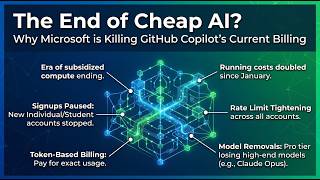
The Opus Tax and the Multiplier Math That Breaks Annual Plans

The number that has galvanized the community is not in GitHub's blog post — it is in the multiplier table. Annual subscribers who locked in expecting roughly 1,500 monthly requests are running the math and finding their effective allotments collapse to somewhere between 55 and 250 'real' prompts depending on which model they invoke. The phrase circulating on X and Reddit is the 'Opus Tax': @BuildFastWithAI flagged that Claude Opus 4.7's multiplier jumped from 3 to 27 — a 9x increase — while Sonnet moved from 1x to 9x. The cheapest path through the new model has gotten dramatically more expensive for anyone who actually wants the strongest models.

Reddit's r/GithubCopilot, r/devops, and r/technology threads have crystallized the same arithmetic from the user side. One widely shared calculation pins a five-file Sonnet conversation at roughly $21. Another points out that $10 in Pro credits buys 'barely a few prompts' once tokens are counted honestly. The community language — 'rugpull,' 'scam,' 'enshittification' — is intemperate, but the underlying complaint is mathematical, not emotional: the multiplier table makes the same workflow cost many times what it cost last quarter, even though the sticker price did not move. GitHub did note that annual plans can be refunded until May 20, an unusually generous concession that itself signals the company expected the multiplier shock to land hard.

The Hidden Second Tax: Code Review Now Eats Actions Minutes

Buried in a separate April 27 changelog is a parallel change that the headline coverage has largely missed: starting June 1, 2026, Copilot code review will additionally consume GitHub Actions minutes on private repositories. Public and open-source repos remain free, but every private-repo review run will now draw down the team's existing Actions entitlement, with overage billed at standard Actions rates. For organizations that already treat their Actions budget as a tightly managed resource, this is a second metering line item arriving on the exact same day as the AI Credit cutover.

The combined effect is that two formerly 'free-feeling' surfaces — chat/agent invocations and automated code review — both start showing up on the bill simultaneously. An enterprise that monitored Copilot seats and Actions minutes as independent line items now has to model their interaction: more agentic activity means more reviews, more reviews means more Actions minutes, and Actions overage stacks on top of AI Credit overage. This is the architectural change Greyhound's Gogia hinted at — the dashboards alone will not save anyone whose default workflow assumed both surfaces were sunk cost.

Why This Is an Industry Move, Not a GitHub Move

The timing is the giveaway. Cursor flipped to credit pools on June 1, 2025. Anthropic moved Claude enterprise pricing to a dynamic usage-based model on April 15, 2026. OpenAI's Codex pricing migrated to token-based credits and GPT-5.2 input pricing jumped from $1.25 to $5.75. GitHub announced its own transition on April 22, 2026 — exactly one week after Anthropic's move and with a cutover date precisely one year after Cursor's. ITSC News is right to call this 'no surprise': the upstream model layer has repriced, and every downstream tool that resells inference must either eat the margin compression or pass it through.

Simon Willison's framing helps explain why GitHub was the last holdout: 'Copilot was also unique (I believe) among agents in charging per-request, not per-token.' That uniqueness was a competitive advantage in a world of cheap models and short prompts, and a structural liability the moment agentic coding made every session unpredictable in length. Maximilian Schwarzmüller's video frames the move as 'inevitable but weird,' and the inevitability is exactly the industry-wide signal: when the three biggest model providers and the leading rival tool have all already moved, the SaaS-style flat-rate AI subscription is no longer a viable business model — it is a transitional artifact.

The Contrarian Case: Honest Pricing Beats Hidden Subsidies

The loudest voices online are angry, but they are not the only voices. A recurring contrarian thread runs through the Reddit discussion: 'phylter99' writes, 'I'd rather them charge us transparently than to keep hiding the costs.' 'vajeen' adds that 'the old pricing was broken.' And 'worldofzero' offers the math from the other side, noting that '$5000/seat monthly would make even the most enthusiastic exec balk' — a reminder that the upper end of agentic consumption has always been there, just absorbed silently by Microsoft's balance sheet.

The Monetizely YouTube analysis frames the new structure as a 'three-part tariff' (base subscription + included credits + metered overage) and argues the Pro+ overage curve 'feels unfair' even as the base/included structure is defensible. That nuance matters. The transition is not a single decision to charge more; it is a decision to make the existing cost structure visible. Heavy agentic users were already expensive; under the legacy model, light users effectively subsidized them. The June 1 change reallocates that cross-subsidy back to the workloads that generate it. Whether that is 'fair' depends on whether you were the subsidizer or the subsidized — and the social-media discourse, weighted heavily toward power users running multi-step agents, naturally over-represents the latter.

Historical Context

2021-06-29
GitHub announced Copilot for technical preview in Visual Studio Code, powered by OpenAI Codex.
2022-06-21
Copilot exited technical preview and became a paid subscription product for individual developers, establishing the flat-rate seat model that endured for nearly four years.
2025-06-01
Cursor moved from fixed fast-request allotments to usage-based credit pools tied to actual API costs, becoming the first major AI coding tool to adopt consumption-based pricing.
2026-04-15
Anthropic moved Claude enterprise pricing from fixed to a dynamic usage-based model, tightening cost pressure on every downstream tool that resells Claude inference.
2026-04-22
GitHub publicly announced the Copilot usage-based billing transition, triggering immediate developer backlash on Reddit, Hacker News, and X.
2026-04-27
GitHub published a changelog confirming Copilot code review would also begin consuming GitHub Actions minutes on private repositories from the same June 1 date.
2026-06-01
Scheduled cutover when premium request units retire, AI Credits go live across all plans, and Copilot code review starts drawing Actions minutes on private repos.

Power Map

Key Players
Subject

GitHub Copilot shifts to usage-based billing

GI

GitHub (Microsoft)

Owner of Copilot redesigning the billing model to recover escalating inference costs from agentic, multi-step coding workloads while keeping advertised subscription prices unchanged.

CU

Cursor

Coding-tool rival that pioneered the consumption shift on June 1, 2025 by replacing fast-request allotments with credit pools tied to actual API costs, setting the template GitHub is now following.

AN

Anthropic

Frontier model provider that moved Claude enterprise pricing from fixed to dynamic usage-based billing on April 15, 2026, just one week before GitHub announced the Copilot transition.

OP

OpenAI

Upstream model supplier whose Codex pricing also migrated to token-based credits and whose GPT-5.2 input pricing jumped from $1.25 (GPT-5.1) to $5.75, pressuring downstream tools to meter usage.

EN

Enterprise and Business Copilot customers

Receive promotional included usage in June, July, and August 2026 plus pooled usage and new budget controls, but face the prospect of token-metered overages on agentic workloads.

IN

Individual developers

Bear the brunt of pricing uncertainty, with vocal community backlash on Reddit, Hacker News, and YouTube about token bills being harder to predict than request counts.

Source Articles

Top 4

THE SIGNAL.

Analysts

"Frames the change as a necessary evolution because Copilot has fundamentally transformed from a code-completion tool into an agentic platform that runs long, autonomous coding sessions."

Mario Rodriguez
Chief Product Officer, GitHub

"Argues that GitHub's sustainability framing is accurate but incomplete: the per-seat model is breaking under agentic workloads, and only architectural change reduces real costs. As he puts it, 'The dashboards do not lower the bill. The architecture lowers the bill.'"

Sanchit Vir Gogia
Chief Analyst, Greyhound Research

"Notes that agentic workflows have fundamentally changed Copilot's compute profile and that 'Copilot was also unique (I believe) among agents in charging per-request, not per-token.'"

Simon Willison
Independent developer and analyst

"Captures the prevailing community sentiment that, in practical terms, 'You will get less, but pay the same price.'"

Anonymous developer (Visual Studio Magazine)
Developer community voice

"Warns that enterprise bills could explode once token consumption is metered transparently: 'I don't see companies going to be all happy if they get a 50x larger bill. People really underestimate how many tokens they use.'"

Anonymous Reddit developer
Enterprise developer community
The Crowd

"Starting June 1st, GitHub Copilot will move to a usage-based billing model as GitHub Copilot supports more agentic and advanced workflows. In early May, you'll see a preview bill experience, giving visibility into projected costs before the transition."

@@github0

"Microsoft has now confirmed that GitHub Copilot is moving to token-based billing on June 1 2026 (as I reported last week)"

@@edzitron0

"GitHub Copilot is moving to usage-based billing on June 1st, and the 'Opus Tax' is real. Look at these multipliers. Claude Opus 4.7 is jumping from 3 to 27. That is a 9x increase in cost for high-end reasoning. In early May, you'll get a 'Preview Bill.'"

@@BuildFastWithAI0

"Change to useage based billing"

@u/DamienBMike361
Broadcast
Told you so

Told you so

The End of Cheap AI? Why Microsoft is Killing GitHub Copilot's Current Billing

The End of Cheap AI? Why Microsoft is Killing GitHub Copilot's Current Billing

GitHub Copilot Pricing Controversy Demystified

GitHub Copilot Pricing Controversy Demystified