Apple $250M Siri AI Settlement
TECH

Apple $250M Siri AI Settlement

45+
Signals

Strategic Overview

  • 01.
    Apple agreed to pay $250 million to settle a class-action lawsuit alleging it falsely advertised AI-powered Siri features tied to the iPhone 16 launch and iPhone 15 Pro lineup, without admitting wrongdoing.
  • 02.
    Eligible U.S. customers will receive a presumptive $25 per device, scalable up to $95 per device depending on claim volume, drawn from a non-reversionary common fund.
  • 03.
    Eligible devices are all iPhone 16 models (16, 16e, 16 Plus, 16 Pro, 16 Pro Max) plus iPhone 15 Pro and 15 Pro Max purchased between June 10, 2024 and March 29, 2025 — roughly 36 million devices.
  • 04.
    The case is Landsheft v. Apple Inc., Case No. 5:25-cv-2668, filed in the U.S. District Court for the Northern District of California; preliminary approval has been granted and the final approval hearing is scheduled for June 17, 2026.
  • 05.
    Claimants will need to provide proof of purchase, the device serial number, a phone number, and Apple Account information; notices are slated to go out within 45 days.
  • 06.
    A separate, still-active securities class action led by South Korea's National Pension Service alleges the same Siri delay caused billions in shareholder losses — meaning the consumer payout is not Apple's last bill.

The math of $25 to $95: a settlement that pays you more if your neighbors don't claim
The math of $25 to $95: a settlement that pays you more if your neighbors don't claim
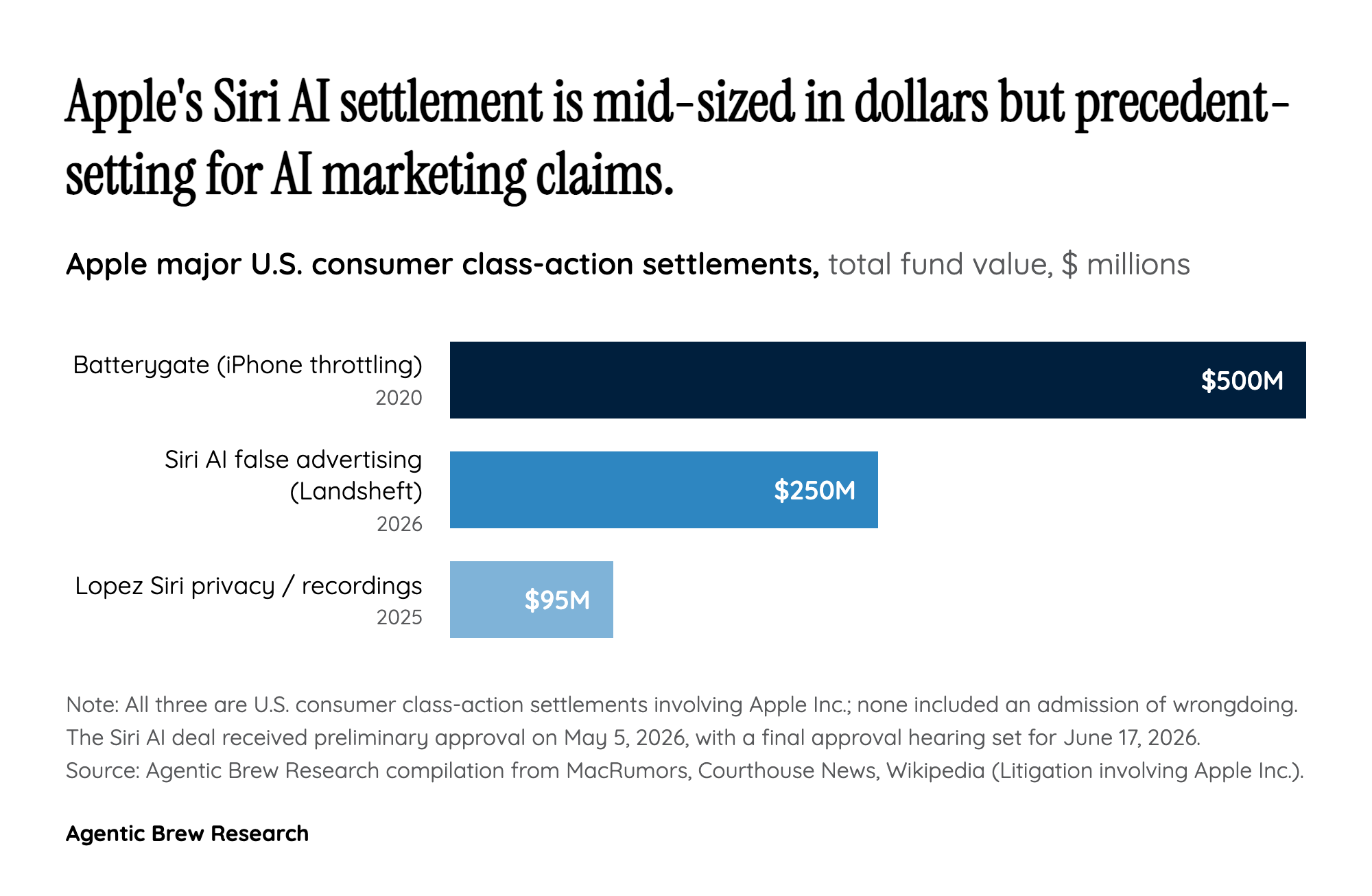
Apple's recent U.S. consumer class-action settlements compared: batterygate ($500M, 2020), Siri AI false advertising ($250M, 2026), and the Lopez Siri privacy case ($95M, 2025).

The headline number people are seeing is '$95 per device,' but the structural number is $25. The $250 million is a non-reversionary common fund, meaning it must all be paid out — none reverts to Apple. With roughly 36 million eligible devices, $250M divided evenly is just under $7 per device, but the settlement architecture sets a presumptive $25 floor and an apparent $95 ceiling, scaling per-device payouts inversely to participation.

That creates an unusual incentive: every claimant who doesn't file makes the pot larger for everyone who does. Practically, this is why the early online discussion has fixated on whether the average household will see $25, $40, or something closer to $95. Class-action participation is often low, which can push real payouts toward the ceiling, but only for the people who actually file. The $95 figure is therefore not a promise — it is what happens if the bulk of eligible owners ignore the notice.
Why this is among the first major consumer-class precedents for AI marketing claims

What separates this case from prior tech-marketing settlements is the subject matter: Apple did not get sued over a battery, a hardware defect, or a privacy lapse — it got sued over the gap between an AI demo and a shipping product. The plaintiffs' complaint frames it bluntly, alleging Apple 'promoted AI capabilities that did not exist at the time, do not exist now, and will not exist for two or more years.' That is a precedent-setting characterization of AI puffery as actionable false advertising, and one of the first major consumer-class outcomes built on that theory.

Equity research is already reading it that way. A Simply Wall St note argues 'the settlement may influence how Apple frames future AI features, including updates to Siri and broader system level tools,' and predicts 'investors will likely be watching for any shifts in marketing language, disclosures around AI limitations, and how Apple addresses consumer expectations.' In other words: every AI feature ad — not just Apple's — now has a $250M data point hanging over its claims department. Online discussion has surfaced an obvious comparison to other AI-on-the-roadmap promises (Tesla's Full Self-Driving recurs as the parallel), with the consensus that Apple was uniquely exposed because it ran specific TV commercials with concrete feature promises rather than vaguer roadmap language.

The $250M consumer fund is dwarfed by a securities case you haven't heard of

Buried in the coverage is a fact that reframes the whole financial story: the $250M consumer settlement is not Apple's largest exposure to the Siri delay. A separate, still-active securities class action — led by South Korea's National Pension Service — alleges the same delayed Siri features caused billions of dollars in stock-market losses to Apple shareholders. That case has not settled.

The consumer class and the securities class measure different harms (paying too much for a phone vs. paying too much for a share), but they spring from the same set of statements about the same product. If the securities suit goes the way of the consumer one, Apple's total bill for the Apple Intelligence rollout could end up being structured less like a marketing line item and more like a category of legal risk. It also explains Apple's careful corporate framing — 'we resolved this matter to stay focused on doing what we do best' — as a posture aimed at the still-pending litigation, not just the closed one.

Federighi's V1-to-V2 pivot: a self-inflicted wound or quality discipline?

The engineering backstory, per Apple's own SVP of Software Engineering Craig Federighi, is that the team had a working V1 Siri architecture they had high confidence in shipping, then pivoted to a deeper V2 architecture they believed was the right long-term answer. In Federighi's words, 'version one was working at the time they were getting close to the conference and had high confidence they could deliver it.' The implication is that the delay was not a failure to build the demo, but a decision not to ship the version they had built.

This explanation is doing two contradictory things at once. From a product-quality standpoint, it is the kind of disciplined call Apple has historically been praised for. From a legal standpoint, it is closer to an admission that the company knew the marketed Siri was not the Siri it would ship — exactly the gap the plaintiffs allege. The settlement avoids forcing the court to choose between those two readings, but the V1/V2 framing will reappear in the still-pending securities case, where the question of what executives knew and when becomes financially material.

What the public reaction actually says: not anger about AI, but about who bears the cost

The most counter-intuitive theme in the post-settlement reaction is not anger that Apple Intelligence is late — it is ambivalence about whether anyone wanted it to begin with. A recurring sentiment in technology forums has been a darkly funny inversion: that the absence of an AI-rewritten Siri is, for many users, a feature rather than a deprivation, and that the more reliable complaint is that today's Siri is worse at basic tasks like timers and reminders than it was a decade ago.

The genuine grievance, where it appears, is narrower and more specific: people who upgraded earlier than they otherwise would have specifically because Apple promised Apple Intelligence on the iPhone 16 — including buyers of adjacent products like the M4 iPad Pro who described feeling 'suckered into buying vaporware.' That subset is exactly the class the settlement is designed to compensate. A second, louder complaint is about exclusion: April 2024 buyers, iPhone 17 owners, and non-U.S. iPhone owners discovering the date window and geography lock them out entirely. The takeaway: this is less a referendum on Siri than a referendum on whether marketing pulled forward a purchase that would otherwise have waited.

Historical Context

2020
Apple agreed to pay roughly $500 million (about $25 per affected user) to settle the iPhone 'batterygate' class action over throttling older devices — the closest large-scale consumer comparable.
2024-06-10
Apple unveiled Apple Intelligence and a context-aware, personalized Siri at WWDC 2024 — the start date of the eligibility window for the settlement class.
2024-09
Apple launched the iPhone 16 lineup with marketing prominently featuring the upcoming Apple Intelligence Siri, despite the feature not shipping with the device.
2025
Apple separately agreed to a $95 million settlement in the Lopez voice assistant case over Siri privacy and recordings allegations — a distinct prior class action that bookends the new $250M deal.
2025
Landsheft filed the consumer class action (Case No. 5:25-cv-2668) in the Northern District of California, alleging false advertising and unfair competition.
2025-03-29
Apple publicly delayed the personalized Apple Intelligence Siri features and pulled related ads — closing the eligibility window for the settlement class.
2026-05-05
Cotchett, Pitre & McCarthy and Clarkson announced the proposed $250M settlement; the court granted preliminary approval and set the final approval hearing.
2026-06-17
Final approval hearing scheduled for the Landsheft v. Apple settlement.

Power Map

Key Players
Subject

Apple $250M Siri AI Settlement

AP

Apple Inc.

Defendant funding the $250M non-reversionary common fund without admitting fault; pulled the original Apple Intelligence Siri ads after the March 2025 delay announcement.

PE

Peter Landsheft

Lead consumer plaintiff who filed Landsheft v. Apple Inc. in the Northern District of California alleging false advertising tied to the iPhone 16 launch.

CL

Clarkson Law Firm

Co-Lead Class Counsel representing the consumer class.

CO

Cotchett, Pitre & McCarthy

Co-counsel that publicly announced the proposed $250M settlement.

U.

U.S. District Court for the Northern District of California

Forum for the consumer class action; will hold the final approval hearing on June 17, 2026 (Judge Noel Wise reported as presiding).

SO

South Korea's National Pension Service

Lead plaintiff in a separate, still-active securities class action against Apple alleging the Siri delay inflicted billions in stock-market losses on shareholders.

AP

Approximately 36 million U.S. iPhone owners

Estimated size of the eligible consumer settlement class who can submit claims for a per-device payment.

Source Articles

Top 5

THE SIGNAL.

Analysts

"Characterized Apple's iPhone 16 ad campaign as misleading millions of consumers about an enhanced Siri that was not deliverable on the promised timeline: "Apple's advertising campaign surrounding its new generation of iPhones promised to deliver an enhanced Siri personal digital assistant, allegedly misleading millions of consumers into purchasing its device.""

Clarkson Law Firm
Co-Lead Class Counsel

"Alleges the AI capabilities Apple promoted at the iPhone 16 launch "did not exist at the time, do not exist now, and will not exist for two or more years" — framing the marketing as fundamentally divorced from the engineering reality."

Plaintiffs' complaint (Landsheft v. Apple)
Class action complaint

"Has previously explained the delay as a deliberate pivot from a working V1 Siri architecture to a deeper V2 architecture after concluding the original would not meet Apple quality standards on time: "version one was working at the time they were getting close to the conference and had high confidence they could deliver it.""

Craig Federighi
Senior Vice President, Software Engineering, Apple

"Framed the deal as a way to avoid prolonged litigation rather than an admission: "We resolved this matter to stay focused on doing what we do best, delivering the most innovative products and services to our users.""

Apple (corporate statement)
Defendant

"Argues the settlement will reshape Apple's AI marketing posture: "The settlement may influence how Apple frames future AI features, including updates to Siri and broader system level tools," and that "investors will likely be watching for any shifts in marketing language, disclosures around AI limitations, and how Apple addresses consumer expectations.""

Simply Wall St research note
Equity research / valuation analysis
The Crowd

"Apple reaches $250M settlement over Siri delays, users could get up to $95 per device"

@u/pdfu3400

"iPhone users could get up to $95 per device as Apple reaches $250M settlement over Siri delays"

@u/Ok-Surprise-84191600

"Apple agrees to pay iPhone owners $250 million for not delivering AI Siri"

@u/Plastic_Ninja_90141000
Broadcast
Some iPhone owners could get up to $95 payment after Apple agrees to settle case for $250 million

Some iPhone owners could get up to $95 payment after Apple agrees to settle case for $250 million

Some iPhone owners could get up to $95 payment after Apple agrees to settle case for $250M

Some iPhone owners could get up to $95 payment after Apple agrees to settle case for $250M

Legal Analyst: iPhone user could get $95 settlement over AI

Legal Analyst: iPhone user could get $95 settlement over AI