Chipmakers AI-driven earnings surge
TECH

Chipmakers AI-driven earnings surge

44+
Signals

Strategic Overview

  • 01.
    Intel reported Q1 2026 revenue of $13.6 billion, up 7% year-over-year, with the Data Center and AI segment generating $5.1 billion (up 22% YoY) and well ahead of the $4.41B consensus.
  • 02.
    Texas Instruments posted $4.83B in Q1 2026 revenue (+19% YoY) with net income up 31%, and its data center segment grew roughly 90% YoY, now a >$1B annual revenue business.
  • 03.
    TI stock jumped 19% on April 23, 2026 — its best single day since 2000 — while Intel shares surged 15-20% after hours, pushing the company above its 2000 tech-bubble all-time high.
  • 04.
    The Philadelphia Semiconductor Index (SOX) crossed 10,000 for the first time the same day, capping a 16-day winning streak and a roughly 39% cumulative gain — its longest run since data collection began in 1994.

Deep Analysis

The Day the AI Trade Stopped Being a GPU Trade

For most of the generative-AI cycle, 'AI capex' has effectively been shorthand for 'Nvidia.' April 23, 2026 is the day that story broke open. Texas Instruments, a 94-year-old analog house best known for op-amps, power-management ICs, and calculators, posted 19% revenue growth and guided Q2 revenue to $5.0-5.4B versus a $4.86B consensus — and the stock jumped 19% for its best single day since 2000. The reason isn't a new GPU architecture. It's that every AI server rack the hyperscalers build needs dense arrays of TI's voltage regulators, signal-conversion chips, and interface parts. TI's CEO Haviv Ilan put a number on it: the data center segment grew 'around 90 percent from the same period last year,' and is now a >$1B annual revenue business layered on top of an industrial base that is itself recovering from a multi-year downcycle.

Intel's print reinforces the same thesis from the other side of the chip. The Data Center and AI segment hit $5.1B, up 22% YoY and ~$700M above consensus, and CFO David Zinsner specifically attributed the beat to 'the growing and essential role of the CPU in the AI era.' That framing would have been laughed off in 2023. In 2026 it's the beat. Put the two earnings together and the market read is unambiguous: AI capex is spilling out of the GPU silo and into analog, CPUs, advanced packaging, and interconnect — the full bill of materials for an AI data center, not just its accelerator. That's why the Philadelphia Semiconductor Index crossed 10,000 for the first time on the same day these two companies reported. The rally is broadening, not narrowing.

Intel's Turnaround Just Broke a 25-Year Ceiling

Intel shares spent a quarter century trapped under the ~$75.81 all-time closing high they set during the 2000 tech bubble. That ceiling broke this week. Q1 2026 marks Intel's sixth consecutive revenue beat, and non-GAAP EPS came in at $0.29 against a $0.01 consensus — a miss by a factor of 29x on the way up. After-hours trading sent the stock up 15-20%, and YTD performance is now roughly +105%. For a company whose narrative for most of the last decade was 'structurally disadvantaged,' this is a regime change.

Lip-Bu Tan, who joined as CEO in 2025 after his Cadence turnaround, has repeatedly framed Intel's opportunity as the shift from training to inference and agentic workloads. His formulation — 'The next wave of AI will bring intelligence closer to the end user, moving from foundational models to inference to agentic' — matters because it maps directly onto Intel's product stack. Agentic workflows orchestrate tool calls, spreadsheets, browsers, and pipelines; that orchestration runs on general-purpose CPUs, not H100s. If Tan is right about where the compute shifts next, Intel's x86 installed base becomes an asset rather than a legacy. The Q2 guide — $13.8-14.8B in revenue and $0.20 non-GAAP EPS — is well ahead of where sell-side models were set, and multiple brokers have already repriced (Northland to $92, Stifel to $65). The turnaround thesis is no longer a contrarian call.

Everyone Is Watching the Calendar, Not Just the Numbers

Everyone Is Watching the Calendar, Not Just the Numbers
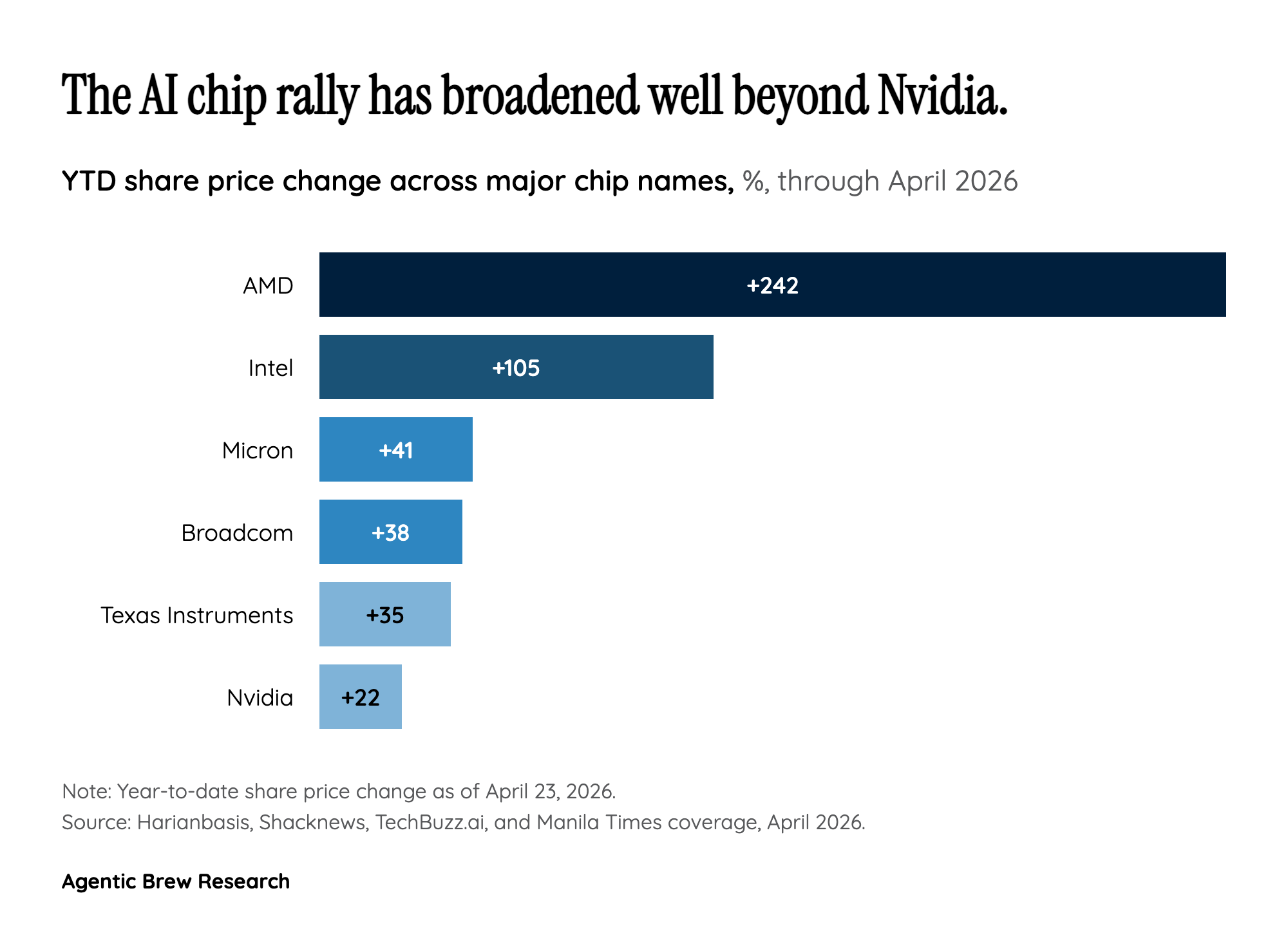
YTD stock performance across chip names, April 2026

Read the quiet part out loud: TI's best single day since 2000. SOX's best month since February 2000. Intel breaking its 2000 closing high. Three separate 'since 2000' datapoints in one session is not a coincidence — and Wall Street has noticed. The harianbasis recap flagged that SOX is now trading more than 16% above its 50-day moving average and at a 52-week high, a configuration that historically precedes mean reversion. Year-to-date gains on individual chip names have decoupled from any reasonable growth rate: AMD +242%, Micron +41%, Broadcom +38%, Nvidia +22%, all in a single quarter.

The bull counter is that the fundamentals are arriving, not just the multiple. Bank of America upgraded TXN to Buy with a $320 price target and raised 2026-28 EPS forecasts by 21%, 31%, and 33% respectively — numbers that only make sense if this is a sustained capex super-cycle, not a sentiment spike. BofA separately projects global semiconductor sales to grow 30% YoY in 2026 and cross the $1T annual milestone. Commentary across the week has reframed this phase as an 'industrialization' of AI — meaning deployment at factory scale rather than the speculative generative-AI enthusiasm of 2023-24. The tension for investors is real: the earnings confirm demand, but the calendar comparisons to 2000 are the kind of echo that has cost people money before. Dan Ives of Wedbush states the bull case flatly — 'no cracks in AI demand on the chips/hardware or software front' — but 'no cracks yet' is a sentence that ages in interesting ways.

Why the TI Print Is the One to Study

Intel's move is louder, but TI's is the more analytically interesting result, because TI doesn't make AI accelerators. It sells boring components into boring end markets, and yet its Q1 is the one that crystallizes the broadening thesis. Three numbers do the work. First, analog revenue was $3.92B, up 22% YoY — that's the core franchise accelerating, not just a hot adjacent segment carrying the print. Second, the data center line grew ~90% YoY to a >$1B annual run-rate, demonstrating that even non-accelerator silicon is being pulled into hyperscaler buildouts at a rate that dwarfs any historical compare. Third, the Q2 guide ($5.0-5.4B revenue, $1.77-$2.05 EPS) is more than $500M ahead of the Street at the midpoint, with the industrial segment — long the overhang on this name — inflecting at the same time.

Stifel's Tore Svanberg framed the industrial piece precisely: 'industrial is particularly strong with lean inventories and improving sell-through.' That's the key structural point. TI is not getting a one-quarter AI bump on top of a weak base. It's getting an AI-driven data center acceleration layered on top of an industrial recovery where customer inventories have already been drained. The combination is why BofA's 33% EPS hike for 2028 is survivable — the thesis is that TI is now a dual-engine compounder rather than a cyclical commodity analog shop. For investors trying to size the AI capex wave, TI is a cleaner read than the hyperscalers themselves, because it's priced on delivered orders rather than capex promises. If the wave is real and durable, TI's P&L is where it shows up first without accelerator distortion. Business-news video coverage over the last 24 hours leaned heavily into this exact framing, treating the print less as a company story and more as an industry-wide signal.

What 'AI Industrialization' Actually Means for the Next Four Quarters

The phrase 'AI industrialization phase' appeared in analyst commentary before these prints; the prints are what make it concrete. Industrialization here has a specific operational meaning: AI stops being a concentrated bet on frontier-model training capex at a handful of labs and hyperscalers, and becomes a distributed bet on deployment infrastructure across thousands of racks, edge locations, and enterprise installations. That shift is what creates the next four quarters of non-obvious watch items.

First, inference and agentic deployment creates steady-state capacity growth rather than lumpy training orders — which is why TI can credibly guide Q2 up after a monster Q1 without flagging pull-forward, and why Intel's Q2 guide of $13.8-14.8B implies sequential acceleration rather than mean reversion. Lumpy-to-smooth is the P&L signature analysts should look for in Micron, Broadcom, and Lam Research prints in the next two weeks. Second, capital intensity spreads from accelerators into facility spend: power delivery, cooling, interconnect, and rack-level integration. That is specifically why TI's analog franchise is printing +22% rather than simply its data center segment — the bill of materials has widened. Third, the forward indicator to watch is not revenue, which is already rising, but order book duration. BofA's 33% EPS hike for 2028 makes sense only if orders are being booked with multi-year visibility; if TI or Intel flags shortening order tails in the Q2 call, the 'industrialization' framing weakens fast. The marketminute framing of silicon as 'the world's most critical commodity' is less hype than logistics. Over the next four quarters, the earnings signal is whether order visibility holds — not whether demand is loud today.

Historical Context

2000
April 2026 is on pace to be the SOX's best month since the dot-com peak of 2000, with 16 consecutive up days — the longest streak since data collection began in 1994.
2000
TI's 19% April 23, 2026 surge is the company's best single-day gain since 2000 — a comparison that has become a recurring motif across this earnings cycle.
2000
Intel's post-earnings move pushed shares above the ~$75.81 all-time closing high set during the 2000 tech bubble — the first clear break of that 25-year-old ceiling.
2025
Tan joined Intel as CEO in 2025 with a turnaround mandate, drawing on his prior success revitalizing Cadence Design Systems.
2025
TI's data center business grew more than 60% in 2025 before accelerating to ~90% YoY in Q1 2026 — the inflection now visible in the stock.
2026-04-10
SOX posted an all-time closing high of 8,926.08 as the AI cycle was described as entering an 'industrialization phase' — setting up the final leg to 10,000.

Power Map

Key Players
Subject

Chipmakers AI-driven earnings surge

IN

Intel Corporation

Legacy x86 CPU leader that is now being revalued as an AI-era winner, as agentic and inference workloads raise demand for server CPUs, foundry capacity, and advanced packaging.

TE

Texas Instruments

Largest analog chipmaker; its power-regulation and signal-conversion chips are now essential to every AI server rack, giving it exposure to the same capex cycle driving Nvidia and AMD.

LI

Lip-Bu Tan (Intel CEO)

Turnaround architect credited with Intel's sixth consecutive revenue beat; the former Cadence CEO is steering the company toward inference, agentic AI, and a foundry alternative to TSMC.

HA

Haviv Ilan (Texas Instruments CEO)

Credited the ~90% YoY data center growth and industrial recovery in the Q1 print, and issued a Q2 guide of $5.0-5.4B revenue that triggered the stock's best day in a quarter century.

HY

Hyperscalers (Meta, Amazon and peers)

Primary demand engine whose data center buildouts now flow through to both advanced chipmakers (Intel DCAI) and analog and embedded suppliers (TI), widening the AI capex surface.

BA

Bank of America semiconductor research

Sell-side voice whose upgrade of TXN to Buy with a $320 PT and 21-33% EPS forecast hikes across 2026-28 encapsulated the Street thesis that the AI boom is at its 'midpoint.'

THE SIGNAL.

Analysts

"Tan frames the next AI wave as a move beyond foundational model training into inference and agentic deployment — a shift that pulls more CPUs, wafers, and advanced packaging into the AI value chain. Verbatim: 'The next wave of AI will bring intelligence closer to the end user, moving from foundational models to inference to agentic.'"

Lip-Bu Tan
CEO, Intel

"Zinsner directly ties the Q1 beat to the AI cycle, arguing CPUs are no longer incidental to AI but 'growing and essential' — language Intel notably avoided for most of the Nvidia-dominated generative-AI phase. Verbatim: 'We delivered robust Q1 results, reflecting the growing and essential role of the CPU in the AI era.'"

David Zinsner
CFO, Intel

"Ilan points to data center as a standout growth engine at TI, with roughly 90% YoY expansion as hyperscalers aggressively add capacity. Verbatim: 'The data center segment grew around 90 percent from the same period last year.'"

Haviv Ilan
CEO, Texas Instruments

"Svanberg highlights that TI's industrial segment — long the drag on the stock — is now inflecting on lean customer inventories and improving sell-through, meaning the AI data center story lands on top of an already recovering base business. Verbatim: 'We believe industrial is particularly strong with lean inventories and improving sell-through.'"

Tore Svanberg
Analyst, Stifel

"Ives treats the prints as confirmation that AI demand has not cooled, calling it a 'bright green light' to stay long the core tech winners heading into the rest of Q1 earnings season. Verbatim: 'We are seeing no cracks in AI demand on the chips/hardware or software front which gives us a bright green light to own the core tech winners heading into 1Q earnings season.'"

Dan Ives
Analyst, Wedbush
The Crowd
Broadcast
Texas Instruments Soars on Upbeat Earnings, GM Rallies, Insurers Decline | Stock Movers

Texas Instruments Soars on Upbeat Earnings, GM Rallies, Insurers Decline | Stock Movers

INTC Stock Alert: Intel's 15% Price Hike & Q1 2026 Earnings Prediction

INTC Stock Alert: Intel's 15% Price Hike & Q1 2026 Earnings Prediction

Should You Buy Intel Stock Before the Huge Investor Update?

Should You Buy Intel Stock Before the Huge Investor Update?