Anthropic Surpasses OpenAI in Revenue as AI Rivalry Intensifies
TECH

Anthropic Surpasses OpenAI in Revenue as AI Rivalry Intensifies

40+
Signals

Strategic Overview

  • 01.
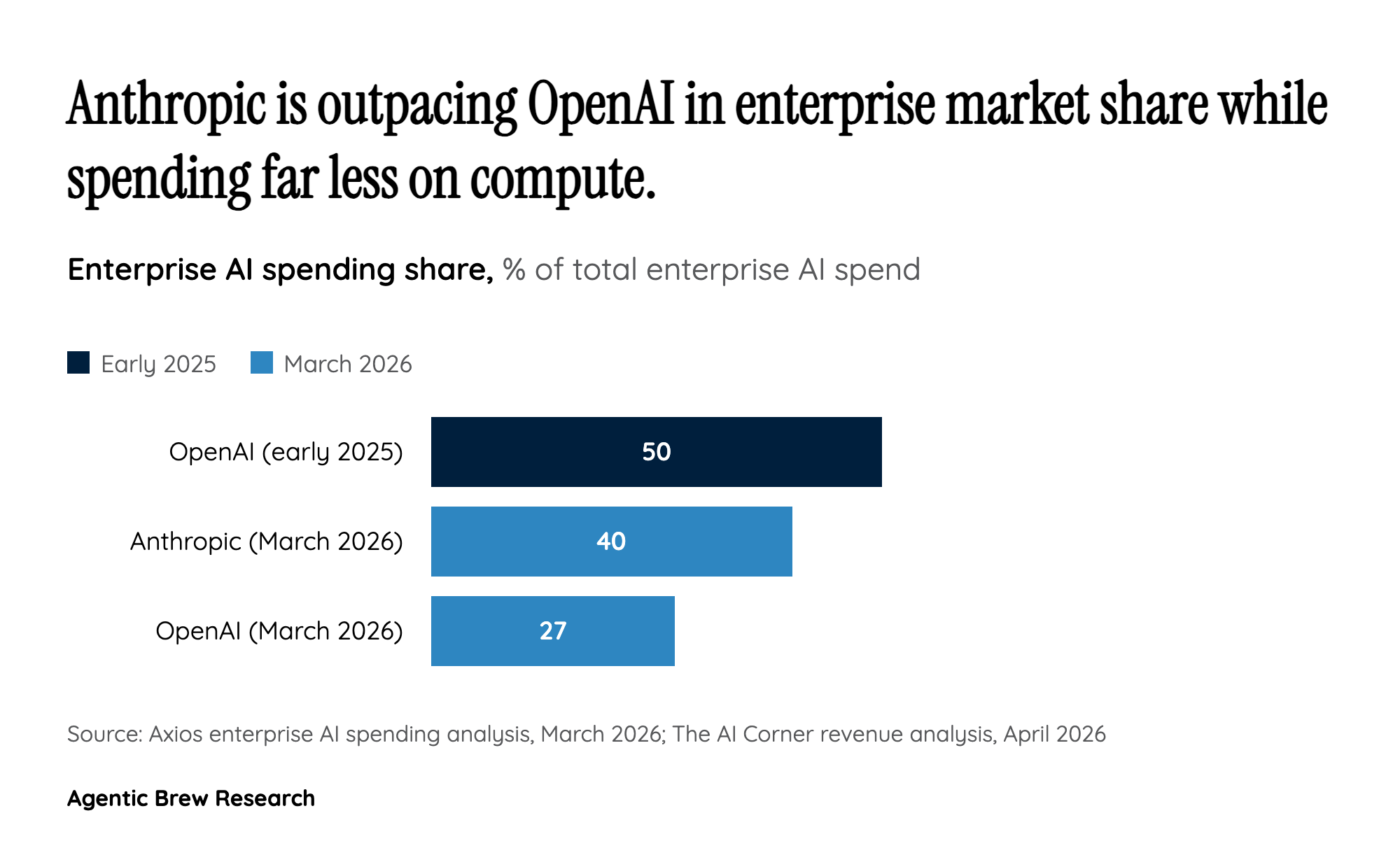
    Anthropic's annualized revenue run rate has reached $30 billion as of April 2026, surpassing OpenAI's $25 billion ARR — a 30x growth from $1 billion just 15 months earlier. The reversal is driven by enterprise adoption, with Anthropic now commanding 40% of enterprise AI spending compared to OpenAI's 27%, down from 50%. As one widely shared X.com analysis by @lmrankhan (over 7,000 engagements) put it, the rivalry comes down to focus vs. breadth — Anthropic built deep enterprise capability while OpenAI spread across consumer products.
  • 02.
    OpenAI responded with an April 2026 shareholder memo attacking Anthropic's compute capacity, claiming a planned 30 GW advantage by 2030 versus Anthropic's 7-8 GW by end of 2027, and describing Anthropic as operating on a 'meaningfully smaller curve.' The memo arrived days after Anthropic's revenue milestone became public — timing that @TFTC21 flagged in a post garnering 1,700 likes, noting the memo read as reactive damage control rather than proactive strategy.
  • 03.
    The two companies represent divergent financial models: OpenAI projects $14 billion in losses for 2026 with $121-125 billion in annual training costs by 2030, while Anthropic projects positive free cash flow by 2027 spending roughly four times less on training. Both companies' combined valuation exceeds $1 trillion, with Anthropic eyeing a $60 billion IPO as early as October 2026. Yet despite the fierce rivalry, Bloomberg reported that OpenAI, Anthropic, and Google are cooperating through the Frontier Model Forum to combat Chinese model-copying — a reminder that geopolitical threats can unite even the bitterest competitors.

Deep Analysis

The Enterprise Flip: How Anthropic Captured the Market OpenAI Built
The Enterprise Flip: How Anthropic Captured the Market OpenAI Built
Enterprise AI spending share showing Anthropic's rise to 40% vs OpenAI's decline from 50% to 27%

The most striking data point in this rivalry is not the revenue crossover itself but the speed and mechanism of the enterprise market share reversal. OpenAI held 50% of enterprise AI spending as recently as early 2025. By March 2026, that number had collapsed to 27%, while Anthropic climbed to 40%. This is not a gradual shift — it is a rout. Anthropic now has over 1,000 enterprise customers each spending more than $1 million annually, and 80% of its revenue comes from business customers.

The enterprise flip reveals a structural vulnerability in OpenAI's business model. With 900 million weekly ChatGPT users but only 5% paying, OpenAI built a consumer attention machine that struggles to convert into enterprise revenue. Anthropic, by contrast, never chased consumer virality. Its product development centered on reliability, safety guarantees, and developer tooling — exactly what enterprise procurement teams evaluate. The framing that resonated most on social media came from @lmrankhan, whose post comparing Anthropic to a focused tool and OpenAI to a broad multi-tool drew over 7,000 engagements — capturing the intuition that breadth of consumer reach matters less than depth of enterprise capability. The launch of Claude Code, which prompted OpenAI's reactive $100/month ChatGPT Pro subscription, demonstrates how Anthropic is setting the product agenda in the segment that actually generates sustainable revenue. When Anthropic commands 40% of enterprise spending to OpenAI's 27% — a near-complete inversion from 18 months prior — it suggests the gap is not just about marketing but about product-market fit in the highest-value customer segment.

Compute Arms Race vs. Capital Efficiency: Two Theories of Victory

OpenAI's shareholder memo makes a specific bet: that raw compute capacity will determine the winner of the AI race. The numbers are staggering — 30 gigawatts of compute by 2030, at a projected training cost of $121-125 billion per year. Anthropic's planned 7-8 GW by end of 2027 is roughly a quarter of that ambition. On paper, OpenAI's argument sounds compelling.

The financial math tells a different story. OpenAI is projected to lose $14 billion in 2026 while generating $25 billion in revenue. Anthropic, spending approximately four times less on training, projects positive free cash flow by 2027 on $30 billion in revenue. This is not just a difference in scale — it reflects fundamentally different theories about what drives AI capability. OpenAI's position assumes that scaling laws will continue to reward brute-force compute investment linearly. Anthropic's position, informed by its founders' deep research background, bets that algorithmic efficiency and architectural innovation can deliver comparable or superior results at a fraction of the cost. The compute debate sparked significant discussion on X.com, with @CNBCi's coverage of the memo generating 632 likes and extensive commentary on whether raw infrastructure or research efficiency would prove decisive. CNBC's companion YouTube video 'Why The Rivalry Is Heating Up' drew 223,000 views, indicating broad investor and public interest in which theory of victory will prevail. If Anthropic is right, OpenAI's compute infrastructure becomes not an advantage but an albatross — billions in fixed costs that must be fed regardless of whether they translate into proportionally better models.

The Pentagon Paradox: How Saying No Became a Competitive Advantage

Anthropic's refusal to comply with Department of Defense demands to remove restrictions on surveillance and autonomous weapons use resulted in the company being declared a 'supply chain risk' by Secretary of War Hegseth. In conventional business terms, losing access to the world's largest defense customer should be catastrophic. For Anthropic, it may have been the most effective marketing campaign imaginable.

The Pentagon confrontation crystallized a distinction that enterprise buyers had been sensing but could not articulate: Anthropic's safety commitments are not marketing copy — they are policies the company will defend at material cost. This matters enormously to enterprise customers in regulated industries like healthcare, finance, and legal services, where deploying AI that might behave unpredictably creates existential liability risk. CNBC's documentary-style video 'How Safety Became The Advantage' drew 236,000 views on YouTube, tracing how Anthropic's willingness to walk away from military contracts became its strongest commercial signal. OpenAI's January 2024 decision to remove military and warfare use bans from its policies, while commercially rational, sent the opposite signal. Former OpenAI Superalignment Lead Jan Leike's public statement that 'safety culture and processes have taken a backseat to shiny products' provided insider validation. In his Big Technology Podcast interview (267,000 YouTube views), Dario Amodei elaborated on this dynamic, arguing that genuine safety practices and commercial success are not in tension but are mutually reinforcing. The irony is precise: by refusing to militarize its product, Anthropic won the trust of the commercial customers who generate far more revenue than any defense contract.

The Shareholder Memo as Defensive Signal: What OpenAI's Tone Reveals

Public companies and pre-IPO giants do not typically devote shareholder communications to attacking competitors by name. OpenAI's April 2026 memo — which specifically named Anthropic, cited its compute limitations, and described it as operating on a 'meaningfully smaller curve' — is unusual enough to warrant analysis as a signal rather than just a statement. The timing, arriving days after Anthropic's $30 billion ARR became public, suggests the memo was reactive rather than planned. As @TFTC21 noted in a post that garnered 1,700 likes, the memo's timing and tone read more like damage control than strategic communication — a point that resonated widely with the tech and finance commentariat on X.com.

The rhetoric escalation extends beyond the memo. Sam Altman has called Anthropic 'clearly dishonest' and an 'authoritarian company.' Dario Amodei has called Altman's statements 'straight up lies' and described OpenAI's safety messaging as 'safety theater.' This is not standard competitive positioning — it is personal hostility rooted in the 2020 split. For investors, the shareholder memo's focus on future compute capacity rather than current metrics — revenue growth, enterprise market share, profitability trajectory — is telling. When a company's best argument is about infrastructure it plans to build by 2030, it is implicitly conceding that today's scoreboard does not favor it. Notably, this pure-rivalry framing coexists with a more complex reality: Bloomberg reported the same week that OpenAI, Anthropic, and Google are cooperating through the Frontier Model Forum to combat Chinese model-copying, suggesting that the companies' relationship involves strategic collaboration on existential threats even as commercial competition intensifies. Anthropic's potential $60 billion IPO as early as October 2026 will provide a direct market test of which narrative investors find more compelling.

Historical Context

2015
OpenAI founded as a nonprofit AI research organization. Dario Amodei joined around 2016 as AI Safety Team Lead.
2020-12
Dario Amodei departed OpenAI after disagreements over the company's approach to AI safety.
2021-01
Dario Amodei and seven former OpenAI employees, including his sister Daniela Amodei, founded Anthropic as a safety-focused AI company.
2024-01
OpenAI removed military and warfare use bans from its usage policies, a policy shift that widened the philosophical gap with Anthropic.
2026-02
Anthropic and OpenAI launched major models within minutes of each other. Anthropic aired Super Bowl ads mocking OpenAI's advertising. At the India AI Summit, Altman and Amodei publicly refused to hold hands with PM Modi.
2026-03
Anthropic refused DoD demands to remove restrictions on surveillance and autonomous weapons. Secretary of War Hegseth declared Anthropic a 'supply chain risk.' Enterprise AI market data showed Anthropic at 40% share versus OpenAI's 27%.
2026-04
OpenAI sent shareholder memo dismissing Anthropic's compute capacity. Anthropic's ARR reached $30B, surpassing OpenAI's $25B. OpenAI launched $100/month ChatGPT Pro subscription to compete with Claude Code. Meanwhile, OpenAI, Anthropic, and Google were cooperating through the Frontier Model Forum to combat Chinese model-copying.

Power Map

Key Players
Subject

Anthropic Surpasses OpenAI in Revenue as AI Rivalry Intensifies

AN

Anthropic

Enterprise-first AI company with $30B ARR, 80% revenue from business customers, over 1,000 enterprise customers spending $1M+ annually, backed by Amazon Web Services

OP

OpenAI

Consumer-first AI company with 900 million weekly ChatGPT users (only 5% paying), $25B ARR, projected $14B losses in 2026, backed by Microsoft

U.

U.S. Department of Defense

Declared Anthropic a 'supply chain risk' after the company refused to remove restrictions on surveillance and autonomous weapons use, highlighting the geopolitical stakes of AI safety policies

EN

Enterprise AI Buyers

Driving the revenue shift — Anthropic now commands 40% of enterprise AI spending versus OpenAI's 27%, with enterprise customers citing safety reputation and product quality as deciding factors, and over 1,000 companies each spending more than $1M annually on Anthropic products

THE SIGNAL.

Analysts

"Called Sam Altman's public statements 'straight up lies' and 'gaslighting,' and described OpenAI's safety messaging as 'mendacious' and 'safety theater.' In a wide-ranging interview on the Big Technology Podcast with Alex Kantrowitz (267K YouTube views), Amodei elaborated on how Anthropic's safety-first approach became its commercial differentiator rather than a constraint."

Dario Amodei
CEO, Anthropic; former OpenAI VP of Research

"Called Anthropic 'clearly dishonest' and an 'authoritarian company,' accusing them of 'doublespeak.' His shareholder memo framed the competition in terms of compute capacity, arguing OpenAI's planned 30 GW infrastructure would prove decisive against Anthropic's smaller footprint."

Sam Altman
CEO, OpenAI

"Stated that at OpenAI, 'safety culture and processes have taken a backseat to shiny products,' providing an insider's validation of the concerns that originally drove the Anthropic founders to leave."

Jan Leike
Former OpenAI Superalignment Lead
The Crowd

"OpenAI sent a memo to investors this week that directly names and critiques Anthropic, unusually pointed language for shareholder communications. The timing tracks closely with Anthropic's announcement that its revenue run rate hit $30 billion, surpassing OpenAI's most recently reported figures."

@@TFTC211700

"OpenAI sent a memo to investors this week blasting chief rival Anthropic for operating on a meaningfully smaller curve. OpenAI said it is planning to have 30 gigawatts of compute by 2030, while it expects Anthropic to have roughly 7 to 8 gigawatts by the end of 2027."

@@CNBCi632

"Anthropic is a butter knife. OpenAI is a Swiss Army knife. Classic startup tradeoff, go deep on a hair on fire problem vs expand across everything. It is no surprise Anthropic is already at ~$30B ARR by staying focused, while OpenAI is pushing into multiple products."

@@lmrankhan80
Broadcast
Anthropic CEO Dario Amodei: AI's Potential, OpenAI Rivalry, GenAI Business, Doomerism

Anthropic CEO Dario Amodei: AI's Potential, OpenAI Rivalry, GenAI Business, Doomerism

Anthropic Vs. OpenAI: How Safety Became The Advantage In AI

Anthropic Vs. OpenAI: How Safety Became The Advantage In AI

Why The OpenAI And Anthropic Rivalry Is Heating Up

Why The OpenAI And Anthropic Rivalry Is Heating Up