Anthropic-Microsoft Maia 200 chip talks
TECH

Anthropic-Microsoft Maia 200 chip talks

41+
Signals

Strategic Overview

  • 01.
    Anthropic is in early-stage talks with Microsoft to rent Azure servers powered by Microsoft's proprietary Maia 200 AI accelerator, first reported by The Information on May 21, 2026.
  • 02.
    A deal would make Anthropic the first external customer for Maia 200, which Microsoft has kept inside its own data centers since announcing the chip on January 26, 2026.
  • 03.
    Maia 200 is purpose-built for inference, not training, and Microsoft claims it delivers more than 30% better tokens-per-dollar than the latest silicon in its existing Azure fleet.
  • 04.
    The discussions follow Microsoft's November 2025 commitment of up to $5B in Anthropic, Nvidia's parallel commitment of up to $10B, and Anthropic's $30B Azure spending commitment.

Deep Analysis

The cap-table irony: Microsoft and Nvidia co-invested in Anthropic, now Microsoft's chip displaces Nvidia

Six months ago, Microsoft and Nvidia jointly bet on Anthropic — Microsoft committing up to $5B and Nvidia up to $10B in a financing that valued Anthropic in the $350B range [1]. Anthropic in turn pledged $30B in Azure spending [2]. The pitch was a tidy triangle: Microsoft books cloud revenue, Nvidia ships GPUs into the Azure racks that Anthropic rents, and Anthropic gets the capacity to run Claude. The Maia 200 talks, first reported by The Information on May 21, 2026, scramble that geometry [3]. If Anthropic leases servers running Microsoft's own inference accelerator instead of Nvidia HGX boxes inside Azure, Microsoft moves up the value stack from landlord to chip vendor — and Nvidia's share of Claude's inference workload starts shrinking inside a deal it helped finance.

Jim Cramer captured the strategic vibe shift bluntly, calling Microsoft paying Anthropic for products it considers superior 'big' [4]. The cap-table irony is that Nvidia's $10B equity stake now sits alongside a customer-and-supplier arrangement explicitly designed to lower Anthropic's dependence on Nvidia GPUs [5]. Anthropic gets a fourth silicon supplier; Microsoft gets its first external Maia customer ever; Nvidia gets a slightly thinner slice of one of its largest frontier-lab buyers — all routed through equity it just wrote.

Why inference is the wedge — and why Maia 200 was built for it, not training

Maia 200 is not aimed at the headline-grabbing training runs that defined the H100 era. Microsoft positions the chip as squarely focused on inference — the workload that runs every time a Claude prompt is answered, every time a Copilot autocompletes, every time an agentic loop fires a tool call [9]. That framing matters strategically. Training is episodic — a multi-month sprint per frontier model — but inference is the 24/7 revenue engine that scales with every API call. A 30%+ tokens-per-dollar advantage, as Satya Nadella claims for Maia 200 against the latest silicon in Microsoft's fleet [7], compounds across billions of daily requests.

For Anthropic, the calculus is even sharper: Dario Amodei has publicly flagged 'difficulties with compute' as a binding constraint [8], and inference economics directly govern gross margin on Claude. Choosing a chip purpose-built for inference — with 216GB of HBM3e, 7 TB/s of memory bandwidth, and FP4/FP8 tensor cores tuned for the low-precision regime modern serving stacks have moved to [10]— lets Anthropic spend its training budget on Nvidia and Trainium while bending unit economics on the part of the stack that touches the customer. The Maia 200 talks aren't a wholesale Nvidia replacement; they're a surgical strike on the highest-volume slice of compute.

Anthropic's real moat is multi-silicon abstraction, not any single chip

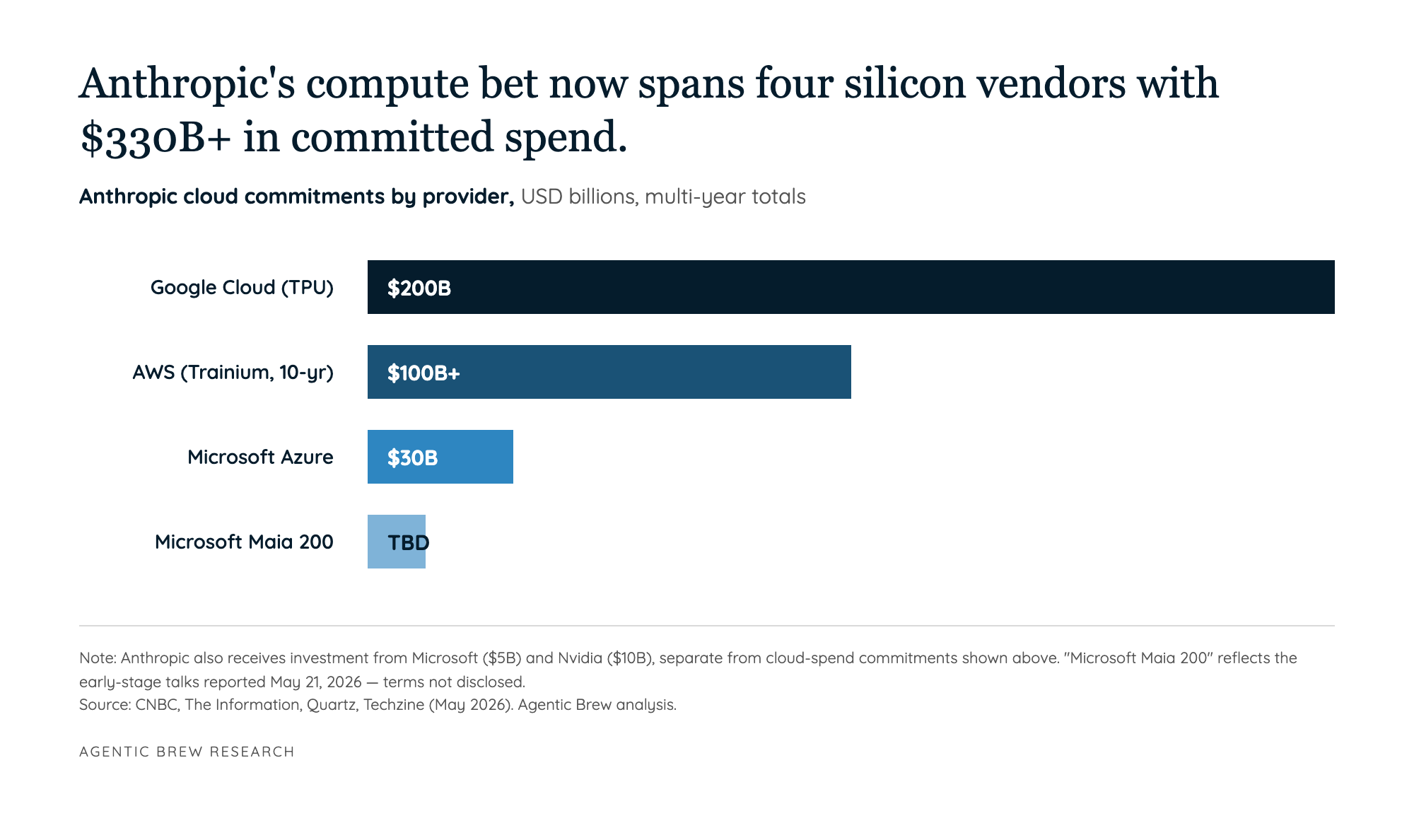
By May 2026, Anthropic has signed for compute across four distinct silicon families: Nvidia GPUs (incumbent), Google TPUs (announced October 2025) [8], AWS Trainium (10-year, $100B+ arrangement) [8], and now potentially Microsoft Maia 200 [3]. The reported Google Cloud commitment alone is roughly $200B [2]. Discussion on developer-focused subreddits surfaced the most interesting framing of this strategy: Anthropic's real moat may not be Claude itself but the abstraction layer that lets it ship the same model across TPU, Trainium, Nvidia, and Maia without rewriting the serving stack.

That gives Anthropic two things its peers lack — supply-chain resilience when any one vendor's allocation slips, and price leverage every time a contract comes up for renewal. The community read on Maia specifically is that holding an in-house alternative reduces the pressure to accept potential Nvidia price increases, even if the alternative is slightly less powerful. The Maia 200 talks are less a one-off procurement decision than the fifth front in a deliberate effort to keep every silicon supplier in a competitive bid for Claude's inference workload.

By the numbers: where Maia 200 actually sits in the hyperscaler ASIC field

By the numbers: where Maia 200 actually sits in the hyperscaler ASIC field
Maia 200 vs hyperscaler ASIC peers: peak FP4/FP8 throughput, HBM capacity, and process node.

Strip out the marketing and Maia 200 is a genuinely aggressive piece of hardware: TSMC 3nm (N3P), 140B+ transistors on an 836 mm^2 die, 216GB of HBM3e at 7 TB/s, 272MB of on-die SRAM, >10 PFLOPS FP4, >5 PFLOPS FP8, 1.268 PFLOPS BF16, and a 750W TDP [10]. Scott Guthrie's headline claim is that Maia 200 delivers three times the FP4 performance of the third-generation Amazon Trainium and FP8 performance above Google's seventh-generation TPU [6].

The skeptics' caveat — surfaced in technically literate community discussion — is that Microsoft is comparing a fresh 3nm part stacked with 216GB of HBM against an older TPU generation, not Google's current v7, so the 3x figure is closer to 'par for the generation' than a generational leap. The chart below normalizes the public spec sheet across the three hyperscaler ASICs that matter — Maia 200, Trainium 3, and Google TPU v7 — so the reader can see where Microsoft's claims hold up and where the comparison is generationally favorable.

The skeptics' read: is $135B+ of cap-table commitments mostly bookkeeping?

Not everyone reads the Maia 200 talks as a real procurement event. The dominant tone on cross-platform community discussion is cap-table cynicism: the suspicion that hyperscaler AI deals are accounting theater — Microsoft commits dollars into Anthropic, Anthropic commits the same dollars back to Azure, and both companies book it as growth without much actual cash changing hands.

The arithmetic is uncomfortable. Microsoft has committed up to $5B into Anthropic and Anthropic has committed $30B back to Azure [1]. Nvidia has committed up to $10B into Anthropic [1], AWS holds a 10-year, $100B+ Trainium arrangement [8], and Google Cloud reportedly carries another ~$200B in commitments [2]. Add Maia 200 leasing on top and Anthropic sits inside a four-way cap-table circle approaching half a trillion dollars in directional commitments. Hardware skeptics also pushed back on the headline performance numbers, noting Microsoft is benchmarking against Google's older TPU generation rather than v7 — making 3x FP4 'par for the generation' rather than a leap.

Whether Maia 200 actually carries Claude inference at scale will hinge less on the May 21 announcement and more on what the per-token economics look like after the chip ships outside Microsoft's own walls for the first time [11].

Historical Context

2023-11-15
Microsoft unveils its first-generation custom silicon — Azure Maia 100 AI accelerator and Azure Cobalt 100 Arm CPU — kicking off its in-house chip program.
2025-10-01
Anthropic announces plans to use Google TPU chips, broadening its compute mix beyond Nvidia GPUs.
2025-11-18
Microsoft commits up to $5B and Nvidia up to $10B in Anthropic at a ~$350B valuation; Anthropic commits $30B in Azure spending.
2026-01-26
Maia 200 announced and deployed first in US Central (Des Moines, Iowa); TSMC 3nm, 216GB HBM3e, FP8/FP4 tensor cores, >10 PFLOPS FP4, 750W TDP.
2026-04
Anthropic locks in a 10-year, $100B+ arrangement to use AWS Trainium chips for training and inference.
2026-05-21
The Information reports early-stage Maia 200 leasing talks; Bloomberg, CNBC and Reuters confirm; reaction frames it as Microsoft's first external Maia customer.

Power Map

Key Players
Subject

Anthropic-Microsoft Maia 200 chip talks

AN

Anthropic

Prospective lessee seeking additional inference capacity for Claude; pursuing a multi-silicon strategy across Nvidia GPUs, Google TPUs, AWS Trainium, and now potentially Microsoft Maia.

MI

Microsoft

Chip designer, Azure operator, and Anthropic investor (up to $5B). A deal would deliver its first external Maia customer and validate its in-house silicon program against AWS Trainium and Google TPU.

NV

Nvidia

Incumbent GPU supplier to Anthropic and one of its largest investors (up to $10B); would see its share of Claude inference workloads shrink if the Maia talks convert.

TS

TSMC

Sole foundry partner fabricating Maia 200 on its 3nm (N3P) process — 140B+ transistors on an 836 mm^2 die.

SK

SK hynix

Reportedly the sole HBM3e memory supplier for Maia 200 (216GB per chip, 7 TB/s bandwidth).

AW

AWS

Competing custom-silicon supplier — Anthropic signed a 10-year, $100B+ Trainium arrangement in April 2026.

GO

Google Cloud

TPU supplier to Anthropic since October 2025; reportedly holds roughly $200B in Anthropic cloud commitments.

Fact Check

11 cited
  1. [1] Microsoft and Nvidia invest in Anthropic
  2. [2] Anthropic wants to run Claude models on Microsoft's Maia chip
  3. [3] Anthropic in talks to use Microsoft AI chips, Information says
  4. [4] Microsoft, Anthropic: What's going on
  5. [5] Anthropic, Microsoft AI server chips talks: compute capacity demand
  6. [6] Maia 200: The AI accelerator built for inference
  7. [7] Anthropic in talks to use Microsoft's Maia 200 AI chips
  8. [8] Anthropic, Microsoft Maia 200 AI chips talks
  9. [9] Anthropic in early talks with Microsoft to run Claude on Azure Maia 200 AI accelerator
  10. [10] Microsoft introduces newest in-house AI chip Maia 200
  11. [11] Anthropic, Microsoft in talks for AI chip deal after $5B investment

Source Articles

Top 5

THE SIGNAL.

Analysts

"Frames Maia 200 as a tokens-per-dollar leader against existing fleet silicon — the economic pitch underwriting any Anthropic deal. Quote: 'offers over 30% improved tokens per dollar, compared to the latest silicon in our fleet.'"

Satya Nadella
CEO, Microsoft

"Positions Maia 200 as the most performant first-party hyperscaler silicon, claiming wins over both AWS Trainium 3 and Google's seventh-generation TPU. Quote: 'Maia 200 is the most performant, first-party silicon from any hyperscaler, with three times the FP4 performance of the third generation Amazon Trainium, and FP8 performance above Google's seventh generation TPU.'"

Scott Guthrie
Executive Vice President, Cloud + AI, Microsoft

"Has publicly flagged compute scarcity as a binding constraint on Anthropic's growth, citing 'difficulties with compute' — motivating a multi-supplier, multi-silicon strategy."

Dario Amodei
CEO, Anthropic

"Reads Microsoft paying Anthropic for products it considers superior as a major strategic shift away from OpenAI dependence — calling it 'big.'"

Jim Cramer
Host, CNBC
The Crowd

"ANTHROPIC EYES MICROSOFT CHIPS Anthropic is in early talks to rent Azure servers powered by $MSFT's Maia AI chips, per The Information. This would deepen a relationship that is already moving fast: Microsoft has pledged up to $5B to Anthropic, Anthropic committed $30B of Azure"

@@wallstengine263

"Anthropic is in talks to use Microsoft's custom AI chips for its Claude models"

@u/Logical_Welder34670

"Anthropic Is Reportedly Looking Beyond Nvidia for AI Inference Chips"

@u/Such-Run-44120

"Anthropic's real moat might not be Claude itself — it's their multi-chip infrastructure"

@u/Full-Definition62150
Broadcast
EP 399 : AI's Dark Side: Anthropic CEO Dario Amodei & Microsoft's Maia 200

EP 399 : AI's Dark Side: Anthropic CEO Dario Amodei & Microsoft's Maia 200

Anthropic at $1.2 Trillion, AMD's Blowout Quarter, and the PE-Backed AI Enterprise Play | Ep. 304

Anthropic at $1.2 Trillion, AMD's Blowout Quarter, and the PE-Backed AI Enterprise Play | Ep. 304

2026 Next-gen AI GPUs & ASICs

2026 Next-gen AI GPUs & ASICs