Cerebras Systems IPO Debut
TECH

Cerebras Systems IPO Debut

52+
Signals

Strategic Overview

  • 01.
    Cerebras Systems priced its IPO at $185 per share — well above the $150-$160 marketed range — selling 30 million shares to raise approximately $5.55 billion, making it the largest US semiconductor IPO ever and the biggest tech debut of 2026.
  • 02.
    On its May 14 Nasdaq debut, CBRS opened at $350 (+89%), peaked intraday near $385-$386 (+108%), and closed at $311.07 — up 68.2% — briefly pushing the market cap above $100 billion before settling around $66 billion.
  • 03.
    Institutional orders exceeded the available shares by more than 20x, forcing Cerebras to upsize both the price range and share count twice during the roadshow — a level of demand that minted co-founders Andrew Feldman (~$3.2B) and Sean Lie (~$1.7B) as billionaires.
  • 04.
    Shares fell roughly 10% the day after debut as analysts including Jim Cramer publicly questioned a valuation reported near 187x trailing sales versus Nvidia's ~26x and AMD's ~21x.

By The Numbers: How Cerebras Priced Itself Past Nvidia
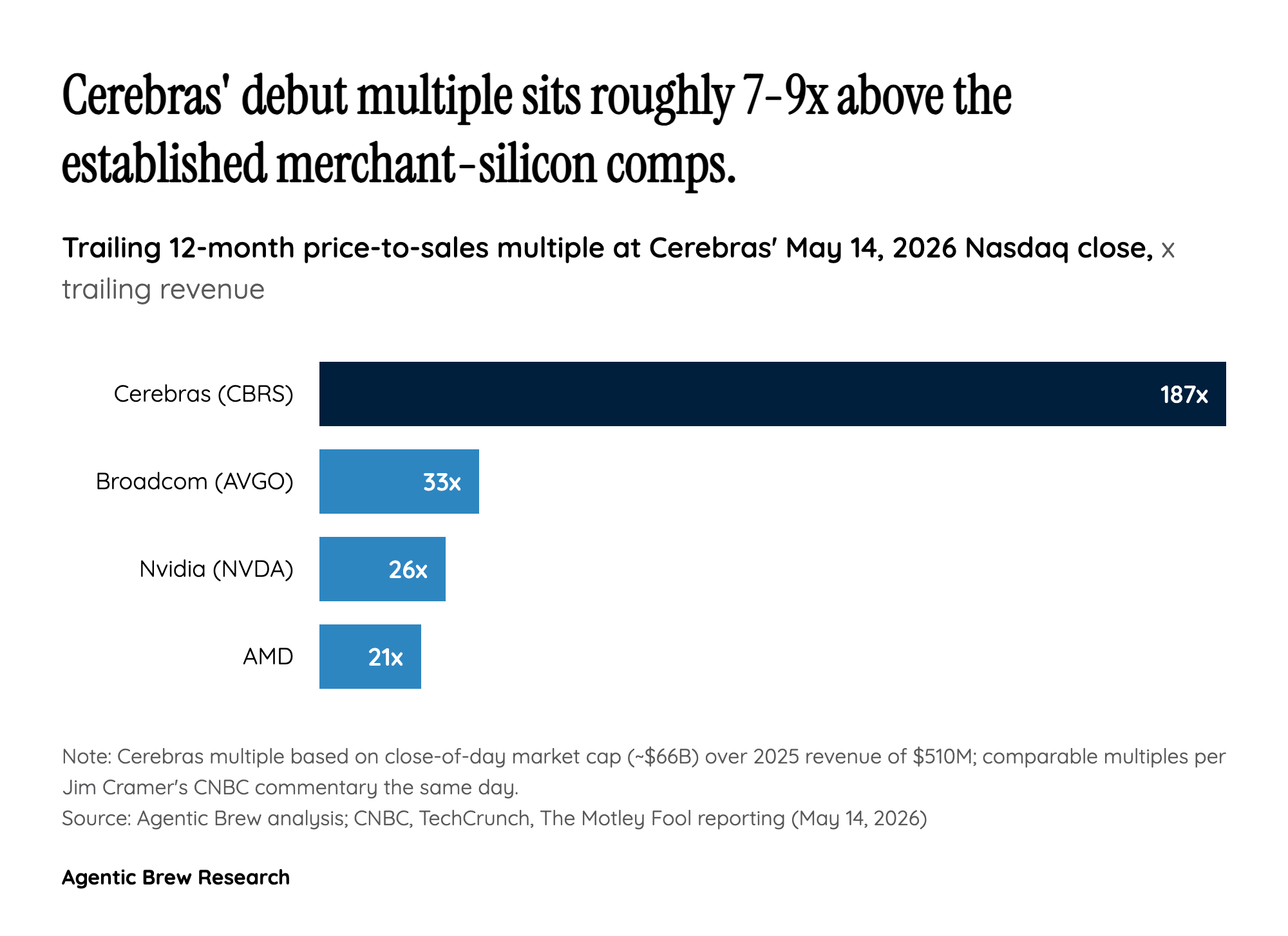
By The Numbers: How Cerebras Priced Itself Past Nvidia
Cerebras vs incumbent AI chip companies by trailing price-to-sales multiple at the May 14, 2026 close.

The mechanics of the Cerebras IPO are the story. The company marketed shares at $150-$160, priced at $185 — well above the top of the range — and still saw orders exceed available shares by more than 20x, forcing it to upsize both the share count and the price range twice during the roadshow [1]. That is institutional desperation, not enthusiasm. By the time CBRS opened on Nasdaq it printed $350 (+89%), peaked intraday near $385 (+108%), and closed at $311.07 — up 68.2% on the day, with the market cap brushing $100 billion before settling near $66 billion at the close [2][3].

The valuation math is where the air gets thin. Cerebras booked $510M in 2025 revenue, up 76% year over year, but with a $145.9M operating loss. At a closing market cap near $66B, that's roughly 187x trailing sales — versus Nvidia at ~26x and AMD at ~21x. Jim Cramer called the multiple 'fanciful' on CNBC and said the action was 'right out of 1999,' explicitly telling viewers not to chase the stock [4]. D.A. Davidson, more sober, wrote that 'after reading the S1 and watching the roadshow, we wouldn't get too excited' [4].

The community on Reddit went further. One r/investing technical analyst noted that 2025 reported net income includes a $363.3M non-cash gain from a G42 forward contract — strip that out and Cerebras is at a $75.7M non-GAAP loss. By that lens the apparent profitability narrative is an artifact of the regulatory restructuring, not operating leverage. Shares fell roughly 10% the day after debut as those critiques surfaced in mainstream coverage [5].
Under the Hood: Why Wafer-Scale Wins Inference (and Loses Training)

Cerebras' flagship Wafer Scale Engine 3 (WSE-3) is not a chip — it is a chip the size of a dinner plate. The Register describes a 46,225 square millimeter die carved from a single 300mm silicon wafer, packing 4 trillion transistors, 900,000 cores, 44GB of on-chip SRAM, and 21 PB/s of memory bandwidth on TSMC's 5nm process [6]. The pitch is straightforward: if you keep an entire model resident in on-die SRAM, you eliminate the off-chip memory hops that bottleneck GPU inference. For tasks like single-model token generation at scale, this is structurally faster than a Blackwell cluster — and the company has been demoing throughput numbers on open-weight models like Llama and DeepSeek that hyperscalers care about.

But the architecture is also where the bull and bear cases part ways. A wafer is a wafer — yield is per-wafer, not per-die, so a single bad cell historically meant losing the whole part. Cerebras solves that with hardware redundancy, but it caps how aggressively they can scale node-shrinks. More importantly, wafer-scale doesn't compose cleanly into the kind of massive distributed training topologies that Nvidia's NVLink+InfiniBand stack was built for. The Reddit technical community made this explicit: WSE-3 is excellent for single-model inference but doesn't scale to hyperscale training the way Blackwell does. That's why the OpenAI deal is structured as inference capacity (750 MW dedicated, not 'a training fabric').

There is also a hard upstream ceiling: TSMC. Every wafer Cerebras ships is a wafer Nvidia, AMD, and Apple are not getting. The 2026-2028 ramp implied by the OpenAI contract requires TSMC to allocate meaningful 5nm/3nm capacity to Cerebras — and TSMC's allocation decisions are a known industry chokepoint, not a Cerebras product roadmap. The Register's framing — that wafer-scale was the bet that finally paid off after a decade — captures the engineering win, but the manufacturing dependency is a risk the S-1 cannot make go away [6].

The OpenAI Entanglement: Anchor Customer or Single Point of Failure?

OpenAI is the reason this IPO got priced where it did, and OpenAI is also the largest single risk in the prospectus. In January 2026, OpenAI signed a multi-year compute commitment valued at over $20 billion for 750 megawatts of Cerebras capacity through 2028 — the anchor that turned the second-attempt IPO into a blockbuster [1][7]. That deal followed a more unusual arrangement: in December 2025, OpenAI loaned Cerebras $1 billion, secured by warrants on more than 33 million shares [7]. Read that again. The largest customer is also a creditor and a near-shareholder.

The entanglement gets tighter when you stack it against the rest of the customer book. In 2025, MBZUAI (the Abu Dhabi-government-affiliated AI university) accounted for 62% of Cerebras revenue, with G42 contributing another 24% — meaning roughly 86% of revenue came from two Gulf-linked customers, before the OpenAI ramp even begins [1]. Cerebras' own framing, from CEO Andrew Feldman on the roadshow, was that 'if you ask Anthropic, if you ask OpenAI, they have vastly more demand for their offering than they have compute to make it' — and that 'we are not in a situation like the movie Field of Dreams, where if you build it, they will come' [1]. Translation: this is real demand, not speculative capacity.

The counter-read is that 'demand from three customers' is not 'demand from a market.' If OpenAI renegotiates or delays the ramp — as has happened with hyperscaler capacity deals before — the revenue ladder for 2027 and 2028 has nothing under it. And the warrant overhang means OpenAI has structural incentive to push valuation in directions that may not align with public-market shareholders. The S-1 acknowledges customer concentration as a risk factor. The market priced it like an opportunity.

The Lockup Overhang: What the Technical Community Is Positioning Around

Most coverage of the Cerebras debut has focused on the pop. The technical investor community has been focused on the calendar. By standard IPO convention, post-listing lockups typically expire around 180 days — meaning, if Cerebras follows convention, the first major insider-supply unlock would land around mid-November 2026, when employees, pre-IPO investors, and the Series G cohort led by Fidelity and Atreides can begin to sell [8]. Fidelity's stake alone is reportedly worth ~$3.8B at current prices; Feldman's is ~$3.2B; Lie's is ~$1.7B [3][9]. That is a meaningful share-supply shock relative to the float, in a stock that traded 68%+ on day one because the float was scarce.

Reddit's derivatives crowd has already started positioning. Multiple r/wallstreetbets threads framed the post-IPO rip as 'retail exit liquidity' and discussed options-based plays calibrated to lockup expiry — buying puts on the November cycle or selling covered calls into earnings prints between now and then. This is not a fringe view: it is the standard institutional playbook for any oversubscribed IPO that prints above range and pops on day one. The 1999 comp Cramer invoked ends, historically, in a drawdown around the first lockup unlock, not on debut day [4].

The other shoe is sentiment. The day after debut, CBRS dropped roughly 10% as analyst skepticism filtered into mainstream coverage [5]. For Cerebras to defend a $66B market cap into the November lockup, the company will need to print a Q2 and Q3 that materially de-risks the customer-concentration story — meaning new logos beyond the OpenAI/MBZUAI/G42 triangle, ideally a hyperscaler logo. Without that, the path of least resistance for the stock from May to November is sideways-to-down on multiple compression, and then a supply shock in Q4. The bull case requires Cerebras to use the next two earnings cycles to broaden the revenue base. The bear case is that they cannot, because the product is structurally optimized for a narrow inference workload that only a handful of buyers need at this scale.

Historical Context

2015-01-01
Cerebras founded by Andrew Feldman, Sean Lie and others to pursue wafer-scale AI compute, following Feldman's SeaMicro exit to AMD in 2012.
2024-09-30
Cerebras filed its original S-1, surfacing the heavy G42 revenue-concentration risk that would dog the listing.
2024-10-08
The Committee on Foreign Investment in the United States opened a review of G42's investment over concerns about advanced US AI technology leakage to China; the first IPO attempt was postponed.
2025-03-01
CFIUS cleared the deal after G42 agreed to convert to non-voting shares, removing the principal regulatory hurdle to a US listing.
2025-10-01
Cerebras formally withdrew its 2024 IPO registration ahead of the eventual refile.
2025-12-19
Cerebras raised $1.1B Series G at an $8.1B valuation led by Fidelity and Atreides, then announced plans to refile for IPO targeting Q2 2026.
2026-01-01
OpenAI signed a multi-year compute deal worth over $20 billion for 750 MW of Cerebras capacity (2026-2028), the anchor commitment that anchored the IPO narrative.
2026-05-13
Cerebras priced its IPO at $185 per share — above the $150-$160 range — raising $5.55B in the largest US semiconductor IPO on record.
2026-05-14
CBRS debuted on Nasdaq, opening at $350, peaking near $385-$386, and closing at $311.07 — up 68% — briefly pushing the market cap above $100B before settling near $66B.
2026-05-15
Shares fell roughly 10% the day after debut as analysts publicly questioned the 187x trailing-sales multiple.

Power Map

Key Players
Subject

Cerebras Systems IPO Debut

AN

Andrew Feldman

Co-founder and CEO of Cerebras; his post-IPO stake reached roughly $3.2 billion.

SE

Sean Lie

Co-founder and hardware technology chief; stake valued at approximately $1.7 billion at close, the architect behind the Wafer Scale Engine product line.

OP

OpenAI

Anchor customer; signed a multi-year, ~$20 billion deal in January 2026 for 750 megawatts of Cerebras compute capacity (2026-2028), and previously loaned Cerebras $1B in December 2025 secured by warrants on more than 33 million shares.

MB

MBZUAI (Mohamed bin Zayed University of Artificial Intelligence)

Largest single customer in 2025, contributing 62% of Cerebras revenue — a new concentration risk that replaced G42 as the dominant single buyer.

G4

G42 (Abu Dhabi)

Former dominant customer; 85% of 2024 revenue, falling to 24% in 2025 after CFIUS scrutiny forced restructuring. G42 now holds non-voting shares.

FI

Fidelity Management & Atreides Management

Led the $1.1B Series G in December 2025 at an $8.1B valuation, the round that revived Cerebras' IPO trajectory; Fidelity's post-IPO stake is reportedly worth ~$3.8B.

NV

Nvidia

Incumbent AI compute leader and the implicit benchmark Cerebras' debut was priced against; positions Cerebras as the leading public-market alternative for AI inference workloads.

Fact Check

9 cited
  1. [1] Cerebras prices shares at $185 ahead of biggest tech IPO in years
  2. [2] Cerebras shares jump 89% in Nasdaq debut, pushing market cap to $100 billion
  3. [3] Cerebras raises $5.5B, kicking off 2026's IPO season with a bang
  4. [4] Jim Cramer's advice on Cerebras
  5. [5] Cerebras stock falls after blockbuster IPO debut
  6. [6] Cerebras' wafer-scale AI bet delivers blockbuster IPO
  7. [7] OpenAI's cozy partner Cerebras is on track for a blockbuster IPO
  8. [8] AI chipmaker Cerebras revives IPO plans after $1.1B raise and CFIUS clearance
  9. [9] Cerebras CEO turns year's largest IPO into $3.2 billion fortune

Source Articles

Top 5

THE SIGNAL.

Analysts

"Praised Cerebras' technology and timing but said the post-IPO valuation cannot be defended at current levels, comparing the action to 1999 dot-com excess and explicitly urging viewers not to chase the stock."

Jim Cramer
Host, CNBC Mad Money

"Argued that demand for AI compute vastly outstrips supply and that Cerebras represents real customer pull, not speculation — invoking OpenAI and Anthropic as evidence that even hyperscaler-class buyers cannot get the inference capacity they need."

Andrew Feldman
Co-founder and CEO, Cerebras Systems

"Cautious going into the listing, writing that after reading the S-1 and watching the roadshow they 'wouldn't get too excited.'"

D.A. Davidson analysts
Sell-side equity research, D.A. Davidson
The Crowd

"Cerebras pops 68% in Nasdaq debut, pushing the AI chipmaker's market cap to $95 billion"

@@CNBC0

"AI chipmaker Cerebras will begin trading on the Nasdaq today under the ticker symbol $CBRS at $185 per share. The listing is expected to mark the largest IPO of the year so far. "We're feeling pretty good," CEO @andrewdfeldman tells Yahoo Finance."

@@YahooFinance0

"@cerebras will start trading later today. Cerebras Systems ($CBRS) priced its IPO on Wednesday, May 13, 2026, at $185 per share, above its upwardly revised range. Cerebras gross margins are in low 40s way below mid 70s of Nvidia. The AI chipmaker is raising $5.55 billion,"

@@sarbjeetjohal0

"Cerebras pops 68% in Nasdaq debut, pushing the AI chipmaker's market cap to $95 billion"

@u/Several_Print4633762
Broadcast
The $100B Chip IPO Challenging Nvidia (Cerebras)

The $100B Chip IPO Challenging Nvidia (Cerebras)

Cerebras IPO is a huge success and plays into chipmaker strength, says Axios' Dan Primack

Cerebras IPO is a huge success and plays into chipmaker strength, says Axios' Dan Primack

AI Chipmaker Cerebras Raises $5.55 Billion in Year's Biggest IPO

AI Chipmaker Cerebras Raises $5.55 Billion in Year's Biggest IPO