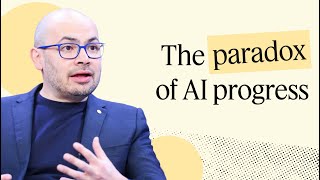
Hassabis declares 'foothills of the singularity' at Google I/O 2026
TECH

Hassabis declares 'foothills of the singularity' at Google I/O 2026

26+
Signals

Strategic Overview

  • 01.
    Closing the Google I/O 2026 keynote, Google DeepMind CEO Demis Hassabis said attendees were 'standing in the foothills of the singularity,' framing the current AI moment as the opening stage of full AGI rather than a routine product cycle.
  • 02.
    Hassabis told an interview after the keynote that he 'debated' ending the talk this way and 'wanted to be authentic about what I'm thinking with AGI,' and reiterated a 50% probability of AGI by 2030.
  • 03.
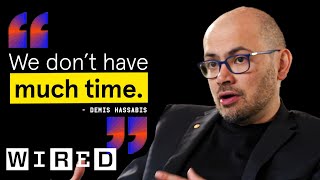
    He paired the singularity framing with a sharp critique of AI-driven job cuts, telling WIRED that companies firing engineers because of AI gains lack imagination and should use the productivity to tackle 'more ambitious projects.'
  • 04.
    Hassabis compared AI's potential societal impact to being roughly 100 times that of the Industrial Revolution, and tied the singularity claim to demos of agentic systems and Gemini 3.5 Flash coding capabilities shown earlier in the keynote.

Deep Analysis

Why It Matters That Hassabis, Of All People, Picked This Word

The news is not that someone running an AI lab said 'singularity' on stage. The news is that Hassabis said it. Among the major frontier-lab CEOs he has been the most consistent hedger — historically quoting 5-10 year AGI ranges and using softer language than peers at OpenAI or Anthropic. By his own framing at I/O 2026 he is still a 'cautious optimist' with a 50% AGI-by-2030 probability [1]. So the line lands harder coming from him than it would from a peer who already trades in superlatives.

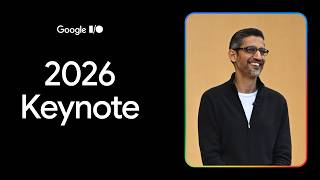
Hassabis was also explicit that the word choice was deliberate, not accidental marketing copy. He told Semafor he 'debated' ending the keynote that way and 'wanted to be authentic about what I'm thinking with AGI' [2]. Crucially, he redefined the term in the same breath: 'The singularity, at least my interpretation of that word and that term, means the era that we're in' [2]. That is a quiet but important move — he is borrowing Kurzweil's vocabulary while jettisoning the runaway-intelligence connotation, repositioning 'singularity' as a label for the present transition rather than a future event. The downstream effect is that every Google I/O 2026 demo, from agentic coding to Gemini for Science, gets re-cast as evidence in an AGI brief.
The Quiet Walk-Back Inside The Big Claim

The framing the headlines picked up — 'foothills of the singularity,' AGI by 2030, 100x the Industrial Revolution [3]— is bolder than the substance underneath. Hassabis has been deliberate about pairing each strong claim with a load-bearing caveat. On scientific creativity he is on the record saying current systems still struggle with generating new questions and theories, and that fully autonomous self-improvement is unresolved [2]. His Axios framing — that agentic systems make the moment 'tangible' — is conditional, not declarative.

The pattern is even sharper in his WIRED interview the same week. Hassabis pointedly said AI has still not produced a single major standalone app or video game without human input [4], and called AI-driven layoffs 'short-sighted' and a 'lack of imagination' — arguing the entire productivity-augmentation story should expand engineering ambition rather than shrink headcount [4]. Read together, the picture is not 'AGI imminent, brace for impact.' It is closer to 'the trend line is steep, but we are very obviously not done, and the right operational response is to do more, not fire people.' That nuance is exactly what gets stripped out of clip culture, which is why the 'foothills' soundbite is doing more work than the surrounding paragraph.

The Reception Fault Line: LeCun, The r/singularity Faithful, And The Enterprise Buyer

Reactions cluster along a predictable three-way split. The skeptics, anchored by Meta's Yann LeCun, treat any AGI-by-2030 talk as marketing — LeCun called the genre 'just completely delusional, just complete delusion' months before I/O [5]. Hassabis answered LeCun directly on X with a 'general vs. universal intelligence' distinction [5], which makes the I/O framing read partly as the next move in that running debate rather than a fresh declaration.

The AGI-curious online community read it the opposite way — as a meaningful timeline compression. The r/singularity thread on the keynote, the most upvoted Reddit conversation tied to the moment, opened with the observation that Hassabis had moved from '5-10 years' to '5 years' and now to 'just a few years' in roughly a year, and the comment immediately following landed on the right read: 'Demis has been notoriously conservative, so when he says this, he must be pretty confident it's coming soon.' That community is treating the word choice itself as the news.

The enterprise-buyer reaction is more cynical and arguably more consequential. Counterpoint's Neil Shah warned that selling agentic platforms on an AGI-imminent narrative 'can introduce vendor lock-in, and that changes the math completely' for procurement [6]. In other words: the 'foothills' line is not just a research take, it is a sales motion — and CIOs evaluating Spark, Gemini for Science, and Google's agentic stack are now being asked to underwrite an AGI thesis when they procure them. The same sentence comforts the believer and alarms the buyer, and that is what makes it strategically interesting.

Compressed Timelines: What 'Just A Few Years' Actually Means In Frontier-Lab Speak

Setting aside the rhetoric, the operative claim is that AGI has roughly a 50% probability by 2030 in Hassabis's own framing [1], alongside a description of AI as potentially '100 times' the impact of the Industrial Revolution [3]. Two things make those numbers worth taking seriously even from a skeptic's seat. First, Hassabis's previous public estimates clustered in the 5-10 year range, and the I/O language has compressed that to 'just a few years' inside roughly twelve months — a faster move than is typical for him, and one his own community noticed in real time. Second, the empirical anchors he chose are concrete: agentic systems that build mini video games end-to-end, Gemini 3.5 Flash translating between codebases and writing operating systems from scratch [4], and a Gemini-for-Science model that beat the CDC's own COVID-19 hospitalization forecasting ensemble on peer-reviewed benchmarks the day before the keynote [7].

What that does not settle is whether the 100x Industrial Revolution analogy is doing analytical work or rhetorical work. The Industrial Revolution took roughly a century to fully diffuse and produced a labor-market dislocation we are still litigating two hundred years later. A 100x version compressed into a decade would, by definition, outrun every governance framework currently in flight. Hassabis's optimism on the upside is paired with effectively no public answer on the diffusion-speed downside — and that is the question the next year of his press tour will probably be forced to engage.

Historical Context

2025-12-22
Called the AGI-in-a-year-or-two narrative 'completely delusional' on a podcast appearance, prompting Hassabis to respond publicly on X with a 'general vs. universal intelligence' distinction.
2026-05-19
Published two Nature papers and launched Gemini for Science, with one paper showing an AI system outperforming the CDC's COVID-19 hospitalization forecasting ensemble — providing the empirical backdrop for the singularity framing the next day.
2026-05-20
Closed the Google I/O 2026 keynote with the 'foothills of the singularity' line and a 100x Industrial Revolution comparison, immediately followed by an Axios interview defending the choice as authentic rather than promotional.

Power Map

Key Players
Subject

Hassabis declares 'foothills of the singularity' at Google I/O 2026

DE

Demis Hassabis

CEO of Google DeepMind. The most credibility-weighted voice in the AGI-timeline debate because of his prior conservatism; when he tightens the timeline publicly, it moves the Overton window for the whole field.

GO

Google / Alphabet

The line landed inside the closing keynote of Google's largest developer event, immediately wrapping every I/O 2026 product launch in an AGI thesis and giving the company's sales motion a long-horizon narrative.

YA

Yann LeCun

Meta's outgoing chief AI scientist and the loudest public skeptic; called AGI talk 'complete delusion' months earlier, making him the foil whose objections the Hassabis framing implicitly answers.

EN

Enterprise CIOs and developer workforce

Direct targets of the framing: enterprise buyers are being asked to procure agentic platforms now on an AGI-imminent narrative, while developers are being told their jobs should grow rather than shrink as productivity climbs.

Fact Check

7 cited
  1. [1] Here's why Google DeepMind's CEO thinks the singularity is closer than ever
  2. [2] DeepMind founder Demis Hassabis on what Google AI products say about 'singularity'
  3. [3] Demis Hassabis Declares 'Foothills of the Singularity' at I/O
  4. [4] Demis Hassabis Thinks AI Job Cuts Are Dumb
  5. [5] Yann LeCun calls general intelligence 'complete BS' and Deepmind CEO Hassabis fires back publicly
  6. [6] Google talks 'singularity' while scaling up agentic AI for enterprises
  7. [7] Gemini for Science Launches With Peer-Reviewed Benchmarks: ERA Beat CDC Forecasting Model

Source Articles

Top 3

THE SIGNAL.

Analysts

"Defined the term on his own terms — 'The singularity, at least my interpretation of that word and that term, means the era that we're in' — and described himself as a 'cautious optimist' who still sees AGI as roughly a coin flip by 2030."

Demis Hassabis
CEO, Google DeepMind

"On layoffs: argued that AI productivity gains should expand engineering ambition, not shrink headcount, and noted that despite Gemini 3.5 Flash's coding capabilities AI has still not produced a major standalone app or video game without human input."

Demis Hassabis
CEO, Google DeepMind (Wired interview)

"Months before I/O, called the AGI-in-a-year-or-two genre 'just completely delusional, just complete delusion,' arguing that tokenizing the world through language models will not get there — a position Hassabis rebutted on X by distinguishing 'general intelligence' from 'universal intelligence.'"

Yann LeCun
Chief AI Scientist, Meta

"Read Hassabis's framing as a deliberate signal that 'we're still very early in the AI race' and that Google is 'the only company that has all its bases covered, even if every base is hotly contested.'"

Reed Albergotti
Technology editor, Semafor

"Warned that positioning AI as a path to AGI 'can introduce vendor lock-in, and that changes the math completely' for enterprise procurement, framing the keynote as much a sales motion as a scientific claim."

Neil Shah
Vice President, Counterpoint Research
The Crowd

"Demis Hassabis at Google I/O: "Artificial General Intelligence is just a few years away""

@u/socoolandawesome549
Broadcast
Google I/O '26 Keynote

Google I/O '26 Keynote

Demis Hassabis On The Future of Work in the Age of AI

Demis Hassabis On The Future of Work in the Age of AI

Google DeepMind's Demis Hassabis & The Paradox of AI Progress | Semafor Tech

Google DeepMind's Demis Hassabis & The Paradox of AI Progress | Semafor Tech