The charitable-trust theory: a narrow doorway with two surviving claims
Musk v. Altman survives at trial on a much smaller footprint than Musk's original complaint suggested. Of his 26 original claims, only two were allowed to reach a jury: breach of charitable trust and unjust enrichment. The theory rests on Musk's roughly $38 million in donations (out of a pledged $1 billion) supposedly establishing a charitable trust binding OpenAI to remain a nonprofit. The asked-for remedy is enormous — up to $150 billion redirected into OpenAI's charitable arm, with disgorgement estimated in the docket summary at $79–134 billion based on Musk's early contributions.
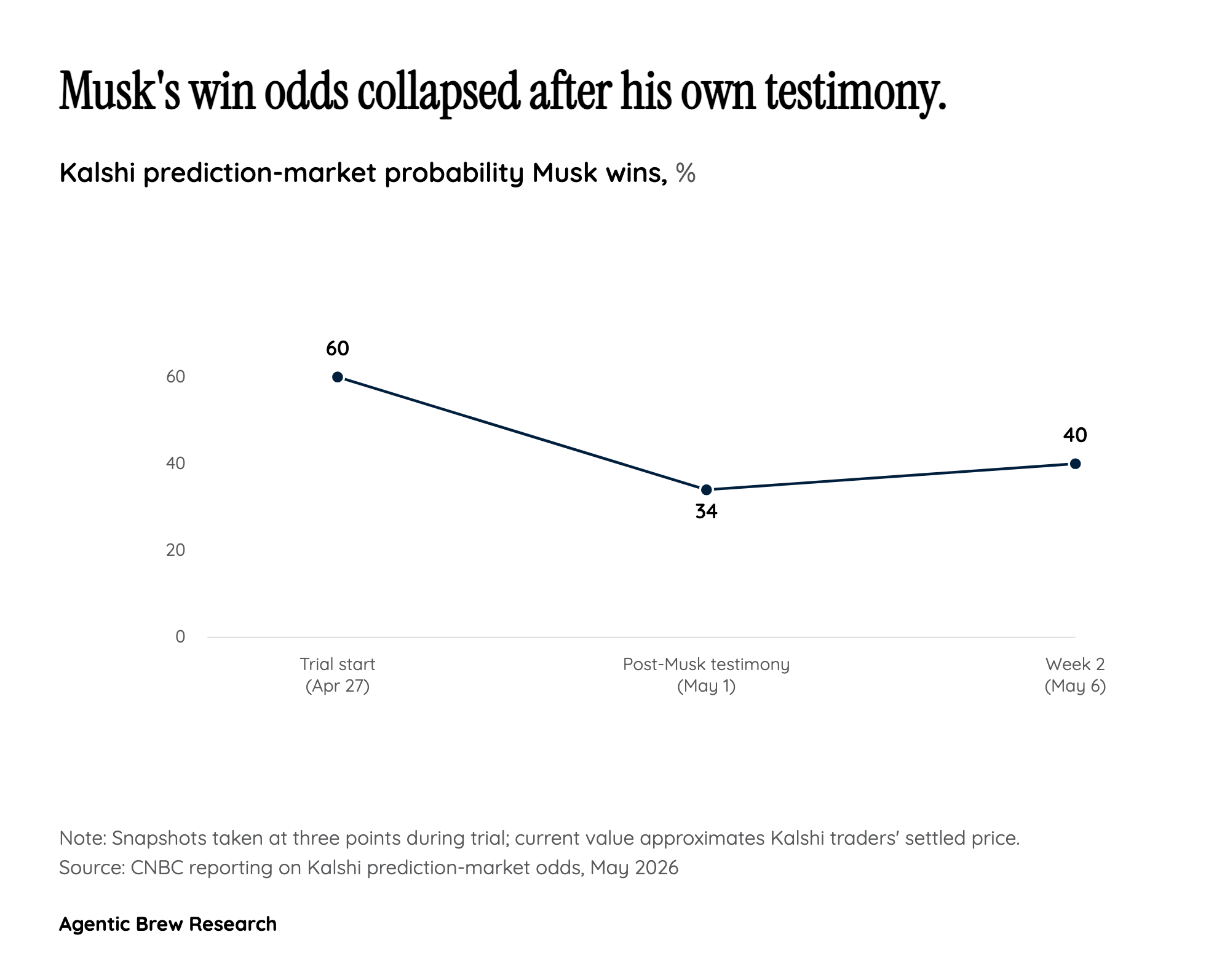
Most legal analysts cited in the trial coverage call the case weak — and the structural reasons matter. Judge Yvonne Gonzalez Rogers retains binding authority on equitable remedies regardless of what the advisory jury concludes, and she has already barred testimony on AI existential risk as outside the trial's scope. That keeps the case tightly framed as a charity-law dispute rather than the AI-governance referendum Musk's public messaging suggests. Prediction markets caught up to that framing fast: Kalshi traders repriced Musk's win probability from 60% at trial start to as low as 34% after his own testimony, hovering near 40% as Week 2 began.