GPT-5.5 launch: OpenAI's agentic model release and super-app pivot
TECH

GPT-5.5 launch: OpenAI's agentic model release and super-app pivot

49+
Signals

Strategic Overview

  • 01.
    OpenAI launched GPT-5.5 and GPT-5.5 Pro on Thursday, April 23, 2026, rolling the models out to Plus, Pro, Business, and Enterprise ChatGPT subscribers, inside Codex, and via the API.
  • 02.
    The release came roughly six weeks after GPT-5.4, an unusually fast cadence as OpenAI races Anthropic, Google, and xAI in the enterprise market.
  • 03.
    GPT-5.5 Pro ships with a roughly 1M-token context window (1,050,000 tokens) and up to 128,000 max output tokens, designed to use more compute for higher-accuracy answers.
  • 04.
    Alongside the launch, OpenAI opened a Bio Bug Bounty offering $25,000 to the first researcher who lands a universal jailbreak across five biosecurity questions in Codex Desktop.

The 2x Price Hike That Looks Like 20%

On paper, GPT-5.5's API pricing is a shock: $5 per million input tokens and $30 per million output tokens, exactly double GPT-5.4. GPT-5.5 Pro climbs further to $30 per million input and $180 per million output. For developers staring at invoices, that headline number reads as a punitive jump in a market where competitors have been compressing the cost of intelligence. But OpenAI has engineered an offsetting lever directly into the model. According to Artificial Analysis, GPT-5.5 burns roughly 40% fewer output tokens to reach the same answer on its Intelligence Index suite. Net effective cost per task lands only around 20% above GPT-5.4 — the price tag doubled, but the work shrank.

That is the actual product strategy: monetize intelligence gains by tying pricing to per-token rates while shipping an upgrade that quietly reduces token consumption per task. It works because most enterprise workloads are billed by the job, not by the round-trip. If GPT-5.5 finishes a code review in 6,000 output tokens where 5.4 needed 10,000, the cost of that review barely moves even at double the rate. The risk in the trade is that token-light reasoning isn't uniform across workloads — agents that loop on tools, or chat-heavy consumer surfaces, may see closer to the full 2x. OpenAI is, in effect, asking the market to trust an averaged efficiency claim while it captures the upside on the per-token line item.

From Chat API to 'Agent in a Box'

The most underappreciated line in OpenAI's launch coverage came from TechCrunch's framing: 'OpenAI has stopped selling a chat completion API and started selling an agent.' That isn't marketing; it's a deliberate repositioning. GPT-5.5's headline capability gains — Terminal-Bench 2.0 at 82.7%, debugging cycles compressed from days to hours per NVIDIA's early-access reports — are concentrated in long-horizon, tool-using, multi-step work. The 1M-token context window on GPT-5.5 Pro isn't really for chat; it's for letting an agent hold an entire codebase, ticket queue, or research corpus in working memory while it acts.

This is why the launch is bundled with a 'super app' pitch combining ChatGPT, Codex, and an AI browser into one enterprise-facing surface. OpenAI is no longer competing for the model API line item on a developer's spreadsheet — it's competing for the workflow itself. Greg Brockman's framing of the model as 'a big step towards more agentic and intuitive computing' tracks directly with that pivot. The strategic implication is that mid-stack tools that wrap GPT-5.4 to add agent loops, retrieval, or tool-calling now have to ask whether OpenAI just absorbed their layer. For Cursor, Perplexity, and Cloudflare — all of whom shipped same-day integrations — the answer was to lean in. For independent agent frameworks, the runway just got shorter.

The Coding Crown Is Still Contested

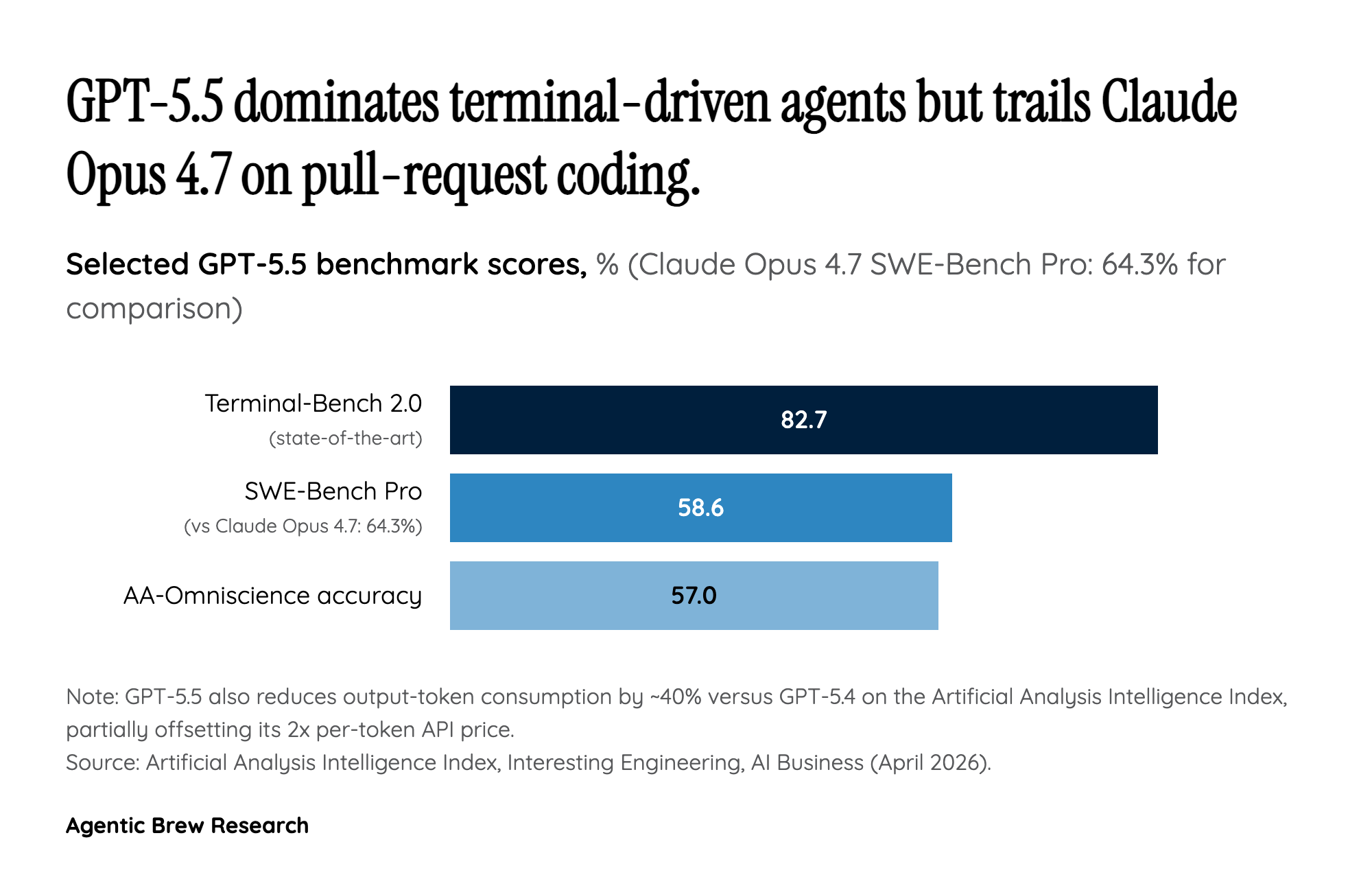
OpenAI's launch deck claims the Intelligence Index crown, and Artificial Analysis confirms it: GPT-5.5 tops that aggregate benchmark by 3 points, breaking a previous three-way tie among the frontier labs. But the most economically valuable benchmark in the AI industry right now isn't an aggregate score — it's coding. And on SWE-Bench Pro, the pull-request-level evaluation that closely mirrors real engineering work, GPT-5.5 lands at 58.6% versus Claude Opus 4.7 at 64.3%. That's a 6.6-point gap, not a rounding error. AI Business's coverage put it bluntly: GPT-5.5 boasts coding advancements but falls short of Opus 4.7 on the metric that matters most to working developers.

This matters because Cursor, GitHub Copilot-style products, and the entire wave of agentic coding IDEs route their default model selection in part based on these scores. Cursor responded by making GPT-5.5 its 'most advanced model' option while keeping Claude available — a multi-model hedge that has become standard. The contrarian read on developer forums captures the wider sentiment: benchmark-watchers are unimpressed by 'modest gains at 2x price' when Anthropic's coding scores still loom over the comparison. Hands-on users tell a different story, calling 5.5 'Opus-class' on instruction-following and real-world code edits. Both can be true: GPT-5.5 may win on the median enterprise task while losing the headline coding leaderboard, and that ambiguity is exactly what keeps the frontier race competitive.

The $25,000 Hedge Against Catastrophic Misuse

Tucked inside a launch otherwise dominated by capability claims, OpenAI opened a Bio Bug Bounty offering $25,000 to the first researcher who lands a 'universal jailbreak' across five specific biosecurity questions inside Codex Desktop. Applications opened on launch day, run on a rolling basis until June 22, and active testing extends through July 27 under NDA. That's a structurally different kind of program than a generic bounty — it's a time-bounded, scoped, contractually-controlled probe of a specific catastrophic-risk surface.

The timing is not coincidental. As GPT-5.5 becomes more agentic — better at tool use, longer context, more autonomous over multi-step plans — the worst-case bio uplift scenario gets sharper. By paying outside researchers to find the worst prompts before regulators, journalists, or threat actors do, OpenAI is doing two things at once: it generates real safety evidence to wave at policymakers, and it buys structured early warning of the kinds of attacks the in-house red team won't anticipate. The trade-off shows up in user-facing friction: GPT-5.5 visibly ramps up refusals on cyber-related prompts, which OpenAI calls its 'strongest safeguards yet.' Some legitimate security work will hit those refusals, and that tax is now part of the deal.

Community Verdict: Hype Meets Pricing Hangover

The reception split cleanly along audience lines. On X, partner accounts and reviewer voices framed the launch as a step-change toward 'real work' — the agentic framing OpenAI seeded landed nearly intact. One widely-shared early take captured the partisan high end: a 'massive leap forward' for the few percent of users running agentic workflows, paired with one significant regression flagged for the rest. YouTube coverage skewed toward agentic-coding angles, with OpenAI's official walkthrough framing the release as a paradigm shift toward autonomous computer work, while independent reviewer coverage debated whether the leap was real or whether benchmark gains were overhyped given the price step.

Reddit, predictably, read the launch through a sharper lens. r/singularity threads were dominated by benchmark disappointment and pricing shock — modest aggregate gains at double the per-token rate, with Anthropic's coding scores looming over the comparison. Sam Altman's accompanying 'we love you' tweet became shorthand for the perception that OpenAI's communications outpaced the substance of the upgrade. Hands-on threads in r/OpenAI and r/codex were warmer, with users reporting better instruction-following and 'big model feel' that doesn't show up in headline numbers. The split is the story: GPT-5.5 lands as an unambiguous win for builders running agentic, tool-heavy workloads, and an underwhelming refresh for the chat-completion crowd who still pay per token to ask a single question.

By the Numbers: Where GPT-5.5 Actually Lands

By the Numbers: Where GPT-5.5 Actually Lands
GPT-5.5 hits 82.7% on Terminal-Bench 2.0 and 57% on AA-Omniscience accuracy, but lands at 58.6% on SWE-Bench Pro—5.7 points behind Claude Opus 4.7's 64.3%.

Stripped of marketing, the quantitative picture is more nuanced than either the launch deck or the backlash suggests. On the win side: a 1,050,000-token context window on GPT-5.5 Pro with up to 128,000 max output tokens, a state-of-the-art 82.7% on Terminal-Bench 2.0, and roughly 40% lower output-token consumption per task on the Artificial Analysis Intelligence Index. On the loss side: a 58.6% on SWE-Bench Pro that trails Claude Opus 4.7's 64.3%, an 86% hallucination rate on AA-Omniscience even at 57% accuracy, and API pricing that doubles to $5 / $30 per million tokens for the base model and $30 / $180 for Pro.

The scale numbers explain why OpenAI can defend this pricing at all: 900 million weekly active ChatGPT users, 50 million ChatGPT subscribers, 9 million paying business users, and 4 million active Codex users at launch. The infrastructure underneath is similarly outsized — NVIDIA reports 35x lower cost per million tokens and 50x higher throughput per megawatt on the GB200 NVL72 systems versus the prior generation, against a 10+ gigawatt total deployment commitment. That hardware leverage is what makes the token-efficiency story possible: every percentage point of inference cost OpenAI pulls out of the stack widens the margin between what users pay and what the company spends to serve them.

Historical Context

2026-03
GPT-5.4 shipped roughly six weeks before GPT-5.5, setting up the unusually rapid cadence between the two releases.
2026-04-23
GPT-5.5 and GPT-5.5 Pro launched in ChatGPT, Codex, and the API alongside a Bio Bug Bounty for biosecurity red-teaming.
2026-04-23
Cloudflare's Workers AI / AI Gateway added native GPT-5.5 support with the full 1M-token context window.
2026-04-23
Cursor documented GPT-5.5 (and a gpt-5.5-fast variant) as its most advanced coding model with a 272k-token Max Mode threshold.
2026-04-28
Active testing phase of the Bio Bug Bounty begins, with applications open through June 22 and testing running through July 27.

Power Map

Key Players
Subject

GPT-5.5 launch: OpenAI's agentic model release and super-app pivot

OP

OpenAI

Builds and ships GPT-5.5 / GPT-5.5 Pro across ChatGPT, Codex, and the API, runs the Bio Bug Bounty, and is repositioning itself from a model vendor to an agent platform serving 900M+ weekly active users.

NV

NVIDIA

Provides the GB200 NVL72 rack-scale systems that power Codex and GPT-5.5 inference under a 10+ gigawatt deployment commitment with OpenAI, making it the load-bearing hardware partner for the agentic stack.

CU

Cursor

Coding-IDE distribution channel that lists GPT-5.5 as its most advanced model and gates Max Mode pricing above 272k input tokens, shaping how working developers experience the new model.

CL

Cloudflare

Routes GPT-5.5 inference through Workers AI / AI Gateway with the full 1M-token context, giving enterprise developers observability, caching, and rate-limiting on top of OpenAI's endpoint.

PE

Perplexity

Consumer search and agent product that ships GPT-5.5 as its default orchestration model for Pro and Max users, giving the model immediate distribution beyond ChatGPT itself.

AN

Anthropic, Google, xAI

Frontier-lab competitors whose recent releases compressed OpenAI's lead into a three-way tie; Anthropic's Claude Opus 4.7 still beats GPT-5.5 on SWE-Bench Pro, keeping the coding crown contested.

BA

Bank of New York

Anchor enterprise reference customer publicly endorsing GPT-5.5 for hallucination resistance, signaling that the model is being adopted in regulated, accuracy-sensitive workflows.

THE SIGNAL.

Analysts

"Frames GPT-5.5 as a 'new class of intelligence' and 'a big step towards more agentic and intuitive computing,' a model that needs less hand-holding than 5.4 while being a 'faster, sharper thinker for fewer tokens.'"

Greg Brockman
President and Co-founder, OpenAI

"Pushes back on the AI-plateau narrative, saying 'I think the last two years have been surprisingly slow' relative to what GPT-5.5 makes possible."

Jakub Pachocki
Chief Scientist, OpenAI

"Calls out scientific and technical research as the standout improvement area, saying the model 'shows meaningful gains on scientific and technical research workflows.'"

Mark Chen
Chief Research Officer, OpenAI

"Reports a step-change in factual reliability inside an enterprise workflow, citing 'response quality—but also a really impressive hallucination resistance.'"

Leigh-Ann Russell
CIO, Bank of New York

"Praises the model's combination of accuracy and efficiency, saying 'GPT-5.5 is very precise and very token-efficient.'"

Denis Yarats
Co-founder and CTO, Perplexity AI

"Calls GPT-5.5 the new leading model, noting that 'GPT-5.5 tops the Artificial Analysis Intelligence Index by 3 points, breaking a three-way tie' among the frontier labs."

Artificial Analysis
Independent benchmarking lab

"Defends OpenAI's tighter cyber-task refusal posture in 5.5, saying 'we have a strong and longstanding strategy for our approach to cyber.'"

Mia Glaese
Member of Technical Staff, OpenAI
The Crowd

"Introducing GPT-5.5 A new class of intelligence for real work and powering agents, built to understand complex goals, use tools, check its work, and carry more tasks through to completion. It marks a new way of getting computer work done. Now available in ChatGPT and Codex."

@@OpenAI0

"I've been using GPT-5.5 for the last few weeks. It's a MASSIVE leap forward. But the weird thing is: for 99% of users, it probably won't matter. And there's one BIG, incredibly frustrating regression. Read more in my review."

@@mattshumer_0

"GPT-5.5 is now available on Perplexity for Max subscribers. GPT-5.5 is also rolling out as the default orchestration model in Computer for both Pro and Max subscribers."

@@perplexity_ai0

"Introducing GPT-5.5"

@u/ShreckAndDonkey123831
Broadcast
Introducing GPT-5.5

Introducing GPT-5.5

OpenAI's GPT 5.5 is wild...

OpenAI's GPT 5.5 is wild...

OpenAI just dropped GPT-5.5... (WOAH)

OpenAI just dropped GPT-5.5... (WOAH)