Cerebras files for IPO
TECH

Cerebras files for IPO

30+
Signals

Strategic Overview

  • 01.
    Cerebras Systems publicly filed for a US IPO on April 17, 2026, intending to list on Nasdaq under ticker 'CBRS' with Morgan Stanley, Citigroup, Barclays, and UBS as lead underwriters.
  • 02.
    The company reported $510 million in 2025 revenue, up 76% from $290.3 million the prior year, and swung to a $1.38 EPS profit from a $9.90 loss per share.
  • 03.
    Net income reached $87.9 million for 2025, marking Cerebras' first profitable year as it heads into public markets.
  • 04.
    OpenAI has committed over $20 billion across three years to deploy 750 megawatts of Cerebras chips, and received warrants for up to 33.4 million Class N shares that could equate to a roughly 10% stake if spend reaches $30B.

Deep Analysis

The Customer-Concentration Swap That Made the Refile Possible

The story behind Cerebras' refile is not new financials but a structural cap-table surgery. The original 2024 S-1 disclosed G42, the UAE-based AI conglomerate, accounted for 83% of 2023 revenue and 97% of 2024 hardware sales — a concentration so severe it triggered a CFIUS national-security review that froze the listing. SiliconANGLE's reporting captured the political calculus directly: G42's inclusion made the deal politically risky enough that executives waited for new administration appointments rather than push forward into a regulatory wall. The October 2024 $1.1B raise at an $8.1B valuation kept the company funded but the IPO paperwork sat withdrawn for over a year.

What changed is not the absence of concentration risk but its replacement. G42 is reportedly off the new investor list, CFIUS clearance landed in late 2025, and OpenAI now occupies the same anchor-customer slot — committing over $20 billion across three years and 750 megawatts of deployed chips. Cerebras has effectively traded a foreign sovereign-aligned customer for a domestic AI hyperscaler, which is regulatorily palatable but does not actually diversify revenue. The same single-buyer fragility exists; it just wears a different jersey now.
OpenAI's Warrants: Vendor-as-Equity-Holder as a New AI Supplier Pattern

Buried in the structure of the OpenAI deal is a financial mechanism that deserves more attention than the headline dollar number. OpenAI is not just buying compute — it received warrants to purchase up to 33.4 million Class N shares, with a path to a roughly 10% stake if its spend reaches $30 billion. This converts what would normally be a procurement contract into a hybrid customer-investor relationship where the buyer captures upside on the seller's equity appreciation driven by the buyer's own purchases.

The pattern echoes other recent AI-era arrangements (Microsoft-OpenAI, Nvidia's strategic investments in customers it also sells to) but inverts the polarity: here the customer is taking equity in the supplier, not the other way around. For Cerebras, this aligns OpenAI's incentives to keep deploying — every additional megawatt strengthens the warrant value — but it also means the IPO is partially pricing in a self-reinforcing flywheel that depends on OpenAI's own capex trajectory remaining intact. If OpenAI throttles spending, Cerebras loses both revenue and the credibility of the warrant-implied valuation simultaneously.

The Valuation Stretch on $510M of Revenue

The Valuation Stretch on $510M of Revenue
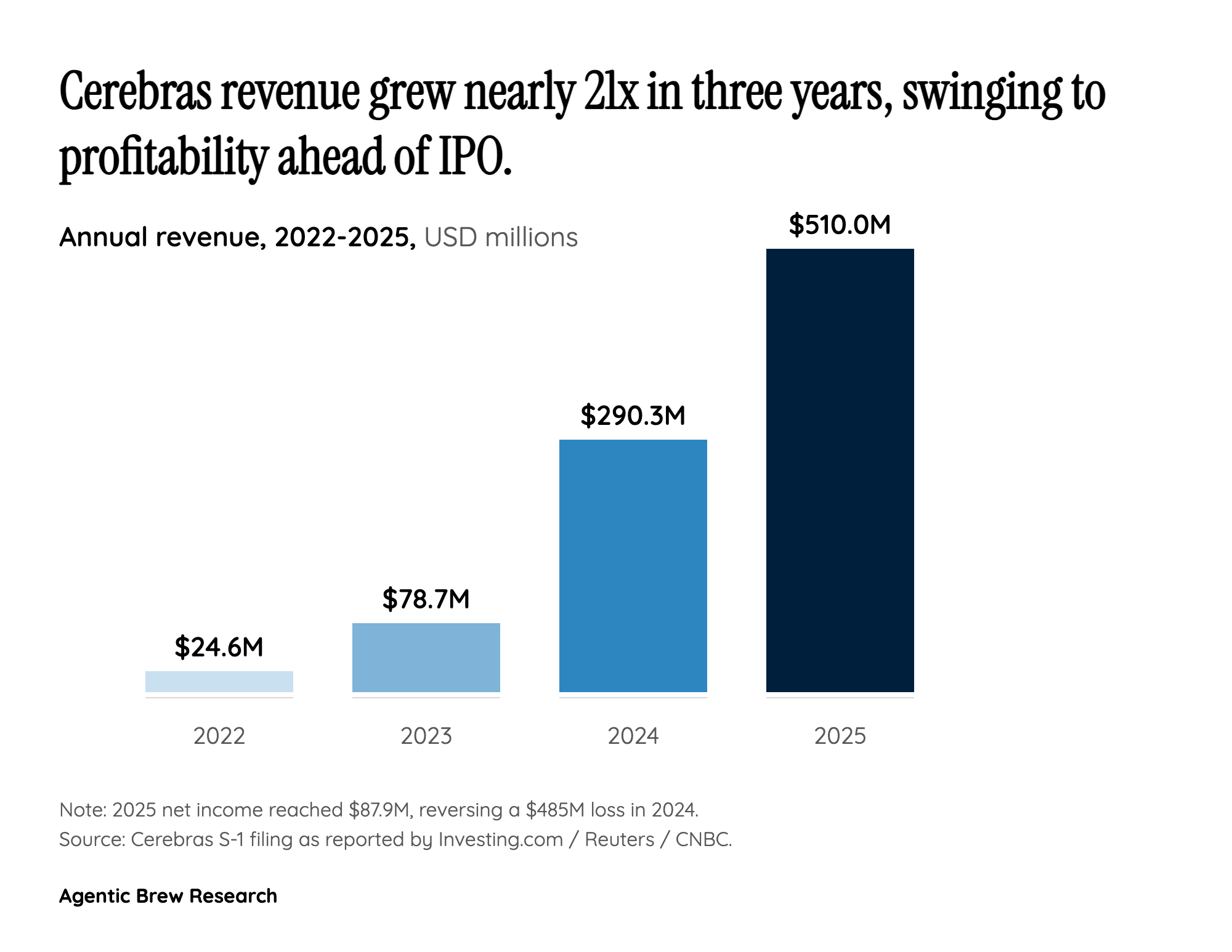
Cerebras revenue trajectory, 2022-2025: $24.6M → $78.7M → $290.3M → $510M.

The financials Cerebras put on the table are objectively strong: $510M in 2025 revenue, a 76% YoY climb from $290.3M, and a swing to $87.9M of net income from a per-share loss of $9.90 to a $1.38 profit. The full revenue ladder — $24.6M in 2022, $78.7M in 2023, $290.3M in 2024, $510M in 2025 — describes a roughly 20x expansion in three years. That is the kind of curve that justifies a premium multiple in any market, let alone an AI-infrastructure one.

But the reported targeted valuation of $22-25 billion (with some reports up to $35B) implies a price-to-sales ratio of roughly 45x against $510M of revenue, a multiple notably above where Nvidia trades despite Nvidia's vastly larger profit base. The Techi analyst framing matters here: Cerebras is the first pure-play Nvidia alternative to reach public markets in this cycle, which creates a scarcity premium institutional investors may pay for diversification within their AI compute exposure. The risk is that the multiple is being supported less by intrinsic margin economics and more by the OpenAI deal narrative — a contract that, again, is concentrated in a single customer whose own future cash flows are still being negotiated.

Why the Wave Lands Now: Diversification Demand Meets the AI-IPO Glut

The timing of this filing is not coincidence. The 2026 IPO calendar is shaping up around AI mega-listings (with SpaceX, OpenAI, and Anthropic also in the conversation), and a vocal r/investing thread on the dynamic — surfacing concerns about retail being positioned as exit liquidity for late-stage AI capital — captures the broader market mood. Into that backdrop, Cerebras lands as the cleanest pure-play wager on Nvidia not winning everything, which is exactly the diversification trade institutional AI portfolios have been trying to construct.

CEO Andrew Feldman's public posture is built for this moment. His claim that switching from Nvidia GPUs to Cerebras inference takes about ten keystrokes and under a minute is a direct attack on the CUDA-lock-in thesis that underpins Nvidia's terminal-value story. Whether the claim survives serious workload migration tests is a different question — but the narrative is calibrated to the exact concern allocators have when they look at their AI compute exposure and ask what would happen if the moat is thinner than priced. Cerebras is offering itself as the hedge, and the IPO is the vehicle for institutions to actually buy it.

Historical Context

2024-09
Filed initial S-1 with the SEC, disclosing G42 represented 83% of 2023 revenue and 97% of 2024 hardware sales.
2024-10
Withdrew its IPO paperwork days after announcing a $1.1B raise at an $8.1B valuation while CFIUS review of G42's stake remained unresolved.
2025-12
Announced CFIUS clearance and renewed IPO preparations, with G42 reportedly no longer appearing on the investor list.
2026-01
Reports surfaced of an OpenAI compute deal worth over $10B covering up to 750 MW of AI capacity, later expanded to >$20B.
2026-04
Publicly filed for proposed Nasdaq IPO under ticker CBRS with Morgan Stanley, Citigroup, Barclays, and UBS as lead underwriters.

Power Map

Key Players
Subject

Cerebras files for IPO

CE

Cerebras Systems

The Sunnyvale-based AI chipmaker is the issuer, pitching its wafer-scale processors as a Nvidia alternative and using the IPO to convert a 2025 financial inflection into permanent capital under ticker CBRS.

OP

OpenAI

Anchor customer effectively underwriting the IPO narrative with a >$20B multi-year commitment, while taking warrants for up to 33.4M Class N shares that turn vendor spending into equity upside.

G4

G42

UAE-based prior anchor customer whose minority investment triggered the CFIUS review that derailed the original 2024 IPO; reportedly no longer on the new investor list, clearing the political path to refile.

MO

Morgan Stanley, Citigroup, Barclays, UBS

Lead underwriters whose involvement signals tier-one bank confidence in pricing a $22-25B+ valuation against $510M of revenue.

NV

Nvidia

Incumbent GPU market leader whose dominance Cerebras is challenging with wafer-scale architecture; investor appetite for diversification away from a single AI compute supplier is the core thesis behind the listing.

CF

CFIUS

US national-security regulator whose unresolved review of G42's stake forced the prior IPO withdrawal; its 2025 clearance was the precondition for refiling.

THE SIGNAL.

Analysts

"Argues hardware lock-in to Nvidia is overstated, claiming switching workloads to Cerebras inference takes minutes rather than months."

Andrew Feldman
CEO, Cerebras Systems

"Frames the prior S-1 withdrawal not as a setback but as a mechanical consequence of a refreshed cap table requiring updated disclosures."

Andrew Feldman
CEO, Cerebras Systems

"Calls Cerebras the first pure-play Nvidia alternative to reach public markets this AI cycle but flags that the transition from G42 (87% of H1 2024 revenue) to OpenAI as primary customer is unproven at scale."

Techi.com analyst commentary
Industry analyst, Techi

"Characterizes G42's involvement as politically risky enough that executives delayed the IPO until political appointments shifted the regulatory backdrop."

SiliconANGLE reporting
Analyst commentary cited by SiliconANGLE
The Crowd

"Cerebras Systems, a chip startup that makes processors customized for running advanced artificial-intelligence models, filed paperwork Friday for an initial public offering. Cerebras Files for IPO as Demand Surges for More Efficient AI Chips"

@@WSJTech1

"JUST IN: OpenAI has agreed to pay Cerebras $20+ billion to use their AI chips over the next 3 years in exchange for equity rights."

@@PolymarketMoney225

"Cerebras files for Nasdaq IPO "CBRS", pivots to AI cloud • $510M revenue (+76% YoY) with $87.9M net income in 2025 • Transitioning from chip sales to AI cloud infrastructure model • OpenAI deal could exceed $20B, but customer concentration remains high"

@@allday_stocks0

"Cerebras Systems Announces Filing of Registration Statement for Proposed Initial Public Offering"

@u/claytonbeaufield12
Broadcast
Cerebras CEO, Andrew Feldman on Why Raise $1BN and Delay the IPO & Why NVIDIA's Worried About Growth

Cerebras CEO, Andrew Feldman on Why Raise $1BN and Delay the IPO & Why NVIDIA's Worried About Growth

Cerebras CEO: Here's why our chips are a more efficient alternative to Nvidia

Cerebras CEO: Here's why our chips are a more efficient alternative to Nvidia

Nvidia challenger Cerebras files for IPO

Nvidia challenger Cerebras files for IPO