Meta space-based solar power deal
TECH

Meta space-based solar power deal

40+
Signals

Strategic Overview

  • 01.
    Meta has signed a first-of-its-kind capacity reservation agreement with stealth-emergent startup Overview Energy for up to 1 GW of space-based solar power, with an orbital demonstration in 2028 and commercial deliveries beginning in 2030.
  • 02.
    Overview's architecture differs from classical space-solar concepts: satellites in geosynchronous orbit roughly 22,000 miles up will collect continuous sunlight and beam it to existing terrestrial solar farms as low-intensity, near-infrared light rather than microwaves to dedicated rectennas.
  • 03.
    In a parallel deal announced April 21, 2026, Meta also reserved up to 1 GW / 100 GWh of ultra-long-duration energy storage from Noon Energy, with an initial 25 MW/2.5 GWh pilot expected in 2028 — signaling a portfolio approach to powering AI data centers.
  • 04.
    Overview plans a fleet of about 1,000 spacecraft in geosynchronous orbit covering roughly one-third of the planet, building on a November 2025 demonstration that beamed power from a Cessna aircraft at 16,500 ft to a ground solar installation.

Deep Analysis

The architectural twist: near-infrared to existing solar farms, not microwaves to new rectennas

The most consequential technical detail in the Meta-Overview deal is what isn't being built. Classical space-based solar power, proposed by Peter Glaser at Arthur D. Little in 1968 and stress-tested by NASA and the DOE through the late 1970s and early 1980s, depends on dedicated ground infrastructure: large rectennas tuned to receive microwave transmissions from geosynchronous orbit. That ground footprint — and the political, regulatory, and capital requirements that come with it — has historically been one of the heaviest anchors on the concept's economics.

Overview Energy is trying to lift that anchor. Its satellites, which will sit in geosynchronous orbit roughly 22,000 miles above the equator where sunlight is constant, convert solar energy into low-intensity, near-infrared light and beam it directly at conventional, utility-scale ground-based solar farms. Existing photovoltaic panels — already permitted, sited, and grid-connected — become the receivers. Marc Berte's pitch of "reliable siting, and speed to power" hinges on this idea: if a hyperscaler doesn't need to build a new ground station for every gigawatt, the orbital fleet plugs into infrastructure that already exists. Whether ground arrays designed for diffuse sunlight can efficiently absorb a focused near-infrared beam at scale is the open engineering question the 2028 demonstration is meant to answer.
Why Meta is buying orbital sunlight in the first place

Why Meta is buying orbital sunlight in the first place
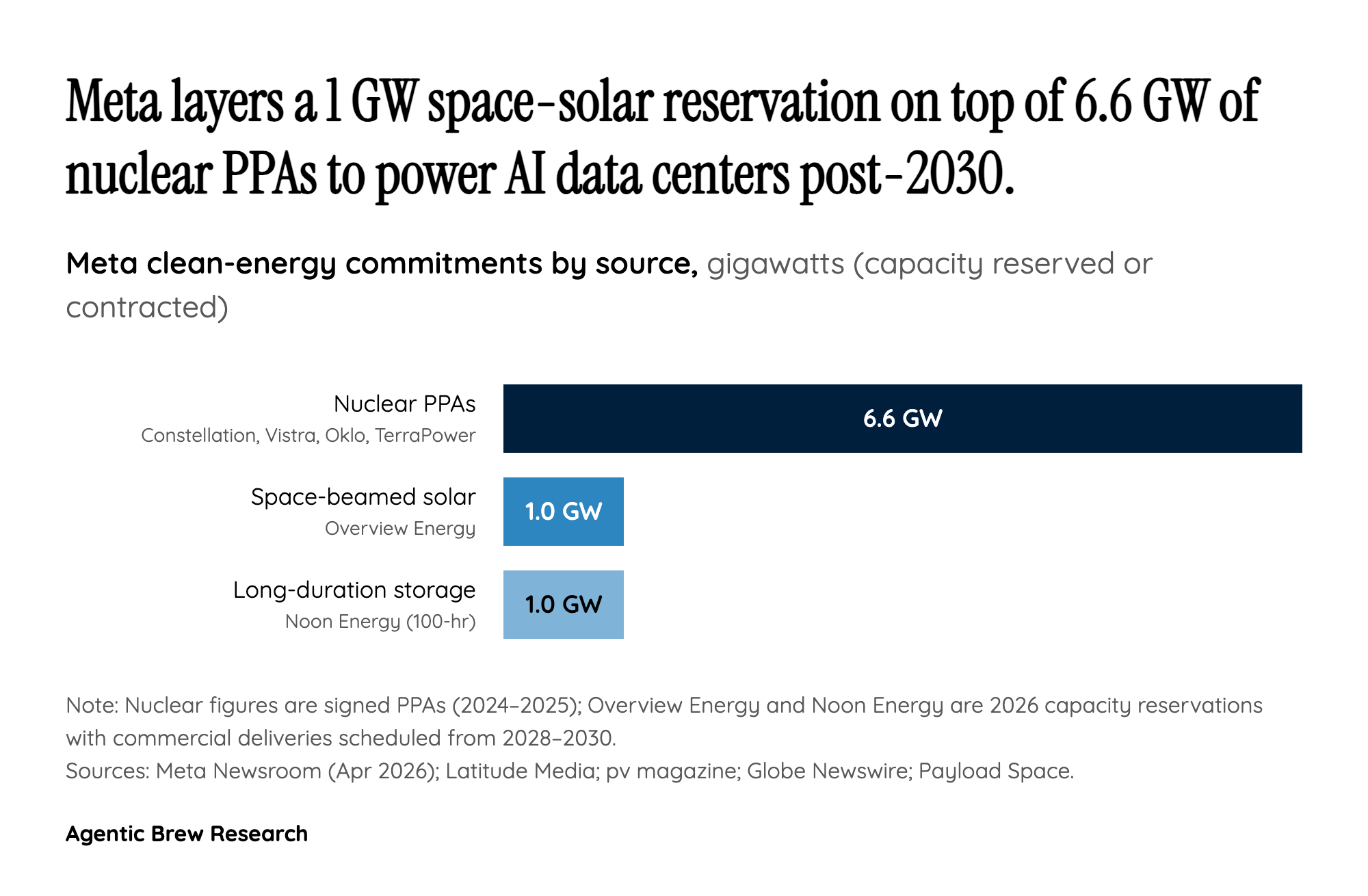
Meta clean-energy commitments by source: 6.6 GW nuclear PPAs, 1 GW reserved Overview Energy space solar, 1 GW reserved Noon Energy long-duration storage.

Meta's data centers consumed more than 18,000 GWh of electricity in 2024 — roughly the equivalent of 1.7 million U.S. homes for a year — and that load is climbing as AI training and inference workloads scale. The company was already the largest corporate clean-energy offtaker globally in 2025 at 10.24 GW, and over 2024 and 2025 it stacked roughly 6.6 GW of nuclear PPAs with Constellation, Vistra, Oklo, and TerraPower. The Overview agreement, plus the parallel 1 GW / 100 GWh ultra-long-duration storage reservation with Noon Energy, slots into that portfolio rather than replacing any piece of it.

The strategic logic is diversification across both technology and timeline. Nuclear deals address baseload but face long permitting cycles; terrestrial renewables plus storage handle near-term load growth; space solar and 100-hour storage are bets on the back half of the decade and beyond. Nat Sahlstrom's framing of space solar as "leveraging existing terrestrial infrastructure to deliver new, uninterrupted energy from orbit" is the cleanest articulation of why a hyperscaler would pay to reserve a technology that doesn't yet exist commercially — it's an option on 24/7 carbon-free generation that doesn't require Meta to abandon its existing solar siting strategy.

The skeptical case: NASA, the IPCC, and the politics of decarbonization

The cleanest counterweight to Meta's announcement is a January 2024 NASA Office of Technology, Policy, and Strategy report that concluded space-based solar would still be more expensive than terrestrial alternatives by 2050 unless major capability gaps close. Latitude Media reinforces the point with the blunt observation that "shooting solar panels into space and maintaining them for several decades is very, very expensive," and notes that the IPCC's net-zero pathways do not include the technology at all. None of those baselines have shifted because of a corporate capacity reservation.

The critique gets sharper when it turns to motive. Caroline Golin, formerly Google's global head of energy, frames space solar less as an engineering breakthrough than as a political maneuver: "I think the real motivation is less about harnessing the sun's power and avoiding the power crunch on Earth and more about getting out of the politics of completely transitioning this economy." In that reading, Meta's deal does work that goes beyond electrons — it lets a hyperscaler tell a clean-power story that doesn't require contentious local fights over transmission lines, land use, or interconnection queues. The ESG framing comes prepackaged with the orbital narrative.

The launch-economics dependency hiding under a 1,000-satellite fleet

Overview is targeting a fleet of roughly 1,000 spacecraft in geosynchronous orbit with more than 10-year lifespans, eventually covering about one-third of the planet. Whatever the merits of the near-infrared architecture, the financial spine of the project is launch cadence and cost. 24/7 Wall St. captures this directly: "Meta's pact to explore space-based solar power for its data center fleet is fundamentally a launch story." Without sustained access to cheap, frequent heavy-lift capacity to GEO, a thousand-satellite constellation moves from ambitious to uneconomic regardless of how efficiently the beam reaches the ground.

That dependency makes Overview a downstream beneficiary of every reusable-rocket and small-launcher cost curve in the industry, and it ties Meta's ESG narrative to a launch market that neither company controls. The November 2025 demonstration — power-beaming from a Cessna aircraft at 16,500 feet down to a ground solar installation — proved the optics work in atmosphere. It says nothing about the unit economics of putting the transmitter 22,000 miles up, where every kilogram of satellite mass is priced by the launch market on the day it ships.

Reading the timeline: "speed to power" versus a 2030 commercial start

Berte's marketing line is "speed to power," but the announced schedule reads more cautiously. The first orbital power-transmission demo is planned for low Earth orbit in January 2028. Satellite launches for Meta begin in 2030. The Noon Energy storage pilot is also a 2028 milestone, at 25 MW / 2.5 GWh — a fraction of the headline 1 GW / 100 GWh figure. None of the gigawatt numbers reserved this April are scheduled to meet a real load this decade.

That gap matters because Meta's AI compute build-out is happening now. The 6.6 GW of nuclear PPAs and the 10.24 GW of clean-energy contracts signed through 2025 are doing the heavy lifting for near-term demand. The Overview agreement is best read as an option on a different post-2030 generation mix — one that, if it works, gives Meta access to a generation source that doesn't compete with anyone else for terrestrial siting. If it doesn't, the company has lost a capacity reservation, not a power plant. The asymmetry of that bet is probably the single best explanation for why a hyperscaler would sign first.

Historical Context

1968
Originated the modern space-based solar power concept, proposing microwave power transmission from geosynchronous orbit to ground-based rectennas — the architectural baseline that Overview's near-infrared approach now departs from.
1975
Demonstrated wireless microwave power transmission across a mile-wide valley at Goldstone, California — a foundational proof-of-concept for beaming power over long distances.
1978-1986
Joint Satellite Power System Concept Development and Evaluation Program (~$50M budget) studied a 60-satellite GEO constellation, but the concept did not reach commercialization.
January 2024
Report concluded space-based solar would still be more expensive than terrestrial alternatives by 2050 unless major capability gaps close — a recent baseline of skepticism that the Meta deal directly challenges.
2024-2025
Signed multi-gigawatt nuclear PPAs (~6.6 GW total) with Constellation, Vistra, Oklo, and TerraPower; was the largest corporate clean-energy offtaker globally in 2025 at 10.24 GW — establishing the portfolio that the Overview deal extends.
November 2025
Demonstrated power beaming from a Cessna aircraft at 16,500 ft to a ground solar installation, ahead of its planned 2028 LEO orbital demo.
April 21, 2026
Meta announced a parallel agreement reserving up to 1 GW / 100 GWh of ultra-long-duration storage from Noon Energy, with a 25 MW/2.5 GWh pilot due in 2028.
April 27, 2026
Announced the capacity reservation agreement for up to 1 GW of space-beamed solar, with a January 2028 orbital test and commercial deliveries from 2030 to a ~1,000-satellite geosynchronous fleet.

Power Map

Key Players
Subject

Meta space-based solar power deal

ME

Meta Platforms

Hyperscaler offtaker reserving up to 1 GW of space-beamed solar plus 1 GW/100 GWh of long-duration storage to power AI data centers; was the largest corporate clean-energy offtaker globally in 2025 at 10.24 GW.

OV

Overview Energy

Space-solar startup founded in 2022 that emerged from stealth in late 2025; building GEO satellites that beam near-infrared light to terrestrial solar farms; Meta is its first commercial offtaker.

MA

Marc Berte

CEO of Overview Energy, pitching space as part of U.S. energy infrastructure for hyperscalers and arguing the technology offers reliable siting and speed to power.

NA

Nat Sahlstrom

Meta VP of Energy and Sustainability who signed the agreements and frames space solar as leveraging existing terrestrial solar infrastructure for 24/7 generation.

NO

Noon Energy

Long-duration storage startup, led by CEO Chris Graves, using abundant carbon-and-oxygen chemistry; counterparty to Meta's 1 GW/100 GWh ultra-long-duration storage reservation.

OV

Overview Energy advisory board

Includes former NASA administrators Jim Bridenstine and Mike Griffin and former FERC chair Joseph Kelliher, providing space-policy and energy-regulatory credibility.

Source Articles

Top 3

THE SIGNAL.

Analysts

"Argues space solar gives hyperscalers reliable siting and speed to power, framing orbital generation as a natural extension of America's energy infrastructure. Quote: "Space is becoming part of America's energy infrastructure. Our approach to space solar energy enables hyperscalers and technology providers to secure clean power with reliable siting, and speed to power.""

Marc Berte
CEO, Overview Energy

"Frames space solar as a transformative way to extend existing terrestrial solar infrastructure into 24/7 generation for AI data centers. Quote: "Space solar technology represents a transformative step forward by leveraging existing terrestrial infrastructure to deliver new, uninterrupted energy from orbit.""

Nat Sahlstrom
VP Energy & Sustainability, Meta

"Skeptical of the underlying motivations, suggesting tech firms are using exotic energy bets to sidestep harder decarbonization politics. Quote: "I think the real motivation is less about harnessing the sun's power and avoiding the power crunch on Earth and more about getting out of the politics of completely transitioning this economy.""

Caroline Golin
Former global head of energy at Google; Open Circuit podcast host

"Notes long-running skepticism of space-solar economics and observes the IPCC's net-zero pathways do not include the technology. Quote: "shooting solar panels into space and maintaining them for several decades is very, very expensive.""

Latitude Media analysis
Industry trade publication

"Argues the deal's viability hinges on launch economics — gigawatt-scale orbital arrays only pencil out if launches are cheap and frequent. Quote: "Meta's pact to explore space-based solar power for its data center fleet is fundamentally a launch story.""

24/7 Wall St. analysis
Investing publication
The Crowd

"UPDATE: $META Meta Partners with Overview Energy on Space Solar Power for Data Centers. Key Highlights: Meta signs deal for up to 1GW of space solar energy capacity. First-of-its-kind agreement to power AI data centers."

@AIStockSavvy0

"Meta just signed a deal to buy solar power beamed down from space. Satellites collect solar energy in orbit (24/7 - no night, no clouds) -> Convert it to near infrared light -> Beam it down to solar farms on Earth -> Solar farms convert the light to electricity"

@RealNickMugalli0
Broadcast
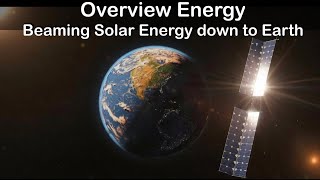
Overview Energy's Path to Orbital Solar Dominance: Beaming Unlimited Solar Energy down to Earth

Overview Energy's Path to Orbital Solar Dominance: Beaming Unlimited Solar Energy down to Earth

Space and Energy

Space and Energy

Bloomberg Money Minute: Microsoft Ends OpenAI Exclusivity and Meta's Space Power

Bloomberg Money Minute: Microsoft Ends OpenAI Exclusivity and Meta's Space Power