Kentucky family rejects $26 million offer to sell farmland for AI data center
TECH

Kentucky family rejects $26 million offer to sell farmland for AI data center

31+
Signals

Strategic Overview

  • 01.
    Ida Huddleston, 82, and her daughter Delsia Bare rejected a $26 million offer from an unnamed Fortune 100 AI company to purchase approximately half of their 1,200-acre farm near Maysville, Mason County, Kentucky, for a data center—roughly 10 times the local market value of $6,000 per acre.
  • 02.
    The proposed hyperscale data center campus would require rezoning 28 agricultural parcels totaling more than 2,000 acres, demand up to 2.2 gigawatts of power—nearly doubling local utility capacity—and consume up to 5 million gallons of water per day.
  • 03.
    At least five of Huddleston's neighbors also categorically rejected offers from the data center buyer, with one told he could name any price, as the story went viral nationally with top social media posts generating over 190,000 engagements.
  • 04.
    Public hearings on the rezoning proposal are scheduled for March 25-26, 2026, at Maysville Community and Technical College, as a 1,600-member grassroots opposition group demands transparency about the anonymous buyer's identity.

Deep Analysis

Why This Matters

The Huddleston family's rejection of a $26 million windfall has become a cultural flashpoint because it crystallizes a collision between two of America's most powerful narratives: the sanctity of family farmland and the relentless expansion of artificial intelligence infrastructure. When Delsia Bare declared that '$26 million doesn't mean anything' compared to feeding a nation, she articulated a value system that resonates far beyond Mason County. The story taps into deep anxieties about whether the AI boom is enriching communities or hollowing them out, and whether rural Americans have any real agency when Fortune 100 companies come calling with offers that dwarf generational wealth.

The timing amplifies its significance. Public hearings on the rezoning began today, March 25, 2026, making this not just a human-interest story but an active land-use battle with immediate consequences. The fact that at least five neighboring landowners also refused to sell suggests this is not an isolated act of sentiment but an emerging pattern of collective resistance. Nationally, the story has ignited debate across the political spectrum—conservatives frame it as defending property rights and food sovereignty, while progressives emphasize corporate secrecy and environmental justice. A single social media post about the family garnered 159,000 likes, demonstrating that the tension between AI growth and agricultural preservation has become one of the defining land-use conflicts of the decade.
How It Works: The Mechanics of Data Center Land Acquisition

Hyperscale data centers require specific conditions that make rural farmland uniquely attractive. Companies seek what the industry calls 'powered land'—large contiguous parcels with access to substantial electricity, abundant water for cooling systems, and favorable zoning that can be changed relatively quickly. Mason County checks every box: flat agricultural terrain, proximity to East Kentucky Power Cooperative's infrastructure, ample water resources, and a local government eager for economic development after decades of population decline. The anonymous buyer's approach—using NDAs to conceal its identity, offering multiples of market value, and working through intermediaries—follows a well-established playbook used by tech giants to acquire land before public opposition can organize.

The scale of the Mason County proposal is staggering even by industry standards. At 2,000+ acres requiring 2.2 gigawatts of power and 5 million gallons of water daily, it would be among the largest data center campuses in the United States. For context, average data center land transactions have grown to 224 acres—up 144% since 2022—but this project dwarfs that average nearly tenfold. The rezoning of 28 agricultural parcels represents a permanent land-use conversion: once farmland is paved for server buildings and cooling infrastructure, it does not return to agricultural production. The project's $1 billion+ price tag and the willingness to pay 10 times market value for land reveal just how desperate the demand for AI computing real estate has become.

By The Numbers

By The Numbers
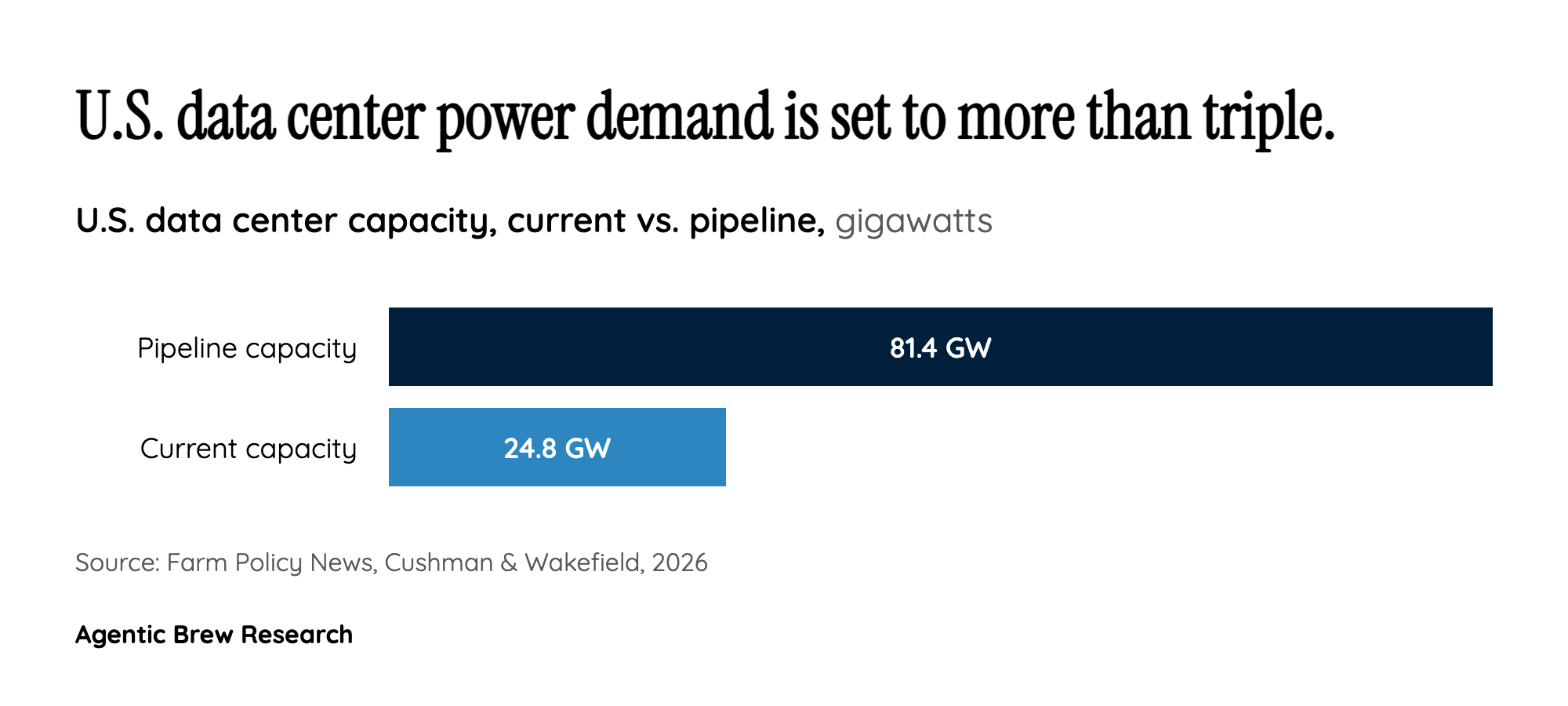
U.S. data center capacity is projected to grow from 24.8 GW to 81.4 GW

The statistics surrounding this story illustrate the sheer scale of the AI infrastructure buildout and its collision with American agriculture. The $26 million offer for roughly 600 acres works out to approximately $43,000 per acre—more than seven times the Mason County average of $6,000 per acre. Even at that premium, the cost of land is a rounding error for a company planning a billion-dollar campus. U.S. data center capacity currently stands at 24.8 gigawatts and is projected to more than triple to 81.4 gigawatts through projects already in the pipeline, requiring an estimated 40,000 acres of new land globally over the next five years.

The local resource demands are equally striking. The proposed 2.2 gigawatts of power would nearly double the capacity of the East Kentucky Power Cooperative, which currently operates a coal plant nearby. Five million gallons of daily water consumption is equivalent to the household water use of roughly 45,000 people—far exceeding Mason County's entire population. Meanwhile, approximately 40 states now offer tax incentives to attract data center investment, creating a competitive environment where local governments may accept lopsided deals. On social media, the story's viral spread—281,000 YouTube views on the original Local 12 report, 5.9 million views on Business Insider's broader data center investigation, and nearly 200,000 engagements on a single tweet—demonstrates that public awareness of these trade-offs is growing rapidly.

Impacts and What's Next

The immediate impact is on the March 25-26 rezoning hearings, where the Mason County Joint Planning Commission will decide the fate of 2,000+ acres of agricultural land. The Huddleston family's viral refusal has galvanized opposition—the 'We Are Mason County, Ky.' group now counts 1,600 members—and put national media attention on proceedings that would otherwise have been a quiet local matter. The anonymous buyer faces a public relations problem: the secrecy that was designed to prevent opposition has instead become the opposition's most effective rallying point. Sierra Club representative Elisa Owen's warning that proprietary contracts prevent verification of environmental commitments has given opponents a substantive policy argument beyond emotional appeals.

Beyond Mason County, the story is accelerating a broader policy conversation. Texas Agriculture Commissioner Sid Miller's observation that there are 'no guardrails of any kind' for data center expansion onto farmland signals that regulatory frameworks may be coming. Farm policy researchers have documented a growing pattern of farmers rejecting data center offers, suggesting that the industry cannot simply buy its way to the land it needs. The economic case is also more complex than proponents admit: while data centers create construction jobs, they employ remarkably few people once operational—often fewer than 50 permanent workers for a billion-dollar facility. Rising land prices driven by data center speculation also increase property tax burdens on surrounding farmers who have no intention of selling, potentially forcing more agricultural land out of production through indirect economic pressure rather than direct purchase.

The Bigger Picture: Food Security vs. Digital Infrastructure

This story sits at the intersection of two megatrends that will define American land use for decades. On one side, the AI revolution demands an unprecedented buildout of physical infrastructure—server farms, power plants, water systems, and fiber networks—that must be located somewhere. On the other, the United States has already lost more than 11 million acres of farmland to development since 2001, and food security experts warn that continued conversion threatens the nation's long-term agricultural capacity. The Huddleston family's stand, and the public's overwhelming support for it, suggests that Americans are beginning to question whether AI's insatiable appetite for resources should take priority over food production.

The secrecy dimension adds a governance crisis to the resource competition. When a Fortune 100 company can approach landowners under NDA, work with local development authorities behind closed doors, and seek rezoning of thousands of acres before the public knows who is behind the project, it raises fundamental questions about democratic accountability in land-use decisions. The Mason County case may prove to be a turning point—not because one family said no, but because their refusal exposed a process that many Americans find deeply troubling. Whether the rezoning is approved or denied, the precedent being set in this small Kentucky county will echo through hundreds of similar battles as the data center industry seeks tens of thousands of additional acres in the years ahead. The question is no longer whether AI needs more land, but whether the communities that own that land will have a meaningful voice in deciding its future.

Historical Context

2024-12-01
Initial discussions about siting a hyperscale data center campus in Mason County, Kentucky began in late 2024.
2025-04-01
The unnamed AI company approached Ida Huddleston and Delsia Bare with a $26 million offer to purchase approximately half of their 1,200-acre farm for the proposed data center.
2025-08-21
Kentucky Lantern reported on the secretive nature of the proposal, noting that despite being described as a $1 billion+ investment, key details including the buyer's identity remained undisclosed.
2025-12-18
Northern Kentucky residents raised formal concerns and a 1,600-member Facebook group called 'We Are Mason County, Ky.' organized in opposition to the project.
2026-03-18
The Huddleston family's rejection of the $26 million offer went viral nationally, with top social media posts generating over 190,000 engagements.
2026-03-25
Public hearings on rezoning 28 agricultural parcels totaling 2,000+ acres began at Maysville Community and Technical College.

Power Map

Key Players
Subject

Kentucky family rejects $26 million offer to sell farmland for AI data center

ID

Ida Huddleston & Delsia Bare

82-year-old landowner and her daughter who rejected the $26 million offer to preserve their 1,200-acre multi-generational family farm near Maysville, Kentucky. Bare stated: 'Stay and hold and feed a nation. $26 million doesn't mean anything.'

UN

Unnamed Fortune 100 AI Company

Anonymous buyer seeking 2,000-5,000 acres of farmland in Mason County for a $1 billion+ hyperscale data center campus. Identity remains concealed under non-disclosure agreements until project approval.

TY

Tyler McHugh / Mason County Industrial Development Authority

Executive Director promoting the project as essential economic development for a county that has experienced sharp population decline over 15-20 years, citing hundreds of potential jobs and infrastructure investment.

MA

Max Moran / We Are Mason County, Ky.

Director of a 1,600-member grassroots organization opposing the data center. Organized community resistance and demanded the anonymous buyer reveal its identity.

EA

East Kentucky Power Cooperative

Local power provider operating a nearby coal plant whose capacity would need to nearly double to supply the proposed 2.2 GW data center campus.

MA

Mason County Joint Planning Commission

Government body responsible for the rezoning decision on 28 agricultural parcels, holding public hearings March 25-26, 2026.

THE SIGNAL.

Analysts

"Criticized the absence of regulatory frameworks governing data center expansion onto agricultural land: 'There's no oversight, there's no regulation, there's no organization, there's no guardrails of any kind.'"

Sid Miller
Agriculture Commissioner, State of Texas

"Warned that the secretive nature of data center contracts prevents accountability: 'If contracts are proprietary—secret—there's no way they can be verified,' raising concerns about unverifiable environmental commitments."

Elisa Owen
Representative, Sierra Club

"Explained the cultural dimension of farmer resistance, noting that farmland is often viewed as a birthright tied to past and future generations, making financial offers insufficient to overcome emotional and identity-based attachments to the land."

Mary Hendrickson
Professor of Rural Sociology, University of Missouri

"Framed the tension as a short-term versus long-term policy failure: 'We're taking farmland that could grow food for data centers. That's short-sighted.'"

Karen Dalton
Republican candidate, Pennsylvania

"Argued the data center represents a lifeline for a declining community: 'Over the past 15-20+ years, we've seen sharp population decline,' promoting the project's potential for hundreds of jobs and significant infrastructure investment."

Tyler McHugh
Executive Director, Mason County Industrial Development Authority
The Crowd

"NEW: Kentucky family rejects $26 million offer to convert part of their farm into a data center despite the offer being about 10 times the going rate for farmland in the area."

@@CollinRugg159000

"Developers are trying to buy out American farms to turn them into Data Centers. This elderly woman in Kentucky was offered $60,000 per acre for her 71 acre farm."

@@WallStreetApes16000

"A mother and daughter in Kentucky have rejected multimillion-dollar offers for their land, offers made by an anonymous tech company trying to build a data center."

@@MorePerfectUS441

"Kentucky woman rejects $26M offer to turn her farm into a data center"

@u/unknown0
Broadcast
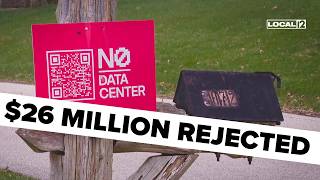
Northern Kentucky family declines $26 million bid as data center plans advance

Northern Kentucky family declines $26 million bid as data center plans advance

Exposing The Dark Side of America's AI Data Center Explosion

Exposing The Dark Side of America's AI Data Center Explosion

I Live 400 Yards From Mark Zuckerberg's Massive Data Center

I Live 400 Yards From Mark Zuckerberg's Massive Data Center