OpenAI CRO Dresser Memo Attacks Anthropic, Distances from Microsoft
TECH

OpenAI CRO Dresser Memo Attacks Anthropic, Distances from Microsoft

28+
Signals

Strategic Overview

  • 01.
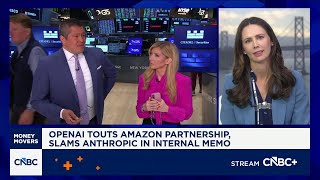
    OpenAI CRO Denise Dresser sent an internal memo on April 13, 2026, touting the Amazon partnership as transformative for enterprise reach while criticizing Microsoft for constraining OpenAI's ability to meet enterprises where they are.
  • 02.
    The memo attacked Anthropic as a single-product company with inflated revenue, claiming Anthropic's reported $30B run rate is overstated by approximately $8B due to gross-basis accounting that includes hyperscaler revenue shares.
  • 03.
    Enterprise revenue now represents 40% of OpenAI's total revenue and is on track to reach parity with consumer revenue by the end of 2026, underscoring why the Amazon Bedrock distribution channel is strategically critical.
  • 04.
    Anthropic's share of US enterprise AI spending has climbed to 40% while OpenAI's has fallen from 50% to 27%, providing critical context for the memo's aggressive tone.
  • 05.
    Prediction markets give Anthropic a 59% probability of having the best AI model by June 2026, compared to just 6% for OpenAI — a striking market signal that undercuts the memo's narrative of Anthropic as a weaker competitor.

Deep Analysis

The Microsoft Breakup Letter: Why OpenAI Is Publicly Distancing from Its Most Important Partner

Dresser's memo reads less like an internal update and more like a carefully orchestrated public signal — a breakup letter to Microsoft drafted with full awareness it would leak. The core complaint is structural: Microsoft's Azure exclusivity locked OpenAI out of AWS, where the majority of Fortune 500 enterprise workloads already run. By the time OpenAI secured its Amazon deal in February 2026, the damage was done. Anthropic had spent two years building deep integrations with both AWS Bedrock and Google Cloud, capturing enterprise customers OpenAI could not even bid on.

The social media reaction has been sharp and largely sympathetic to this reading. On X.com, @ai_for_success summarized the dynamic bluntly: 'Leaked OpenAI memo shows Denise Dresser pushing Amazon hard while calling out Microsoft for holding them back.' More pointedly, @petergostev offered an analysis that many enterprise observers share: 'Microsoft pointlessly screwed over OpenAI and handed the enterprise market to Anthropic. Microsoft is a big investor in OpenAI and decided to make their models exclusive to Azure Cloud.' This captures the central irony — Microsoft's attempt to use OpenAI as an Azure moat may have backfired by starving OpenAI of the multi-cloud distribution it needed to compete.

The memo's timing is also significant. With OpenAI's IPO approaching, the company needs to demonstrate enterprise growth acceleration. Publicly distancing from Microsoft's constraints — while framing the Amazon deal as a liberation event — serves both the internal morale narrative and the external investor narrative. But the underlying math is unforgiving: Anthropic's enterprise market share climbed to 40% during the exact period OpenAI was locked into Azure exclusivity. The Amazon partnership may be 'frankly staggering' in its inbound demand, as Dresser claims, but it is also a late-stage correction to a strategic error that competitors exploited for over a year.
The $8 Billion Accounting War: How Revenue Recognition Became a Competitive Weapon

At the heart of the memo's attack on Anthropic is a surprisingly technical claim about revenue accounting. Dresser argues that Anthropic's reported $30B annual run rate is overstated by approximately $8B because Anthropic recognizes revenue on a gross basis — counting the full amount billed through cloud partnerships with Amazon and Google, including the hyperscalers' revenue share, rather than netting it out. OpenAI, by contrast, reports net revenue after Microsoft takes its roughly 20% cut from Azure-distributed sales.

This accounting distinction has gained significant traction on social media, where it is being dissected as a window into how AI companies frame their growth stories. On X.com, @0xOrkward posted a widely shared thread breaking down the math: 'Anthropic reports the full gross amount billed through cloud partnerships — Amazon, Google — while OpenAI reports the net after Microsoft takes its 20% cut.' The thread also surfaced a Bank of America estimate that Anthropic could pay hyperscalers $6.4 billion in revenue-sharing fees in 2026 alone, which would represent a substantial portion of its reported run rate if accounted for on a net basis.

The accounting dispute matters beyond the headline numbers because it shapes investor perception heading into OpenAI's IPO. If Anthropic's $30B run rate is really $22B on a net basis, the gap between the two companies narrows considerably — and OpenAI's narrative of clear market leadership becomes more defensible. But the argument cuts both ways. Gross-basis accounting is standard practice for platform companies and is how Amazon itself reports AWS Marketplace revenue. By attacking Anthropic's accounting, OpenAI risks drawing attention to its own unusual arrangement with Microsoft, where it effectively cedes 20% of Azure-distributed revenue — a deal structure that few enterprise software companies would accept. The accounting war is ultimately a proxy fight over which company's growth trajectory is real and which is inflated by partnership economics.

Enterprise Market Share Inversion: The Numbers That Forced This Memo Into Existence

The most telling data point in the Dresser memo is the one OpenAI cannot spin: Anthropic's share of US enterprise AI spending has risen to 40%, while OpenAI's has fallen from 50% to 27%. This market share inversion — happening in under 18 months — represents one of the fastest competitive reversals in enterprise software history. It is the number that forced this memo into existence, and no amount of accounting disputes or partnership announcements can obscure it.

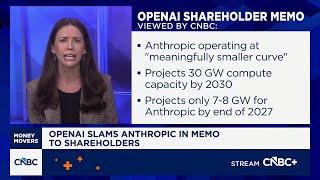
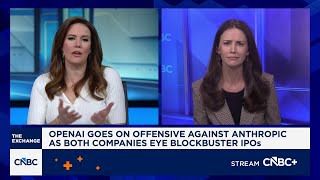
The story has generated substantial media coverage, with CNBC running three separate YouTube segments on the memo within hours of its leak, accumulating over 22,000 combined views. Kate Rooney's lead segment, 'OpenAI slams Anthropic in memo to shareholders,' framed the story as an escalation in the AI enterprise war — a framing that CNBC doubled down on with follow-up segments titled 'OpenAI goes on offensive against Anthropic in internal memo' and 'OpenAI memo criticizes Anthropic.' The volume of mainstream coverage for what was nominally an internal employee memo underscores how transparently it was designed for public consumption. On X.com, @ai_for_success amplified the leak with commentary highlighting Dresser's aggressive posture toward both Microsoft and Anthropic.

The enterprise market share numbers also explain why Glean CEO Arvind Jain's description of 'Claude mania' stings so much. Enterprise buyers are not just testing Anthropic's models — they are standardizing on them. When the CEO of a major enterprise AI platform calls competitor adoption 'a religion,' it signals a preference shift that is cultural, not just technical. OpenAI's response — attacking Anthropic's accounting, questioning its compute strategy, dismissing it as a 'single-product company' — has the tone of a market leader watching its position erode in real time. Notably, while the story generated intense coverage on X.com and YouTube, Reddit showed no posts as of publication — the story broke today and Reddit has blocked most AI news crawlers, leaving one of the internet's largest discussion platforms silent on a story that is dominating other channels.

The Compute Gap Narrative: OpenAI's Bet That Infrastructure Wins the Long Game

Beneath the accounting attacks and partnership announcements, the Dresser memo advances a deeper strategic argument: that Anthropic is a model company in a platform war, and model companies lose. OpenAI's framing positions itself as the full-stack AI platform — with consumer products (ChatGPT), enterprise APIs, the Amazon partnership for cloud distribution, and now agentic AI infrastructure — while casting Anthropic as overly dependent on a single model family. The 'single-product company' label is deliberate: it evokes the cautionary tales of companies like BlackBerry or Palm that had a great product but lost to platform players.

The compute dimension reinforces this narrative. OpenAI claims access to superior compute resources through its Microsoft and Amazon partnerships, and the April 9 shareholder memo explicitly stated that Anthropic is 'operating on a meaningfully smaller curve' in compute acquisition. The implication is that even if Anthropic's Claude models are winning today's enterprise deals, OpenAI's compute advantage will produce superior models over time. This is a bet on the scaling hypothesis — that more compute reliably produces better models — at a moment when that hypothesis is being seriously questioned by the AI research community.

Prediction markets offer a striking counterpoint to OpenAI's confidence. As of April 2026, prediction markets give Anthropic a 59% probability of having the best AI model by June 2026, compared to just 6% for OpenAI. If these markets are even directionally correct, OpenAI's compute-advantage narrative is not translating into expected model superiority. The market is pricing in a scenario where Anthropic's research efficiency — doing more with less compute — continues to outpace OpenAI's brute-force scaling approach. This creates a paradox at the heart of the Dresser memo: it simultaneously argues that Anthropic is a weaker competitor on a smaller curve while the company's own aggressive tone and the prediction market data suggest that internally, OpenAI knows the race is far closer than it wants to admit.

Historical Context

2026-02-28
Amazon announced up to $50B investment in OpenAI, making OpenAI models available through AWS Bedrock and establishing a joint Stateful Runtime Environment.
2026-04-03
OpenAI CEO Fidji Simo took medical leave, triggering a leadership reshuffle that elevated Dresser's visibility and strategic influence.
2026-04-09
OpenAI distributed a shareholder memo characterizing Anthropic as 'operating on a meaningfully smaller curve' and questioning its compute acquisition strategy.
2026-04-13
Dresser sent the internal employee memo touting Amazon, criticizing Microsoft constraints, and attacking Anthropic's revenue claims and product strategy.

Power Map

Key Players
Subject

OpenAI CRO Dresser Memo Attacks Anthropic, Distances from Microsoft

OP

OpenAI

Author of the memo, seeking to diversify cloud partnerships beyond Microsoft and preparing for IPO while defending enterprise market share against Anthropic

DE

Denise Dresser

OpenAI's newly appointed Chief Revenue Officer and author of the internal memo, leading the enterprise growth strategy pivot toward multi-cloud distribution

AM

Amazon / AWS

New strategic partner with up to $50B committed investment, providing OpenAI enterprise distribution through AWS Bedrock including exclusive third-party access to OpenAI Frontier

MI

Microsoft

Foundational cloud partner whose Azure exclusivity arrangement is now characterized by OpenAI as having limited enterprise reach

AN

Anthropic

Primary competitor whose rising enterprise market share and Claude model demand prompted the defensive memo, characterized by OpenAI as a single-product company with inflated revenue figures

THE SIGNAL.

Analysts

"Dresser wrote that the Microsoft partnership 'has also limited our ability to meet enterprises where they are — for many that's Bedrock,' and described inbound demand from the Amazon partnership as 'frankly staggering.' She attacked Anthropic's revenue accounting, stating 'They use accounting treatment that makes revenue look bigger than it is, including grossing up rev share with Amazon and Google,' and warned that 'You do not want to be a single-product company in a platform war.'"

Denise Dresser
Chief Revenue Officer, OpenAI

"Jain described enterprise demand for Anthropic's Claude as 'Claude mania,' calling it 'a religion' — a characterization that directly contradicts OpenAI's narrative of Anthropic as a weakening competitor."

Arvind Jain
CEO, Glean
The Crowd

"Leaked OpenAI memo shows Denise Dresser pushing Amazon hard while calling out Microsoft for holding them back - OpenAI is positioning its Amazon partnership as a key driver for enterprise growth - Says Microsoft partnership, while important, limits access to customers who prefer AWS Bedrock"

@@ai_for_success0

"Something I don't hear discussed enough - how Microsoft pointlessly screwed over OpenAI and handed the enterprise market to Anthropic. Microsoft is a big investor in OpenAI and decided to make their models exclusive to Azure Cloud. This turned out perfectly for Anthropic, but not for OpenAI and possibly not for Microsoft either."

@@petergostev0

"stop scrolling.. anthropic and openai count revenue differently.. the information just broke down the math. anthropic reports the full gross amount billed through cloud partnerships — amazon, google — while openai reports the net after microsoft takes its 20% cut > bank of america estimates Anthropic could pay hyperscalers 6.4 billion in 2026"

@@0xOrkward0
Broadcast
OpenAI slams Anthropic in memo to shareholders

OpenAI slams Anthropic in memo to shareholders

OpenAI goes on offensive against Anthropic in internal memo

OpenAI goes on offensive against Anthropic in internal memo

OpenAI memo criticizes Anthropic

OpenAI memo criticizes Anthropic