
Autonomous AI Agent Payments
TECH

Autonomous AI Agent Payments

51+
Signals

Strategic Overview

  • 01.
    In a single week (May 5-7, 2026) three machine-to-machine payment systems launched: Solana Foundation and Google Cloud's Pay.sh, Anchorage Digital and Google Cloud's Agentic Banking, and AWS Amazon Bedrock AgentCore Payments built with Coinbase and Stripe.
  • 02.
    The new stack converges on stablecoins (USDC on Base and Solana) settling in roughly 200 milliseconds via Coinbase's x402 protocol, which has now processed over 169 million machine-native payments across 590,000 buyers and 100,000 sellers.
  • 03.
    Three competing machine-native protocols are emerging as the foundation: Coinbase's x402 (HTTP-native), Google's Agent Payments Protocol (AP2), and Stripe and Tempo's Machine Payments Protocol (MPP).
  • 04.
    PYMNTS projects the global agentic commerce market will reach roughly $28 billion by 2030 at a 46% CAGR, with Visa, Mastercard and American Express all positioning their networks for agent-initiated transactions.

The Protocol War: x402, MPP, and AP2 Are Fighting to Be the TCP/IP of Agent Commerce
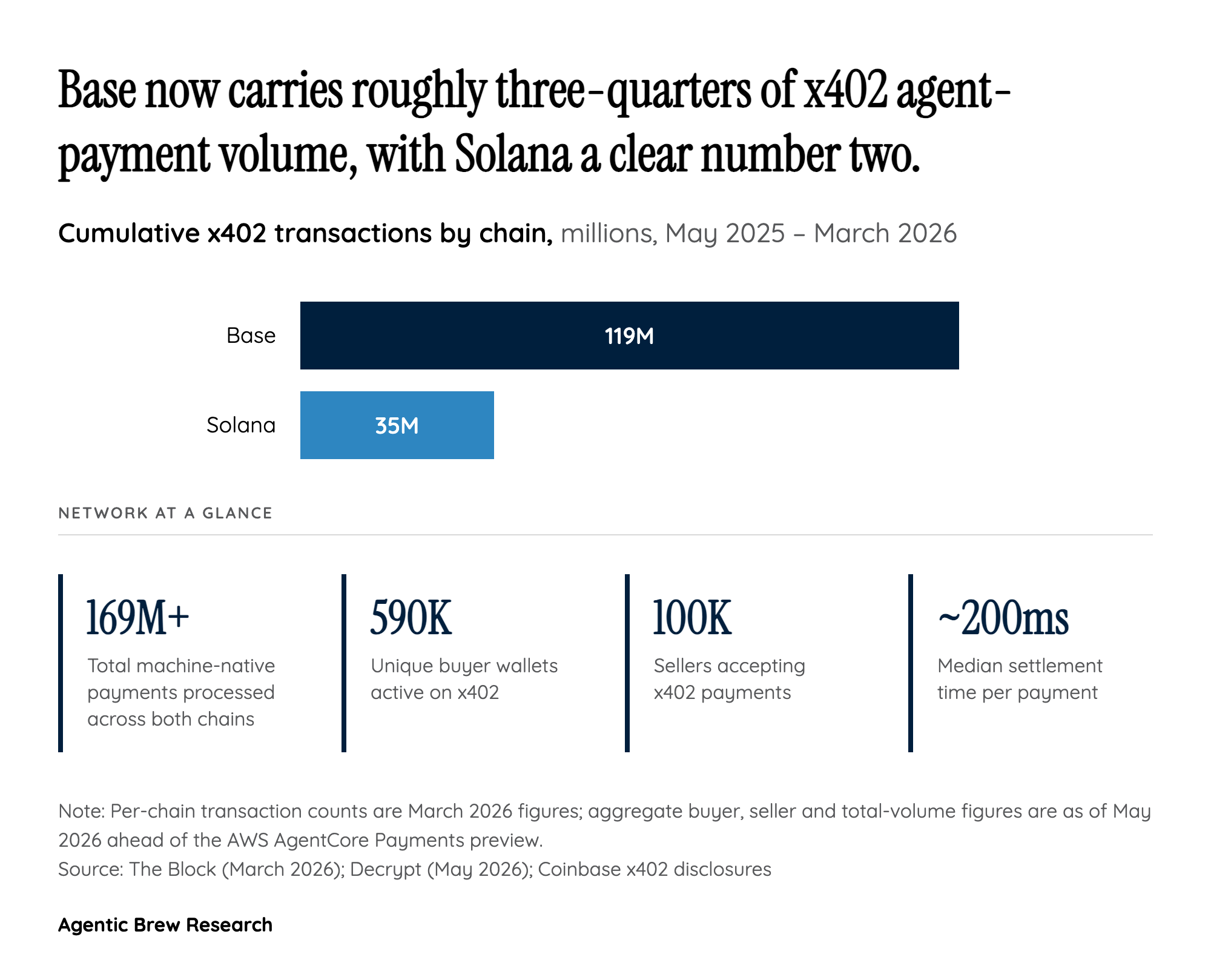
The Protocol War: x402, MPP, and AP2 Are Fighting to Be the TCP/IP of Agent Commerce
Cumulative x402 transactions by chain (May 2025 – March 2026), with network-wide buyer, seller and settlement metrics.

Three machine-native payment protocols launched into competition this spring, and which one wins will shape who collects rent on the agent economy for the next decade. Coinbase's x402 is the early volume leader: it revives the long-dormant HTTP 402 'Payment Required' status code, lets any API server demand a stablecoin payment as part of a normal HTTP exchange, and has processed over 169 million machine-native payments across 590,000 buyers and 100,000 sellers, with transactions settling in roughly 200 milliseconds. Stripe and Tempo's Machine Payments Protocol (MPP) takes a more enterprise-friendly route, integrating with traditional card networks and Stripe's existing merchant base. Google's Agent Payments Protocol (AP2) is positioning as the orchestration layer that can sit on top of either rail — and notably, Coinbase CEO Brian Armstrong has publicly framed x402 as 'powering the stablecoin rail inside Google's new Agentic Payments Protocol (AP2),' suggesting the two camps may end up complementary rather than zero-sum.

The deeper question is structural. Fenwick's analysis frames these protocols as the equivalent of TCP/IP for machine-to-machine commerce — once one becomes the default, every API provider, every agent framework, and every wallet has to speak it. AWS hedged its bet by building AgentCore Payments to be 'protocol- and framework-agnostic' (per Bedrock director Preethi CN), supporting both Coinbase CDP and Stripe Privy wallets in the same SDK. That neutrality is itself a tell: hyperscalers don't yet know which protocol wins, but they know they need to be the runtime that calls it.

What Actually Broke: Subscriptions and API Keys Cannot Price an Autonomous Agent

Strip away the press releases and the underlying engineering problem is sharp: the unit economics of agents do not fit the unit economics of subscription SaaS. A human developer might call an API a few hundred times a day under a flat $99/month plan. An autonomous agent doing recursive research, multi-step tool use, or per-task negotiation can fan out to thousands of calls in minutes — at sub-cent cost per call, in unpredictable bursts, often across APIs the agent itself discovers at runtime. There is no monthly plan that prices that correctly, and no billing department willing to onboard a customer that may not exist tomorrow.

Authentication breaks the same way. Traditional API keys assume a long-lived human owner who rotates credentials, gets invoiced, and is liable for misuse. Pay.sh's design eliminates that loop entirely: the agent's Solana wallet payment itself is the credential, replacing rotating keys with cryptographic settlement. AgentCore Payments adds session-level spending limits so an agent cannot drain a wallet on a runaway loop. And on the consumer-protection side, Coinbase's Brian Foster summarizes why enterprises are pushed into this design rather than pulled: 'Enterprises have been telling us the same thing: They want agents that can transact, but they can't get past legal and compliance review.' Stablecoins, programmable wallets and HTTP 402 are not chosen because they are elegant — they are chosen because subscription billing and shared API keys make compliance unsignable when the user is software.

The Regulatory Time Bomb: Reg E, Money Transmission, and Who Is Liable When an Agent Buys the Wrong Thing

Every announcement in this wave assumes a legal regime that does not yet exist. Fenwick's April 2026 analysis flags two unresolved questions sitting under all of these products: it is currently unclear whether a consumer who grants an AI agent access to their bank account or payment credentials has satisfied Regulation E's authorization requirements for electronic fund transfers, and money transmission is regulated state-by-state in the US — meaning an agent intermediating payments between two parties may itself be performing an unlicensed activity. Neither question has been tested in court or addressed by the CFPB.

MIT's Christian Catalini sets an even higher bar: 'Real agentic payments begin when the AI is the counterparty,' meaning atomic settlement against delivery, per-second streaming and KYC-less counterparties. Today's products mostly do not meet that definition — they treat the agent as a controlled extension of an authorized human or corporate principal. That is precisely why Anchorage's Agentic Banking exists. CEO Nathan McCauley is direct: 'You cannot give an AI system direct access to a corporate treasury.' Anchorage's product inserts a federally chartered, regulated trust layer between the agent and the money, enforcing Know Your Agent identity, corporate spending policy and real-time compliance before any settlement clears. The trillion-dollar opportunity McCauley describes is real, but it is also, in his own framing, the opportunity to be the regulated chokepoint between agents and capital — which is a different business than building rails. WEF coverage cited in the research projects that one in four enterprise breaches by 2028 could stem from AI-agent exploitation, which gives the chokepoint a defensible reason to exist.

The Builder Reality: Rails Are Not the Bottleneck — Authorization Is

The press releases describe finished systems. The builder communities tell a different story. Threads in agent-developer subreddits land on the same conclusion: rails work, transactions settle, but identity and authorization are unsolved. Wallet custody is openly debated — ERC-6551 token-bound accounts get proposed as a way to give each agent its own non-custodial wallet, but no consensus exists. A high-engagement proof-of-concept of an agent earning revenue from other agents via x402 drew enthusiastic comments tempered by replies pointing out the agent still needs a human to top up its wallet before it can transact at all.

The contrarian read across these threads is consistent: the headline products solve the rail (how does money move) but punt on the harder problem (which agent, on whose authority, with what spending mandate, accountable to whom). Stripe's MPP is seen as the practical enterprise answer because it inherits Stripe's existing merchant identity layer; x402 is seen as the crypto-native answer that still requires builders to roll their own authorization. Developer YouTube reinforces the same framing — Oracle's ERP demo is an agent picking ACH, EFT or virtual card based on invoice analysis, which is sophisticated but is still optimizing rails a human authorized. The honest summary is that the agentic-payment stack shipped this month is necessary, impressive and incomplete: the governance layer that decides what an agent is allowed to spend money on is being written in production, by builders, with the rails already live.

Historical Context

2025-05
Coinbase launches x402, reviving the long-reserved HTTP 402 'Payment Required' status code as an open payment standard for APIs and AI agents.
2026-04-22
Law firm Fenwick publishes 'Is 2026 the Year of Agentic Payments?' framing AP2, x402, MPP and MCP as the protocols defining the new commerce stack and flagging unresolved Regulation E and money-transmission questions.
2026-04-30
Stripe updates its Link digital wallet so autonomous AI agents can shop, pay for reservations and buy tickets under user-authorized approval flows.
2026-05-04
PYMNTS reports Visa, Mastercard and American Express readying network infrastructure for agentic commerce at scale, including Mastercard's 'verifiable intent' tokenization and AmEx's industry-first Agent Purchase Protection guarantee.
2026-05-05
Pay.sh goes live as an open-source API proxy bridging autonomous agents to Google Cloud and 50+ third-party APIs via stablecoin micropayments on Solana, with onboarding in roughly 60 seconds and no Google account required.
2026-05-06
Anchorage launches Agentic Banking, framed as the regulated custody and governance layer for AI-controlled capital with Know Your Agent identity and corporate spending policy enforcement.
2026-05-07
AWS launches Amazon Bedrock AgentCore Payments in preview, built on x402 with Coinbase CDP and Stripe Privy wallets, with Warner Bros. Discovery and Heurist AI named as early enterprise adopters.

Power Map

Key Players
Subject

Autonomous AI Agent Payments

GO

Google Cloud

Co-issuer of Pay.sh (fronts BigQuery, Gemini, Vertex AI, Cloud Run for accountless stablecoin payment) and strategic partner to Anchorage on Agentic Banking, supplying AI/MPC key management and the agent discovery and negotiation layer.

AW

AWS (Amazon Bedrock)

Launched AgentCore Payments preview, providing a managed agent runtime that connects to Coinbase CDP and Stripe Privy wallets with session-level spending limits, available in four regions including US East, US West, Frankfurt and Sydney.

CO

Coinbase

Author of the x402 HTTP-native payment protocol, provider of CDP wallet and facilitation infrastructure inside AgentCore, and co-governor of the x402 Foundation with Cloudflare.

ST

Stripe (with Privy)

Provides Privy wallet infrastructure as the second payment connection inside AgentCore and co-author of the Machine Payments Protocol (MPP) with Tempo; updated Stripe Link in April 2026 so AI agents can shop and pay under user-authorized approval flows.

AN

Anchorage Digital

Federally chartered crypto bank valued at $4.2B providing Agentic Banking as the regulated custody, governance and settlement layer that enforces corporate spending policies and Know Your Agent identity before institutional AI agents can settle in stablecoins or fiat.

SO

Solana Foundation

Co-issuer of Pay.sh providing the high-throughput Solana network for stablecoin settlement and the agent's wallet-as-identity model that replaces rotating API credentials.

Source Articles

Top 5

THE SIGNAL.

Analysts

"Frames agentic banking as a trillion-dollar opportunity built on agent-to-agent and agent-to-merchant payments, while warning that legacy financial systems were not built for non-human actors and that 'you cannot give an AI system direct access to a corporate treasury' without a regulated gateway."

Nathan McCauley
Co-Founder and CEO, Anchorage Digital

"Argues that agents will soon out-transact humans and need money that is programmable, always-on and global, and that enterprise demand for transacting agents already exists but consistently gets blocked at legal and compliance review — the bottleneck AgentCore Payments is designed to clear."

Brian Foster
Head of Infrastructure Growth and Strategy, Coinbase

"Sets a high technical bar for what counts as 'real' agentic payments — atomic settlement against delivery, per-second streaming, and KYC-less counterparties — implying that today's launches are only an early step, not a finished system."

Christian Catalini
MIT Professor

"Treats agentic commerce as additive rather than disruptive to Visa, framing AI agents as an expansion of the company's addressable market on top of its existing 300 billion annual transactions."

Ryan McInerney
CEO, Visa

"Predicts a structural realignment between hyperscalers and banks, with AI labs pushing deeper into regulated infrastructure while banks build intelligence on top of core systems — a sign that the Anchorage and Google Cloud partnership is a template, not an exception."

Oliver Segovia
Researcher, Ripple Labs
The Crowd

"x402 + @Google just unlocked a new level for AI agents. Agents can actually pay each other now, with x402 powering the stablecoin rail inside Google's new Agentic Payments Protocol (AP2). Really cool."

@@brian_armstrong0

"JUST IN: Coinbase announces AI agents can now pay for services on AWS with USDC through x402."

@@Polymarket0

"Solana Foundation and Google Cloud Launch AI Agent Payment Gateway. Solana Foundation announced a partnership with Google Cloud to launch a payment gateway for AI agents, enabling access to and payment for APIs via Solana wallets using stablecoins on a pay-per-call basis, without human authorization."

@@WuBlockchain0

"I built an AI agent that earns money from other AI agents while I sleep"

@u/LCRTE286
Broadcast
Stripe Enables AI AGENTS to Make Online Payments

Stripe Enables AI AGENTS to Make Online Payments

Payments AI Agent in Oracle Cloud ERP: Demo

Payments AI Agent in Oracle Cloud ERP: Demo

AI Agents Transforming Payments in 2026

AI Agents Transforming Payments in 2026