Google Launches AI Design Tool Stitch, Impacting Figma
TECH

Google Launches AI Design Tool Stitch, Impacting Figma

34+
Signals

Strategic Overview

  • 01.
    Google Labs unveiled a major redesign of Stitch on March 18, 2026, repositioning it as an AI-native 'vibe design' platform that enables UI design through natural language, images, or voice prompts within Google AI Studio.
  • 02.
    The launch triggered an approximately 12% drop in Figma stock over two days (8% followed by 4%), pushing shares to $24.86 as investors assessed the competitive threat from Google's free, integrated design-to-deployment pipeline.
  • 03.
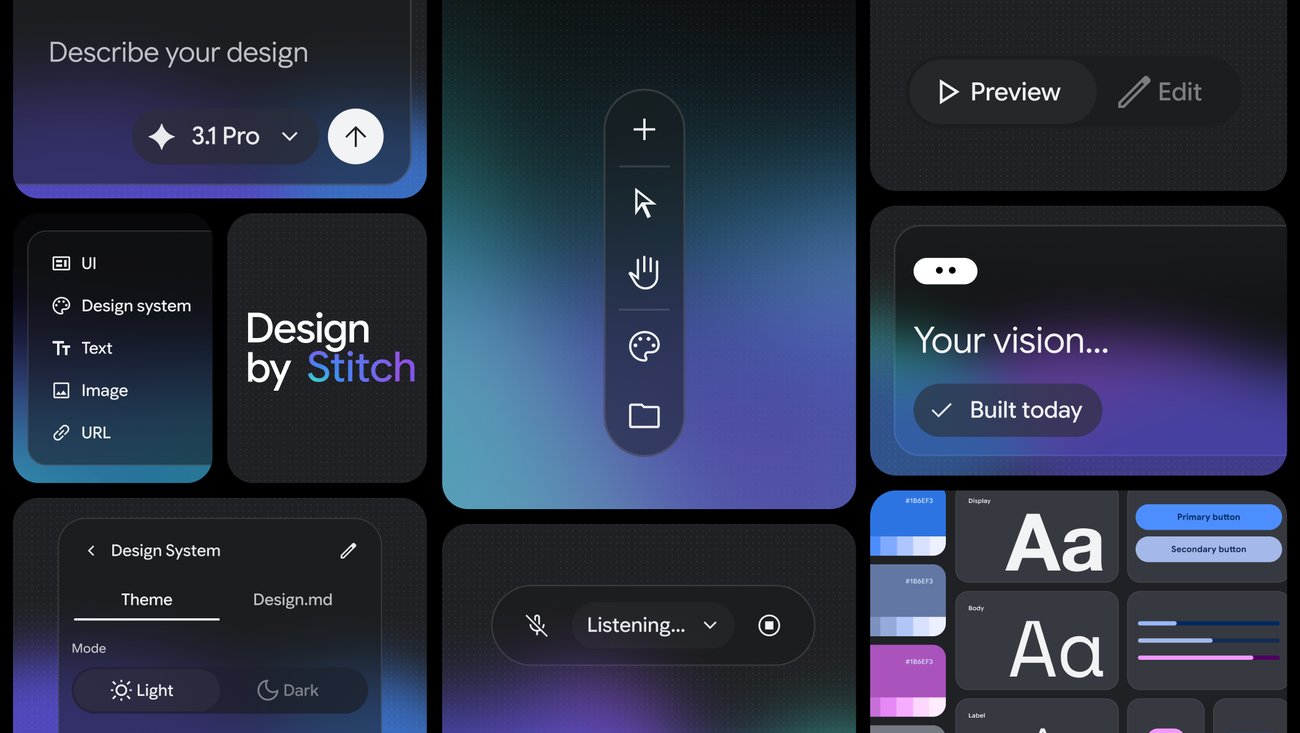
    Key new features include an AI-native infinite canvas, a design agent with project-wide reasoning, multi-screen generation of up to 5 screens simultaneously, Voice Canvas for voice-driven design, and DESIGN.md export for portable design systems.
  • 04.
    Alongside Stitch, Google launched full-stack vibe coding in AI Studio with the Antigravity coding agent and Firebase integration, plus an SDK and MCP server connecting Stitch with tools like Gemini CLI, Claude Code, and Cursor.

Why This Matters

Google's relaunch of Stitch represents more than an incremental product update — it signals a fundamental challenge to the established design tooling paradigm. For the past decade, the design industry has consolidated around tools like Figma and Adobe XD that digitized but largely preserved the manual workflow of wireframing, prototyping, and iterating on pixel-level decisions. Stitch introduces what Google calls 'vibe design,' where users describe business objectives and desired outcomes in natural language, images, or voice, and the AI handles the visual execution. This shifts the designer's role from craftsperson to creative director.

The market impact was immediate and severe. Figma's 12% stock decline over two days was not merely a reaction to a new competitor — it reflected investor anxiety about a structural shift in how design work gets done. Figma's per-seat SaaS pricing model depends on large teams of designers spending significant time in the tool. If AI can compress days of design exploration into minutes, the economic rationale for large design teams weakens, and with it, Figma's revenue model. The fact that Stitch offers 350 free generations per month further underscores the pricing pressure. Google is not trying to compete on Figma's terms; it is redefining the terms entirely.

How It Works

Stitch's redesigned architecture centers on an AI-native infinite canvas powered by Google's Gemini 2.5 Pro and Flash models. Users can generate UI designs through three input modalities: text prompts describing desired functionality or business objectives, reference images that the AI interprets and adapts, and voice commands via the new Voice Canvas feature. The design agent operates with project-wide reasoning, meaning it understands the context of the entire application rather than treating each screen in isolation, enabling coherent multi-screen generation of up to five screens simultaneously.

The technical integration layer is equally significant. Stitch exports design systems via DESIGN.md, a portable format that preserves design tokens, component relationships, and style guidelines. An SDK and MCP (Model Context Protocol) server connect Stitch with coding tools including Google's own Antigravity IDE, Gemini CLI, and third-party tools like Claude Code and Cursor. This creates a continuous pipeline from design intent to deployed application, with Firebase providing the backend infrastructure. The system supports Tailwind CSS output, aligning with modern frontend development conventions. Social media discussions highlighted that this integration story — design to code to deployment within a single ecosystem — is what distinguishes Stitch from standalone AI design experiments.

By The Numbers

By The Numbers
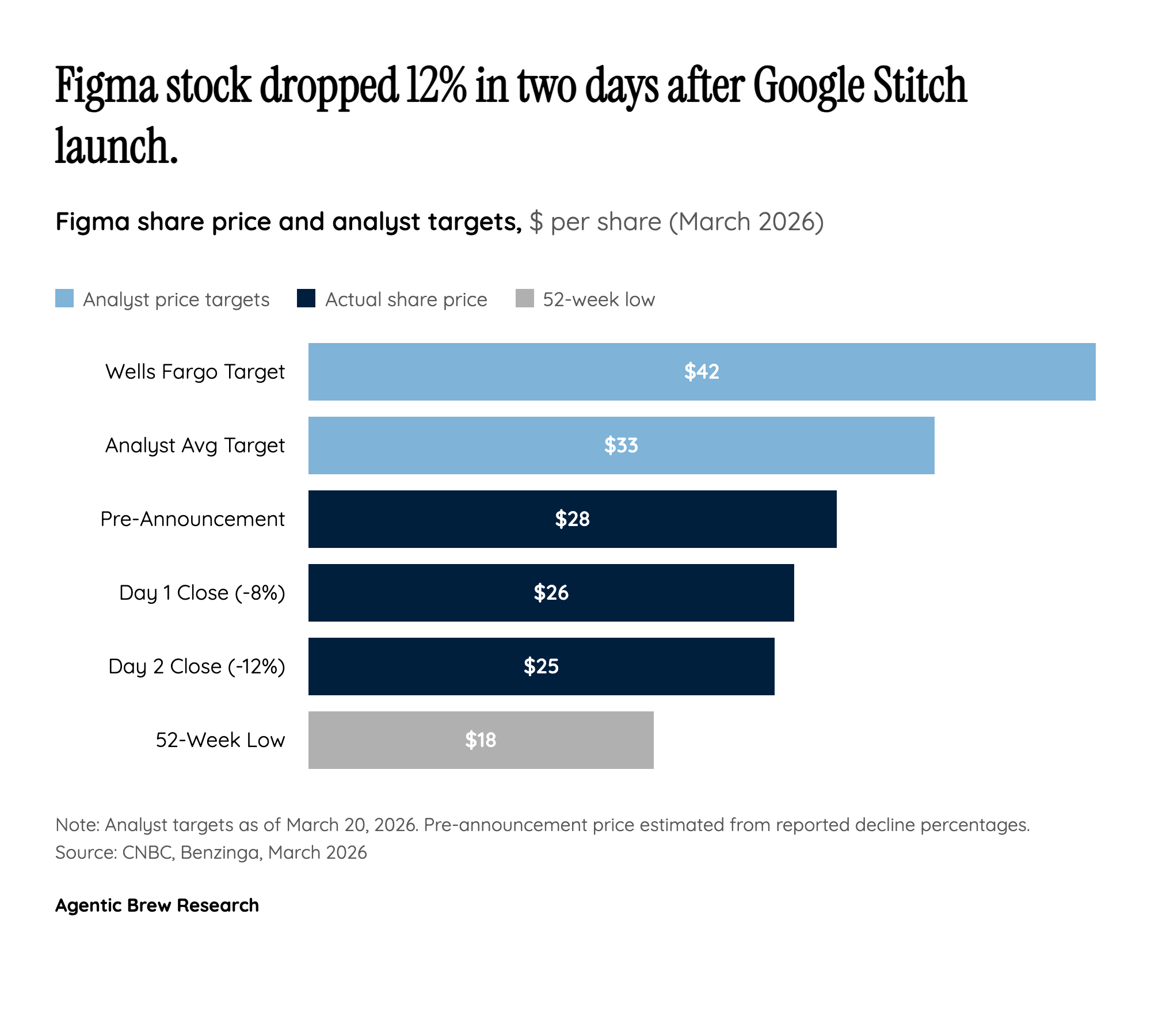
Figma share price declined 12% over two days while analyst targets suggest significant upside potential

The financial impact tells a stark story. Figma's stock fell approximately 12% over two days following the Stitch announcement — an 8% drop on the first day followed by a 4% decline the next. At $24.86 per share, Figma sits uncomfortably close to its 52-week low of $18.41 and has lost roughly 35% of its value year-to-date. Yet Wall Street analysts maintain a consensus Buy rating with an average price target of $33.40, with Wells Fargo's $42 target suggesting 69% upside from current levels. This divergence between market sentiment and analyst targets reflects deep uncertainty about how quickly AI design tools will erode Figma's competitive moat.

On the product side, Stitch's numbers reveal Google's aggressive positioning. The tool offers 350 free generations per month in standard mode — a significant allowance that makes it accessible for individual designers, startups, and prototyping workflows without any financial commitment. Multi-screen generation jumped from 1 to 5 simultaneous screens, dramatically accelerating the design of multi-page application flows. Google also noted that hundreds of thousands of apps have been built using AI Studio internally, suggesting substantial usage data informing Stitch's training and capabilities. On social media, the official Stitch launch post on X garnered 42,900 engagements (36K likes, 6.1K retweets), while Fireship's YouTube coverage reached 650,000 views — indicating massive community awareness.

Impacts & What's Next

The immediate competitive impact extends beyond Figma to the broader design ecosystem. Adobe faces secondary pressure as Google's move validates the AI-native approach to design tooling, potentially accelerating the obsolescence of traditional creative software workflows. For the design profession itself, the community response has been notably split. On Reddit's r/UXDesign, designers acknowledged Stitch's prototyping potential but flagged that outputs remain 'vanilla' and 'lifeless' — functional but lacking the craft and personality that distinguishes premium design work. Privacy concerns also surfaced, with Slashdot discussions dominated by skepticism about sharing business objectives and design goals with Google's AI systems.

Looking ahead, the critical question is whether vibe design tools can evolve beyond rapid prototyping into production-quality design. The Muzli Blog's framing is instructive: AI is absorbing the low-value exploration phase, but judgment, taste, and strategic design thinking remain human domains. Figma's path forward likely involves deepening its own AI capabilities while emphasizing collaborative design workflows and enterprise features that Stitch does not yet address. Google's strategy appears focused on ecosystem lock-in — connecting Stitch to Antigravity, Firebase, and Gemini creates a compelling full-stack pipeline where design is just the entry point to a broader developer platform. The MCP server integration with third-party coding tools suggests Google is also pursuing an open-ecosystem strategy to avoid the perception of vendor lock-in.

The Bigger Picture

Stitch's emergence fits within a broader pattern of AI collapsing traditional creative and technical workflows. Just as GitHub Copilot transformed coding from writing every line to guiding AI-generated suggestions, and just as AI image generators disrupted stock photography and illustration, vibe design represents the same compression applied to interface design. The common thread is that AI excels at generating competent baseline work at extraordinary speed, while human value migrates toward curation, judgment, and strategic decision-making. Google's explicit framing — shifting from wireframes to business objectives — makes this transition unusually legible.

The competitive dynamics also reflect a deeper strategic reality about AI platform economics. Google can offer Stitch for free because its value lies not in the design tool itself but in driving adoption of the Google AI Studio ecosystem, Firebase deployments, and Gemini API usage. This 'loss leader' approach to design tooling is structurally different from Figma's business, which must monetize the design tool directly. As AI capabilities improve and the quality gap between AI-generated and human-crafted designs narrows, pricing power will increasingly matter. The design tooling market may be entering a phase similar to what happened in web browsers — where a once-profitable software category became a free gateway to broader platform engagement. For designers, the imperative is clear: the profession's value proposition is shifting from execution skill to design strategy, and professionals who adapt to directing AI rather than competing with it will be best positioned.

Historical Context

2025-05-20
Google launched the original Stitch at I/O 2025 as a tool for generating HTML/CSS from text and image prompts, establishing its initial foothold in AI-assisted design.
2025-11-01
Google launched the Antigravity IDE alongside Gemini 3, building the coding infrastructure that would later integrate with Stitch for full-stack vibe coding.
2026-03-18
Google unveiled the complete Stitch redesign as an AI-native vibe design platform alongside full-stack vibe coding capabilities in AI Studio, with SDK and MCP server integrations connecting to third-party tools.
2026-03-19
Figma stock dropped approximately 12% over two trading days as investors reacted to Google's competitive entry into AI-powered design tooling, pushing shares to $24.86 and extending the YTD decline to roughly 35%.

Power Map

Key Players
Subject

Google Launches AI Design Tool Stitch, Impacting Figma

GO

Google Labs

Developer and operator of Stitch, leveraging Gemini models, Firebase, and AI Studio to offer a free integrated design-to-deployment pipeline with 350 monthly generations

FI

Figma

Primary competitive target whose stock dropped approximately 12% over two days and is down 35% year-to-date, facing existential questions about AI-native competition against its per-seat SaaS model

AD

Adobe

Secondary competitor facing additional pressure in the design tooling market as Google's AI-native approach challenges traditional creative software paradigms

JO

Josh Woodward

VP of Google Labs, leading the Stitch development effort and positioning it as a paradigm shift from traditional wireframing to AI-driven design

UI

UI/UX Design Community

End users and professionals whose workflows face disruption; sentiment ranges from excitement about prototyping speed to skepticism about output quality and professional relevance

THE SIGNAL.

Analysts

"Emphasized Stitch's speed and interactivity: 'Stitch screens together in seconds and simply click Play to quickly preview your interactive app flow,' positioning it as a tool that collapses the traditional design-to-prototype pipeline into near-instantaneous iteration."

Josh Woodward
VP, Google Labs

"Described the paradigm shift as completing work 'in minutes rather than days,' arguing that the fundamental workflow changes from wireframing and pixel-pushing to describing business objectives and letting AI handle the visual execution."

Rustin Banks
Product Manager, Google Labs

"Called it 'a meaningful departure from how every major design tool has worked for the last 20 years,' arguing that 'AI is absorbing the low-value exploration phase' and what remains is 'the judgment to know which direction is right, the taste to sense when something's off.'"

Muzli Blog (Design Industry Analysis)
Design Industry Publication

"Despite the stock drop, analysts maintained a consensus Buy rating on Figma with an average price target of $33.40 — representing significant upside from the $24.86 trading price. Wells Fargo set the highest target at $42, suggesting the market overreacted to the competitive threat."

Wall Street Analyst Consensus
Financial Analysts (Wells Fargo, RBC, Stifel)

"Framed the Stitch update as a genuine game-changer rather than hype, highlighting the shift from manual design tooling to AI-native workflows and the competitive implications for incumbent design platforms."

Fireship (YouTube Creator)
Developer Education, 650K views on Stitch coverage
The Crowd

"Meet the new Stitch, your vibe design partner. Here are 5 major upgrades to help you create, iterate and collaborate: AI-Native Canvas, Smarter Design Agent, Voice, Instant Prototypes, Design Systems and DESIGN.md. Rolling out now."

@@stitchbygoogle36000

"Do you understand what Google just did to Figma? Stitch now generates UI designs from voice, builds prototypes on click, exports your entire design system as a DESIGN.md file. Figma stock dropped the moment the announcement landed."

@@Motion_Viz5400

"Google disrupting Figma is unexpected"

@@scottastevenson5500

"Transform Ideas into UI Designs with Stitch"

@u/unknown450
Broadcast
Google just changed the future of UI/UX design...

Google just changed the future of UI/UX design...

Google NEW AI Vibe Design Tool IS INSANE! The Greatest AI Design System I Have Ever Used! (Stitch)

Google NEW AI Vibe Design Tool IS INSANE! The Greatest AI Design System I Have Ever Used! (Stitch)

The New Google Stitch - Are Designers Finished?

The New Google Stitch - Are Designers Finished?