Garry Tan GBrain Open-Source Personal AI Agent Platform
TECH

Garry Tan GBrain Open-Source Personal AI Agent Platform

42+
Signals

Strategic Overview

  • 01.
    GBrain is an open-source personal AI knowledge management system created by Garry Tan, CEO of Y Combinator, released on April 9, 2026 under the MIT license. Unlike most AI productivity tools, GBrain is Tan's actual daily-use setup — not a cleaned-up demo — comprising 10,000+ Markdown files, 3,000+ people pages, 280+ meeting transcripts, 300+ captured original ideas, 13 years of calendar data, 40+ skills, and 20+ continuous cron jobs.
  • 02.
    GBrain is designed as persistent, searchable long-term memory for AI agents — specifically built for OpenClaw and Hermes Agents. It uses a three-layer architecture: a Git-based Brain Repo (Markdown files as the human-readable source of truth), GBrain Retrieval (Postgres + pgvector with hybrid search), and an AI Agent Skills layer. The default database is PGLite — an embedded Postgres 17.5 instance running via WASM — requiring no Docker or Supabase to start.
  • 03.
    Within roughly 24 hours of its April 9 release, GBrain amassed 4,800+ GitHub stars and 541 forks across 47 commits. The project exposes 37 CLI operations and 30 MCP (Model Context Protocol) tools via stdio. On April 10, v0.8.0 was released, adding a Voice WebRTC endpoint with automated Twilio number installation for voice interaction with agents.
  • 04.
    GBrain is derived from MemPalace, reimplemented natively for OpenClaw/Hermes Agents. Integration recipes cover email (Gmail), calendar (Google Calendar), voice (Twilio + OpenAI Realtime), X/Twitter, and meeting transcripts via Circleback. Full MCP support with Supabase Auth is announced as coming soon.

A Personal Brain Made Public: The Credibility of Real-World Scale

The most unusual thing about GBrain's launch is not what it does but what it proves. Tan did not build a demo system or a cleaned-up version of a personal workflow — he shipped the actual infrastructure he uses to manage 13 years of his own life and career. The 14,700+ brain files, 3,000+ people pages, 280+ meeting transcripts, and 300+ original idea captures are not synthetic benchmarks; they are the byproduct of a decade-plus of operating at the intersection of technology and venture capital. This matters because it bypasses the most common failure mode of personal knowledge management tools: they are designed by people who do not heavily use them.

The community recognized the distinction immediately. Within 48 hours of launch, three independent YouTube explainer channels had published breakdowns of GBrain: Prism Labs (140 views), TechWealth Hub (26 views), and AwesomeFOSS (20 views). Prism Labs contextualized Tan's engineering background — Palantir engineer #10, Posterous co-founder — as evidence that GBrain reflects deep systems-thinking discipline, not a weekend project. AwesomeFOSS emphasized that the 13-year personal knowledge system and autonomous agent architecture represent something qualitatively different from typical PKM tools: the AI agent itself functions as the knowledge base maintainer, with entity detection that auto-links nodes across the graph as new information is ingested. This is the brain-agent loop — the system enriches itself.

The GitHub reception reinforced this reading: 4,800+ stars and 541 forks within 24 hours placed GBrain in the same launch-day tier as GStack (which reached 23,000+ stars in its first week). The critical difference is that GStack was a framework; GBrain is a lived artifact. Tan's framing — "I'm open sourcing it MIT license so we can all speed up and have our own personal mini-AGI" — is both a product pitch and a credibility signal. The memex vision, long considered speculative, is here instantiated with timestamps and schema.
Architecture: Designed to Run Anywhere, On Purpose

GBrain's architecture contains a deliberate philosophical choice at every layer. The Brain Repo is plain Markdown tracked in Git — not a proprietary database, not a vendor-specific format. This means a human can always read and edit it directly, the entire knowledge base is diff-able and version-controlled, and any AI agent that can read files can consume it. The retrieval layer uses Postgres with pgvector for hybrid search (combining dense vector similarity with BM25 keyword scoring), but the default installation runs on PGLite — an embedded Postgres 17.5 instance compiled to WASM that ships inside the Node.js process. No Docker. No external services. Setup takes approximately 30 minutes; importing 7,000 files takes roughly 30 seconds; vectorizing 1,000 pages takes approximately one minute.

TechWealth Hub's analysis highlighted this as GBrain's most strategically significant characteristic: it "fits the local-first coding-agent stack" precisely because there is no remote dependency in the default configuration. The verification runbook included in the repository — which walks through schema validation, retrieval accuracy checks, and benchmark reproduction — is what distinguishes GBrain from vaporware. Most personal AI projects ship a README and a demo video. GBrain ships a runbook. When a developer runs the verification suite, they are testing the same system Tan uses, against the same performance expectations Tan documented.

The 30 MCP tools exposed via stdio represent the integration surface. Email, calendar, voice, X/Twitter, and meeting transcript sync are delivered as Markdown recipes — human-readable instructions that the agent can execute. The "dream cycle" enrichment loop (surfaced in Prism Labs' video analysis) runs as one of the 20+ cron jobs: periodically, the agent wakes, traverses recent additions to the knowledge graph, and enriches entity nodes by pulling in related context from other files. This is not retrieval-augmented generation in the conventional sense; it is the agent acting as an asynchronous librarian, continuously compiling a more accurate picture of the world from the raw data the human captures. The result is what Tan calls "compiled truth" — a knowledge base that becomes more accurate over time without requiring manual curation.

The Benchmark Controversy and Honest Limits

GBrain's relationship to MemPalace — the upstream project it was derived from — introduces a live controversy. Tan cited MemPalace's 100% score on the LongMemEval benchmark as evidence of retrieval quality. LongMemEval is a standardized benchmark measuring whether a memory system can accurately answer questions about long conversational histories. A 100% score would be genuinely remarkable. Hacker News commenter darkhanakh pushed back directly: "the 100% LongMemEval score is a bit misleading if you actually look at what's going on...honest top-10 no rerank gets you 88.9%." The implication is that the benchmark result reflects a specific retrieval configuration — likely with reranking enabled and a large candidate set — that may not match real-world latency and cost constraints.

This is a legitimate technical concern. Hybrid search with reranking is more accurate but slower and more expensive than a simple top-k vector lookup. At GBrain's documented scale (14,700+ files, approximately 1 minute per 1,000 pages for vectorization), reranking across large candidate sets could meaningfully affect the responsiveness of agent interactions. The production Supabase path ($25/month) likely handles this differently than the local PGLite default.

The YouTube community reception, notably, did not dwell on this controversy — all three video analyses treated GBrain as a credible, functional system worth covering in depth, suggesting that for the practical developer audience, the benchmark dispute is secondary to the question of whether the system works in practice. The 4,800+ GitHub stars and the verification runbook give independent validators a path to test that claim themselves. The honest framing is that 88.9% accurate recall on a long-memory benchmark, achieved with a system that runs locally on a laptop in 30 minutes, is still a strong result — one that most competing approaches, including vendor-hosted solutions, cannot match on the cost-and-control dimension. The controversy does not undermine GBrain; it clarifies what "100%" means in context.

Historical Context

2026-03-14
Garry Tan released gstack, a Claude Code AI agent framework, as the foundational layer that GBrain would later be built upon.
2026-03-18
GStack reached 23,000+ GitHub stars within one week of release, establishing Tan's credibility as an open-source AI tooling author and priming the audience for GBrain.
2026-04-09
Garry Tan open-sourced GBrain under the MIT license; on the same day he discussed GBrain and GStack with Salesforce CEO Marc Benioff on the Big Island, Hawaii.
2026-04-10
GBrain v0.8.0 launched with a Voice WebRTC endpoint and automated Twilio number installation, enabling real-time voice interaction with OpenClaw/Hermes agents.

Power Map

Key Players
Subject

Garry Tan GBrain Open-Source Personal AI Agent Platform

GA

Garry Tan

Creator of GBrain; CEO of Y Combinator; his personal endorsement and real-world usage data give the project immediate credibility in the startup and developer communities.

Y

Y Combinator

Institutional backdrop amplifying GBrain's reach; YC's network of founders and developers represents a natural early-adopter base.

SU

Supabase

Key infrastructure partner providing the production-tier database backend ($25/month); deeper MCP + Auth integration announced as forthcoming.

MA

Marc Benioff (Salesforce CEO)

Discussed GBrain and the broader GStack with Tan on April 9, 2026, signaling enterprise-level interest in the platform.

OP

OpenClaw / Hermes Agent community

Primary intended user base; GBrain is built as the native memory and skills layer for these AI agent frameworks.

AN

Anthropic / OpenAI / Google

Incumbent providers whose proprietary AI systems GBrain positions itself against by democratizing persistent agent memory and skills.

ME

MemPalace creator

Inspired GBrain; MemPalace is the predecessor project from which GBrain's architecture was derived and extended for agent-native use.

THE SIGNAL.

Analysts

""GBrain is useful for anyone who has more people or projects or ideas than can fit in a normal human brain. And the thing with OpenClaw is that now those ideas can have electric hands." Tan frames GBrain as the realization of the "memex vision" — a self-building knowledge system with entity detection, enrichment, and compiled truth."

Garry Tan
Creator, GBrain; CEO, Y Combinator

"Described GStack (GBrain's parent framework) as encoding "the method, workflow, scope, and mindset of a specific person who has reviewed thousands of startups over many years" — framing it less as a developer tool and more as an externalized cognitive system."

Luong NGUYEN
Technology analyst, Medium

"GBrain challenges incumbent AI providers (Anthropic, OpenAI, Google) by democratizing agent capabilities through persistent, searchable memory that allows agents to enrich their knowledge autonomously. Flagged scalability concerns for enterprise-scale deployments."

Surf AI
AI industry analysis platform

"Challenged the claimed 100% LongMemEval benchmark score for MemPalace (the upstream project): "the 100% LongMemEval score is a bit misleading...honest top-10 no rerank gets you 88.9%" — raising questions about how retrieval performance is measured and reported."

darkhanakh (Hacker News)
Community critic

""We love what @garrytan built with GBrain! Have been testing it for the last few hours. Great work here…" — among the first notable external validators of the project."

Brian Roemmele
Technology researcher and commentator
The Crowd

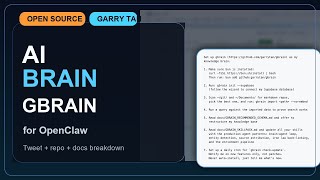
"I'm open sourcing it MIT license so we can all speed up and have our own personal mini-AGI. It's been amazing for me and I want you to have it. To install GBrain in your OpenClaw, just paste this image to your OpenClaw or paste this text: Set up gbrain"

@@garrytan0

"Hats off to anyone releasing open source and showing what they do. GBrain is my actual setup, and now anyone can have it. Full MCP support with Supabase Auth coming soon."

@@garrytan0

"We love what @garrytan built with GBrain! Have been testing it for the last few hours. Great work here…"

@@BrianRoemmele0
Broadcast
GBrain: The Y Combinator CEO Built His Own AI Knowledge Brain

GBrain: The Y Combinator CEO Built His Own AI Knowledge Brain

Garry Tan's GBrain Explained, The Open Source AI Memory System

Garry Tan's GBrain Explained, The Open Source AI Memory System

GBrain: The YC CEO Open-Sourced His Brain — 10,000 Files, 3,000 Dossiers

GBrain: The YC CEO Open-Sourced His Brain — 10,000 Files, 3,000 Dossiers