SpaceX's $60B option to acquire Cursor and Colossus compute partnership
TECH

SpaceX's $60B option to acquire Cursor and Colossus compute partnership

37+
Signals

Strategic Overview

  • 01.
    SpaceX has secured an option to acquire AI coding startup Cursor (parent: Anysphere) for $60 billion later in 2026, or alternatively pay $10 billion for the ongoing collaboration work.
  • 02.
    Cursor will train its Composer coding model on xAI's Colossus supercomputer, which SpaceX describes as having compute power equivalent to roughly one million Nvidia H100 chips.
  • 03.
    SpaceX preempted Cursor's nearly finalized $2 billion fundraise at a ~$50B valuation (with Andreessen Horowitz, Thrive, Nvidia, and Battery Ventures) with a competing offer just hours before the round was set to close.
  • 04.
    The potential acquisition is timed to close after SpaceX's summer 2026 IPO, partly to avoid restating confidential financial filings and to use newly public stock as acquisition currency.

Deep Analysis

The $10B Floor: A New Kind of Venture Mechanic
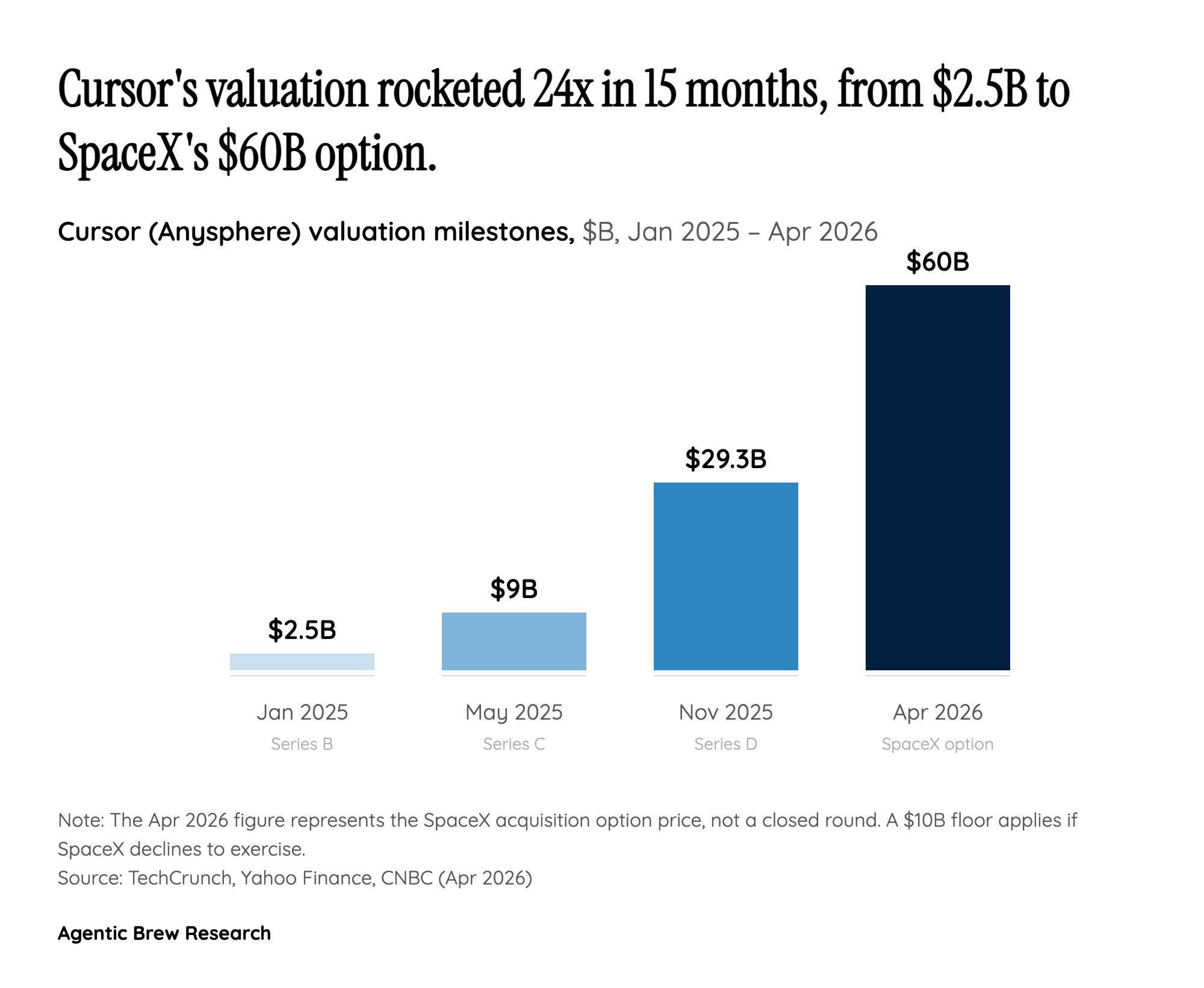
The $10B Floor: A New Kind of Venture Mechanic
Cursor's valuation milestones — Jan 2025 to SpaceX's $60B option in Apr 2026.

The most unusual part of this announcement isn't the $60 billion headline — it's the $10 billion floor underneath it. SpaceX didn't offer to buy Cursor outright. It bought an option to buy Cursor later in 2026, while promising that if it walks away, it still pays Cursor $10 billion for the collaboration work done in the meantime. In practice, that means Cursor's downside is no longer 'round gets pulled.' Its downside is 'we get ten billion dollars and keep the company.' SpaceX intervened with this structure, according to TechCrunch, hours before Cursor was set to close a $2 billion fundraise at a roughly $50 billion valuation with Andreessen Horowitz, Thrive, Nvidia and Battery Ventures. An existing $50B round priced in that risk; an option with a $10B floor essentially replaces the round.

The timing is the second half of the trick. The Information reports SpaceX deliberately pushed the deal past its planned summer 2026 IPO — so it doesn't have to restate confidential financial filings before going public, and so it can finance a $60B purchase in newly listed stock rather than cash. That turns what looks like an acquisition into a call option on Cursor that SpaceX can exercise using public-market currency it doesn't yet have. Patronus AI's Anand Kannappan captured the asymmetry: 'Either outcome, Grok ends up stronger than it would have been' — the collaboration feeds xAI's training regardless, which means the $10B breakup fee isn't really a breakup fee. It's prepayment for a training partnership SpaceX wants anyway.

Musk's Vertical Stack, Assembled Before the IPO Bell

Theory Ventures' Tomasz Tunguz reduces the strategic logic to one line: 'Winning in agentic coding requires three layers: compute, models, & distribution.' This deal gives SpaceX all three under one roof for the first time. Compute comes from Colossus — the Memphis supercluster SpaceX says is equivalent to about one million Nvidia H100s, with roughly 555,000 GPUs already installed as of February 2026. Models come from xAI's Grok plus whatever Cursor's Composer team produces using the same infrastructure. Distribution comes from Cursor itself, which InfoWorld notes is already deployed across more than half the Fortune 500, including Nvidia, Salesforce and Uber.

This isn't happening in a vacuum — it's happening right before SpaceX's summer 2026 IPO. The February 2026 all-stock merger with xAI already put the combined entity at roughly $1.25 trillion in private valuation. Bolting a working AI coding product onto that narrative changes the story institutional investors get in the roadshow from 'launch company plus a satellite network plus a chatbot' to 'vertically integrated AI conglomerate with its own training cluster, frontier model, and a deployed developer tool generating real revenue.' Cursor's reported $2 billion ARR by February 2026 — projected by TechFundingNews to hit roughly $6B by year-end — is the kind of recurring-revenue anchor that public investors pay multiples on. The option structure is, in that light, a way to pre-wire the IPO pitch without disturbing the S-1.

Who Actually Pays: Enterprises, Rivals, and the Zero-Data-Retention Problem

Cursor's Fortune 500 footprint rests on a specific set of promises that a SpaceX acquisition would put in play. IDC's Deepika Giri flagged the core risk: Cursor's zero-data-retention agreements with OpenAI and Anthropic — the contracts that let regulated enterprises use Cursor at all — 'could be challenged under the new SpaceX ownership.' If those agreements lapse, every CIO who signed off on Cursor has to re-evaluate under a new vendor identity, and likely add change-of-control clauses with 90-to-180-day notice provisions to any renewal. That is a procurement headache measured in quarters, not days.

Gartner's Nitish Tyagi surfaces a second-order concern that applies regardless of the acquisition outcome: 'Cursor's Composer model relies on Chinese base model Kimi 2.5, raising governance concerns for restricted organizations.' Combine the two and the buyer profile that gets most nervous is precisely the buyer profile Cursor has been winning — defense-adjacent, financial-services, and export-controlled enterprises who care about the provenance of model weights and the legal identity of their vendor. Meanwhile, Anthropic and OpenAI, who until now were simultaneously Cursor's upstream model suppliers and its direct competitors (via Claude Code and Codex), lose a distribution channel if SpaceX pushes Grok and Composer as defaults. The deal therefore reshuffles the enterprise AI-coding market in two directions at once: it consolidates one vendor's stack, and it forces every risk-averse enterprise to re-underwrite that vendor.

The Contrarian Read: Is $60B a Bargain or a Tombstone?

Not everyone thinks Musk is buying a winner. Eniac Ventures' Hadley Harris offered the sharpest contrarian line: 'Every frontier dev I know has moved off Cursor and off IDEs entirely.' The argument underneath that quip is that agentic coding is moving away from the 'developer plus AI assistant in an IDE' pattern toward autonomous agents that execute tasks end-to-end — a substitution where Cursor's VS Code fork is not the endgame but the last stop before one. Aadit Sheth of The Narrative Company sharpened the same worry: 'Distribution without a defensible model underneath is a rental.' Cursor's historical moat has been product velocity on top of other people's models; if OpenAI's Codex or Anthropic's Claude Code close the product gap at the same time Composer's training plateaus, the $60B number starts to look like paying for an installed base mid-decay.

The bull case answers this with the other half of the chessboard. Cursor shipped Composer less than six months before the announcement; Composer 1.5 scaled reinforcement learning by more than 20x, and Composer 2 added continued pretraining at what Cursor says is 'frontier-level performance at a fraction of the cost of other models.' Plug that training recipe into Colossus — a training cluster most competitors can't access at any price — and the story shifts from 'distribution renter' toward 'distribution plus a proprietary model trained on the largest cluster on earth.' Community reaction on X and creator YouTube skewed bullish on the deal mechanics, with several voices framing it as the opening move in a broader compression of coding startups into compute-owning parents — Helium Ventures' Rohit Mittal called it, flatly, 'The Hunger Games have just begun.' A more cautious thread, led by capital-markets framings on business TV, focused less on the product than on what the $10B floor implies about SpaceX's conviction: it's big enough to keep Cursor alive and motivated, small enough that Musk can walk if Composer plateaus. FE International's Thomas Smale gave the cleanest summary of the binary: 'That answer will determine whether $60 billion looks like a bargain or a cautionary tale.'

Historical Context

2022-04
Founded by MIT students Michael Truell, Sualeh Asif, Arvid Lunnemark and Aman Sanger on a $400K pre-seed round.
2023-03
Anysphere launched Cursor, an AI-powered IDE built on VS Code.
2023-10
Raised an $8 million seed round led by the OpenAI Startup Fund, with angels including Nat Friedman and Arash Ferdowsi.
2024-07
Colossus supercomputer came online in Memphis, Tennessee, becoming one of the world's largest AI training clusters.
2025-11
Raised a $2.3B Series D at a $29.3B valuation, led by Thrive Capital, Andreessen Horowitz and Accel.
2026-02-02
SpaceX acquired xAI in an all-stock merger valuing the combined entity at roughly $1.25 trillion — the largest private merger on record.
2026-02-15
Memphis complex housed approximately 555,000 Nvidia GPUs (H100, H200, GB200) with plans to expand to one million.
2026-04-21
SpaceX and Cursor announced their partnership and disclosed the $60B acquisition option and $10B collaboration floor.

Power Map

Key Players
Subject

SpaceX's $60B option to acquire Cursor and Colossus compute partnership

SP

SpaceX

Acquirer holding the $60B option; parent of xAI following the February 2026 all-stock merger; provides Colossus compute and gains a vertical AI coding stack ahead of its planned IPO.

CU

Cursor (Anysphere)

AI coding startup whose Composer model was explicitly compute-constrained; now gains Colossus access, a guaranteed $10B floor, and a path to a $60B exit less than six months after its last round.

XA

xAI / Colossus

Wholly owned SpaceX subsidiary since February 2026; supplier of the ~555,000-GPU Memphis supercluster powering Cursor's training, and a direct beneficiary because Grok can run the same training recipe.

EL

Elon Musk

CEO of SpaceX orchestrating the consolidation of compute, models, coding tools, satellites and social media into a single conglomerate.

AN

Andreessen Horowitz, Thrive Capital, Accel

Existing Cursor investors positioned for a major windfall if the $60B deal closes; Thrive and a16z co-led Cursor's prior $29.3B Series D just months earlier.

AN

Anthropic and OpenAI

Rival foundation-model providers (Claude Code, Codex) whose zero-data-retention deals with Cursor could be challenged or voided under SpaceX ownership, creating enterprise contractual risk.

THE SIGNAL.

Analysts

"Argues agentic coding requires three layers — compute, models, and distribution — and this deal lets Musk own all of them. "Winning in agentic coding requires three layers: compute, models, & distribution.""

Tomasz Tunguz
Founder and General Partner, Theory Ventures

"Skeptical of the deal's premise, arguing the target audience has shifted away from Cursor-style tools: "Every frontier dev I know has moved off Cursor and off IDEs entirely.""

Hadley Harris
Cofounder, Eniac Ventures

"Calls the deal a strategic win-win because "xAI has been behind on coding products for years now" while Cursor lacked its own frontier model."

Alex Finn
Investor and AI commentator

"Frames the deal as a hedged bet where xAI benefits regardless of whether the option is exercised: "Either outcome, Grok ends up stronger than it would have been.""

Anand Kannappan
Cofounder, Patronus AI

"Flags enterprise contractual risk: Cursor's zero-data-retention agreements with OpenAI and Anthropic "could be challenged under the new SpaceX ownership.""

Deepika Giri
Analyst, IDC

"Raises governance concerns that "Cursor's Composer model relies on Chinese base model Kimi 2.5, raising governance concerns for restricted organizations" — a risk that persists regardless of the acquisition outcome."

Nitish Tyagi
Analyst, Gartner

"Warns the deal's premise is fragile: "Distribution without a defensible model underneath is a rental.""

Aadit Sheth
Cofounder, The Narrative Company
The Crowd

"SpaceXAI and @cursor_ai are now working closely together to create the world's best coding and knowledge work AI. The combination of Cursor's leading product and distribution to expert software engineers with SpaceX's million H100 equivalent Colossus training supercomputer will..."

@@SpaceX0

"SpaceX gets the option to fully acquire Cursor later in 2026 for $60 billion. Or they can just pay $10 billion for the value of the joint work they've done together. What does Cursor have that is so valuable to SpaceXAI?"

@@martinvars0

"Wow. SpaceX/xAI to potentially buy Cursor this year for 60 billion $ This makes SO much sense xAI has been behind on coding products for years now Cursor has a great coding product, but will fail unless they build their own model xAI gets an incredible coding product. Cursor..."

@@AlexFinn0
Broadcast
SpaceX inks Cursor deal ahead of IPO: Here's what to know

SpaceX inks Cursor deal ahead of IPO: Here's what to know

The Real Story Behind the SpaceX-Cursor Deal

The Real Story Behind the SpaceX-Cursor Deal

Elon Just Made A $10 Billion Bet On Cursor

Elon Just Made A $10 Billion Bet On Cursor