Anthropic's Mythos AI cybersecurity model: restricted release, unauthorized Discord breach, and Microsoft/federal adoption
TECH

Anthropic's Mythos AI cybersecurity model: restricted release, unauthorized Discord breach, and Microsoft/federal adoption

57+
Signals

Strategic Overview

  • 01.
    Anthropic unveiled Claude Mythos Preview on April 7, 2026, a frontier model so capable at offensive cybersecurity that the company refused to ship it publicly, instead launching the restricted 'Project Glasswing' coalition with 12 launch partners and over 40 critical-infrastructure organizations.
  • 02.
    In internal testing Mythos surfaced thousands of zero-days across every major operating system and browser, including a 27-year-old OpenBSD bug, a 17-year-old FreeBSD RCE, and a 16-year-old FFmpeg flaw; it built working exploits 181 times in a single benchmark, crushing Opus 4.6.
  • 03.
    Despite the restricted rollout, a private Discord group reportedly gained access on launch day by guessing Anthropic's endpoint URL patterns, aided by data from the earlier Mercor breach and third-party vendor contractor credentials; Anthropic is investigating the compromise.
  • 04.
    Microsoft committed to embedding Mythos into its Security Development Lifecycle across Windows, Azure, Microsoft 365, and developer tools, while Mozilla used the model to find 271 vulnerabilities patched in Firefox 150.
  • 05.
    Federal adoption is lopsided: the NSA and the Commerce Department's Center for AI Standards and Innovation are actively using Mythos, but CISA, the lead U.S. civilian cyber defender, was left off the access list despite a Pentagon label calling Anthropic a 'supply chain risk.'

Deep Analysis

Capability jump: what Mythos actually does that prior Claude models could not
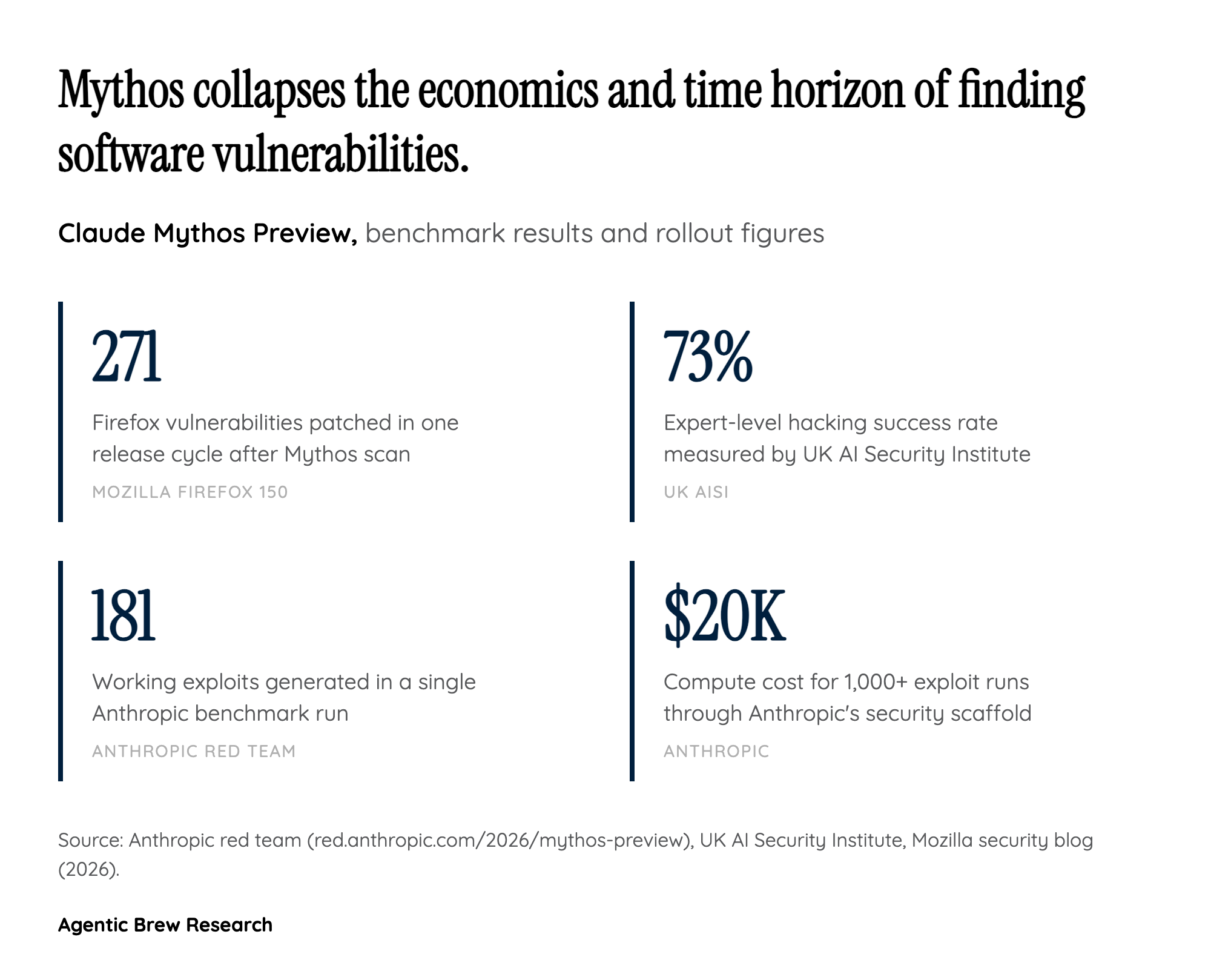
Capability jump: what Mythos actually does that prior Claude models could not
Mythos performance and cost metrics across the April 2026 rollout.

Mythos is not a marginal improvement to Claude's coding chops; it is a step-change in autonomous offensive capability. In one benchmark, the model built working exploits 181 times and gained register control on 29 additional tries, shredding Opus 4.6's baseline. The U.K. AI Security Institute clocked it at a 73% success rate on expert-level hacking tasks, and Anthropic reports an 89% agreement between Mythos's severity judgments and human validators — meaning it not only finds bugs but triages them credibly.

The depth is as striking as the breadth: a 27-year-old OpenBSD vulnerability, a 17-year-old FreeBSD RCE, and a 16-year-old FFmpeg flaw all surfaced in testing. Mozilla's Firefox 150 shipped fixes for 271 Mythos-found vulnerabilities in a single release cycle. The economic signal is just as important as the technical one: more than 1,000 runs through Anthropic's scaffold cost under $20,000 in compute. Exploit generation has historically been bottlenecked by scarce senior talent; Mythos collapses that bottleneck into a line item that any motivated actor can afford.


The Discord breach exposes the weakest link: third-party vendors, not the model itself

Anthropic pitched Project Glasswing as a carefully gated release — 12 launch partners, 40-plus vetted critical-infrastructure organizations, and an explicit refusal to make Mythos generally available. Yet on launch day a private Discord group reportedly reached the model by combining two low-tech ingredients: Anthropic's predictable endpoint naming conventions and contractor credentials flowing through a third-party vendor environment, reportedly seeded by data from the earlier Mercor breach. Anthropic's own statement confirms the entry point was a third-party vendor, not a model jailbreak.

That framing matters. The safety case for a restricted release rests on access control, and access control in 2026 is a supply-chain problem that no RLHF pipeline can solve. Security researcher Dominic Alvieri debunked a ShinyHunters impersonator trying to claim credit, which narrows the story back to the Discord group and underscores how mundane the attack chain was. The Discord users described themselves as curious tourists, 'interested in playing around with new models, not wreaking havoc with them' — which is precisely why David Lindner's counterfactual lands so hard: if curious hobbyists got in this easily, state-sponsored operators with Mercor-scale data almost certainly did too.

Federal access map: NSA in, CISA out, and a quiet Pentagon rift

The government side of Glasswing is the most politically loaded part of the rollout. The NSA is actively running Mythos for cyber-defense, and the Commerce Department's Center for AI Standards and Innovation is evaluating it. CISA — the civilian agency legally tasked with defending federal networks and publishing patch guidance to everyone else — is not on the list. Axios reports CISA was briefed on capabilities but denied hands-on access, meaning the agency that talks to the public about vulnerabilities is learning about them slower than the spy agency that exploits them.

Compounding the friction, Dario Amodei met with White House Chief of Staff Susie Wiles and Treasury Secretary Scott Bessent to discuss government use, even as Pentagon officials have reportedly called Anthropic a 'supply chain risk.' The result is a two-track federal posture: national-security users get the model, civilian defenders get the briefing. If 99% of the vulnerabilities Mythos discovered remain unpatched at the time of Scientific American's reporting, CISA's exclusion is not an administrative oversight — it is a disclosure policy choice with measurable downstream risk for the private companies and agencies that rely on CISA's advisories.

The economics of commodified offense: $100M in credits, $20K per 1,000 exploit runs

Anthropic's stated post-preview pricing is $25 per million input tokens and $125 per million output tokens — premium but not prohibitive. Combined with the disclosure that 1,000-plus runs through its security scaffold cost under $20,000, the unit economics of offensive AI come into focus. A well-funded criminal crew or mid-sized intelligence service can plausibly budget for tens of thousands of exploit attempts per week.

Anthropic's answer is to subsidize the defender side: $100M in Mythos usage credits routed through Glasswing, plus $2.5M to Alpha-Omega/OpenSSF via the Linux Foundation and $1.5M to the Apache Software Foundation. That is meaningful for open-source maintainers but modest relative to the surface area involved. West Monroe's Trevor Jones predicts cyber-insurance claim frequency will rise before severity, which is the clearest quantitative read on what happens when exploit generation gets cheap: more incidents, not necessarily bigger ones, at least until adversaries learn to chain Mythos-class findings. The insurance market is often the earliest honest signal on technology-driven risk shifts, and it is already repricing.

PR success or policy inflection? Reading the expert skepticism

Bruce Schneier and Peter Swire independently landed on the same verb: 'PR'. Schneier called the rollout 'very much a PR play by Anthropic — and it worked,' while Swire agreed the announcement was 'very dramatic and was a PR success, if nothing else.' Ciaran Martin, formerly head of the UK's NCSC, warned that vendor framing tends to overshoot: 'It's a big deal, but it's unlikely to prove to be the end of the world.' That skepticism is not the same as dismissal. Schneier simultaneously argues the sea change in AI-enabled offense 'will happen' — the question is only timing.

The public reaction map is worth reading on its own. On developer YouTube, the dominant voices — Fireship and Low Level Learning — amplified the capability-shock narrative to a million-plus viewers, framing Mythos as genuinely dangerous rather than hype. On X, the split was cleaner: tech journalists like Kevin Roose treated the 40-company Glasswing coalition as the real headline, while AI-policy commentators like Peter Wildeford anchored on the earlier CMS-misconfiguration leak that first exposed Mythos's existence, suggesting Anthropic's narrative control had been slipping for weeks. A visible contrarian camp — including creators who framed Glasswing as marketing theater — stayed small but loud. The honest synthesis is that all three readings are simultaneously true: the restricted-release drama is branding, the underlying capability is a genuine policy inflection, and the community is already bifurcating along those lines. For journalists and policymakers, the tell will be whether, six months out, Mythos-class findings flow through CISA and into public CVEs faster than before — or whether the Glasswing coalition becomes a closed club where vulnerabilities get patched in partners' products first and everyone else's later.

Historical Context

2026-04-07
Anthropic publicly announces Claude Mythos Preview and Project Glasswing, committing $100M in usage credits and pairing with 12 launch partners plus 40+ critical-infrastructure organizations.
2026-04-10
Within days of launch, a private Discord group reportedly reconstructs the Mythos endpoint URL from Anthropic's naming patterns and begins running the model.
2026-04-19
Axios reports the NSA is actively using Mythos despite Pentagon officials labeling Anthropic a supply-chain risk, surfacing a rift inside the U.S. government.
2026-04-21
Bloomberg breaks the unauthorized-access story; Anthropic confirms it is investigating a third-party vendor environment as the entry point for the Discord access.
2026-04-21
Follow-up Axios reporting highlights that CISA, the civilian cyber-defense lead, is not on the Mythos access list even as NSA and Commerce evaluate the model.
2026-04-22
Microsoft publicly commits to embedding Mythos into its Security Development Lifecycle across Windows, Azure, Microsoft 365, and developer tools.
2026-04-23
Fortune's post-mortem captures the 'if Discord got in, so did China' consensus forming among CISOs, framing the breach as an inflection for AI-versus-AI defense economics.

Power Map

Key Players
Subject

Anthropic's Mythos AI cybersecurity model: restricted release, unauthorized Discord breach, and Microsoft/federal adoption

AN

Anthropic

Developer of Claude Mythos Preview; architect of Project Glasswing's restricted release; currently investigating the third-party vendor environment compromise that enabled the Discord access.

MI

Microsoft

Project Glasswing launch partner integrating Mythos directly into the Security Development Lifecycle to harden Windows, Azure, Microsoft 365, and developer tools before shipping.

NS

NSA

Operational federal user of Mythos Preview for cyber-defense work, proceeding despite Pentagon leadership labeling Anthropic a 'supply chain risk.'

CI

CISA

Lead U.S. civilian cyber-defense agency conspicuously excluded from the 40+ Glasswing access list; briefed on capabilities but denied hands-on access.

U.

U.S. Commerce Department — Center for AI Standards and Innovation

Federal evaluator granted Mythos access to assess the model for standards and national-competitiveness purposes.

WH

White House

Chief of Staff Susie Wiles and Treasury Secretary Scott Bessent convened with Dario Amodei to discuss government use of Mythos.

MO

Mozilla

Critical-infrastructure participant that ran Mythos against Firefox and shipped fixes for 271 vulnerabilities in Firefox 150.

PR

Private Discord group

Unauthorized users who reconstructed Mythos endpoint URLs using Anthropic's naming conventions and contractor-linked vendor access, reportedly running the model for weeks for non-malicious curiosity.

THE SIGNAL.

Analysts

"Sees the Mythos rollout as a successful PR maneuver but concedes capability gains are real and warns the defender's head start will evaporate once comparable models go public. "This is very much a PR play by Anthropic—and it worked.""

Bruce Schneier
Security technologist, Harvard Kennedy School

"Treats the announcement as an expected milestone in academic cybersecurity circles and considers the framing more PR than substance. "The Anthropic announcement was very dramatic and was a PR success, if nothing else.""

Peter Swire
Professor, Georgia Institute of Technology

"Calls Mythos significant but warns against apocalyptic framing coming from vendors with commercial stakes. "It's a big deal, but it's unlikely to prove to be the end of the world.""

Ciaran Martin
Professor, University of Oxford; former UK NCSC chief

"Argues if a Discord group reached Mythos, state actors almost certainly did too, and defenders who do not deploy AI will fall behind. "If some group—some random Discord online forum, got access to it. it's already been breached by China.""

David Lindner
CISO, Contrast Security

"Views Microsoft's SDLC integration as a watershed moment for how commercial software is built and hardened. "This marks a seminal turning point in the secure software development lifecycle process.""

Keith Prabhu
CEO, Confidis

"Describes an AI-versus-AI stalemate where defenders have no choice but to match attackers' tooling. "Attackers are already using AI at scale. Defenders need to do the same. It's essentially AI versus AI.""

Rawley Lind
Cybersecurity advisor, West Monroe

"Predicts cyber insurance will feel Mythos-era pressure through a spike in claim frequency before severity catches up. "We're likely to see claims frequency increase before severity.""

Trevor Jones
Insurance partner, West Monroe
The Crowd

"NEWS: Anthropic's new model, Claude Mythos, is so powerful that it is not releasing it to the public. Instead, it is starting a 40-company coalition, Project Glasswing, to allow cybersecurity defenders a head start in locking down critical software."

@@kevinroose0

"CLAUDE MYTHOS. A CMS misconfiguration at Anthropic just leaked draft blog posts about "Claude Mythos". Anthropic confirmed it's real, calling it "the most capable we've built to date." Mythos is a new, fourth tier, larger and more expensive than Opus."

@@peterwildeford0

"The Mythos timeline is actually insane: anthropic accidentally leaks a document last month calling their new model "by far the most powerful AI we've ever built" — the model, Mythos, finds thousands of zero-day vulnerabilities in weeks; some of them 27 years old"

@@markgadala0
Broadcast
Claude Mythos is too dangerous for public consumption...

Claude Mythos is too dangerous for public consumption...

An initiative to secure the world's software | Project Glasswing

An initiative to secure the world's software | Project Glasswing

Claude Mythos is Actually Scary

Claude Mythos is Actually Scary