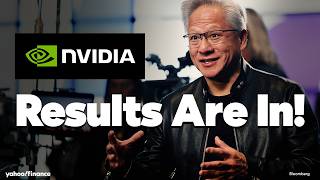
Nvidia Q1 FY2027 earnings and Jensen Huang commentary
TECH

Nvidia Q1 FY2027 earnings and Jensen Huang commentary

50+
Signals

Strategic Overview

  • 01.
    Nvidia reported record Q1 FY2027 revenue of $81.6 billion, up 85% year-over-year and roughly 20% sequentially, beating the ~$79.2B Street consensus, with data center revenue alone hitting $75.2B (up 92% YoY).
  • 02.
    The company guided Q2 FY27 revenue to approximately $91 billion plus or minus 2%, well above the $86.8B Street consensus, with the guide explicitly excluding any China data-center compute revenue.
  • 03.
    Nvidia's board authorized an additional $80 billion share buyback and raised the quarterly dividend 25x to $0.25 from $0.01, on top of roughly $20B already returned to shareholders in Q1.
  • 04.
    Jensen Huang used the call to declare AI demand 'parabolic,' unveil a brand-new $200 billion TAM for the Vera CPU built for agentic AI, and concede the Chinese AI accelerator market to Huawei.

Deep Analysis

The Beat That Didn't Beat

On paper, this was the kind of print companies dream about. Revenue of $81.6B blew past a $79.2B consensus, data center alone hit $75.2B (up 92% YoY), Q2 was guided to ~$91B against an $86.8B Street estimate, and the board piled on an $80B buyback authorization plus a 25x dividend hike [1][2][3]. Free cash flow came in at $48.6B in a single quarter. The stock opened about 0.5% lower.

That reaction is the real story. As Kiplinger's roundup of sell-side notes laid out, Nvidia has now beaten revenue estimates by 3-4% for six consecutive quarters and still closed lower on four of the last five prints [4]. Daniel Newman of Futurum captured the dynamic precisely: 'Wall Street has pulled itself above the company's own guide for the first time in this cycle, which raises the bar for what counts as a beat' [4]. Capital.com's Kyle Rodda called it 'a garden variety beat... well telegraphed,' and Wedbush's Matt Bryson had warned beforehand that the open question was simply whether the stock could rally on a solid print at all [4]. The arithmetic of the buyback only sharpens the point — when management is willing to absorb $80B of its own shares plus $38.5B already authorized [5], and the market still shrugs, it is the buy-side bar, not the company, that has changed.
Inside the $200B Vera CPU Claim

Huang's most novel disclosure was not a number on the income statement — it was a market that did not exist a year ago. Vera, introduced in March 2026 alongside the upcoming Rubin GPU, was reframed on the call as the world's first CPU purpose-built for agentic AI, with Huang declaring 'Vera opens a brand new $200 billion TAM for Nvidia, a market we have never addressed before' [6]. SpaceX, Anthropic, and OpenAI were named as first customers for standalone Vera systems, with $20B in standalone Vera revenue already booked this year [6].

The quant community immediately pushed back on how that $20B was counted. The r/AMD_Stock earnings discussion thread spent most of its discussion parsing the gap between the prepared remarks and the Q&A — debating whether the figure was truly standalone CPU revenue or attach revenue from GPU bundles, with the CFO's hedged 'nearly $20 billion in total CPU revenue' phrasing flagged as the smoking gun for skeptics. The ambiguity matters because Vera explicitly encroaches on Intel and AMD's data-center CPU turf [7], and any future $200B claim has to survive that line-item scrutiny. Bullish or bearish, the framing change is significant on its own: for the first time in this cycle, Nvidia is selling itself as a CPU story, not just a GPU story.

How Nvidia Lost China — And Why That's Now Permanent

The most blunt sentence Huang has uttered in years was delivered almost in passing: 'We have largely conceded the Chinese AI chip market' [8][9]. Nvidia's share of China's advanced AI accelerator market has gone from roughly 95% before the October 2022 U.S. export controls to effectively zero today, with Huawei now the dominant domestic supplier [10]. China previously contributed at least one-fifth of data-center revenue.

What made this earnings report different is that the concession is now baked into guidance. CFO Colette Kress's commentary explicitly notes that Q2 FY27 revenue guidance of approximately $91 billion excludes any data-center compute revenue from China [5]. In effect, the company is no longer modeling a China recovery — it has been removed from the financial plan. That removes a recurring quarterly source of investor whiplash, but it also closes the door on what was the single biggest upside catalyst sitting outside the AI-capex cycle. Going forward, the bull case has to be carried entirely by the rest of the world, and increasingly by sovereign AI build-outs that Futurum Group's analyst commentary estimates will exceed $30B in revenue this fiscal year — more than triple the prior year [11].

Cisco 1999 vs. Nvidia 2026

Cisco 1999 vs. Nvidia 2026
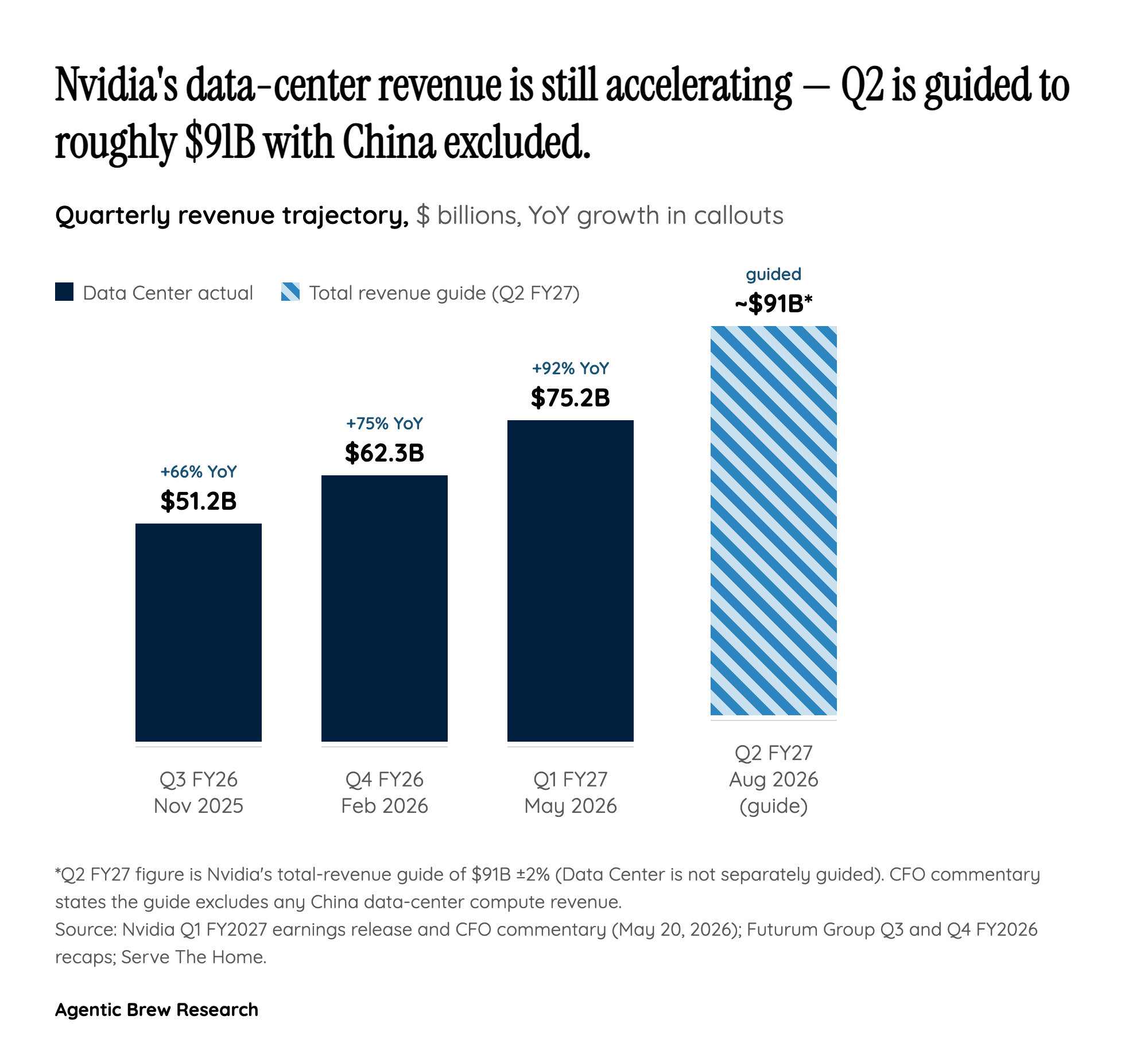
Nvidia's data-center revenue arc through Q1 FY27 ($51.2B → $62.3B → $75.2B), with Q2 FY27 guided to roughly $91B excluding China.

Beneath the celebratory headlines, a small but consequential analyst chorus is asking whether Nvidia's growth is starting to fund itself in uncomfortable ways. Bernstein's Stacy Rasgon, along with notes from Wedbush and Seaport, has flagged Nvidia's pattern of investing in customers as reminiscent of 'Cisco Systems during the late 1990s, which extended substantial vendor financing' — a late-cycle warning sign that preceded a multi-year drawdown for that bellwether [12]. The data-center revenue arc — $51.2B in Q3 FY26, $62.3B in Q4, $75.2B in Q1 FY27 [13]— looks structurally healthier than Cisco's optical-bubble buildup, but the customer-concentration profile is the comparison's most uncomfortable echo: four direct customers account for about 61% of revenue and the largest alone is around 22% [14].

What is different in 2026 is the diversification math Huang spent much of the call defending. Sovereign AI is now a >$30B annual line item [11], the Vera CPU opens a TAM Nvidia did not previously address [6], and Nvidia is dropping standalone gaming and professional graphics reporting to formalize AI/data center as the entire story [15]. Whether the diversification arrives fast enough to outrun customer-concentration gravity is now the single most-watched question for the second half of the fiscal year.

Historical Context

2022-10-01
First wave of advanced-chip export controls hit Nvidia's China business, beginning the multi-year erosion of its roughly 95% China accelerator share toward zero.
2025-11-01
Q3 FY2026 data center revenue hit a then-record $51.2B, up 66% YoY — the baseline for the accelerating ramp into FY2027.
2026-02-26
Q4 FY2026 data center revenue reached $62.3B, up 22% sequentially and 75% YoY; total revenue $68.1B, the immediate prior quarter to the Q1 FY27 print.
2026-03-01
Introduced the Vera CPU as both a standalone product and as part of a bundle with the upcoming Rubin GPU — setting up the $200B TAM claim two months later.
2026-05-18
Approved the additional $80B share repurchase authorization without expiration; $38.5B remained from prior authorization at quarter-end.
2026-05-20
Reported Q1 FY2027 results: $81.6B revenue, $75.2B data center, $1.87 non-GAAP EPS; stock opened roughly 0.5% lower despite the beat-and-raise.

Power Map

Key Players
Subject

Nvidia Q1 FY2027 earnings and Jensen Huang commentary

JE

Jensen Huang

Nvidia CEO; used the print to frame AI demand as parabolic, unveil Vera CPU's $200B TAM, and concede China, reframing the bull case beyond GPUs and hyperscalers.

CO

Colette Kress

Nvidia CFO; signed the CFO commentary detailing $20B returned to shareholders in Q1, $38.5B remaining buyback before the $80B add-on, and the explicit exclusion of China data-center compute from Q2 guidance.

HU

Huawei

Now the dominant supplier of advanced AI accelerators in China after Nvidia's market share collapsed from roughly 95% to effectively zero following 2022+ U.S. export curbs.

HY

Hyperscalers (Meta, Microsoft, Google, Amazon)

Four direct customers each more than 10% of revenue, collectively about 61% of total; the largest single customer is roughly 22%. Hyperscaler capex on Nvidia hardware is still the fastest-growing slice.

SP

SpaceX, Anthropic, OpenAI

First customers to receive standalone Vera CPU systems, validating Nvidia's agentic-AI CPU thesis with $20B in standalone Vera sales already booked this year.

SO

Sovereign AI buyers

A structurally distinct demand pool now exceeding $30B for the full fiscal year, more than triple the prior year, insulating Nvidia from U.S. hyperscaler concentration risk.

Fact Check

15 cited
  1. [1] Nvidia Announces Financial Results for First Quarter Fiscal 2027
  2. [2] Nvidia Q1 FY2027 Earnings: Q2 Guidance Above $87 Billion Will Move Markets
  3. [3] Nvidia (NVDA) Announces $80 Billion Buyback and 25x Dividend Hike: Here's Why It Matters
  4. [4] Nvidia Earnings: Live Updates and Commentary, May 2026
  5. [5] Nvidia CFO Commentary on First Quarter Fiscal 2027 Results
  6. [6] Jensen Huang says he's found a 'brand new' $200B market for Nvidia
  7. [7] Nvidia's Jensen Huang Sees 'Brand New' $200 Billion Opportunity in Vera CPUs
  8. [8] Jensen Huang: Huawei Strong, Nvidia Conceded China Market
  9. [9] Nvidia's Jensen Huang says it has 'largely conceded' China AI chip market to Huawei
  10. [10] From 95% to Zero: Jensen Huang Admits Nvidia Has Lost China's AI Chip Market to Huawei
  11. [11] Nvidia Q4 FY 2026 Earnings Highlight Durable AI Infrastructure Demand
  12. [12] Nvidia Q1 FY27 Earnings: A Closer Read of a Record Quarter
  13. [13] Nvidia Q1 FY2027 Revenue Hits Record $81.6 Billion as AI Infrastructure Demand Accelerates
  14. [14] Nvidia Customer Concentration: A Big 4 Earnings Preview
  15. [15] Nvidia no longer reports sales of graphics solutions as a separate segment, posts eye-watering $81.6 billion Q1 profit thanks to AI boom

Source Articles

Top 5

THE SIGNAL.

Analysts

"Characterized the print as 'a garden variety beat, a better than expected top and bottom line with guidance above the Street estimate, and one that was well telegraphed.' — a beat the market had already priced in."

Kyle Rodda
Senior Financial Market Analyst, Capital.com

"Expected another beat-and-raise but flagged the real question heading into the print: whether 'we finally see a more positive stock reaction after a series of blasé moves following solid prints.'"

Matt Bryson
Analyst, Wedbush

"Frames Q1 as a referendum on the trillion-dollar AI infrastructure cycle, noting 'Wall Street has pulled itself above the company's own guide for the first time in this cycle, which raises the bar for what counts as a beat.'"

Daniel Newman
CEO, Futurum Group

"Among sell-side analysts raising circular-financing concerns, comparing Nvidia's investment patterns to 'Cisco Systems during the late 1990s, which extended substantial vendor financing.'"

Stacy Rasgon
Analyst, Bernstein
The Crowd

"$NVDA earnings"

@u/deepserket945

"NVIDIA Q1 FY27 Earnings Discussion"

@u/brad471156

"Q1-2027 Earnings Thread and Discussion 2026-05-20 Wednesday"

@u/daily-thread40
Broadcast
NVIDIA 2026 Q1 EARNINGS LIVE | JENSEN HUANG SPEAKS

NVIDIA 2026 Q1 EARNINGS LIVE | JENSEN HUANG SPEAKS

Nvidia Q1 earnings results: Top takeaways

Nvidia Q1 earnings results: Top takeaways

Nvidia CEO Jensen Huang says $30 billion OpenAI investment 'might be the last'

Nvidia CEO Jensen Huang says $30 billion OpenAI investment 'might be the last'